
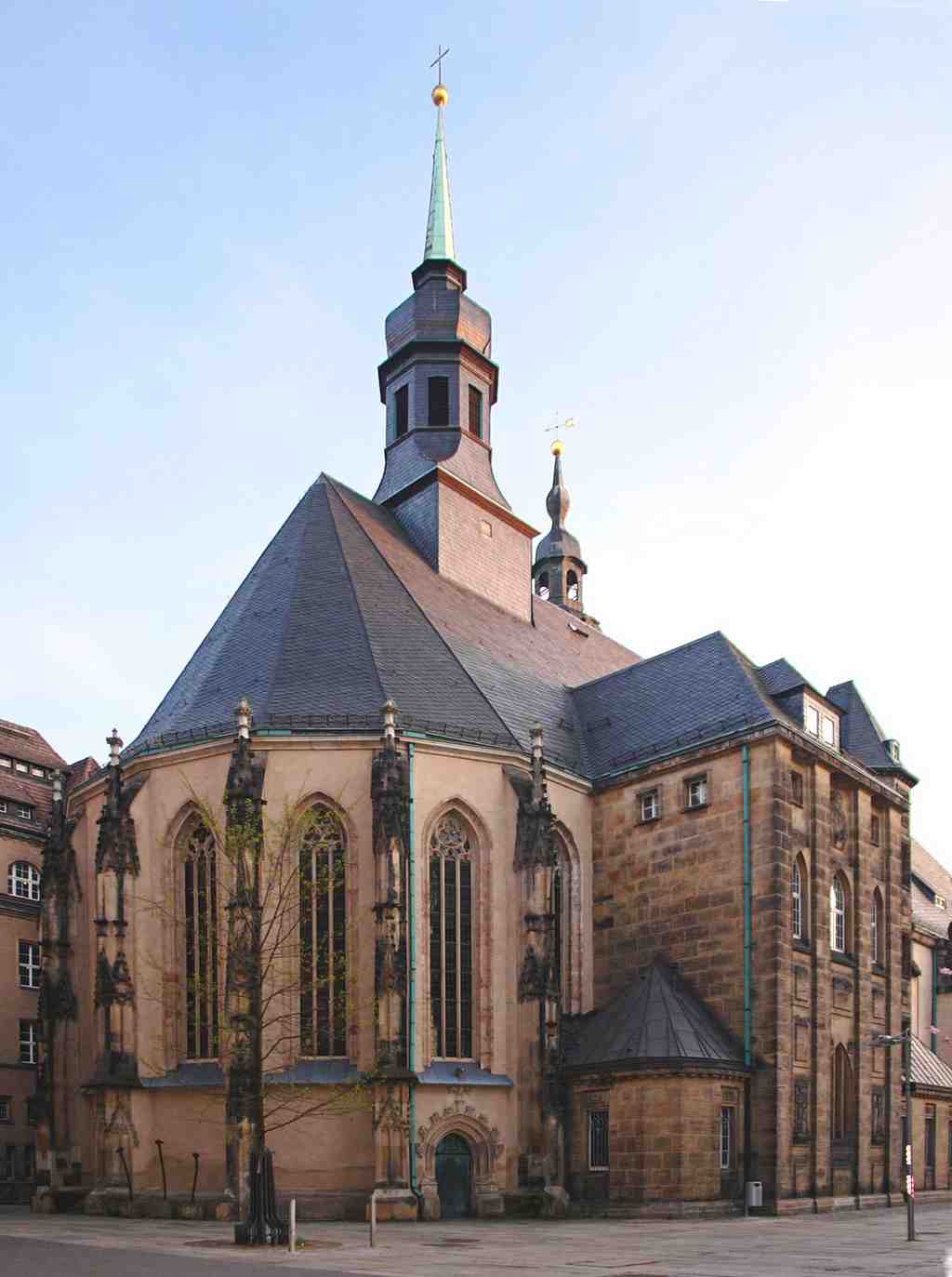
You’re looking for a tall, pointed tower with a cross and gold ball at the very top, long stained glass windows below, and a striking roof that almost looks like it’s wearing a wizard’s hat-spot it rising proudly just ahead on your left.
Welcome to St. Jakobi Church, one of the oldest standing churches in Chemnitz and a master storyteller in stone. Imagine, over 800 years ago, this spot was home to a snug little Romanesque church-but don’t picture anything too fancy, more of a sturdy rectangle with a square choir and a chunky western tower. When archaeologists dug here in the 1950s, they unearthed these ancient foundations, finding stones and fragments like a puzzle from the 12th century-though no time machine was discovered, unfortunately.
Fast forward to the 1200s, the church did what every growing city dreams of-it upgraded to early Gothic! The choir was expanded, complete with buttresses that make it look like it’s bracing for a giant dance competition. By the 1350s, after a city fire gave architects a rather loud nudge, the church was reborn as a mighty hall church-imagine five bays, three naves, and a whole lot of pointed arch drama.
Here’s a twist: After demolishing the old west tower, they moved the bells to a conveniently unoccupied stone tower nearby, cleverly dubbed the “Hoher Turm”-or, as the locals might call it, “the spare bell tower.” That’s still the one ringing out today.
By the early 1400s, St. Jakobi really started to show off. They replaced their choir for something grander, wrapping colonnades around nine sides of a 16-sided polygon, as if the building was spinning in a Gothic waltz. Inside, you'll find a dazzling network vault in the main choir-think of it as architectural lacework, inspired by grand designs in Bohemia and beyond. Outside, take a close look at those buttresses with rich ornamentation, all topped by a gleaming slate roof with intricate details.
This church has more plot twists than a soap opera. The Reformation swept through in 1539, and the church’s interior had to keep up with new Lutheran styles-bye-bye to the many side altars, and hello to a shiny new pulpit and wooden galleries. But Chemnitz had another surprise in store: in 1617, a fierce fire raced through town, consuming the church’s roof and even sending parts of the bell tower crashing down! The interior mostly survived, but the choir filled up with private prayer cubicles like spiritual phone booths.
Over centuries, artists and donors have “tweaked” the inside-empowerments, altars, and at one point, a gigantic late-Gothic altar that later went missing except for a few precious remains. The 1800s saw a wave of Gothic nostalgia sweep through, so St. Jakobi got a dramatic new façade, complete with four apostles on buttress duty and a flood of decorative stonework-although local critics weren’t always thrilled by the elaborate makeover.
By 1912, the church was ready for its next bold look. Four new statues appeared above the main entrance, symbolizing the motto “Pray and Work”-one scholar, one worker, one mother, and one merchant. And, in classic church humor, the apostles were relocated to the back. They even added portraits of Luther and local scenes to keep things modern.
Nothing, however, could prepare St. Jakobi for 1945. The city center was devastated by bombing raids. Here, the church’s timber roof burned thoroughly, its interior gutted, and the iconic tower collapsed into the ruins of the old town hall. Yet, the resilient people of Chemnitz cobbled together emergency roofs and gradually, stone by stone, brought back their church. By the late 20th century, the congregation debated-should they keep the flat emergency ceiling, or recreate the original, majestic vaults? In the end, they rebuilt the ribbed Gothic ceiling with modern techniques, echoing the spirit of the original builders.
Inside today, St. Jakobi is crowned by a splendid late Gothic altar, pieced together from rescued fragments and lovingly restored. The pulpit and baptismal font both found their way here via other churches-so you might say, even the furniture could tell stories of travel and adventure! Its bells still ring out-one of them even survived World War II, making it a real local celebrity. And now, this wonderful old church is open every day-not just for worship, but for concerts, art exhibitions, and curious wanderers just like you.
So, as you stand here, take in all those layers: the ancient stones beneath you, the soaring choir above, the echoes of devotion, disaster, and renewal. St. Jakobi is not just a church; it’s a survivor with a well-earned sense of dramatic flair (and, perhaps, a habit of always coming back for a reunion special).


