
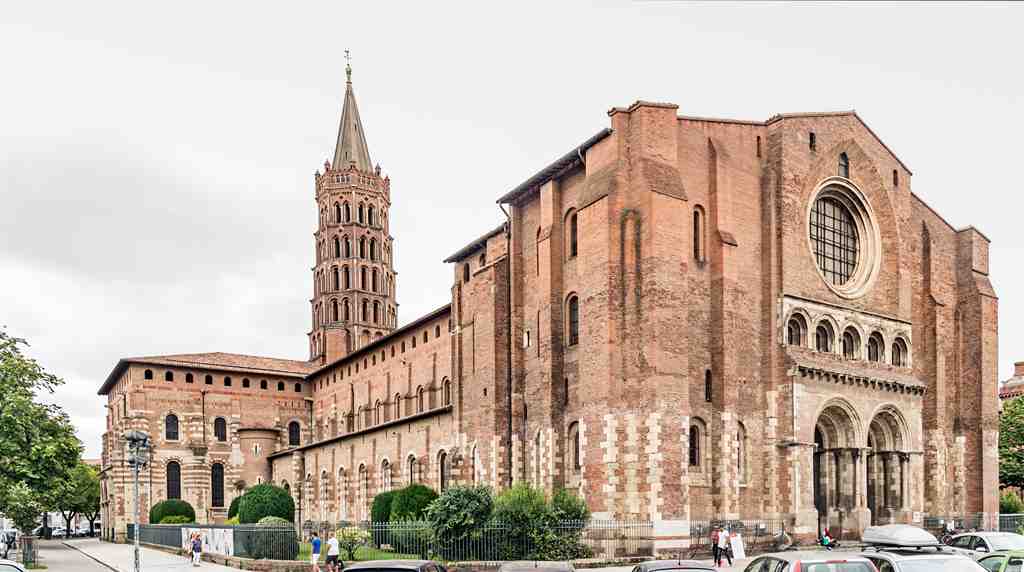
To spot the Basilique Saint-Sernin, just look up and ahead-you’ll see a massive structure built from pale reddish bricks, with a grand, fortress-like façade. It has tall arched doorways and, rising skyward, an impressive octagonal bell tower, layered almost like a wedding cake, that really steals the show. If you see a soaring tower peeking above the rooftops and a church so big you wonder how it fits in the city, you’re in the right place-just follow the crowd of people who, like you, can’t help but stop and stare.
Now that you’re standing out front, let’s step back in time for a moment. Imagine a thousand years ago, the sun rising over the city as crowds of dusty pilgrims arrive, their feet aching and spirits lifted, eager to see the legend that’s Saint-Sernin. This is the most important Catholic building in Toulouse, right in the heart of the city that was once ancient Tolosa. And it’s enormous-not just for today, but even compared to churches in Germany and Spain. This basilica was built at the end of the 11th century, big enough to shelter thousands-and even bigger in legend.
Why is it so important, you ask? Well, Saint Saturnin-known as Sernin-was the first bishop of Toulouse and is one of the earliest and most revered Roman-Gallic Christian martyrs. Here’s where the story gets dramatic: picture ancient Toulouse, about the year 250, where Saturnin, refusing to bow down to Jupiter, finds himself in real trouble. Instead of a polite disagreement, he’s tied to a bull and dragged through the city! (Not the best way to see the sights.) Two brave young women, the “saintes Puelles”, cared for him after his martyrdom and buried him where the basilica now stands.
Centuries later, his grave is discovered by an early bishop, and from that discovery grew one of the largest pilgrimage sites in medieval Europe. Pilgrims streaming to Santiago de Compostela all stopped here, hoping for miracles, adventure, maybe a little divine intervention with their blisters.
The basilica wasn’t just a church-it became the beating heart of the city’s power struggles, art, and urban growth. Imagine the city buzzing with merchants, stonemasons, architects and nobles, all competing or cooperating to leave their mark. The church even had its own community of canons-think of them as a combo of monks and managers-who gathered great riches thanks to the generosity of visitors.
During the Middle Ages, politics and religion were tangled tighter than a knotted shoelace. The abbey’s canons, the local counts, the bishop, the king of France... everyone wanted a piece of Saint-Sernin’s pie. It was all a bit like medieval reality TV, except with less Instagram and more incense.
Now look up at the architecture: this basilica is the perfect model for grand pilgrimage churches. Pilgrims could walk around the relics, soaking up the atmosphere without disturbing worshippers. And if walls could talk, these ones would sing-the basilica is decorated with hundreds of Romanesque capitals (those carved tops of the columns), each one telling scenes of faith, miracles, and maybe a few fierce dragons.
Long after medieval times, Saint-Sernin faced revolutions, remodeling, and even demolition of its cloister and nearby buildings. But people of Toulouse always recognized how exceptional it was. Even today, the church draws admiration and debate over how best to preserve-and show off-this treasure. And since 1998, it’s a UNESCO World Heritage site, saluted by pilgrims of every stripe.
So, don’t just snap a photo-take a second to soak up the ancient energy, the drama, the mystery, and maybe even the odd bull-related legend. With every brick, Saint-Sernin whispers its story to you... if you promise to listen.
Seeking more information about the description, evolution of the status of the basilica or the catholic parish? Ask away in the chat section and I'll fill you in.




