
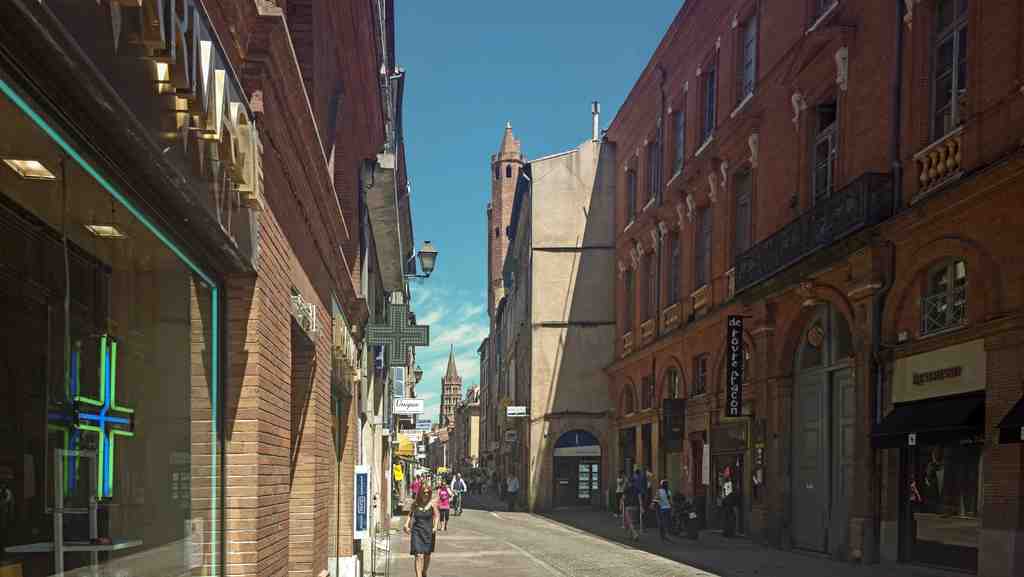
Look just ahead along the gently narrowing, brick-lined street, shadowed by rows of old shops and tall, elegant buildings, and you’ll spot Rue du Taur stretching out between the Place du Capitole and the historic basilica of Saint-Sernin.
Let’s stand still for a moment and let Rue du Taur work its magic on your senses. Imagine the gentle buzz of footsteps on stone, a distant bell chiming, the murmur of café conversations echoing off the ochre brick. It’s easy to believe you’re walking on a street where centuries of stories hide around each bend. Now, the Rue du Taur is a lively pedestrian way, welcoming shoppers, locals, and curious wanderers like us, but underneath its timeless charm lies a story both dramatic and haunting-a street born of martyrdom, legend, and the slow current of history.
Long before fountains and shops, before rows of books and students, this same stretch was a road outside the old Roman city of Tolosa. Picture a dusty, ancient path lined with tombs, a necropolis marking the edge of civilization, the air heavy with mystery and memories. It was here, if you listen closely and let your imagination dream just a little, that the brutal tale of Saturnin, the city’s first bishop, unfolded. In the year 250, persecuted for his faith, he was tied to a wild bull and dragged through the streets, from the steps of the Capitole temple-now Place Etienne-Esquirol-to this very spot. The legend says it was here, by the side of the old road, that the ropes finally snapped and Saturnin’s body fell to the earth. Two young women, known as the “saintes puelles,” found his broken form among the graves, and quietly, courageously, buried him. Mourning and memory echoed through the stones, and later, in the 4th century, Bishop Hilaire raised a chapel to honor the martyr-a seed from which timeless faith would bloom.
Wander forward, letting your hand brush against the centuries-old walls, and you’ll see layers of Toulouse’s history stacked one over the other. By the Middle Ages, Rue du Taur was the main artery-Grand-rue-connecting the southern and northern gates of the growing city. Can you hear the clatter of horses and tradesmen’s laughter? The city bustled here, and noble families built their houses with watchful towers-look for the square Maurand tower at number 56, once home to guardians of the mighty Saint-Sernin Abbey.
Education, too, found a home in these stones. After the 13th century’s university was established, students filled new colleges founded by noble patrons. Right here, the College de Maguelone welcomed young scholars to study law, founded by the Cardinal of Maguelone, while nearby, in a medieval house, the College of Perigord trained future civil and canon lawyers. The air was thick with the debates and excitement of learning, a tradition you can almost hear in the laughter and debate of the students who still flock these lanes today.
Keep an eye on the buildings, from intricate 18th-century Neo-classical façades to grand hotels tucked between simple shops. Number 38 was the exclusive Mazzoli residence, born from the dreams of a St. Petersburg family. Resist the urge to peek through the curtained windows of number 36, where Liliane Simonetta, a Swiss-French heroine of the Resistance, once risked her life to hide fugitives from the Nazis. At number 21, chemist, artist, poet, and musician Georges Gaudion was born-imagine the wild swirl of scientific ideas and creative mischief that shaped his childhood here.
Not every building lines up like obedient soldiers. Some lean and twist, like number 22’s creaking timber frame, echoing the city’s oldest days. Trade leaves its print too-a tangle of shop signs, smell of fresh bread, produce baskets, and, at times, the secret smoke of revolution. For a time during the French Revolution, this bustling lane was renamed Rue de la Philosophie, when revolutionary zeal swirled through its stones and the past seemed up for grabs.
As you walk the Rue du Taur, let your attention drift: one moment, it’s the echo of medieval prayer in the church’s lone nave, the next, the sharp laughter of 20th-century Spanish refugees in the renovated Esquile college, or the soft click of a projectionist’s reel in the Cinémathèque, nestled inside an old chapel.
Rue du Taur is a living tapestry where martyrdom and memory, revolution and resistance, intellect and intrigue all leave their marks. Every window, ironwork, and corniced door here has seen the changing tides of Toulouse. Let yourself wander, and perhaps you’ll hear, beneath the lively clamor of today’s world, a faint thread of ancient grief, scholarly debate, laughter, and hope, winding endlessly along the stones under your feet.
Yearning to grasp further insights on the location and access, odonymy or the heritage and places of interest? Dive into the chat section below and ask away.




