
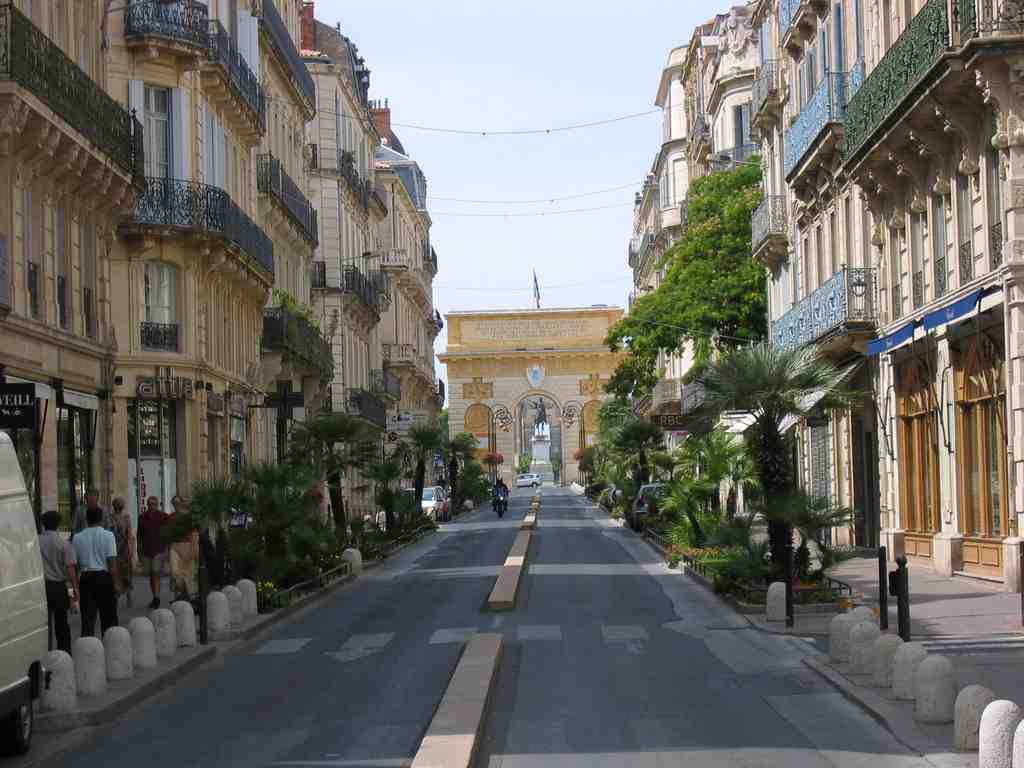
Take a look straight ahead of you! To spot Rue Foch, just follow the long stretch of quiet road lined with elegant, creamy stone buildings-like rows of French pastries standing tall on both sides. Many have those ornate iron balconies, as if they're ready to whisper secrets from centuries past. And at the far end of the view, you can't miss that golden Arc de Triomphe, standing right in the middle, keeping watch over the whole scene. Notice the palms and the flashes of greenery on the sides, making this boulevard feel almost Mediterranean.
Now, as you stand here on Rue Foch, let your imagination spin back in time. The buzz of footsteps and café chatter you hear today was once mixed with the clatter of horses and the shouts of merchants, all the way back in 1205! This street started as a passage through the fortified walls for villagers and traders, eager to reach the city’s famous gateway, the Porte du Peyrou. Imagine being stopped here by a medieval guard asking, “Friend or foe?” For the record, I’d always say ‘friend’-the foes get pretty grumpy.
Rue Foch was originally called rue du Peyrou and was the main commercial artery of Montpellier’s historic Écusson quarter. It didn’t always look this grand. It grew and changed shape over centuries, with big plans, squabbles, and a fair bit of drama-Montpellier took a page from Paris during the time of Haussmann. Suddenly, everyone wanted wide, sunny boulevards, but not everyone wanted to move out of their homes to make way. I can just hear it: “You want to knock down my bakery for a bigger road? Mon Dieu!”
The street changed names as often as a fashion model swaps outfits. It was rue Impériale, then rue Nationale, and finally, in 1929, Rue Foch-named for Marshal Foch, the hero of the Great War. Sometimes, it felt like the only thing faster than these changes was the pace of the city’s revolution.
Look around for the important buildings: the massive Palais de Justice with its fierce columns, the old Hôtel de Paul, the post office that’s seen more love letters than you can count, and of course, the Hôtel Foch. If these facades could talk, oh, the tales they’d tell-of revolutions, lazy summer days, and secret midnight meetings.
So, as you stroll under the gentle shade of the palm trees, just remember: this isn’t just a street. It’s Montpellier’s catwalk, history’s museum, and maybe, if you listen closely, you’ll hear the laughter of past centuries echoing between the walls. Now, keep those eyes open for surprises-Rue Foch is never short on stories!




