
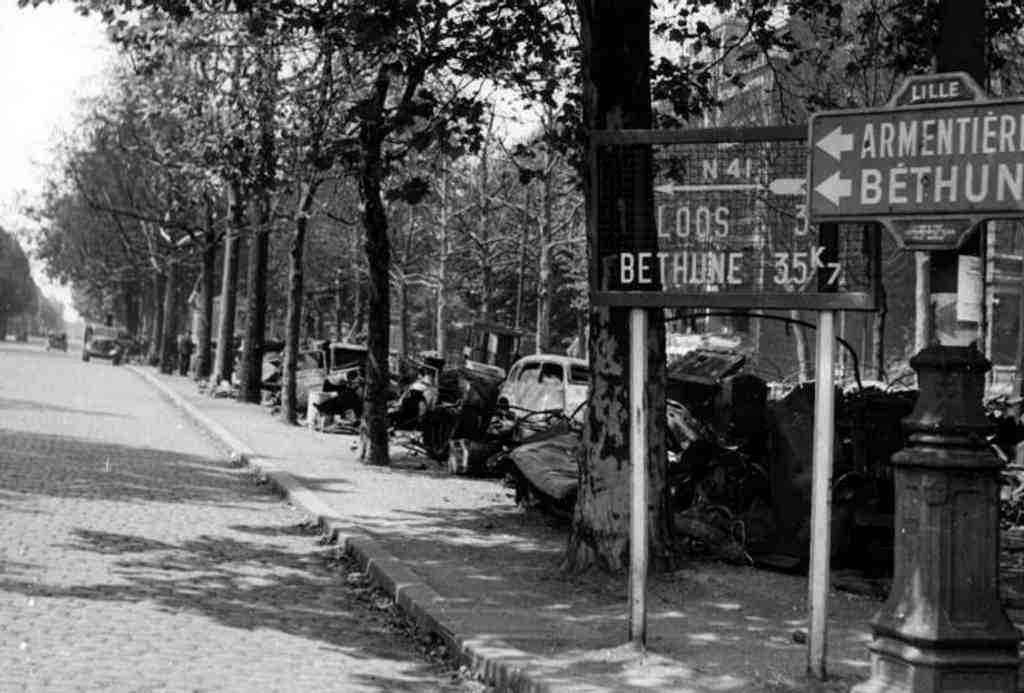
To spot the Lille Pocket, look for the old road signs pointing to Armentières and Béthune right in front of you, next to a shady row of trees and the remnants of battered cars lining the street.
Alright, you’re standing in front of the historic Lille Pocket! Close your eyes for a second and imagine the city not with the calm of today, but with the thunder of tanks, scattered soldiers, and the sharp crackle of battle. It was the end of May 1940, and Lille was about to become the stage for one of the most dramatic acts of World War II in France.
Suddenly, German tanks rumbled down these very roads, engines growling through the early morning air. Commanded by General Waeger, the German army had completely surrounded Lille. But the French, with about 40,000 men led by General Jean-Baptiste Molinié, were not going to give up without a fight. Their defense stretched from the heart of Lille to towns like Loos, Seclin, and Haubourdin, as these streets became a warren of barricades, rifle nests, and desperate men.
Here, resistance wasn’t just about holding ground. While British troops were scrambling to escape at Dunkirk, the defenders of Lille fought to give their allies a chance-five precious days more. Can you imagine it? Soldiers from places as far as Morocco, men of the 1st Moroccan Division and the 2nd and 5th North-African divisions, holding the line with everything they had. The 2nd Moroccan Rifle Regiment, in fact, would later be honored for their bravery.
At one point, the desperate French even managed a bold counter-attack. They captured an entire German commander-Fritz Kühne-snatching not only a high-ranking officer but the German attack plans too! For a fleeting moment, you might hear the chaotic shuffle of boots, the whispered commands, hearts pounding in the narrow alleys.
Every direction was danger. Tanks to the west, infantry to the north, shells whistling overhead. The defenders’ hope faded as their ammunition ran out, and after hundreds of deaths-both civilian and military-the French strongpoints began to fall, one by one. But in the midst of tragedy, there was also a strange, solemn honor. On June 1st, after a night-long negotiation for surrender, French troops marched through the Grand Place-right past the Germans, with their weapons still in hand. Talk about keeping your head held high in defeat!
Even Adolf Hitler himself was furious that the German advance had stalled here, costing precious time and giving those at Dunkirk their shot at evacuation. But unlike many other battles, the Germans recognized the heroism of the Lille defenders. North-African troops, still armed, were saluted by an honor guard of Germans-a rare sight, reserved for the bravest.
So, as you stand beneath the leafy shade, try to picture not just a peaceful French boulevard, but a city that thundered with one of World War II’s fiercest last stands. In this pocket, courage and chaos danced together, giving Lille a story echoing with both heartbreak and honor.


