
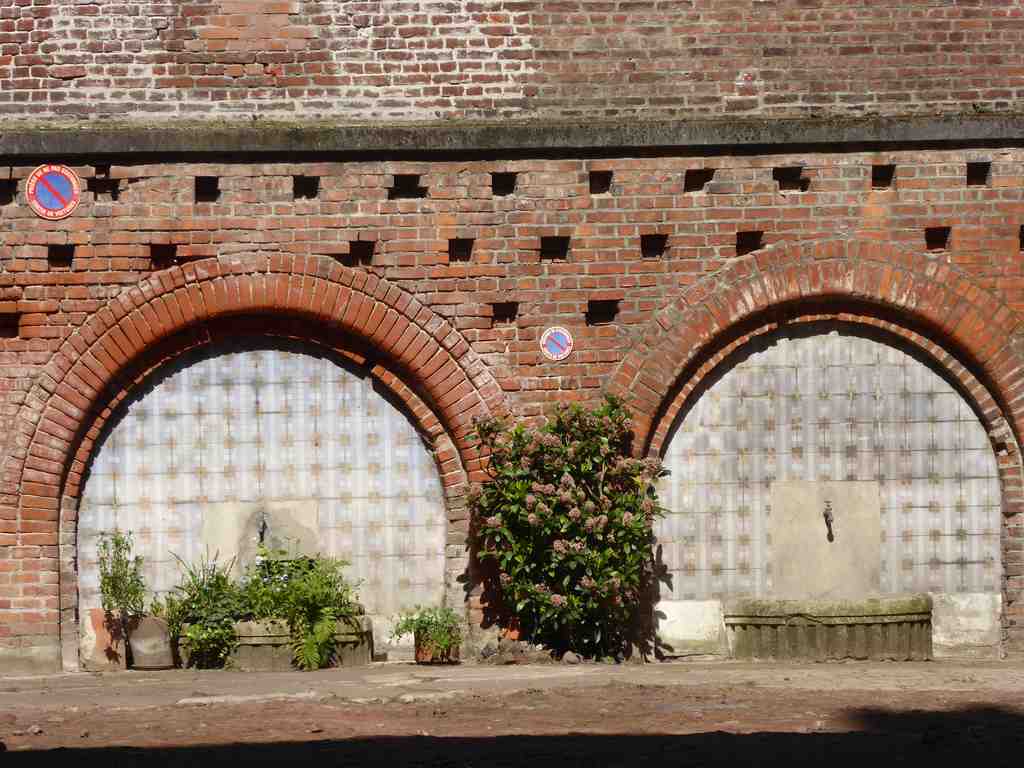
Look for two large, rounded brick arches set into a red brick wall in front of you-one arch is partly filled with leafy plants and the other has an old spout and planter beneath it.
Now, get ready for the last stop of our journey-a place where water once moved like veins through the city, carrying stories just below the surface. You’re standing at the site-now cleverly hidden in plain sight-of the Canal des Hibernois, better known to old-timers as “La Riviérette,” the little river with a big past!
Once upon a time, right here, long before these arches were filled in and flowers took the place of rushing water, a slender canal twisted its way through Lille. Picture narrow boats and streams winding behind houses and contented ducks paddling along, but, plot twist-this wasn’t a navigable waterway. No gondolas or lazy rowboats; instead, it was more like a persistent little trickle determined to wedge itself through the heart of this bustling city.
The canal’s story begins far to the south, in what is now the Moulins district, where it bubbled up from marshy ground. If you listened very carefully back then, you might have even heard the cheerful gurgle of water making its way into Lille. For centuries, this tiny river, the Riviérette, fed not only the canal you’re looking at, but also the imaginations of generations.
Let’s time-travel! Flip back to the Middle Ages. By the 13th century, the city was constantly reworking its defenses, digging trenches after sieges, surrounding itself with thick walls and moats. The Riviérette found itself pressed into service as part of this ambitious system, its sparkling waters running under bridges and through channels beneath the city walls. The segment here was part of the moat and then canal known as the Haut-Hibernois-don’t worry, we’re not in Ireland, but there’s a surprise coming with that name!
With the 1604 expansion-forgive Lille’s penchant for remodeling-new fortifications popped up here, new moats were dug, then filled and repurposed as the city grew. This southern stretch became known as the Canal des Hibernois, which divided like a choose-your-own-adventure book: one branch, the Bas Hibernois, snaked toward the canal des Molfonds; the other, our old friend the Riviérette, wound north beyond the Bruyant Bridge and eventually ducked under what’s now Rue de la Riviérette. Imagine clinging vines and drowsy afternoons as the water whispered alongside convent gardens and behind bustling shops.
But here’s where things get especially interesting-the name Hibernois comes not from a wild plant or mysterious Latin term, but from a school for Irish scholars in exile, the Collège des Hibernois. These young Irish Catholics, escaping persecution back home, found safety just up the road on rue de la Vignette (which, for a time, was even renamed after them). Imagine, right on the banks of the canal: eager students, a church that rang its bell in 1622, lectures that stitched together faith and science, and, with a little luck, more than a few adventures on the water’s edge. The college ran until the revolutionaries closed it in 1792, turning it, in a twist of fate, into a makeshift prison for captured Englishmen.
By the late 1800s, the romance of canals was gone. Lille’s old defenses gave way to proud new boulevards. The canal you stand beside became more hindrance than help and-despite a last stand against being buried alive-slowly slipped under covers, folded into drainage systems and finally, in the early 20th century, hidden altogether. Any rumored ghosts of ancient scholars are now, I imagine, much more comfortable.
Even the Riviérette, once the lifeblood of gardens and alleys, met its end in 2005 underneath the gleaming new Les Tanneurs shopping center-a final modern twist, as if the canal had decided to take its waters straight into the flow of modern life.
But look closely: these two arches in the brickwork are gateways to the past. They’re among the last visible signs of a Lille that was once full of secret water, midnight flows, and the spirited laughter of students by a lonely canal. Imagine the aroma of damp stone, the chill of clean water, and if you listen just a little, maybe you’ll hear a faint echo-a memory that refuses to dry up completely.
So, as you stand here, remember: Lille isn't just bricks and boulevards, but a city built on stories and water, hidden under your feet, always ready to bubble up again. And don’t worry-no wet feet on this tour, unless you’re particularly accident-prone! Congratulations on finishing our adventure-no ducks or Irish scholars to chase away, but so many memories swirling just beneath the surface.


