
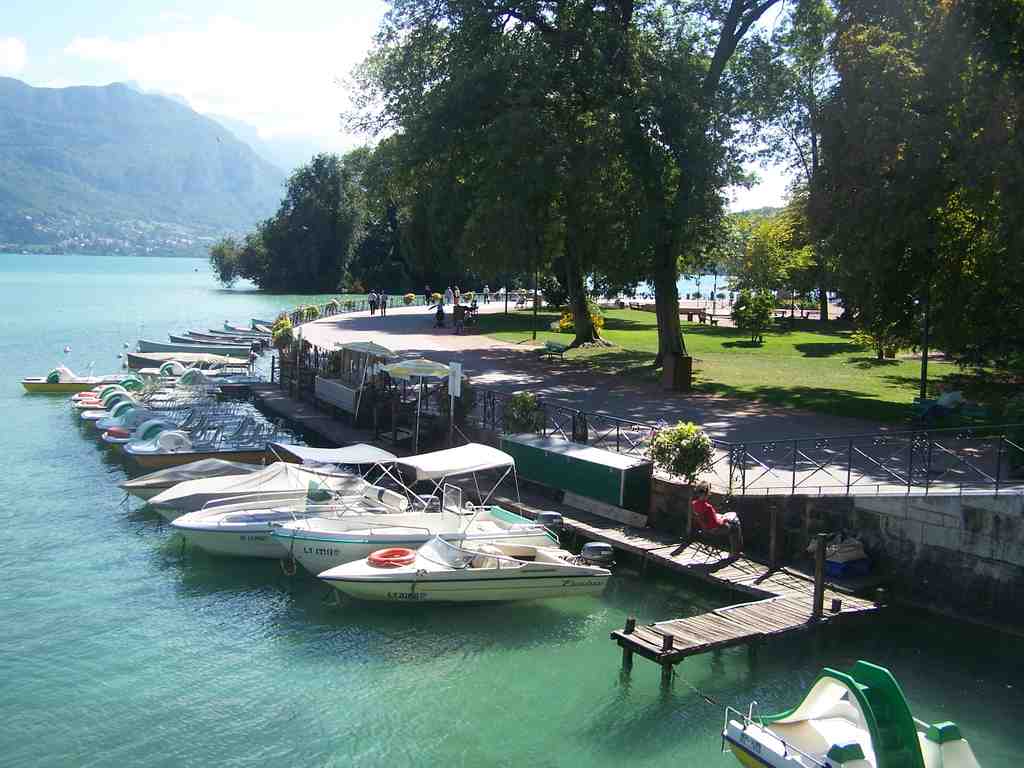
To spot the Gardens of Europe, look ahead for an inviting expanse of green lawns shaded by towering trees, right beside the sparkling edge of Lake Annecy, with boats docked along the water and a wide, open path fringed with flowers and benches.
Close your eyes for a moment-or at least try to focus beyond what you see right now. Imagine this serene park before it became gardens, before the laughter of children, before the benches and the carefully pruned trees. Once, you would have been standing on a wild, marshy island, the air damp and buzzing with mosquitoes, just outside the old city walls. This bit of land, far from being a peaceful retreat, was home to nothing but reeds and muddy ground. In those early days, in the shadowy fog of plague years, you might have heard the distant toll of church bells or the rattling wheels of a cart crossing a makeshift bridge, delivering the sick to small “health huts” built far from the city, where they were kept isolated during times of plague. Sometimes, the silence here was only broken by the wind or the desperate prayers drifting from inside those huts.
Later, the land came into the hands of the Asinari family, bankers from Lombardy. For over a century, their name stuck and locals called it “pré Lombard.” And then change arrived with the digging of a canal in 1563, splitting the marsh in two. On the less-pleasant island, it became a place for isolation-a place of worry but also of hope, where people waited for pestilence to pass.
But the marshes’ fate would change forever in 1602, when Duke Henri I of Savoy-Nemours decided to give Annecy a place of beauty. He turned the grim ground into a promenade for his subjects. Picture men and women strolling, enjoying the new greenery and the fresh air, anxious memories of plagues slowly fading. Later, his successor gifted it to the religious order of the Visitation, who built towering stone walls around their property-so high that the garden was hidden from view. A small chapel appeared, and the nuns transformed part of the space into vegetable gardens, feeding both the body and the spirit with their careful hands.
After the French Revolution, the land found new owners and new purposes. Gone were the cloisters and prayers; an enterprising Genevan entrepreneur used the open space for spreading out freshly printed fabrics to dry in the sun. If you wander here in your mind, you might picture the fluttering of vast sheets-flecks of color against the green-rustling in the alpine breeze.
By the mid-19th century, Annecy had recovered its grandeur. The commune bought back the land, pounding, digging, and changing the two former islands into a peninsula, birthing the Gardens of Europe. The work was driven by grand, English-style dreams: winding paths, open vistas, and rare trees from around the world. In the winter of 1863, hundreds of trees and more than a thousand shrubs were planted, and soon the garden came alive with the fresh green scents of Virginia tulip trees, ginkgo bilobas, laricio pines, and even giant sequoias.
If you keep walking toward the water, you’ll see why the gardens were set where land and lake come together, the peaceful surface now reflecting leafy branches and gentle clouds. Out on the tip, the Île aux Cygnes-Swan Island-beckons with its little haven for wildlife.
Now, these paths offer surprises for the curious. Look up and you might see the bronze statue dedicated to Claude Louis Berthollet, a chemist of great local fame: the monument nearly melted down for metal during World War II, but miraculously saved at the last minute before returning to stand at attention among the trees. Not far away, there’s a rare commemorative plaque for Napoleon III-a tangible link to 1860, when Savoy became part of France and, in gratitude, the Emperor sent Annecy a gleaming steamship, the Couronne de Savoie.
As you explore, you might hear the clinking of boats in their moorings: 270 places where watercraft gently bob between the canal and the gardens.
Welcome to the Gardens of Europe-a place where Annecy’s history runs through every shadow and ray of light, where every step draws you across centuries from muddy beginnings to the flourishing park that welcomes you today.




