
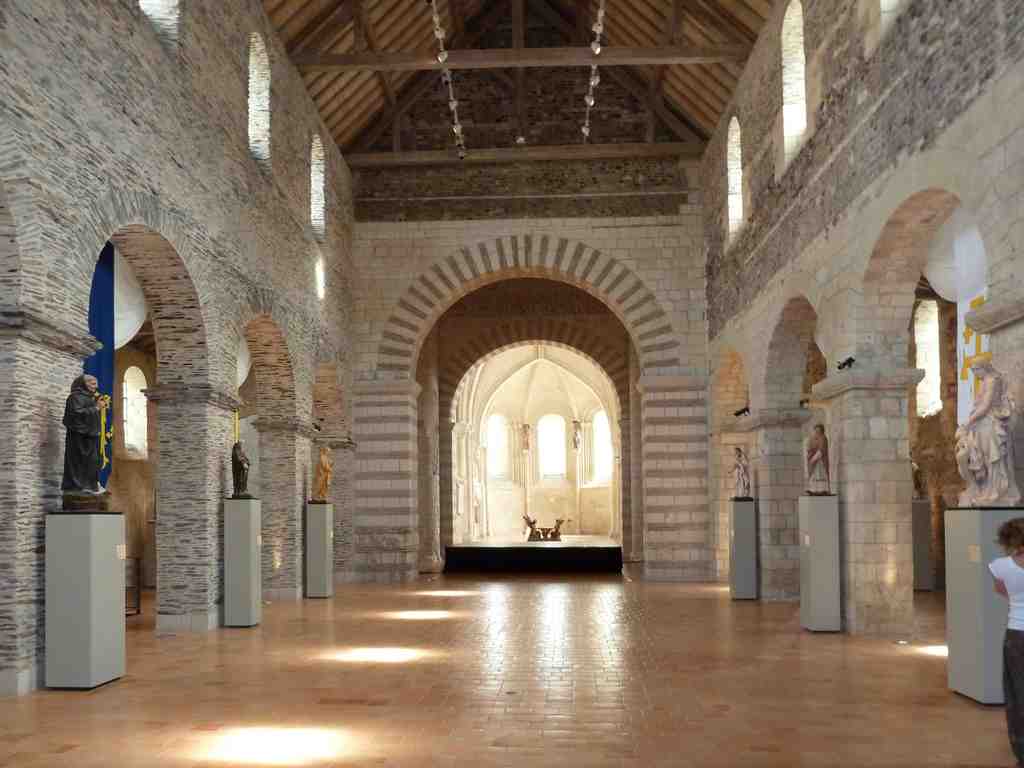
To spot the Church of Saint-Martin, look for a striking stone building with tall arched windows and robust columns-its ancient, textured walls and serene presence make it stand out from the surroundings.
Alright, adventurer, here we are at the magnificent Church of Saint-Martin! Just imagine: you're standing in front of one of France’s best-preserved Carolingian treasures, where time has stacked itself up like layers of cake-only, this cake is made of stone and stories! From outside, the rough blue-gray schist and limestone bricks almost seem to whisper about all the centuries they've seen.
Travel back with me to the 5th, 6th, and 7th centuries, when the very first churches were built on this ground. Legend has it, the original church was created to shelter the tomb of a local bishop. It wasn’t long before things outgrew the bishop-literally! By the 7th century, the ambitious Bishop Loup had overseen the building of an even larger church, cross-shaped and elaborate for its time. Picture a flurry of tools and voices as new walls rose under the gaze of curious townsfolk.
Down below, in the ancient crypt, archaeologists uncovered timeworn sarcophagi and slate coffins. No vampire stories, just real Merovingian graves! If you had a shovel and a time machine, who knows what else you might dig up-though I'd recommend a proper permit instead.
Leaping ahead to the 10th and 11th centuries, the church gets another extreme makeover. With its impressive arches of alternating pale tuffeau stone and red brick, the building sported a look that would have made any medieval architect jealous. During the reign of Foulques Nerra-now there’s a fellow with dramatic flair-the church officially became a collegiate church and received a beautiful stone dome that still stands today. Oh, and Foulques’s wife, Hildegarde, made sure there were 13 canons to keep things orderly. Talk about a power couple!
Fast-forward to the era of soaring Gothic grandeur in the 12th and 13th centuries. The choir was transformed and stretched out with majestic Angevin-also called Plantagenet-gothic vaults, their gently rounded shapes quite the local hallmark. The chapel on the side, named “Chapelle des Anges,” was smothered with vivid paintings; you’d spot angels, a sorrowful massacre, and wise men bowing before the Virgin and Child. These now-faded images are just a whisper of their former splendor, but with the play of sunlight and clever spotlights, the carved capitals still come to life today.
Now, let’s not forget the Renaissance drama. The church got an extra polish thanks to King René-imagine him sweeping in, armor shining, tossing coins for new roof beams and decorating the place with his own emblems. He wanted everyone to know: King René was here.
And that’s not the end-after the Revolution, the church went rogue! It stored confiscated books, became a warehouse for firewood, even hosted tobacco. The poor building saw its roof and bell tower hacked away. And then-plot twist-in 1986, it was sold to the county for just one franc. What a bargain!
Today, this beautiful shell is no longer a church, but a museum where statues from ages past are displayed. It’s a true survivor, rebuilt and lived in over and over, now sharing its ancient secrets with you. You’re not just looking at old rocks; you’re admiring 1,500 years of dramatic change, mishaps, royal bling, and splendid resurrection. If only all old buildings could boast such a wild résumé!
Curious about the foundation and first churches, the tenth and eleventh centuries or the the gothic period? Don't hesitate to reach out in the chat section for additional details.


