
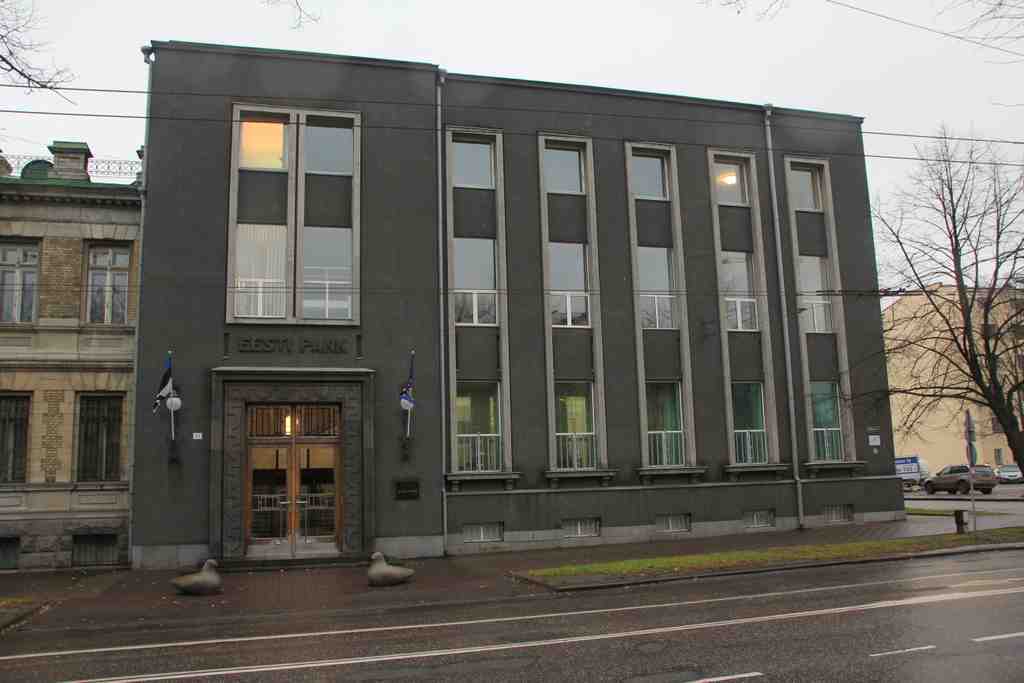
In front of you is a sturdy, dark gray building with tall, narrow windows arranged in neat rows and the words “EESTI PANK” etched above a grand doorway-just look for the Estonian flags on either side of the entrance to spot the Bank of Estonia.
Alright, get ready, because this is not just any ordinary bank-this is the nerve center of Estonia’s entire financial adventure! Imagine it’s 1919. The snow’s still melting from the streets after winter, the air feels fresh with independence, and right here, the government says, “Let’s start printing our own money!” With a bold new plan, the Bank of Estonia is born to give Estonia its first currency, the Estonian mark, and soon after, the kroon-a name that rhymes with “spoon” and jingled in pockets all across the land.
Through the roaring 1920s, the Bank becomes a symbol of trust, managing money, handing out loans, and doing everything to keep those kroons as shiny and stable as a brand-new coin. They even got help from the League of Nations in the 1920s to boost their gold reserves and learn how to be a top-tier central bank! But history isn’t always so cooperative. In 1940, the Soviet army arrives and the Bank’s doors slam shut. Suddenly, all that Estonian money is out and the Soviet ruble takes over. If these gray walls could talk, they’d probably sigh at the mystery and tension of those days-when bank ledgers were hidden and gold was sent far away, meant to be forgotten.
Fast forward to 1990. The world is changing again. The Berlin Wall has just come down, excitement zips through the air, and-guess what?-the Bank of Estonia re-opens! But it’s not all smooth sailing. Estonia is still tangled in the Soviet money system, with rubles flying everywhere, and Moscow controlling the wires. The “new” Bank of Estonia is tiny-barely 25 people with big dreams huddled together, trying to figure out how to move money, keep track of their own gold, and invent a system for the free market. They’re so scrappy, they even start running auctions for currency and counting rubles, making lists by hand. And they sneakily start preparing to bring back the kroon, Estonia’s beloved currency, once freedom comes knocking again.
Freedom bursts in the door in August 1991, and the Bank of Estonia finally takes charge. Now they control their old branch, claim their heritage, and set out for a wild financial ride. Only a few months later, they make a courageous-and sort of nerve-wracking-decision: let’s peg the kroon to the German mark with a currency board, inspired by a sudden visit from the famous economist Jeffrey Sachs. That's right, the fate of the nation's money is being shaped by a brainwave and plenty of coffee, probably.
So, in June 1992, the new kroon is launched. People line up to exchange piles of old rubles for crisp Estonian koomikrons-okay, they're just kroons, but they spark so much excitement the banks must have sounded like casinos! The gold that had been lying “sleeping” in England and Switzerland for decades finally comes home in the form of $97 million in shiny bars-the real treasure of a national story. Suddenly, Estonia isn’t just independent-it’s rich! Alright, maybe not as rich as a dragon hoarding gold, but still, those reserves help back the new money and win trust at home and abroad.
Oh, but the drama’s not quite over yet! Later in 1992, a banking crisis threatens the system-several local banks run into problems because of lost assets in Russia. Yet the Bank of Estonia steps in, sorts things out, and the country’s financial confidence barely takes a wobble.
Before the euro, the Bank even creates its own interbank rates-TALIBOR and TALIBID-sort of like Estonia’s own little Wall Street right here in Tallinn. And then, on a frosty January morning in 2011, history turns a new page again. Estonia becomes a proud member of the Eurozone, and the kroon bows out like a veteran performer, leaving the stage to the euro, though the Bank of Estonia continues to steer the country’s financial ship as part of the mighty Eurosystem.
So next time you hear about gold, markets, or even a simple euro coin jingling in your pocket, just remember-you’re standing at the epicenter of a century-old story of suspense, survival, and plenty of well-counted coins! And that, my friend, is exactly why bank buildings are so solid-they have to keep all these adventures safe!




