
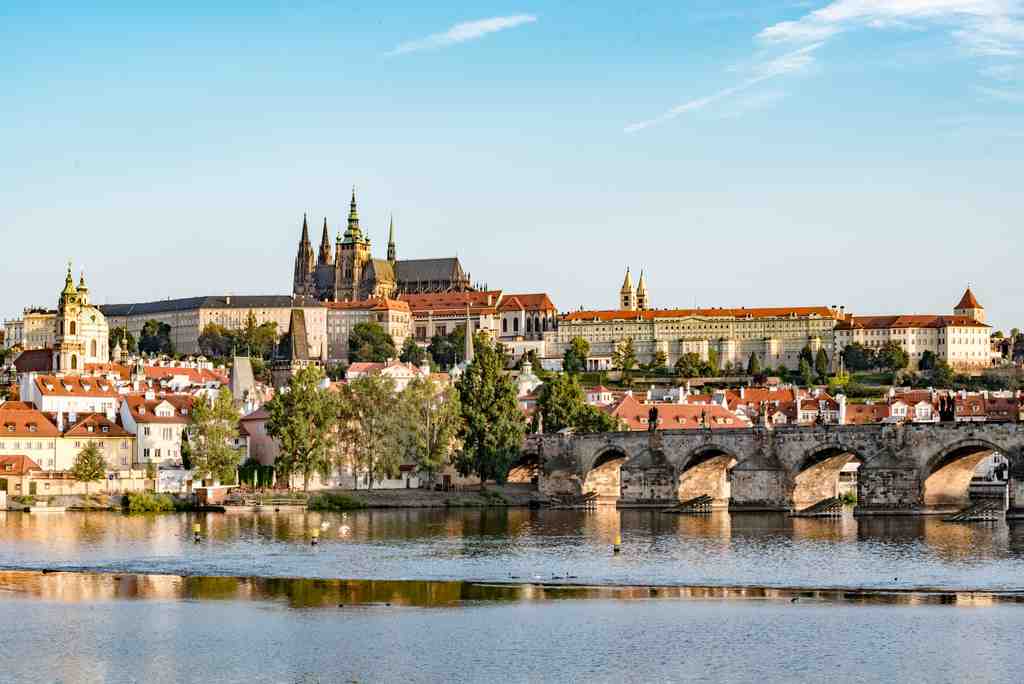
On your right, you will see a sprawling stone complex stretching endlessly along the ridge, anchored by a long, uniform pale facade and the striking, dark Gothic spires rising right out of its center.
Welcome to Prague Castle, or Prazsky hrad. Calling this just a castle almost feels like a vast understatement. According to the Guinness Book of Records, this is the largest ancient castle in the world. It occupies almost seventy thousand square meters and stretches about five hundred and seventy meters in length. For over a millennium, this has been the ultimate seat of power in Bohemia. It is so ingrained in the national identity that saying the Castle, or Hrad, is used by locals to simply mean the president and his staff, much like Americans say the White House.
The story of this massive footprint began simply enough back in the year eight hundred and seventy, with a single walled building called the Church of the Virgin Mary. As the centuries passed, kings, emperors, and eventually presidents continuously added their own touch. Charles the Fourth rebuilt the royal palace in a soaring Gothic style with pointed arches and towering vaults. In the late fifteenth century, the massive Vladislav Hall was added, featuring spectacular, twisting stone ribs across its vast ceiling. The complex was essentially a continuous construction site that survived a devastating fire in fifteen forty one, looting by Swedish troops, and countless political upheavals.
Speaking of upheaval, this very complex was the site of the Third Defenestration of Prague in sixteen eighteen. Defenestration is a highly specific historical term for the act of throwing someone out of a window. When angry Protestant nobles tossed three Catholic officials out of the castle windows, it directly sparked the Bohemian Revolt and kicked off the brutal Thirty Years War.
The castle also holds a much darker and more modern piece of lore. Hidden somewhere inside these thick stone walls is a secret chamber containing the priceless Bohemian Crown Jewels. During the Nazi occupation in World War Two, the castle became the headquarters for Reinhard Heydrich, a notoriously ruthless commander. According to popular local legend, an arrogant Heydrich secretly placed the ancient Bohemian crown on his own head. But old myths fiercely warn that any usurper who wears the crown is doomed to die within a year. Less than a year later, Heydrich was ambushed by British trained Czech and Slovak resistance fighters during Operation Anthropoid. He died from his infected wounds a week later, and his eldest son died the following year in a traffic accident, fulfilling the eerie legend to the letter.
After surviving the war and the communist era, the castle found new life. Just like the very first Czechoslovak president Tomas Masaryk did in nineteen eighteen, the post communist president Vaclav Havel hired a contemporary architect to give the historic spaces a much needed facelift. From its earliest Romanesque chapels to its sweeping Renaissance halls, the sheer volume of history layered here is completely staggering.
Take your time soaking in the scale of this place. Whenever you are ready to move on, we will head toward those towering dark spires for our next stop at St. Vitus Cathedral.




