
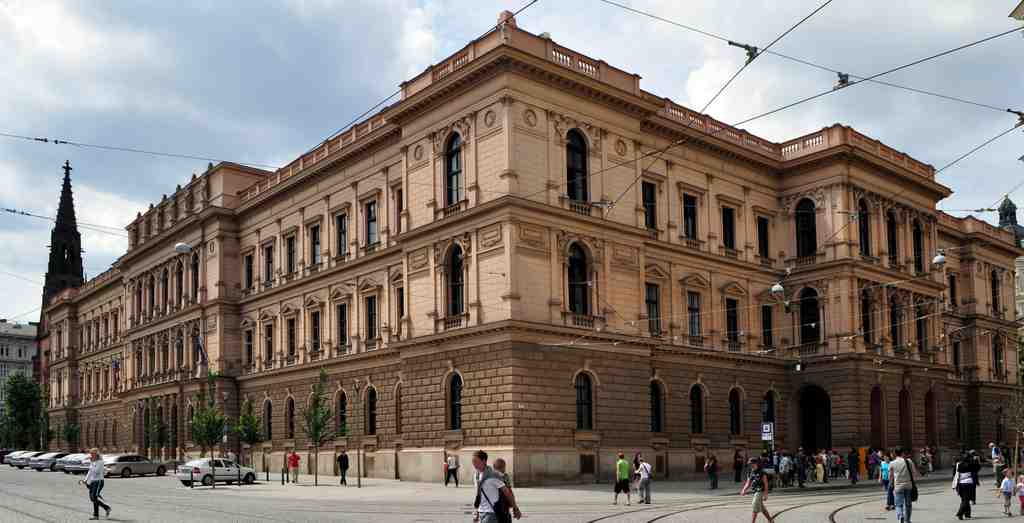
To spot the Constitutional Court of the Czech Republic, look for a grand, light brown, palace-like building with ornate arches, towering windows, and statues along the roof, standing proudly on the corner just ahead of you.
Here you stand, right in front of Brno’s most powerful courtroom-no need to plead your case for taking a break here! This magnificent building wasn’t thrown together overnight: it was built in the 1870s to house the Moravian Provincial Assembly, making it, fun fact, the only true parliamentary building in Czech lands to have been designed from scratch as a parliament. Imagine the air thick with the sharp scent of ink, heated debates echoing off these stone walls, and nervous politicians pacing the corridors in the age of quills and waistcoats.
Flash forward-today, this is the seat of the Constitutional Court, the very institution that holds the ultimate power to guard the Czech Constitution. If you’re picturing big-hammer judges from movies, add a serious sense of justice and a dash of Czech politics! The Court sits outside the regular court system, functioning almost like the referee in a tense chess match. Its mission: protect the core laws of the country and keep fundamental human rights safe, even if an ordinary court gets things wrong. There are fifteen judges here-one president, two vice presidents, and twelve others, each ready to weigh in on the toughest questions in Czech law. You can bet they’ve got a lot of heated debates-and no, you don’t want to be caught holding a loud protest within 100 meters. That’s strictly forbidden!
The story wasn’t always so steady. The first constitutional court for Czechoslovakia appeared all the way back in 1921, in Prague. It was just seven members strong, and, honestly, didn’t make many big splashes-most people barely noticed it! The concept was abandoned and resurrected more times than a soap opera character. It reappeared in 1938, then faded away during World War II, skipped a couple of appearances through the later constitutions, and was only firmly established for both the Czech and Slovak Republics in 1991, after the Velvet Revolution.
Since 1993, this building in Brno, with the statues on its rooftop measuring the weight of stone and law alike, has hosted the Czech Constitutional Court. You might be surprised to learn some of the nation’s biggest controversies walk right through those doors. Controversial laws, heated social reforms, even presidential actions… if it’s a national drama, it probably passed through here. This is where politicians have faced the music-sometimes quite literally, as in the case of the complaint for treason against a president!
Court decisions range from settling who owns historic party headquarters, to ruling on whether a political party gets dissolved or if a health care law is fair. And if you’re one of those who enjoys a good plot twist, the court once even cancelled already-announced elections, which left politicians in a frenzy.
It’s not all black robes and stern faces-the judges themselves are chosen by the president, with the Senate’s approval, and their term is ten years, but they can return for an encore. Just being eligible to join them takes decades of legal experience, and, of course, a steady hand for coffee.
So next time you stroll by this grand building, imagine the swirl of legal arguments, political intrigue, and the quiet determination of those statues above, who-from up high-can watch the drama unfold but don’t ever have to cast a vote.
Ready to delve deeper into the powers, organizational setup and decision-making or the judges of the constitutional court? Join me in the chat section for an enriching discussion.


