
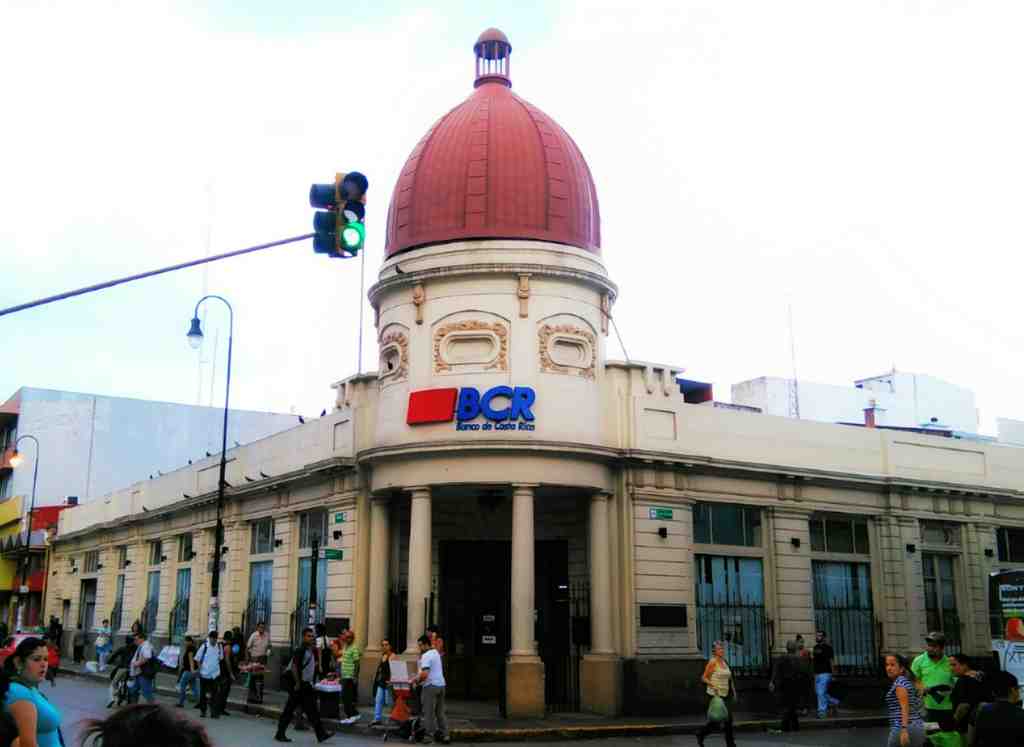
Look to your left for the beige corner building defined by its tall, classic columns and that striking reddish-bronze dome sitting right on top of the curve.
This elegantly curved corner serves as a perfect mask for a turbulent past. Before this neoclassical structure rose up, the ground here belonged to the colonial residence of a man named Antonio Pinto Soares, known locally as Tata Pinto. He wasn't just a merchant; he was a powerful military general. Right here, in his home, he orchestrated the coup of 1842 against Francisco Morazán, the leader who dreamed of a united Central America. It was Tata Pinto who gave the final order to execute Morazán. So, these foundations rest on the site where a grand political dream was violently dismantled.
But cities change, and sites of military power often give way to the bustle of trade. The building you see now was designed by the Salvadoran architect Daniel Domínguez Párraga. He wanted to bring a sense of big-city monumentality to San José. He utilized brick and reinforced concrete, which was cutting-edge technology at the time. This signaled a major shift, moving the city away from the traditional cane-and-mud construction known locally as bahareque.
For decades, this place was known as the Luis Ollé Store, and oh, it was the absolute definition of cosmopolitan ambition! It represented a San José that was hungry to connect with the wider world. This was where the local bourgeoisie came to feel sophisticated. Imagine walking through those doors. You could buy a heavy-duty iron safe from the famous Mosler brand, and then, in the very same trip, pick up fine European wines and chocolates. They even sold those novel American chewing gums, Chiclets Beechies. It was a wonderland of imported luxury, mixing heavy hardware with the sweet taste of life abroad.
Now, look up at that dome again. It looks solid, right? Well, it is actually a replacement. The original was made of heavy reinforced concrete. But years ago, a massive truck crashed into the corner column down here at street level. The impact was so severe that the structural integrity failed, and that massive concrete dome eventually had to be demolished because it was collapsing! The one you see shining today is made of bronze, which is much lighter and far less likely to crush the portico.
In the 1980s, this building housed a private bank called BIESA, which collapsed during a major financial crisis. It was a chaotic time for the economy. But thankfully, the state-owned Bank of Costa Rica stepped in, bought the property in 1988, and saved this architectural gem from falling into ruin. It is a true survivor, transforming from a site of military conspiracies into a nostalgic temple of global trade.
Ready for a change in scale? We are going to look for what was once considered the skyscraper of 1940s San José, the Herdocia Building, just a few steps away.




