
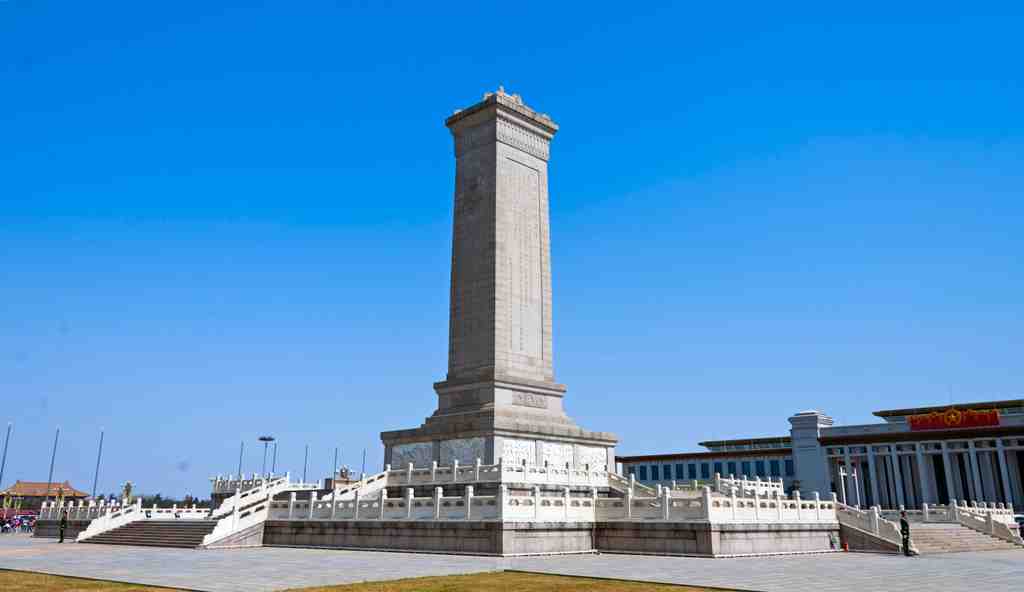
Look straight ahead for a towering grey stone obelisk rising above white marble steps-right in the heart of Tiananmen Square, you can’t miss its commanding presence against the open sky.
Now, as you stand before this impressive sight, imagine the square buzzing with excitement in the late 1940s. After the city of Beijing was taken over by new forces, a decision was made: they needed a grand monument, not just any stone, but a monument dedicated to wish all of China’s people “eternal glory.” Originally, planners debated putting this monument in several different spots around the city-Babaoshan, Dongdan, but in the end, it was Tiananmen Square that was chosen. Why? Because this was where fiery student protests like the May Fourth Movement happened, where the voices of change cried out the loudest.
Picture a chilly morning in September 1949. Workers and craftsmen hurried through Beijing’s old alleyways, commissioned to build a model out of copper lapis lazuli as a foundation stone. Soon after, the very first ceremony at the site played out-a military orchestra marching and the sound of patriotic tunes swirling through those wide Beijing skies. Leaders like Mao Zedong himself wrote the monument’s famous inscription, promising eternal glory to those who had fought and fallen in China’s battles for independence, freedom, and the future.
The design process became a nationwide competition. More than 140 designs poured in-some flat, some sculptural, some tall and thin, some favoring curves. Eventually, they settled on an obelisk, inspired by classic Chinese monuments and the mighty columns in the Summer Palace. Still, there were heated moments: what should top the monument? A statue? Something that lights up? In the end, wisdom prevailed and the designers went with a dignified architectural cap, saving the extravagant ideas for another day (hey, sometimes classic is best, right?).
In 1952, the first stone was cut from Laoshan Mountain far away in Qingdao-imagine the difficult journey as the giant slabs rolled by train and tractor all the way to the capital. Architects Liang Sicheng and Lin Huiyin, a couple famous in China’s design world, devoted long nights and sketches to the project. Stonemasons traced the very handwriting of Chairman Mao and Premier Zhou Enlai, chiseling the words deep into the monument’s heart, then gilded the letters so they would shine in the sunlight.
This column isn’t just a pretty face either-it’s 37.94 meters high, pieced together from over 13,000 slabs of granite and alabaster. Stare at the base and you'll spot eight massive bas-reliefs; each one tells a dramatic chapter from recent Chinese history. There’s the destruction of opium at Humen, the spark of the Taiping Revolution, student protests, uprisings, and the thunderous War of Resistance Against Japan. Walk around, and you relive an entire century of upheaval and hope-look closely, and you might even feel the stone pulses with stories.
On the front, you’ll read “Eternal glory to the people’s heroes,” in Mao Zedong’s own calligraphy, while the back holds an emotional tribute written with Premier Zhou Enlai’s help-a salute to the countless men and women whose courage stretched all the way back to the 1840s and the first Opium War. It’s meant to embrace everyone, from rebellious students to heroic soldiers, who fought for a new dawn.
Over the years, this monument has seen grand ceremonies, foreign dignitaries laying wreaths, and careful repairs-sometimes with workers gently cleaning stone and mending cracks, other times with floral baskets piling up on Martyrs’ Memorial Day. There were even wild ideas like making the top glow at night, but in the end, the monument stands as a steady, silent witness to history.
If you listen carefully, you might almost hear the echoes of all those parades, speeches, and footsteps-the tireless heartbeat of the people’s heroism in the very center of the nation’s capital. So, take a moment-gaze up, and remember the stories carved into every layer of this unforgettable monument.




