
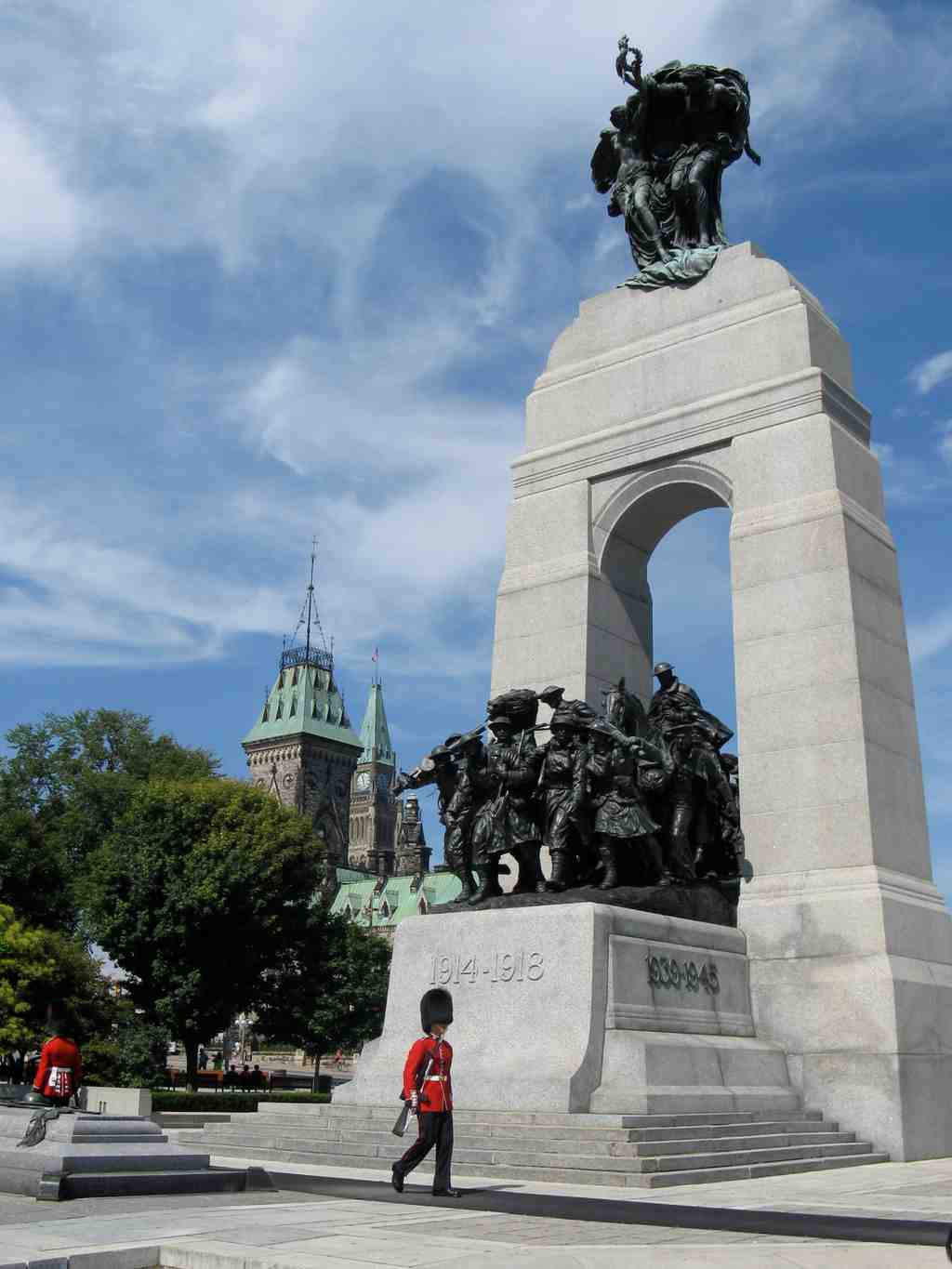
To spot the National War Memorial, look for a strikingly tall granite arch with bold bronze statues of soldiers and two winged figures soaring on top, sitting prominently in the center of Confederation Square-if you see soldiers in red tunics nearby, you're in exactly the right place!
Alright, take a moment to breathe it all in-you're now standing in front of what’s known as “The Response,” Canada’s National War Memorial. Imagine the late spring of 1939: this square is buzzing, banners fluttering, and a crowd of 100,000 people hums with anticipation as King George VI steps forward, ready to unveil this enormous archway. But, let’s rewind! The idea for a memorial started even before the First World War had ended; Prime Minister Robert Borden had a vision of a monument right in the capital, a powerful reminder for all who passed by. The journey here was anything but easy-a bit like herding cats, if those cats were parliamentarians always arguing over costs and locations!
Vernon March, a sculptor from the UK, ultimately won a competition to design it. He lost his battle with illness before it was finished, but his family carried his work across an ocean, casting these massive bronze figures you see before you. If you’re thinking these soldiers look larger than life, you’re spot on-they stand a third taller than the average Canadian, and they’re posed rushing forward, not in parade form but alive with purpose, hope, pride, and maybe just a bit of fatigue-hey, we’ve all felt that way Mondays! Above them, the twin allegorical figures of Peace and Freedom perch together, their wings almost brushing the sky. The design is so layered: one holds a laurel crown for victory, the other a torch, just like in the poem "In Flanders Fields"-a symbol of hope and remembrance, passed from one generation to the next.
These bronze men and women represent all roles from Canada’s First World War effort-nurses, gunners, infantry, even a dispatch rider and a railway troop-all moving out through the arch. There’s no special region, language, or ethnicity singled out; Vernon March wanted them to stand for every Canadian. If you peer at the base, you’ll see a timeline chiseled in granite, marking major conflicts: 1914-1918 for the First World War, 1939-1945 for the Second World War, 1950-1953 for Korea, plus later additions for the Boer War and the war in Afghanistan. Each was added as Canada’s story continued to unfold.
You might notice the flat stone at your feet-that’s the Tomb of the Unknown Soldier, added in 2000. It’s a silent symbol for every Canadian who gave their life, and for those who may still be called to make that sacrifice. Every Remembrance Day, tens of thousands gather right here, joined by dignitaries, veterans, even the occasional royal, to lay wreaths and remember. But it’s not just one day a year; from the careful waxing of the bronze, to posting ceremonial guards, this place is always tended to, because memory needs maintenance.
This memorial wasn’t always so beloved. Back in the day, people hotly debated its location-Parliament Hill, the Gatineau Hills, even the middle of a park-and costs soared, giving critics plenty to complain about. (There’s even a story about a politician grumbling that the soldiers’ bronze heads seem bowed in confusion over all the spending!) Yet when it was finally dedicated, the crowd surged past fences to greet the king and queen-setting off a tradition of close connection.
This is Ottawa’s heart-a spot holding the complicated, sometimes contentious, always powerful history of a country coming of age through conflict and striving for peace. Today, this memorial serves as the preeminent war memorial in Canada, a gathering place, a site of solemn remembrance, and yes, sometimes the target of a too-curious skateboarder or two (though, don’t try your luck-guards have sharp eyes). So stand a little straighter as you walk by; you’re surrounded by stories of courage, loss, and hope that still echo through this grand arch and across the square.
Intrigued by the context and use, design or the commemoration? Make your way to the chat section and I'll be happy to provide further details.




