
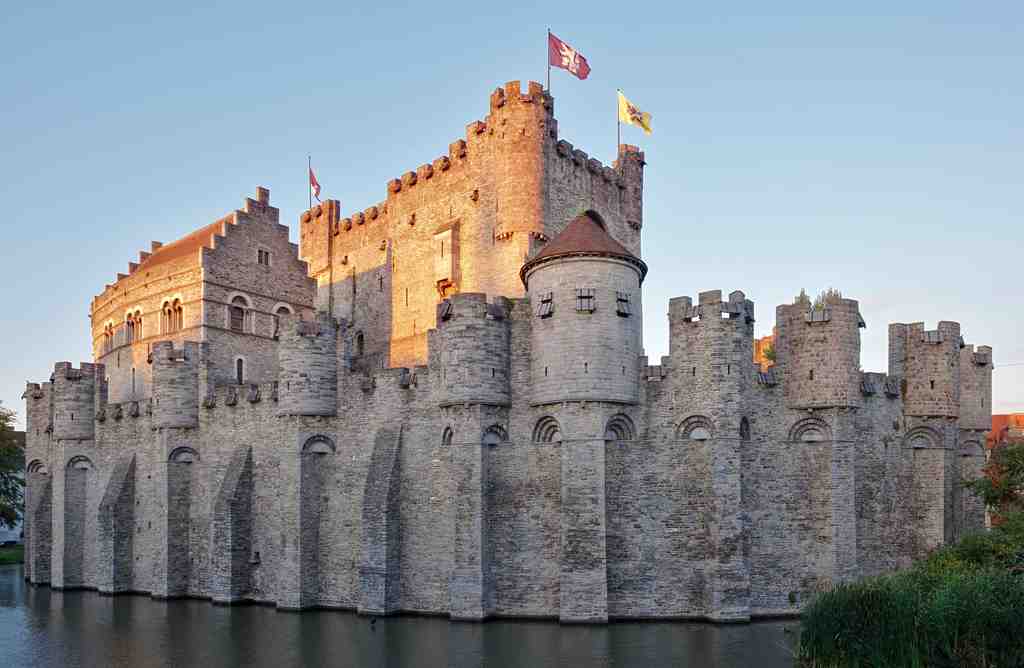
Alright, take a good look ahead! You can’t miss this one. The Castle of the Counts stands boldly before you, its thick stone walls rising up above the dark water of the moat. You’ll see tall round towers at each corner, lined with arrow slits and topped with battlements-those classic tooth-shaped stones where defenders once kept watch. Two flags flap from the top of the tallest keep, like a medieval crown.
Now, imagine walking up here about 850 years ago. The air would carry the sharp scent of smoke and the lively hum of merchants and townspeople. You’re standing in front of Het Gravensteen, or the Castle of the Counts-a place built not just for show, but for power. Its walls are nearly unbroken, as if daring anyone to try their luck storming the gate. Trust me, you’d need more than a butter knife and a brave heart to get in here in the old days!
Built in 1180 by Count Philip of Alsace, the castle was home to the Counts of Flanders until the mid-1300s. It started life with a name that’s quite a mouthful-‘novum castellum’ or ‘new castle.’ But it didn’t just stick to one job. Over the centuries, Het Gravensteen worked overtime: it served as a courtroom, prison, even a cotton factory! At one point you might have heard the clang of coins being made, and at another, the thud of cotton bales hitting the floor. Who knew one castle could have so many careers?
The site was picked for its marshy shores on a tall sand dune, right in the middle of the River Leie-nature’s own moat. Back in the days of rumbling Vikings, it was the perfect spot for a fortress. Count Baldwin I is said to have been the original boss of this stronghold, building it up out of fear of sudden Viking visits-let’s call those “very aggressive house calls.”
But that first fort was made of wood. It was only later that Count Arnulf I beefed things up with a proper stone donjon, turning the place into a luxury castle for its time. Picture grand halls stacked on top of each other, big fireplaces blazing, and some surprisingly fancy toilets-seriously, the medieval folks here liked their comfort just as much as battle.
The castle evolved over time, enduring fires, expansions, and even inspiration from the famous Krak des Chevaliers. In its grandest days, stone towers stood guard over the massive hall, a symbol of the Count’s might in a city that never stopped bustling or arguing. To the rich folks across the river, this was a daily reminder: the Count is watching!
Now, it’s your turn to visit. Step inside if you dare-just watch out for any leftover ghosts from its prison days! And if you find a hidden stash of medieval gold, well, I’ll take a 10% tour guide fee, agreed?
For a more comprehensive understanding of the controversy around the renewal plans, court objects and weapons or the accessibility, engage with me in the chat section below.




