
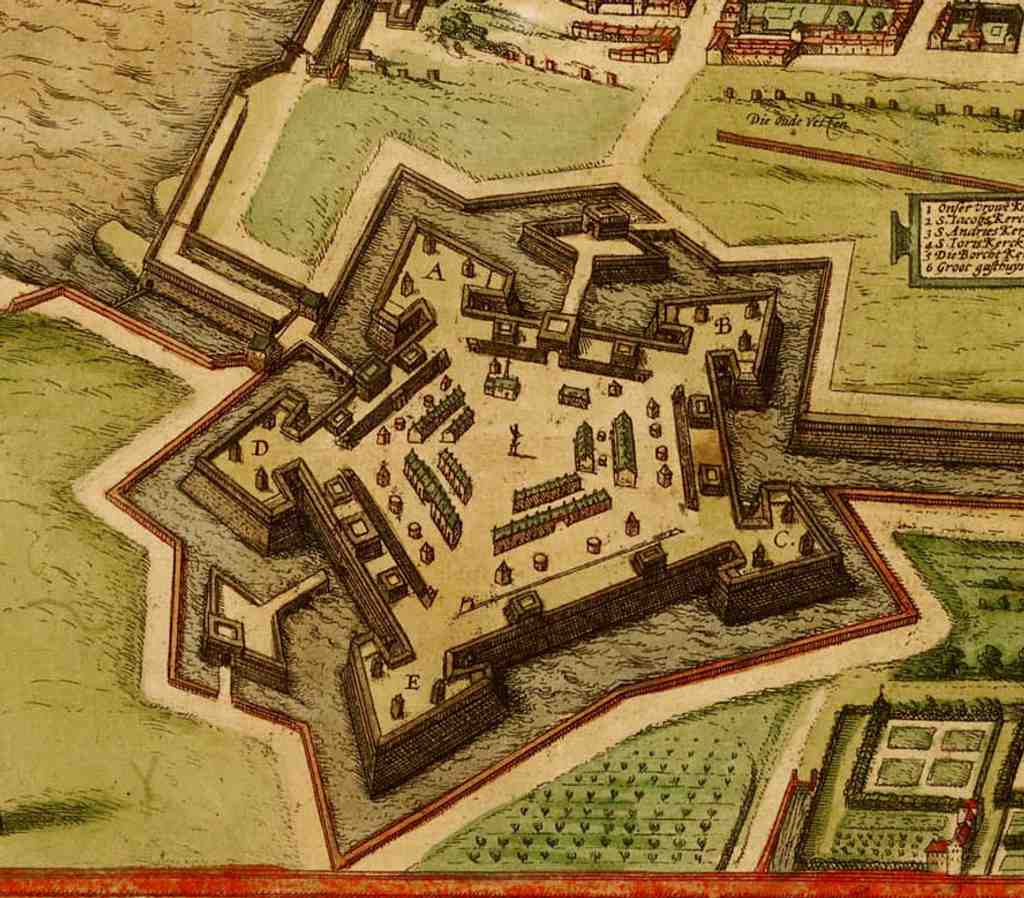
To spot the Citadel, look straight ahead for an old fortress layout-picture a huge five-pointed star with thick walls, surrounded by grassy open space where the city blends into history.
Imagine it’s the late 1500s, and you’re walking where the air is tense with the smell of gunpowder and the echo of marching boots. The Citadel of Antwerp-also called the Zuidkasteel or Zuiderkasteel-wasn’t just for decoration. It was built by order of the Duke of Alva, a man so feared he probably made even the shadows shiver. After a wild spree called the Beeldenstorm swept the Low Countries, everyone was on edge. The Duke charged an Italian architect, Francesco Paciotto, with drawing up plans for a fortress that could crush any hint of rebellion. When Paciotto packed his bags, Bartolomeo Campi, another Italian, stepped in, adding his own twist to the design-a five-sided, star-shaped stronghold with mighty bastions at every point, each one proudly sporting a name like Hernando, Toledo, Pacietto, Alva, and Duc.
Inside, it was a world unto itself: barracks where soldiers squabbled over cards, powder magazines stacked high with the future of Antwerp-sometimes literally, if the wind caught the wrong spark-and a chapel where maybe even the toughest guard muttered a quick prayer. The Duke must have had a sense of humor; he put up a giant bronze statue of himself, but after he left, the locals wasted no time tearing it down.
Then came one of the darkest moments in Antwerp’s story. In 1576, the Citadel became the launching pad for the Spanish Fury, an explosion of chaos led by a man named Sancho d’Avila. During the rampage, the city rang with cries and cannon fire. The following year, fiery citizens took the initiative, chased out the occupying soldiers, and even started knocking down the hated walls. They weren’t kidding around-bastions Hernando and Duca came tumbling down as if they were just tired old stones.
But the Citadel just wouldn’t stay gone. It was rebuilt again and again-surviving attempted assassinations, sieges, and even a case of “revolutionary deja vu” during the Belgian Revolution, when it was battered by Dutch troops before finally surrendering to the French. By 1881, it was finally demolished, but if you dig around (and archaeologists certainly have, in 2006, 2012, and 2020) you’ll discover chunks of ancient fortress hiding under today’s streets.
The Citadel’s story doesn’t just live on in the ground. Its star-shaped outline is still printed on medals, the names of its bastions sitting proudly on monuments in the Netherlands. Not bad for a fortress that began as an instrument of fear and ended up famous. And all because someone thought a five-pointed star was just the right shape for keeping a city on its toes!


