
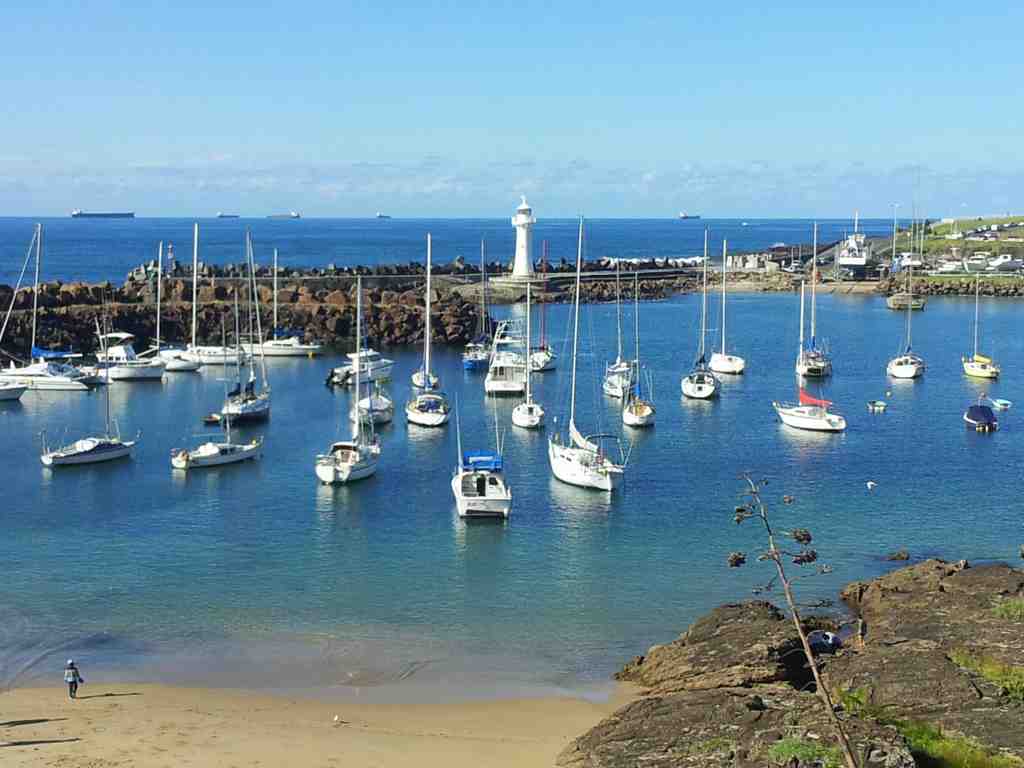
You’re almost there! As you walk towards the Wollongong Harbour Precinct, you should see a picturesque scene unfolding ahead of you. Look out for a collection of boats and yachts gently bobbing in the sparkling blue waters of the harbour. Your eyes should be drawn to the white lighthouse standing tall on the breakwater, acting as a beacon for incoming vessels. The rocky seawalls and the green patches on the headland nearby complete the charming maritime picture!
Now, let’s dive into some fascinating history about this area:
The Wollongong Harbour Precinct is a heritage-listed marvel, located at Cliff Road and Endeavour Drive. Built way back in 1837, it's packed with historical goodies! The precinct includes Belmore Basin, Government Dam, Government Basin, Stockade Point, Flagstaff Hill, Signal Hill, Brighton Beach, Boat Harbour, and Fortress Hill.
Did you know it was added to the New South Wales State Heritage Register on 5 May 2010?
But here's something even cooler: before any European settlers set foot here, the Dharawal people used this natural harbour for cultural and ceremonial activities for thousands upon thousands of years. The natural bay provided them with protection from the rough ocean currents and winds. There was an abundance of fresh water and food, thanks to the combination of marine and riparian environments. Today, archaeological evidence in the form of extensive middens tells the tale of this long occupation.
When the Europeans arrived, it was around 1815, and by 1820, Brighton Beach began serving as a shipping point. Supplies and produce bound for Sydney were transferred here via small flat-bottomed boats. Convicts, soldiers, and various government buildings soon followed, turning the area into Wollongong's main commercial, judicial, and administrative center.
Governor Bourke got involved in 1834 and proclaimed Wollongong as an official town, a proclamation backed by a plan from the Surveyor General, Major Thomas Mitchell, which included a harbour. Construction began under the watchful eye of Captain George Barney in 1837, with convict labour doing much of the hard work. The harbour's basin was expanded, and mooring chains laid across the bay to provide safe anchorage.
So, as you stand here and take in the view, you’re not just admiring a beautiful harbour, you’re looking at a rich tapestry of history that stretches back thousands of years. Enjoy the mix of natural beauty and historical significance!
For a more comprehensive understanding of the description, current condition or the heritage listing, engage with me in the chat section below.


