
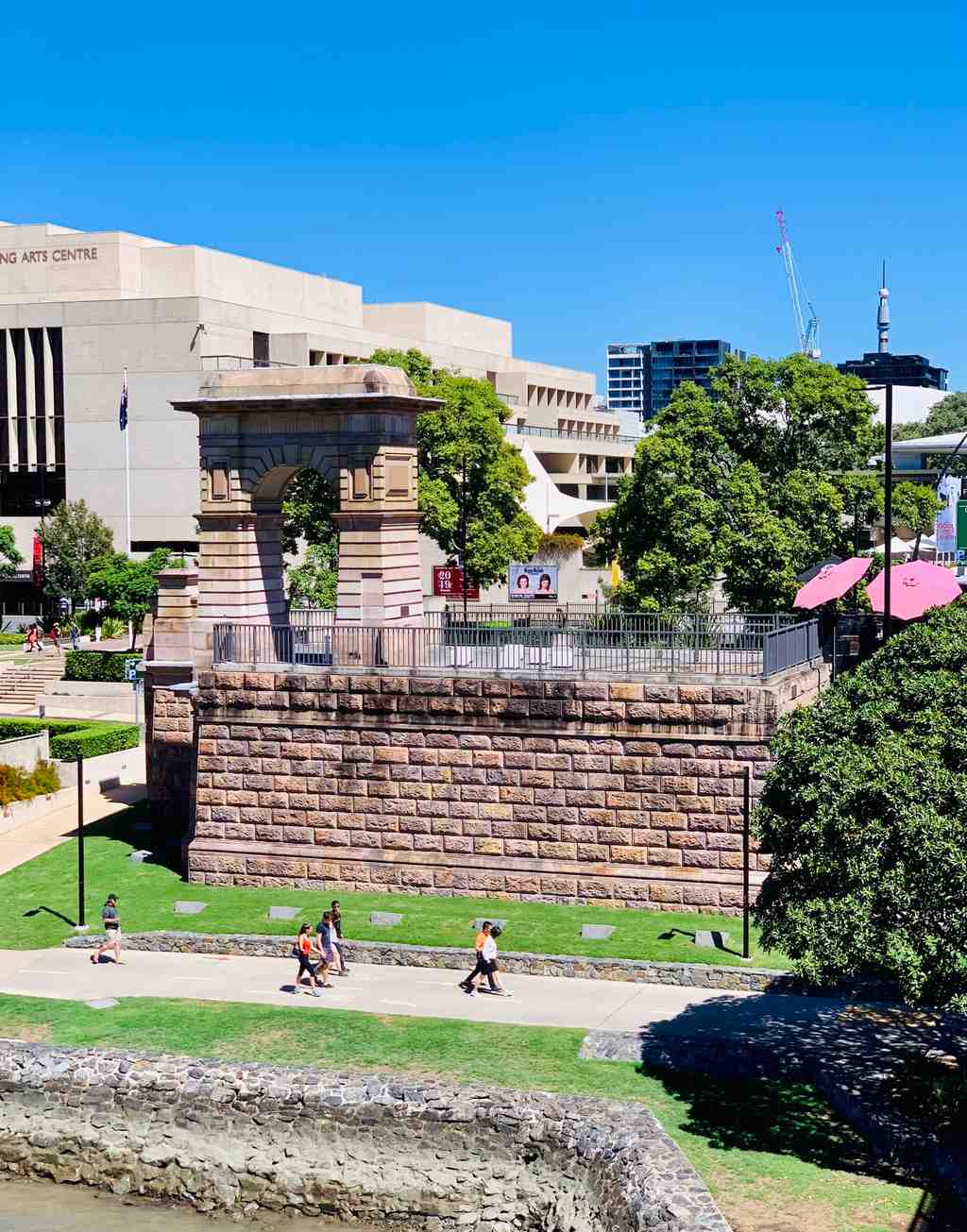
Look ahead and slightly to your left-you’ll see a towering stone structure with an arched gateway and grand blockwork, perched up on a hefty stone podium right by the river, surrounded by a black metal fence.
Now, imagine yourself in late 19th-century Brisbane: the air is thick with anticipation and the clang of ironwork as the Victoria Bridge rises out of the river. This stone abutment, the piece you’re staring at, is a survivor-a relic from 1896, designed by Alfred Barton Brady and built by Arthur Midson, carrying stories of ambition, disaster, and a little bit of mischief. If these walls could talk, I bet they’d have plenty to say…and maybe even a few old river secrets to keep.
Back then, crossing the swirling Brisbane River wasn’t a walk in the park. The first bridge in 1865, made of timber, lasted just two years before hungry marine borers feasted on it. The next try, the first permanent Victoria Bridge, took a decade to finish, finally standing proud in 1874-and then, as luck would have it, swept away by the monstrous floods of 1893. Honestly, Brisbane must’ve wondered if the river gods just liked a bit of drama!
But people don’t give up easily around here. So, in 1896, as the city still wiped silt from its boots, a new, iron-and-stone bridge began to span the banks, crowned by the majestic abutment in front of you. Imagine the sound of chisels and hammers echoing off the masonry as generations of Brisbanites nervously watched another mighty project take shape.
And for its grand opening? Oh, the dignitaries just couldn’t agree which side should celebrate-so they had two separate ceremonies, north and south! They crossed over, ribbon-cutting in hand, and then made the journey right back again, all for a second round of pomp, speeches, and, no doubt, a good strong cup of tea.
Not all the stories are so grand, though. There’s a deep sadness here, too. In 1918, as Brisbane cheered the end of World War I and welcomed soldiers home, eleven-year-old Hector Vasyli, a Greek-Australian boy, was struck and killed in the excitement. His memorial tablet stands right here-look closely for the Corinthian columns and the white marble, topped by a bronze relief of young Hector. Every Anzac Day since, the Greek community gathers with the city to remember him, their loss woven into the history of this place.
And it’s not all floods and sorrow. There was a prank that would make any mischievous uni student proud. In the 1930s, a few cheeky souls snuck out early in the morning and stuck signs at both ends of the bridge reading CLOSED. Well, the police believed it, traffic was stopped for hours, and all of Brisbane’s commuters must’ve wondered if they’d traveled back in time to flood season. The bridge wasn’t really closed-just the city’s sense of humor temporarily opened, courtesy of some creative academics!
Now, take a good look at the fine stonework. Notice the chunky, rusticated blocks and the grand arch that used to lead onto the bridge itself. It’s a stunning blend of styles-a little bit classical, a little bit Egyptian, all proudly Queenslander. The abutment once held gas lamps to guide travelers through the night, and, just beneath, you might spot the last hints of the old tramlines embedded in the road section above: the ghostly metal rails where trams once clattered across the river.
This bridge and abutment were vital; they connected booming South Brisbane with the city heart, bringing people, goods, and electric trams whizzing over the water. Stanley Street just beside you transformed into a hive of commerce, bursting with new industry and stately homes for those who could afford a river view. But with only one river crossing until the 1930s, traffic sometimes piled up so badly that city planners had no choice but to dream bigger-bringing about more bridges for generations to come.
The bridge was demolished in 1969, but no one could let this piece go-especially the Greek community, who made sure Hector’s memorial returned right here where it belonged. During World Expo 88, the stonework was finally restored, ensuring visitors could marvel at a true slice of Brisbane’s grit, grace, and, occasionally, its practical jokes.
So, as you stand here now, imagine the thunder of horses’ hooves, the whistles of old trams, the hum of industry, and the quiet remembrance of young Hector-all part of the heartbeat of Brisbane. That’s your invitation to touch history… but please, don’t try any pranks, or you might have a few modern-day police after you too!




