
Wycieczka audio po Olten: Ponadczasowe historie od wież po świątynie
Pod spokojną panoramą Olten, w łukach wieży kościoła św. Marcina kryją się sekrety, które szepczą w chłodnych korytarzach Kościoła Pokoju. Ta wycieczka audio z przewodnikiem zaprasza do odkrycia ukrytych rewolucji i nieoczywistych sojuszy podczas spaceru zacienionymi uliczkami i nadrzecznymi przejściami miasta – miejscami, których większość ludzi nie zauważa. Co się stało, gdy zakazana wiadomość rozeszła się echem po nawie kościoła św. Marcina? Dlaczego bankierzy z Alternatywnego Banku Szwajcarii zaryzykowali wszystko dla idei, która niemal rozerwała miasto na strzępy? Która wyblakła inskrypcja wewnątrz Kościoła Pokoju wskazuje na skandal zapomniany przez większość mieszkańców? Wyjdź poza znane oblicza Olten i poczuj puls wielowiekowej intrygi pod swoimi stopami. Znajdź dramaturgię w cichych zakątkach i zobacz, jak to, co wielkie, zderza się z codziennością w nieoczekiwany sposób. Gotowy, by wsłuchać się głębiej i odkryć ukryte serce Olten? Twoja podróż zaczyna się teraz.
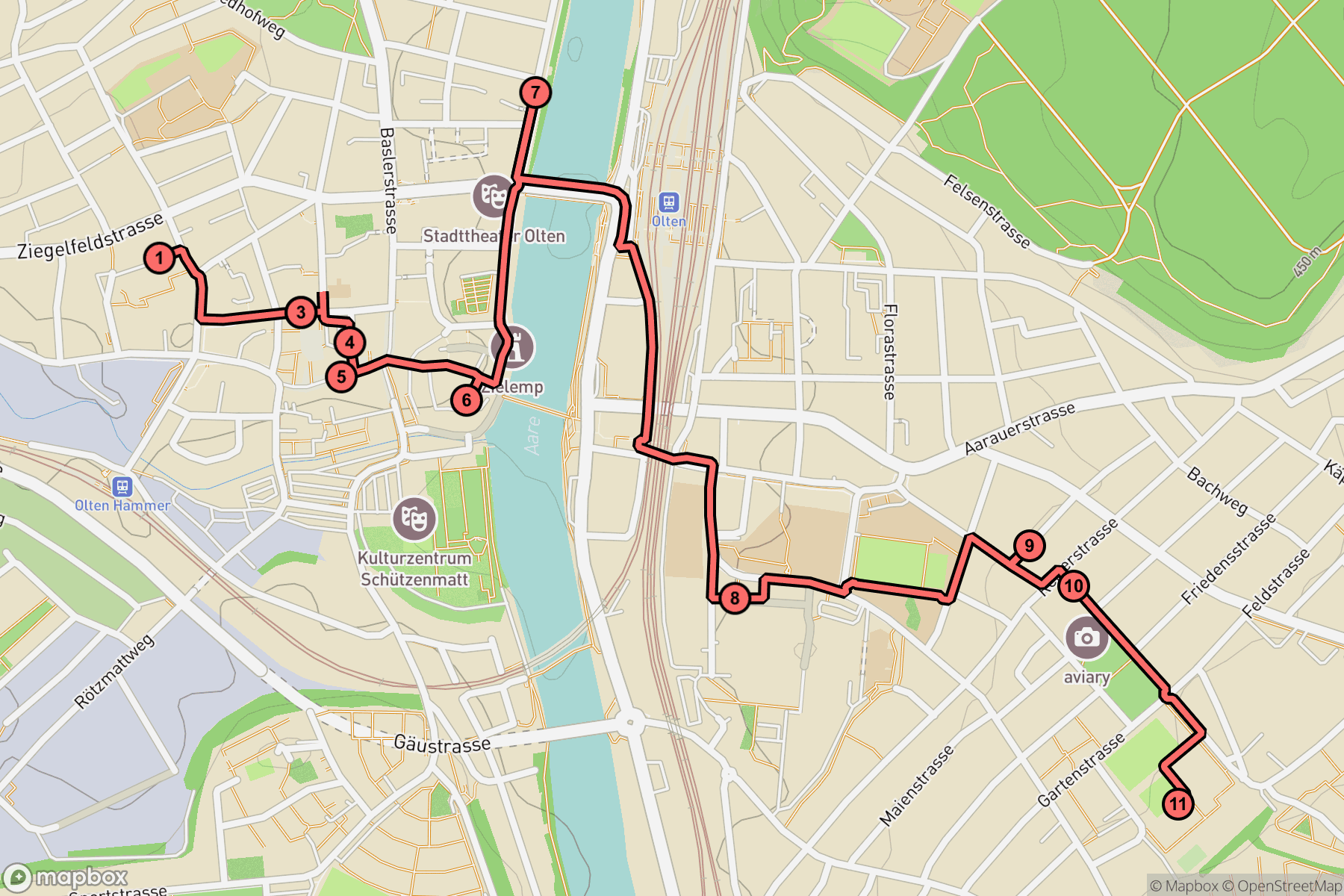
Podgląd trasy
O tej trasie
- scheduleCzas trwania 30–50 minsIdź we własnym tempie
- straighten2.7 km trasy pieszejPodążaj wyznaczoną trasą
- location_onLokalizacjaOlten, Szwajcaria
- wifi_offDziała offlinePobierz raz, korzystaj gdziekolwiek
- all_inclusiveDożywotni dostępOdtwarzaj ponownie w dowolnym momencie
- location_onStart przy Alternatywny Bank Szwajcarii
Przystanki na tej trasie
Now, here’s where it gets mysterious - and maybe a bit bold: the bank is so transparent that it publishes the names of everyone it gives loans to, and exactly why. It’s as if they…Czytaj więcejPokaż mniej
Now, here’s where it gets mysterious - and maybe a bit bold: the bank is so transparent that it publishes the names of everyone it gives loans to, and exactly why. It’s as if they put the town’s secrets right into the daylight! I always say, this bank probably knows more about your neighborhood’s solar panels than your nosy neighbor does. Inside, you’ll find a place where democracy is alive and well. Every employee has a say, and there’s a strong push for equality: no gender can take more than 60% of seats on their board. Sound fair? I think so! They even won the Prix Egalité for this spirit of openness and equality in 2005. By 2021, more than 43,000 customers and over 8,000 shareholders supported this place. If you listen closely, you might almost hear the soft chatter of people discussing how their money can do good in the world. So, here you are, standing at the heart of a revolution - a bank built on values, not vaults. No need to rob one for excitement; just ask the folks inside about their latest eco-projects! Ready to head to the past? Let’s walk to our next stop: the Olten Historical Museum.
Otwórz dedykowaną stronę →To spot St. Martin’s Church, look for a grand white building with tall, classically styled walls and two slightly slender towers topped by greenish domes, peeking above the…Czytaj więcejPokaż mniej
To spot St. Martin’s Church, look for a grand white building with tall, classically styled walls and two slightly slender towers topped by greenish domes, peeking above the treetops right in front of you. Welcome to the storied St. Martin’s Church-where Oltner history echoes through every stone, and, if you listen carefully, you might even hear a bell or two chiming in the background. Try to picture this square more than 200 years ago, when the church you see now was nothing but an architect's dream and an empty patch of ground once occupied by the Heilig-Kreuz Chapel. That chapel had to say goodbye in 1806 because it just wasn’t big enough for the growing town-a little sibling pushed aside by the promise of something grander. Blasius Balteschwiler, the church’s architect, started work in a confident classical style-think dramatic pillars, elegant lines, and all the pride of the early 1800s. The old St. Martin’s was torn down, except for one stubborn neighbor: the City Tower, which still stands nearby, almost like it’s keeping watch over its newer sibling. This church, built between 1806 and 1813, ended up right at the very heart of Olten. But don’t let these calm walls fool you; St. Martin’s witnessed storms-political ones, that is! For years, it was the proud Roman Catholic church in town, until the Vatican Council of 1870 and the fierce Kulturkampf-the “culture struggle”-swept across Switzerland. Suddenly, Oltner Catholics divided, and St. Martin’s became the spiritual home for the Old Catholic congregation. You might imagine heated debates echoing between these walls while the townsfolk decided where-and how-they’d worship. Think the outside is full of surprises? Wait till you hear about the towers! They look like sturdy stone, but in truth they’re clever fakes-wooden frames dressed up with clever paint and metal to look just like real masonry. It’s the architectural equivalent of a well-styled wig. Legend has it, the original towers were meant to look slimmer than what actually got built, but the city’s sense of style was no match for engineering realities and, let’s be honest, a bit of trickery. Every so often, someone would suggest finishing these “temporary” towers for good, but they remain as they are-a bit of a prankster’s legacy. Step inside, and the church’s musical story begins. An 1879 Kuhn organ, proudly perched at the back, still sings nearly as it did on its very first day. When it was new, the golden letters on the organ pipes proclaimed GLORIA IN EXCELSIS DFO-a typo that lasted a whole century. Talk about a keyboard slip! Only with the latest renovations did “DFO” finally become “DEO.” In the choir loft, you’ll now find another treasure-a hand-crafted Italian organ, made with care in 2002 to sound just like an instrument from the 1700s. And what would a city church be without its bells? Listen now: from the left tower, a set of four bells-one ancient, three relatively new-call out to the faithful and let the whole town know the time. The biggest weighs a full 1,000 kilograms. The bells even have a clever tuning: “f1” was chosen as the ideal sound to echo across Olten. After millions of francs and a sweeping renovation that ended in 2018, St. Martin’s shines once again as the home of the city’s Christian Catholic parish. Every stone has a story, and every echo, joke, and even typo inside these walls is part of a tapestry two centuries in the making. So while you’re here, listen close-you never know what secrets St. Martin’s might whisper if you give it a chance. If you're curious about the towers, organs or the bells, the chat section below is the perfect place to seek clarification.
Otwórz dedykowaną stronę →Look for a tall, modern concrete tower with rows of balconies and a flag waving on top-it stands proudly above the other buildings right in front of you. Now, take a moment to…Czytaj więcejPokaż mniej
Look for a tall, modern concrete tower with rows of balconies and a flag waving on top-it stands proudly above the other buildings right in front of you. Now, take a moment to imagine Olten in the post-war years. The city was buzzing with energy; people were dreaming big, ready to build a brighter future after the gray days of World War II. But there was a little hiccup-the old city hall, near the railway bridge, was bursting at the seams! So, in true Swiss fashion, Olten rolled up its sleeves and said, “Let’s build something new, and let’s make it big!” And that's how, right here on the site of an old, sleepy farmhouse, the Stadthaus was born between 1963 and 1966. Picture the area then-mud on everyone's shoes, mountains of blueprints, and architects with more pencils behind their ears than hair on their heads. They held an architecture competition (of course!), and while the famous Haller brothers won, it was the creative trio of Frey, Egger, and Peterhans who got the job. And what an ambitious job it was! With inspiration soaring all the way from France, the tall concrete pillars and unique rooftop of the Stadthaus were modeled after Le Corbusier’s mighty Unité d’Habitation in Marseille. Talk about architectural envy! But the Stadthaus isn’t just a pretty concrete face. Step inside (if only in your imagination), and you'd find more than desks and paperwork: there’s a police station, exhibition spaces, and even artwork by names like Heinz Schwarz and Matias Spescha brightening the ground floor. The building itself is a symbol of democracy-the high-rise for the city’s movers and shakers, a separate hall for council debates, and wide, open reception areas that welcome everybody. Beneath the grand exterior, there’s even a secret garage connected underground-a perfect hideout if you’re ever late for a city meeting! So next time you stare up at this architectural giant, remember-Olten didn’t just build an office; it built a symbol of progress, optimism, and a splash of “Swiss can-do” attitude, all right here under the Jura sun.
Otwórz dedykowaną stronę →
Pokaż jeszcze 7 przystankówPokaż mniej przystankówexpand_moreexpand_less
If the museum’s walls could talk, they’d probably boast about their move in 1932. That’s when the collection needed more room, so it packed up and marched over-carefully, I…Czytaj więcejPokaż mniej
If the museum’s walls could talk, they’d probably boast about their move in 1932. That’s when the collection needed more room, so it packed up and marched over-carefully, I hope-to its new home at Konradstrasse. Imagine the rattle and clink of crates being unloaded here. This clever building didn’t just house the museum. It was also a fire station, a school, and even home to some city offices. You could say this place was Olten’s own version of a Swiss Army knife: handy, versatile, and always ready in an emergency. But as time skipped by, the museum’s collections grew and grew-like a snowball rolling down the Alps collecting bits of Olten’s past. Suddenly, there were so many treasures, from family keepsakes to dusty company tools, that the museum had to stash them in different spots around town. Some of these objects arrived straight from private homes, others from local businesses and even from archaeological digs. Picture Olten’s archaeologists, brushes in hand, crouched above the old ruins of Frohburg Castle, carefully uncovering coins and curiosities that had been waiting underground for centuries. Sometimes history really is buried treasure. By the 1980s, the museum decided it was time to really shine, so under the steady hands of Hans Brunner and Hugo Schneider, they created modern exhibitions that were so impressive, they actually won awards. I like to think this was Olten’s way of saying, “See? You don’t have to go to Zurich for a cool museum.” Let’s talk about what’s inside. The museum’s collection is a patchwork quilt of Olten’s social, economic, and cultural history. There are family heirlooms, everyday tools, company memorabilia, and even personal trinkets from the ingenious railway engineer Niklaus Riggenbach. He once supervised the Central Swiss Railway workshops right here in Olten, which means every time a train clatters by in the distance, a little part of Riggenbach’s legacy chugs along, too. Olten isn’t just any town. Its railroad and industries transformed it into a regional powerhouse, and the museum displays treasures from companies like Usego, Berna, Sunlight soap factory (founded by English folks who loved clean laundry), and the mighty Portland Cement Works. If walls had noses, this place would sometimes reek of soap and industry! But what’s a story without a few sparkling details? The museum boasts an amazing trove of historical jewelry-imagine the glitter of old brooches and rings-alongside ceramics from Solothurn and beyond, antique lighting devices, and a coin collection that would make any pirate swoon with envy. And don’t blink, or you’ll miss the photo collections bursting from the archives, capturing faces, factory floors, and city streets from Olten’s past. Thanks to camera-wielding pros like Emil Werner and Fritz Stüssi, every wrinkle, top hat, and smokestack is preserved. Every year, the museum hosts lively exhibitions on everything from pioneering pilots to the golden age of Olten’s railways. And if you fancy yourself a budding detective, their educational courses-especially on photography-might just make you the next Sherlock, with a camera instead of a magnifying glass. So, as you look at the building in front of you, remember: it’s not just a museum. It’s Olten’s attic, memory box, and time machine, all rolled into one-and it’s always ready for another story. Ready for the next stop, or do you want to peek inside and see which piece of Olten’s past calls to you the loudest?
Otwórz dedykowaną stronę →Look for a long, elegant building with rows of blue-green shutters and a line of round, colorful artworks above stone arches-the words “KUNSTMUSEUM” are written above the glass…Czytaj więcejPokaż mniej
Look for a long, elegant building with rows of blue-green shutters and a line of round, colorful artworks above stone arches-the words “KUNSTMUSEUM” are written above the glass entrance, right by the street corner signs for “Egalité,” “Liberté,” and “Fraternité.” Now, as you stand in front of the Olten Art Museum, let me take you back to its beginning in 1902. Imagine the quiet excitement when the doors first opened, the air thick with the scent of old paint, varnish, and curiosity. Back then, people called this place the “Disteli Museum,” named after the sharp-eyed political cartoonist Martin Disteli, whose sketches could make politicians and townsfolk alike laugh or squirm-or both! His collection was the spark that started it all, and as the years rolled on, paintings and drawings from the 1800s began to surround Disteli’s witty works, bringing a whole conversation in color and line to these halls. By the time modern art joined the family, the museum felt more like a lively dinner party than a quiet gallery. Downstairs and on the first floor, the exhibits are always on the move, swapping places like guests changing seats, while higher up, the old masters and bold experimenters stand guard, keeping watch over the city’s creative spirit. So take a look around-who knows, maybe some of that artistic mischief still lingers in the air, just waiting for a curious visitor like you!
Otwórz dedykowaną stronę →To find the City Tower, just look for a tall, square, stone and white tower with big clock faces near the top and a shiny greenish dome capped with a cross-it's the majestic…Czytaj więcejPokaż mniej
To find the City Tower, just look for a tall, square, stone and white tower with big clock faces near the top and a shiny greenish dome capped with a cross-it's the majestic structure rising above the old town square right before you. Welcome to the City Tower of Olten, standing tall and proud like an old guard who just refuses to retire-no matter how often the architects, clockmakers, or even fate itself have tried to put him out of work! This impressive fellow is sometimes known as the Ildefons Tower, thanks to the square here being named after Ildefons von Arx. But if you ask him, City Tower is just fine-he’s been answering to that for much longer. Now, roll back the clock to the year 1521. Olten was still licking its wounds from a devastating fire in 1422. Imagine the town, a smoky patchwork of stone, timber, and resilience. Suddenly, rising over the rooftops, there’s the brand-new bell tower by master builder Konrad Gibelin from Solothurn. It was majestic then, ringing loud and true in front of the rebuilt St. Martin’s Church, which had only just risen from its own ashes. The tower didn’t always look exactly as it does now-he’s had more makeovers than a reality TV star! Between 1628 and 1676, the top was raised and dressed up in baroque style, giving the tower its elegant, onion-dome crown. At 42 meters tall, it can see right over Olten’s medieval core. “Tallest in town,” it probably boasts each morning! But don’t get too attached to St. Martin’s Church next door, because after years of standing side by side, the church became too rickety for comfort. In 1844-after almost 400 years-the church was demolished, leaving the tower alone. Did the tower miss its companion? Maybe a little bit, but it decided to reinvent itself and stick around as the city’s trusty timekeeper and bell-ringer. A survivor, this tower has endured fires, renovations in 1928, 1975, and 2006, and countless winter storms. Speaking of bells, the City Tower hides a noisy secret: inside, five magnificent bells perch, waiting for their cue. The four largest can sing in perfect harmony: G, C, E, and B. Their chimes are not just for show-centuries ago, they were a lifeline, warning townsfolk of fires or signaling the time to put your bread in the oven. The oldest bell dates back to 1446 and, rumor has it, includes relics from even more ancient bells-think of it as Olten’s own musical time capsule. One bell’s tale is particularly dramatic. The giant bell of 1560 cracked so badly in 1927 that even attempts to weld it together in the SBB workshops failed-imagine the sparks and worried faces as the metal split even further. A replacement was cast using its predecessor’s metal, carrying new decorations and a noble message: “Let the bell’s sound call the citizens of this city to work and togetherness.” If only every alarm clock was so inspirational! But the City Tower isn’t just history-it’s very much alive. Every year, concerts echo from its ancient stones, and the famous Olten carnival (Fasnacht) kicks off right here. So, while you stand before this tower, listen closely: you just might hear echoes of bells, laughter, and centuries of stories-plus maybe one or two tower jokes, if you stay long enough!
Otwórz dedykowaną stronę →This place isn’t just about classrooms and text books. Login is where Switzerland’s trains, stations, and mobility magic really begin. If you’ve ever wondered who keeps the trains…Czytaj więcejPokaż mniej
This place isn’t just about classrooms and text books. Login is where Switzerland’s trains, stations, and mobility magic really begin. If you’ve ever wondered who keeps the trains running on time or who makes a busy train station tick, the answer is often right here. Founded in 2001 as a small association and later turning into a big-league joint-stock company in 2014, Login has become the training ground for young, bright minds from the Swiss railways-SBB, BLS, Rhätische Bahn-and almost 70 other companies, even folks from aviation, like Swissport and Edelweiss. Each year, Login finds and supports about 900 new apprenticeships for dreamers and doers. The learning journey can be a real adventure-imagine spending six months working at a busy train station, then rolling up your sleeves in a technical workshop, then taking on logistics or IT somewhere new. There are even 13 “Junior Stations” run by the apprentices themselves, where they call the shots from selling tickets to figuring out lost luggage. Now, that’s a crash course in responsibility! Login’s passion for teaching is no joke-its trove of awards, including the National Education Prize and a string of “Great Start!” workplace medals, proves it. With so many paths-technical, administrative, hands-on crafts-the only thing missing is perhaps a course in “How to Be a Human Train Whistle.” If only I could whistle, right? So the next time you catch a Swiss train or pass through a gleaming station, give a little mental nod to the folks at Login. They train the people who keep Switzerland moving. And hey, who knows? With all these possibilities, maybe you’ll decide to join them yourself.
Otwórz dedykowaną stronę →To spot St. Marien (Olten), just look straight ahead for a modern, pale church with a tall, narrow bell tower standing slightly apart from the main building, topped with a cross…Czytaj więcejPokaż mniej
To spot St. Marien (Olten), just look straight ahead for a modern, pale church with a tall, narrow bell tower standing slightly apart from the main building, topped with a cross and big vertical windows facing the street. Standing here, imagine it’s the early 1950s and the city’s population is bustling, the sounds of hammers and saws carrying through the newly growing Bifang-Quarter of Olten. The Roman Catholic parish has a grand vision-a church so striking and fresh that it would stand out as a local landmark. From 1952 to 1953, under the clever hand of Basel architect Hermann Baur, St. Marien rises, not as some ancient stone relic but as a crisp, contemporary building with clean lines and brilliant windows, unlike anything this part of Switzerland had seen before. Approaching the entrance, you’ll notice the stairs that twist up to the door. And pause a moment-there’s a statue of the Virgin Mary, carved by local sculptor Paul Speck, greeting every visitor with calm serenity. If you wander toward the tall, detached bell tower-a “campanile” as the Italians would call it-you’ll see it houses four mighty bells. These bells are no lightweight! The largest, the Marienglocke, weighs in at 2,085 kilograms-basically, you’d need an entire rugby team to move it. The bells have their own personalities, each with a special inscription and each donated by locals hoping to leave their mark. When these enormous bells chime, they don’t just announce the hour-they sing out a melody known as the Gloriamotif, filling the neighborhood with sound. Inside, it’s all about light, clarity, and simplicity. No stuffy darkness or lavish gold-just open space and carefully chosen lines. The altar at the center, sculpted by Albert Schilling, is like a bright heart to the room, and if you peek left, you’ll spot the Marienkapelle, set to the side so nothing blocks your view of the main altar. Behind you, above the entrance, rises the choir loft, with a 1956 Kuhn organ sitting on both sides of a grand window. You may not see it from here, but imagine the tremble in your bones when that organ plays, the air shimmering with music. There’s even a smaller chest organ in the choir area, built for delicate, heartfelt performances. Here comes the really juicy bit-decoration wasn’t without its drama. The renowned artist Ferdinand Gehr was chosen to create the mural and stained-glass windows. His style was bold, abstract, and way ahead of his time. When the mural over the altar first appeared, it caused a proper stir! Some folks in German-speaking Switzerland thought it was so modern that they were ready to hide it behind a curtain-just as had been done earlier in Wettingen, where even the bishop refused to bless the church until Gehr’s shocking painting was covered up. Imagine the tension in the air, people coming from all over, outraged or fascinated, while others just came to see what on earth had caused so much fuss. Today, Gehr’s work is a celebrated treasure, and visitors flock here not just for worship, but for a glimpse at one of Olten’s rare public art wonders. Outside again, glance at that tower-it’s said to be the “twin” of Baur’s earlier project, the Allerheiligenkirche in Basel, both proudly showing off their modern concrete and signature windows. And those bells you hear? They’ve even had their clappers swapped out in recent years, to preserve both tone and bell-so next time they ring, know that you’re hearing notes carefully preserved through decades. So, all in all, St. Marien isn’t just a church-it’s a survivor of architectural debate, a beacon of modern art, and the home of some very weighty, melodious bells! Would you have sided with the conservatives, or cheered on those colorful new windows? Either way, this church’s story is anything but ordinary.
Otwórz dedykowaną stronę →Standing on Reiserstrasse, look straight ahead for a large, pale building with a broad front and a tall, square clock tower topped with a star, rising high above everything else -…Czytaj więcejPokaż mniej
Standing on Reiserstrasse, look straight ahead for a large, pale building with a broad front and a tall, square clock tower topped with a star, rising high above everything else - that’s the Church of Peace (Friedenskirche)! Alright, get ready for a story with a bit of everything: bold architects, rumbling organs, mysterious bullet holes, and bells that don’t just ring-they sing! Picture yourself here in the late 1920s. The city needed a new church to replace the smaller, older one on Sälistrasse-a building that had seen its fair share of stories, standing across from the home of the legendary railway pioneer, Niklaus Riggenbach. Riggenbach, by the way, was so passionate about supporting the Reformed community that I suspect even his trains might have paused for Sunday service if he’d had his way! Instead of steam engines today, though, you’ve got a structure built in 1928 and 1929 by Fritz von Niederhäusern, a man who left fingerprints all over Olten’s architectural history. Just imagine him, blueprint in hand, shaping not just this church, but also famous places like the city’s historical museum and the Schweizerhof Hotel. Today, the Friedenskirche is the largest Reformed church in the Olten district. On a packed Sunday, seven hundred sixty people can gather inside. The front steps lead up to those grand arches-on a sunny morning, you might even spot some locals greeting neighbors or heading in for a quiet moment of reflection. But it’s when you step through the doors (and don’t worry, you can just imagine this for now) that the air changes. High above you, nestled in a space large enough for even the tallest altarpieces to feel small, is the famous Kuhn organ, installed in 1929. Back then, this was the biggest organ in Olten! Picture a sea of gleaming pipes, and try to hear it in your mind: the deep, rolling notes washing across the pews. The organ is nearly the same as when it was first built, making it a true monument of musical history. The church even has a smaller Walcker organ tucked in its chapel, for those days when you want a bit less “thunder and lightning” in your music. Outside, you can’t miss the massive sixty-meter tower, which houses an ensemble of five bells, each cast by Rüetschi AG of Aarau. When they ring, they’re tuned to a melody popular in Swiss churches: “Wake, Awake, for Night is Flying.” But here’s a twist-after decades of chiming away, the entire bell installation was renewed in 2015. The city didn’t just replace the old parts; they improved them, adding new clappers for a softer, more harmonious tone. Imagine the echo pulsing down across the rooftops, carrying words inspired by reformers like Luther and Zwingli, engraved on each bell. At night, though, the timekeeping chimes go silent so you won’t have to worry about hourly wake-up calls! And lurking up on that tall spire is something for the mystery lovers among us-during recent restoration, workers discovered bullet holes riddling the tower. Who fired at the church, and why? No one knows! The only thing reported was a baffled congregation and some serious repair work. If you look closely at the church’s wall by the parsonage, you’ll see a fountain, a gift from Olten, with the years 1928 and 1929 carved into stone-a quiet reminder of beginnings, perseverance, and maybe a little Olten stubbornness. Some say the view from the top of the tower is worth the climb: stare out and you’ll see the whole city spread out like a patchwork quilt, stretching north to the foot of the Jura mountains. So, as you stand here, listen for echoes of the organ, the song of the bells, and the laughter that must have filled these steps over generations. The Church of Peace is more than just a building-it’s a woven tapestry of history, music, and mysteries waiting for their next chapter. And hey, keep an ear out-those bells might be ringing just for you!
Otwórz dedykowaną stronę →Right in front of you, you’ll spot the Sälischulhaus by its striking long, modern structure, with big glass doors and a grid of metal slats across its whole front-just look for…Czytaj więcejPokaż mniej
Right in front of you, you’ll spot the Sälischulhaus by its striking long, modern structure, with big glass doors and a grid of metal slats across its whole front-just look for the large, sleek building catching the sunlight with its shiny, grid-like façade. Now, imagine the 1960s in Olten: neighborhoods are popping up, kids are spilling out of new houses, and suddenly the old schools are bursting at the seams! The city had to act fast, and-voilà-a crack team of architects, Hans Zaugg and Alfons Barth, got to work, drawing plans with bold ideas and maybe a hint of coffee-stained blueprints. Up here on the hillside, above the Church of Peace, they created something totally different: three big buildings, one for primary, one for secondary students, and a whole extra section just for sports and swimming-yes, a school with its own pool! The whole thing is built like a mighty skeleton of concrete, steel, and glass, perfect for a city that was growing up fast. And there’s a little twist: right in the schoolyard stands a mysterious three-part granite sculpture by Paul Agustoni. Some say it holds the secrets to good grades, others just use it as a meeting spot. Now a protected landmark, the Sälischulhaus is a living memory of a time when Olten’s future looked bright and full of young voices-so who knows, maybe you’ll hear echoes of laughter and footsteps from years gone by as you stand here.
Otwórz dedykowaną stronę →
Najczęściej zadawane pytania
Jak rozpocząć trasę?
Po zakupie pobierz aplikację AudaTours i wpisz kod realizacji. Trasa będzie gotowa do natychmiastowego rozpoczęcia – po prostu dotknij \"Play\" i podążaj trasą z nawigacją GPS.
Czy potrzebuję internetu podczas trasy?
Nie! Pobierz trasę przed rozpoczęciem i korzystaj z niej w pełni offline. Jedynie funkcja czatu wymaga internetu. Zalecamy pobieranie przez WiFi, aby oszczędzać dane mobilne.
Czy to wycieczka grupowa z przewodnikiem?
Nie – to samodzielny audioprzewodnik. Zwiedzasz niezależnie, we własnym tempie, z narracją audio odtwarzaną przez telefon. Bez przewodnika, bez grupy, bez harmonogramu.
Ile trwa trasa?
Większość tras zajmuje 60–90 minut, ale to Ty kontrolujesz tempo. Wstrzymuj, pomijaj przystanki lub rób przerwy, kiedy chcesz.
Co jeśli nie zdążę ukończyć trasy dzisiaj?
Żaden problem! Trasy mają dożywotni dostęp. Wstrzymaj i wznów, kiedy chcesz – jutro, za tydzień lub za rok. Twój postęp jest zapisywany.
W jakich językach są dostępne trasy?
Wszystkie trasy są dostępne w ponad 50 językach. Wybierz preferowany język podczas realizacji kodu. Uwaga: języka nie można zmienić po wygenerowaniu trasy.
Gdzie znajdę trasę po zakupie?
Pobierz darmową aplikację AudaTours z App Store lub Google Play. Wpisz kod realizacji (wysłany e-mailem), a trasa pojawi się w Twojej bibliotece, gotowa do pobrania i rozpoczęcia.
Jeśli trasa Ci się nie spodoba, zwrócimy Ci pieniądze. Skontaktuj się z nami pod adresem [email protected]
Bezpieczna płatność przez 


