Wycieczka audio po Sztokholmie: Banki, bandyci i barokowe piękno
Pod lśniącymi ulicami Sztokholmu kryją się cienie zakazanych pojedynków, zaginionego złota i gwałtownych powstań. To miasto to nie tylko widokówka, ale labirynt sekretów czekających na odkrycie. Wyrusz na wycieczkę audio z przewodnikiem i zajrzyj za fasady Kungsträdgården, kościoła św. Jakuba, Sveriges Riksbank i nie tylko. Każdy zakątek, który odkryjesz, odsłania historie, których większość podróżnych nigdy nie usłyszy. Kto zorganizował bunt w miejscu, gdzie dziś panuje spokój? Mury której katedry niosły echa ukrytego skandalu? I dlaczego najstarsze monety Sztokholmu wciąż nawiedzają korytarze finansowego serca Szwecji? Podążaj śladami hazardzistów, banitów i dawno zapomnianych wizjonerów. Odkryj ukryte ogrody, w których rodziły się spiski, i śledź tropy skandali w marmurowych salach. Każdy zakręt wyostrza zmysły i zmienia sposób, w jaki postrzegasz Sztokholm. Naciśnij „odtwórz” i odblokuj sekrety wirujące tuż pod wspaniałą powierzchnią miasta. Prawdziwy Sztokholm czeka na Ciebie.
Podgląd trasy
O tej trasie
- scheduleCzas trwania 40–60 minsIdź we własnym tempie
- straighten2.1 km trasy pieszejPodążaj wyznaczoną trasą
- location_on
- wifi_offDziała offlinePobierz raz, korzystaj gdziekolwiek
- all_inclusiveDożywotni dostępOdtwarzaj ponownie w dowolnym momencie
- location_onStart przy Sveriges Riksbank
Przystanki na tej trasie
Look right in front of you at that massive, cubic fortress clad in rough-hewn black granite, defined by a strict, repeating grid of deep-set square windows and a slender antenna…Czytaj więcejPokaż mniej
Otwórz dedykowaną stronę →
Sveriges RiksbankPhoto: Arild Vågen, Wikimedia Commons, CC BY-SA 4.0. Cropped & resized. Look right in front of you at that massive, cubic fortress clad in rough-hewn black granite, defined by a strict, repeating grid of deep-set square windows and a slender antenna mast extending from its flat roofline.
This is Sveriges Riksbank, completed in 1976 by architect Peter Celsing. It is a striking example of brutalist architecture. Brutalism is a mid-twentieth-century style known for heavy, imposing geometric forms and raw, exposed materials, meant to project absolute, unshakeable stability. And stability is exactly what you want here, because this dark monolith is the central bank of Sweden. Established in 1668, it is the world's oldest surviving central bank.
To see how the bank expanded its footprint over the centuries, just glance at your screen for a photo of one of their regional branch offices from nineteen hundred.

This Riksbank branch building in Halmstad illustrates the bank's 19th-century expansion when it opened subsidiary branches in each Swedish county.Photo: Unknown authorUnknown author, Wikimedia Commons, Public domain. Cropped & resized. The story of this institution actually begins with a colossal disaster. In the seventeenth century, Swedish currency consisted of heavy copper plates. Some of these plates weighed nearly twenty kilograms. You literally needed a sled or cart just to go shopping! To solve this, a colorful businessman named Johan Palmstruch introduced Europe's first true paper banknotes in 1661. People deposited their heavy copper in his bank and carried lightweight paper receipts instead.
But Palmstruch got greedy. He secretly printed far more paper money than he had copper to back it. When citizens realized the vault was short on metal, they panicked and rushed the bank. The institution collapsed spectacularly. Palmstruch was stripped of his titles and sentenced to death. Though he was eventually pardoned and released from prison, he died in absolute poverty. The Swedish parliament created the Riksbank from the ashes of that disaster, strictly designing it under their direct control to never let a single individual wield that much reckless power again.
Yet, paper money remained a necessity, which led to another problem: counterfeiting. By the 1750s, the Riksbank desperately needed highly secure banknote paper. The Dutch held the closely guarded secret to making it, so the Riksbank resorted to international industrial espionage. They recruited two Dutch papermakers, the Mülder brothers, to steal the technology. The plot went horribly wrong for Jan Mülder, who was arrested by authorities and died in a Dutch prison. However, his brother Erasmus was successfully smuggled out to Sweden, where he set up a top-secret paper mill that kept the bank's methods locked away from the world.
Fast forward to the modern era, and the Riksbank is still pushing boundaries. They are actively exploring a digital currency called the e-krona. This modern push toward a cashless society was actually accelerated by a wave of violent robberies. The most infamous was a 2009 heist where thieves dramatically landed a stolen helicopter right on the roof of a cash distribution depot and made off with millions.
If you happen to need their services, the bank is open Monday through Friday from eight to five, but closed on weekends.
It is amazing to think that this severe stone fortress holds over three and a half centuries of wild financial triumphs, spectacular failures, and pure ingenuity. Take a moment to soak this in, and when you are ready, we can head over to our next stop.
Look to your left for the wide-open square anchored by a massive flat-roofed red brick building featuring a strict repeating grid of rectangular windows. If you could travel…Czytaj więcejPokaż mniej
Otwórz dedykowaną stronę →
BrunkebergstorgPhoto: Unknown author, Wikimedia Commons, Public domain. Cropped & resized. Look to your left for the wide-open square anchored by a massive flat-roofed red brick building featuring a strict repeating grid of rectangular windows.
If you could travel back in time a few hundred years, you would not be standing on solid ground right now. You would be buried inside a hill, because the original ground level here used to be nineteen meters higher. That is over sixty feet straight up in the air. This area was once dominated by a massive esker, which is a giant ridge of gravel and sand left behind by ancient glaciers. It was so huge it literally split this part of Stockholm in two. They even built a watchtower on top of it to look out for fires. But an enormous hill blocking the center of a growing city was not exactly convenient. So, in a massive feat of engineering, Stockholm simply started digging. Over centuries, they carved away the ridge, leveling the earth until they laid out this triangular square in eighteen oh three.
Once the dust settled, this became the absolute peak of high society. Throughout the eighteen hundreds, Brunkebergstorg was lined with luxurious hotels and elegant stone houses designed by the country's top architects. One spectacular building built by a silk merchant even featured Stockholm's very first indoor water line and a glittering, Parisian-style glass-covered shopping arcade where the elite would stroll.
But cities are living, breathing things, and they are always shifting. By the turn of the twentieth century, the artistic and social crowds moved out, and the financial titans moved in. Insurance companies built towering office palaces, soon followed by the banks. Then came the nineteen sixties, bringing a massive urban renewal project that completely wiped the slate clean. The city brought out the wrecking balls and demolished almost all of that nineteenth-century elegance.
They held a grand architectural competition to redesign the space, won by Peter Celsing. His vision gave us the monumental building dominating the square today, the new headquarters for the Riksbank. Since we were just exploring the central bank, you can see how its heavy, blocky, brutalist architecture set a completely new tone for the entire neighborhood.
Out of all those grand palaces from the eighteen hundreds, only a single one survived the wrecking balls. Look around for a red brick building built in eighteen ninety eight called Nordstiernan, the sole survivor of the old square. Recently, the city totally reimagined the space again, laying down elegant stone paving that won a major architectural award in twenty seventeen. It is a true testament to a city constantly reinventing itself. Whenever you are ready, let's keep moving.
Look to your left at the narrow, sloping cobblestone path bordered by tall, flat-fronted masonry buildings lined with tight rows of rectangular windows. You are looking at a…Czytaj więcejPokaż mniej
Otwórz dedykowaną stronę →
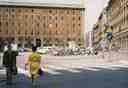
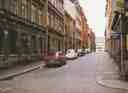
Norra SmedjegatanPhoto: Gunnar Hillbo, Wikimedia Commons, Public domain. Cropped & resized. Look to your left at the narrow, sloping cobblestone path bordered by tall, flat-fronted masonry buildings lined with tight rows of rectangular windows. You are looking at a ghost... because this is the exact location of Norra Smedjegatan, famously known as the street that disappeared.
It is incredibly rare for an entire street to be wiped completely off a city map, but that is exactly what happened here. Norra Smedjegatan existed in some form since the 1640s, originally taking its name from the heavy iron blacksmiths that operated in the area. Over the centuries, its character shifted dramatically. By the 1800s, it was a notoriously shadowy thoroughfare. It was actually a well-known red-light district where prostitution was officially tolerated by the authorities. It was a narrow, remote-feeling strip packed with small craft shops, gloomy hotels, and residential buildings. The famous Swedish writer August Strindberg even wrote about the dark and lonely Catholic Eugenia Chapel that sat right along this stretch.
So how does a centuries-old street just vanish? In 1967, Stockholm was deep into a massive urban redevelopment project known as the Norrmalm regulation. The goal was to modernize the city center, but the execution was incredibly destructive. Wrecking balls swung through Norra Smedjegatan, obliterating 45 historic properties in one fell swoop, including architectural treasures like the Felix Sachs house.
The original plan was to build a colossal, 15-story mega-hotel right here, backed by an American hotel chain. They called the project Storviggen. But right in the middle of this sweeping demolition, the Americans backed out. The city was suddenly left holding a massive, empty crater of dirt and rubble with absolutely no plan. It was a complete disaster. The public was furious, and the empty pit became a glaring symbol of a badly mismanaged city makeover.
Desperate for a solution, architects pivoted to an entirely different concept. Instead of a hotel, they decided to build a massive galleria, which is an enclosed, climate-controlled indoor shopping center. The Gallerian opened its doors in 1976, effectively swallowing the old street whole. If you walk down the main indoor corridor of the mall today, you are actually walking the exact historic path of Norra Smedjegatan.
In 2009, politicians even tried to officially rename the mall's main aisle to Norra Smedjegatan to honor its vanished past, but the motion was unfortunately denied. If you want to explore the shops that sit on top of this lost street, the mall is generally open from 10:00 AM to 8:00 PM most days, closing slightly earlier on weekends. The original cobblestones and dark hotels may be gone, but the footprint of the forgotten street is still hiding right under your feet. Take a breath here before we move on to our next site.
Pokaż jeszcze 10 przystankówPokaż mniej przystankówexpand_moreexpand_less
Look for the grand rectangular palace featuring a rust-red ground level, pale yellow upper floors divided by tall white Corinthian columns topped with carved leaves, and an ornate…Czytaj więcejPokaż mniej
Otwórz dedykowaną stronę →
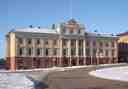
The Hereditary Prince's PalacePhoto: Holger.Ellgaard, Wikimedia Commons, CC BY-SA 3.0. Cropped & resized. Look for the grand rectangular palace featuring a rust-red ground level, pale yellow upper floors divided by tall white Corinthian columns topped with carved leaves, and an ornate sculpted coat of arms crowning the roof. This is The Hereditary Prince's Palace. What you are looking at is a masterclass in architectural recycling.
Back in 1783, Princess Sofia Albertina, the sister of King Gustav III, bought the property that stood right here. At the time, it was the Torstenson Palace, a seventeenth century building that had survived a massive fire and years of neglect. But the Princess did not just tear it down. Instead, architects Erik Palmstedt and Louis Masreliez incorporated the old palace into a massive new complex. If you walk around the side later, you can still see the original 1650s structure hidden in plain sight as one of the wings.
The king actually ordered this new palace to perfectly mirror the Royal Opera House on the other side of the square. They wanted absolute symmetry. The design is spectacular. Take a look all the way up to the roofline. That decorative top section resting above the columns is called an attica, and it is guarded by two Gotland limestone lions flanking the royal coat of arms, sculpted by the famous artist Tobias Sergel.
Inside, the palace is just as breathtaking. Take a look at your screen to see the Red Salon, originally the Princess's audience room where she received guests from a throne. You can still see the royal crowns and the Swedish coat of arms carved into the walls by Jean Baptiste Masreliez. Today, this opulent space serves as a waiting room for the Foreign Minister.

The historic Red Salon, once Princess Sofia Albertina's reception room, now serves as a waiting room for the Foreign Minister.Photo: Burnäs, Tore., Wikimedia Commons, Public domain. Cropped & resized. When Princess Sofia Albertina died in 1829, she left the palace as a fideikommiss, a strict legal arrangement meaning the property could only be passed down intact to the Hereditary Prince, the royal next in line after the Crown Prince. Several royals lived here over the decades. But in 1902, the Swedish state bought the whole property for 2.25 million kronor, which is roughly 150 million kronor today. By 1906, the Ministry for Foreign Affairs moved in, and they have been here ever since. While the elegant neoclassical facade of the palace has been impeccably preserved over 130 years, the surrounding square has evolved to match its modern role as the seat of Swedish diplomacy. Check out the before and after image on your app to see the transformation.
It is amazing to think that inside these walls, beneath the reconstructed silk curtains and next to antique writing desks originally gifted by Marie Antoinette, the modern geopolitical strategies of Sweden are actively being shaped.
Let's continue on when you are ready.

A panoramic view of The Hereditary Prince's Palace on Gustav Adolfs Torg, currently serving as the Ministry of Foreign Affairs.Photo: ArildV, Wikimedia Commons, CC BY-SA 4.0. Cropped & resized. 
The grand main entrance of the palace on Gustav Adolfs Torg 1, the primary public access point.Photo: Holger.Ellgaard, Wikimedia Commons, CC BY-SA 4.0. Cropped & resized. 
The facade along Fredsgatan, showcasing the original part of the 1651 Torstenson Palace, which later became a wing of the larger Hereditary Prince's Palace.Photo: Holger.Ellgaard, Wikimedia Commons, CC BY-SA 4.0. Cropped & resized. 
A detail of the original 1647 sandstone portal by Didrik Blume, featuring the coats of arms of Lennart Torstenson and Beata de la Gardie.Photo: Holger.Ellgaard, Wikimedia Commons, CC BY-SA 4.0. Cropped & resized. 
The southern facade of the palace facing Norrström, which forms part of the large new complex designed for Princess Sofia Albertina.Photo: Holger.Ellgaard, Wikimedia Commons, CC BY-SA 4.0. Cropped & resized. 
A view of the palace's southern facade facing Norrström, highlighting the wing added during Princess Sofia Albertina's expansion.Photo: Arild Vågen, Wikimedia Commons, CC BY-SA 3.0. Cropped & resized. 
A detail of the palace's attica, crowned by Tobias Sergel's sculpture of two lions guarding the national coat of arms.Photo: Holger.Ellgaard, Wikimedia Commons, CC BY-SA 3.0. Cropped & resized. 
The statue of King Gustav II Adolph, dedicated in 1796, stands on Gustav Adolfs Torg facing the palace.Photo: Jacob Truedson Demitz for Ristesson Ent., Wikimedia Commons, Public domain. Cropped & resized. 
An 1790 artwork by Johan Fredrik Martin, showing the palace ('Prinsessans Palais') alongside the Royal Opera House, as it was designed to be a counterpart.Photo: Johan Fredric Martin, Wikimedia Commons, Public domain. Cropped & resized. 
An architectural plan from 1780, likely showing Erik Palmstedt's design for Princess Sofia Albertina's new, larger palace.Photo: Erik Palmstedt (1741-1803), Wikimedia Commons, Public domain. Cropped & resized. 
The Cabinet Secretary's Office, originally three smaller rooms in the Torstenson Palace, now decorated with portraits of Sweden's foreign ministers.Photo: A. Malmström, Wikimedia Commons, Public domain. Cropped & resized. 
U.S. Secretary of State John Kerry meeting with the Swedish Foreign Minister inside the palace, which has been the seat of the Ministry for Foreign Affairs since 1906.Photo: U.S. Department of State, Wikimedia Commons, Public domain. Cropped & resized. Look to your left for a massive pale-orange stone building with a deeply textured stone base, tall arched windows along the front balcony, and a flat rooflined balustrade.…Czytaj więcejPokaż mniej
Otwórz dedykowaną stronę →
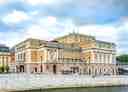
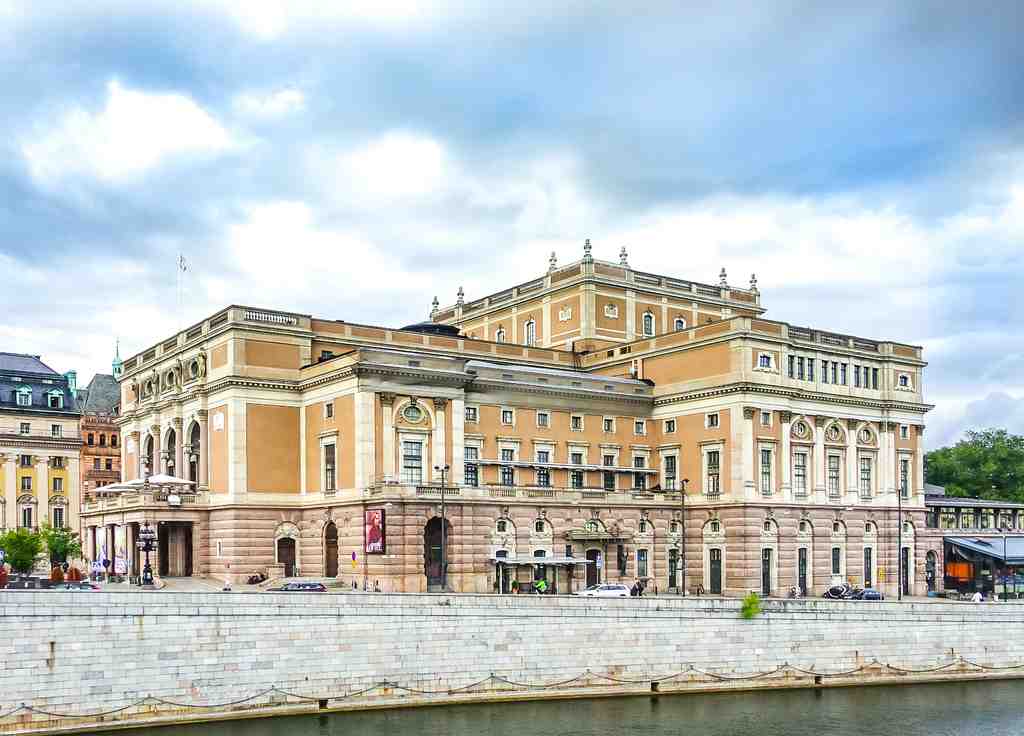
The Royal Swedish OperaPhoto: Frankie Fouganthin, Wikimedia Commons, CC BY-SA 4.0. Cropped & resized. Look to your left for a massive pale-orange stone building with a deeply textured stone base, tall arched windows along the front balcony, and a flat rooflined balustrade. Remember the Hereditary Prince's Palace we saw just a few minutes ago? That palace was built by King Gustav the Third's sister to be an exact architectural twin of the original opera house that used to stand right here on this very spot. So looking at that palace gives you a perfect idea of what this location looked like back in the late seventeen hundreds.
This current version, the Royal Swedish Opera, was inaugurated in 1898. It is designed in the Neo-Baroque style, an architectural movement focused on highly ornate, theatrical designs packed with grand European detailing meant to absolutely dazzle the eye. You can pull up your app to see a full historical view of this magnificent facade. Not everyone was dazzled back then, though. Some local critics hated it so much they called the building a stack of piled up cigar boxes.

The current Royal Swedish Opera building, known as the Oscarianska operahuset, inaugurated in 1898. Designed in Neo-Baroque style, it drew inspiration from the Paris Opera.Photo: Julian Herzog (Website), Wikimedia Commons, CC BY 4.0. Cropped & resized. But the true drama of this site goes back to that original opera house. In 1792, King Gustav the Third attended a grand masquerade ball here. During dinner, he received an anonymous letter warning him not to go down to the ballroom. The King ignored it, walking into the crowd hidden behind a mask and a Venetian silk cloak. It was a fatal mistake. An assassin shot him in the back. The King cried out that he was wounded, while the conspirators yelled that there was a fire to create chaos and escape. The doors were immediately locked, and every single guest was forced to unmask before they were allowed to leave. This shocking murder inspired Giuseppe Verdi's famous opera Un ballo in maschera, though Italian censors actually forced Verdi to change the setting to Boston because depicting the murder of a king on stage was strictly illegal at the time.
The old building was also the site of a horrific accident. In 1877, a ballet dancer named Sophia Dahl got too close to an open gas lamp on stage. Her tulle skirt caught fire, and she tragically died from her burns. People say her spirit never left. Singers practicing alone on the stage still report feeling an unexplainable cold or seeing shadows moving in the upper balconies.
But this place is also filled with pure magic. In 1838, a young girl who had completely lost her voice miraculously regained it on this stage, causing absolute hysteria. That was Jenny Lind, who became a massive global superstar known as the Swedish Nightingale. Decades later, a seventeen-year-old boy auditioned for the famously strict opera director. The director simply wrote in his notebook that the boy was remarkably good, a true phenomenon. That kid was Jussi Björling, who grew up to become one of the greatest tenors in world history. You can check your phone to see how the building completely transforms when illuminated for special events, radiating that same star power.

The Royal Swedish Opera illuminated during Culture Night 2018. The building occasionally features special facade lighting for events, reminiscent of its appearance during 'Nobel week lights'.Photo: Frankie Fouganthin, Wikimedia Commons, CC BY-SA 4.0. Cropped & resized. And the music fueling all of this? The Royal Court Orchestra playing inside is one of the oldest in the world, founded way back in 1526, long before the art of opera even existed.
It is a place where centuries of Swedish history, tragedy, and triumph are built right into the walls. Whenever you are ready to continue your walk, we can head over to our next stop.

A view of the Royal Swedish Opera from Norrbro, highlighting its prominent location in central Stockholm, nestled between Gustav Adolfs torg and Kungsträdgården.Photo: Frankie Fouganthin, Wikimedia Commons, CC BY-SA 4.0. Cropped & resized. To your right stretches Kungsträdgården, marked by a wide, rectangular stone fountain basin lined with large, dark bronze urns and flanked by formal rows of trees. Welcome to…Czytaj więcejPokaż mniej
Otwórz dedykowaną stronę →
KungsträdgårdenPhoto: en.wikipedia, Wikimedia Commons, CC BY-SA 3.0. Cropped & resized. To your right stretches Kungsträdgården, marked by a wide, rectangular stone fountain basin lined with large, dark bronze urns and flanked by formal rows of trees.
Welcome to Kungsan. That is what the locals call Kungsträdgården, or the King's Garden. But if we rewind to the year fourteen thirty, the name was far less glamorous. It was recorded in historical ledgers as konungens kålgård... the king's cabbage patch. It was a purely utilitarian plot feeding the royal kitchen. Over the next few centuries, those humble cabbages were ripped out to make way for a highly manicured, enclosed Baroque pleasure garden, characterized by dramatic, formal symmetry. You can check out the engraving on your screen to see exactly what that royal wonderland looked like in the early seventeen hundreds. It was completely walled off from the city, anchored at one end by a massive palace known as Makalös, meaning Peerless.
Eventually, the walls came down. King Charles the Fourteenth John turned a large section of the space into an open gravel square to honor his predecessor, Charles the Thirteenth, placing a towering Neoclassicist statue of him right in the middle. Neoclassicism was a grand, monumental style inspired by the art of ancient Greece and Rome. But the locals absolutely hated the barren gravel. They mocked the king's monument, calling the statue a gardener without a garden. Stockholmers have always had a sharp, cynical wit. Charles the Thirteenth's statue is flanked by four sculpted lions. Just to the south stands the statue of Charles the Twelfth, surrounded by four mortar cannons, which in Swedish slang are called pots. Naturally, the citizens started referring to the two royal monuments together as a lion among pots and a pot among lions.
In the eighteen sixties, the unpopular gravel was finally replaced by the leafy tree-lined avenues that give the park its character today. They also added a magnificent centerpiece. Pull up the image of Molin's Fountain on your app. This intricate bronze masterpiece depicts the mythological Norse ocean god Ægir, his wife Rán, and the river spirit Nix playing a harp. It acts as a clever geographic metaphor, symbolizing Stockholm itself, wedged right between the upper freshwater bowl of Lake Mälaren and the lower saltwater basin of the Baltic Sea.
But the most dramatic chapter in this park's history happened in May nineteen seventy one. The city was excavating a new metro station and planned to chop down a grove of majestic, centuries old elm trees. The public outrage was explosive. In what became known as the Battle of the Elms, citizens literally chained themselves to the trunks. The protests grew so intense that the government actually backed down. The trees were saved, the metro entrances were rerouted to the edges of the park, and the victory essentially ended an era of careless demolition in central Stockholm.
Today, it is an incredible space of civic pride and resistance, and beautifully, the paths of Kungsträdgården remain open for you to wander twenty four hours a day. Take a breath under these trees before we continue.

Kungsträdgården transforms into a popular ice rink during the winter months, offering a festive activity for Stockholmers.Photo: Pierre Goiffon, Wikimedia Commons, CC BY-SA 4.0. Cropped & resized. 
Each spring, the 63 Japanese cherry trees in the Fountain of Wolodarski section blossom, creating an experience of beauty and scent that attracts many visitors.Photo: Bd incognito, Wikimedia Commons, CC BY-SA 4.0. Cropped & resized. 
Kungsträdgården's central location and outdoor spaces make it one of Stockholm's most popular hangouts and meeting places, with activities like open-air chess.Photo: IngimarE, Wikimedia Commons, CC BY-SA 4.0. Cropped & resized. 
The park frequently hosts open-air concerts and various events, reflecting its role as a vibrant public square.Photo: FarbrorAnna, Wikimedia Commons, CC BY-SA 4.0. Cropped & resized. 
This 1810s drawing shows the Vauxhall on the site of the Makalös Palace, which was rebuilt into an opera house in 1792 before burning down in 1825.Photo: Fredrik Lidströmer, Wikimedia Commons, Public domain. Cropped & resized. Look to your right and you will spot Jacob's Church, a striking cross-shaped building made of vibrant red-plastered brick, topped by an elaborate green copper dome holding four…Czytaj więcejPokaż mniej
Otwórz dedykowaną stronę →
Jacob's ChurchPhoto: Larske, Wikimedia Commons, CC BY-SA 3.0. Cropped & resized. Look to your right and you will spot Jacob's Church, a striking cross-shaped building made of vibrant red-plastered brick, topped by an elaborate green copper dome holding four clock faces.
This building is an absolute survivor. The history of this spot actually stretches way back to the early 1300s, when a small chapel stood here on the outskirts of town. But the magnificent church you are looking at today? Its story kicked off in 1580 under the orders of King Johan the Third.
You would think a royal project would move fast, right? Well, it stalled for decades. The construction dragged on for over 60 years, caught in a loop of delays, until it was finally inaugurated on the first Sunday of Advent in 1643, with Queen Christina herself in attendance.
Because it took so long to build, the architecture is this fascinating collision of late Gothic, Renaissance, and Baroque styles. The stunning red exterior you see today is actually a throwback. In the late 1960s, they restored the plaster to match its original 17th-century vibrant red color. Take a look at your screen to see the lavish Southern portal. That magnificent sandstone entrance was carved in 1644 by the master sculptor Markus Hebel, featuring incredibly dynamic statues of Moses and Saint Jacob.

The lavish Southern portal, likely carved by Markus Hebel in 1644, features dynamic sculptures of St. Jacob and Moses, characteristic of its ornate Renaissance design.Photo: Albabos, Wikimedia Commons, CC BY-SA 3.0. Cropped & resized. But in 1723, disaster struck. A massive fire ripped through the church, completely destroying the central tower, the roof, and the beautiful Renaissance gables. The city had to pivot. They salvaged the melted bronze from the ruined church bells to cast new ones, and a brilliant architect named Carl Hårleman designed the new copper-clad tower hood. That spectacular green dome crowning the building today is considered one of the finest examples of late Baroque design in all of Sweden.
If you could step through those heavy doors, you would enter a soaring nave, which is the vast central hall of the church, where massive stone pillars support star-shaped vaults overhead. You can pull out your phone to catch a glimpse of this majestic interior space. For centuries, this church has been a powerhouse of Swedish music, echoing with the sounds of massive pipe organs and world-class choirs led by titans of classical music like Eric Ericson. Today, the church features a mammoth organ boasting 83 different voice settings, sending thunderous music through the vaults.

The nave of Jacob's Church features high, light vaults resting on massive pillars, creating a majestic interior space.Photo: Koyos, Wikimedia Commons, Public domain. Cropped & resized. In 2019, after nearly four centuries, it actually ceased being a traditional parish church and transformed into a dedicated space for concerts, meditation, and art. If you want to peek inside, note that the church is open Tuesday through Friday afternoons, but closed on weekends and Mondays.
It is a brilliant piece of living history anchored right in the middle of the city. When you're ready, let's wander to our next destination.

An elevated view of Jacob's Church from Kungsträdgården, showing its strategic location opposite the Opera House.Photo: Larske, Wikimedia Commons, CC BY-SA 3.0. Cropped & resized. 
The elaborately carved Western portal, created in 1643 by stone sculptor Heinrich Blume, showcases his German-Dutch Renaissance style.Photo: Albabos, Wikimedia Commons, CC BY-SA 3.0. Cropped & resized. 
The Northern portal, crafted by Heinrich Blume in 1643, exhibits a more restrained ornamentation in the German-Dutch Renaissance style.Photo: Albabos, Wikimedia Commons, CC BY-SA 3.0. Cropped & resized. 
The church's Western facade, featuring its main entrance flanked by two smaller, octagonal towers, showcases elements of its 16th-century construction.Photo: Frankie Fouganthin, Wikimedia Commons, CC BY-SA 3.0. Cropped & resized. 
The church's iconic red-plastered brick exterior, reflecting architectural influences from late Gothic, Renaissance, and Baroque periods, was restored to its 1600s color in 1968-1969.Photo: Johan Bakker, Wikimedia Commons, CC BY-SA 4.0. Cropped & resized. 
An aerial perspective reveals Jacob's Church's unique cruciform layout and central tower within the urban landscape of Stockholm.Photo: L.G.foto, Wikimedia Commons, CC BY-SA 4.0. Cropped & resized. 
This historical image provides a rare glimpse into the church's appearance in an earlier era, predating some of its later reconstructions.Photo: Gustaf Emil Pettersson, Wikimedia Commons, CC BY-SA 4.0. Cropped & resized. 
The distinctive copper-clad tower hood, an exceptional example of elaborate late Baroque design, was skillfully created by Carl Hårleman after the 1723 fire.Photo: Osthyveln från Österrike, Wikimedia Commons, CC BY 4.0. Cropped & resized. Look up at the modern, block-like structure with its dark horizontal bands framing expansive glass windows, where you can easily spot the yellow text of Stockholms Handelskammare…Czytaj więcejPokaż mniej
Otwórz dedykowaną stronę →
Stockholm Chamber of CommercePhoto: StockholmsHandelskammare, Wikimedia Commons, CC BY-SA 4.0. Cropped & resized. Look up at the modern, block-like structure with its dark horizontal bands framing expansive glass windows, where you can easily spot the yellow text of Stockholms Handelskammare mounted along the facade.
You are looking at the headquarters of the Stockholm Chamber of Commerce, an independent organization that has been quietly pulling the strings of the city's development since nineteen zero two. They recently moved into this modern complex, known as Urban Escape, in twenty twenty-two, but their history is packed with incredible twists.
Let me give you my absolute favorite example. Picture the height of the Cold War. The United States and the Soviet Union are locked in a tense standoff. Trade is still happening, but conflicts inevitably arise. The problem? Both nations had just discovered massive espionage setups and listening devices hidden inside their respective embassy buildings.
Neither superpower was about to let the other host their high-stakes trade disputes. They needed a totally neutral, completely trusted referee. Enter the Stockholm Chamber of Commerce. In nineteen seventy-seven, the two superpowers signed an agreement making this very institution the official neutral ground for their commercial conflicts. To this day, their Arbitration Institute, a specialized body that resolves legal disputes outside of traditional courts, handles intense geopolitical clashes.
But they do not just deal in global espionage and international law. They have literally shaped the streets you are walking on. In the nineteen fifties, downtown Stockholm was completely overrun with cars. Total parking chaos. So, in nineteen fifty-seven, the Chamber came up with a highly unusual fix. They proposed a dedicated corps of female traffic wardens. The idea was a massive success, and these women affectionately became known in Swedish pop culture as lapplisor, or ticket Lisas.
And they also saved some of the city's greatest treasures. Remember the Battle of the Elms we discussed back at Kungsträdgården? When those protests over the new subway entrance erupted into full-blown riots, the Chamber of Commerce stepped right into the chaos and brokered a brilliant compromise to move the entrance and save the historic trees.
They had a real streak of going against the grain. While modernists in the nineteen sixties were eagerly tearing down historic neighborhoods to build concrete blocks, the Chamber's fiery director Gösta Bohman was one of the few prominent voices aggressively fighting to save Stockholm's architectural soul. They also pushed boundaries internally. In nineteen fifty-six, business leader Britta Baeckman shattered a major glass ceiling, becoming the first woman elected to their assembly, forcing a deeply traditional boys club into the modern era.
This organization is a fantastic reminder that the real history of a city is not just made by kings and politicians, but by the everyday people fiercely advocating for its future. The Chamber is open Monday through Friday from nine in the morning until five in the evening, though it remains closed on the weekends.
Whenever you are ready, just follow your map forward.
Look to your left and find the pale, smooth-faced building anchored by a striking dark stone portico with heavy granite pillars and an intricate wrought-iron balcony right above…Czytaj więcejPokaż mniej
Otwórz dedykowaną stronę →
The Match PalacePhoto: Holger.Ellgaard, Wikimedia Commons, CC BY-SA 4.0. Cropped & resized. Look to your left and find the pale, smooth-faced building anchored by a striking dark stone portico with heavy granite pillars and an intricate wrought-iron balcony right above the entrance.
This is the Match Palace, a monument to one of the most spectacular rises and devastating falls in twentieth-century financial history. It was built for Ivar Kreuger, famously known as the Match King. By the mid 1920s, Kreuger controlled a staggering portion of the global match industry. He needed a headquarters that radiated pure power, success, and unstoppable modern momentum.
He hired architect Ivar Tengbom, and together they assembled a true dream team of Sweden's finest artists and craftsmen. They worked at breakneck speed, finishing this lavish corporate palace in just two years. It was completed in November 1928 at a production cost of 3.3 million kronor, which translates to roughly one hundred million kronor today.
The entire building is a masterpiece of Swedish Grace, a renowned 1920s architectural style that blended clean classical proportions with incredibly elegant, delicate artistic details. Take a look at your screen to see the breathtaking inner courtyard, designed as a cour d'honneur, which is a traditional three-sided courtyard specifically meant to welcome highly honored guests, complete with a bronze fountain by sculptor Carl Milles. The level of bespoke craftsmanship is staggering. Check out the app again to see the custom wrought-iron gates at the main entrance, forged to absolute perfection.

The palace's central horseshoe-shaped courtyard features Carl Milles' 'Diana Fountain' and his bronze sculptures, set within elegant marble slab paving.Photo: Neoclassicism Enthusiast, Wikimedia Commons, CC BY-SA 4.0. Cropped & resized. Inside, the theme of fire and light is everywhere, a clever nod to the company's core product. The magnificent mahogany-lined boardroom features an eighteen meter long painting of the Greek titan Prometheus bringing fire down from the heavens to humanity. The walls are also adorned with exquisite intarsia, a highly specialized technique where artisans fit together tiny pieces of different colored woods to form intricate, seamless pictures.
But Kreuger was not just passionate about art, he was utterly obsessed with technology. The Match Palace was incredibly futuristic for its time. It featured an advanced electric world clock, a private telegraph exchange that allowed Kreuger to beat his competitors' communication speeds, and an early speakerphone system custom-built by Ericsson so the Match King could pace his office while negotiating massive global deals.
Then, the story takes a sharp and dark turn. Up on the fourth floor was Kreuger's Silent Room, a private sanctuary equipped with its own vault, where only he and the porter had access. It was in that exact room, in February 1932, that a desperate Kreuger sat down and forged Italian state bonds worth one hundred million dollars, or about two billion dollars today, desperately trying to save his collapsing corporate empire. The massive fraud was quickly discovered, and just a month later, Kreuger died in Paris, triggering a catastrophic financial crash that literally shook the globe.
Today, the building is mostly filled with private corporate tenants, but admiring this incredible piece of dramatic financial history right from the street is completely inexpensive.
Let's press on to our next chapter whenever you are set.

The magnificent wrought-iron gates at the main portico, leading from Västra Trädgårdsgatan, were custom-designed by Gustaf Cederwall and Robert Hult.Photo: Neoclassicism Enthusiast, Wikimedia Commons, CC BY-SA 4.0. Cropped & resized. 
An example of the palace's elaborate interior design is this wrought-iron stair railing, part of the many bespoke elements created by Sweden's foremost artisans.Photo: Neoclassicism Enthusiast, Wikimedia Commons, CC BY-SA 4.0. Cropped & resized. Look left to see the imposing structure featuring a rugged stone lower facade, a steeply pitched roof, and a massive towering smokestack rising into the air. Imagine the heavy…Czytaj więcejPokaż mniej
Otwórz dedykowaną stronę →
The Brunkeberg Power PlantPhoto: D. Ljungdahl, Wikimedia Commons, Public domain. Cropped & resized. Look left to see the imposing structure featuring a rugged stone lower facade, a steeply pitched roof, and a massive towering smokestack rising into the air. Imagine the heavy smell of coal, the hiss of pressurized steam, and the low rumble of machinery right here in the heart of the city. What you are looking at is Brunkebergsverket, Stockholm's very first major power plant, which hummed to life on September first, 1892.
Before this colossal temple of energy was built, the city was entirely lit by gas lamps and kerosene. The very first taste of indoor electric light in Stockholm actually happened back in 1878 at a nearby cafe. They hung up four arc lamps powered by an early generator, but the light was incredibly harsh and the lamps gave off a terrible, smoky smell. It was such a strange spectacle that people actually paid one krona just to stand and stare at the glowing bulbs!
But Brunkebergsverket was the real deal. Designed by architect Ferdinand Boberg, it was meant to bring electricity to the masses, or at least, the wealthy masses. Inside this building sat gigantic accumulator batteries and massive steam-powered dynamos. A dynamo is simply an early type of electrical generator that converts mechanical rotation into direct electrical current.
And that direct current is exactly why this massive, soot-spewing factory had to be dropped right into the middle of downtown Stockholm. Direct current, unlike the alternating current networks we use today, could not travel very far without losing its power. So, the power plant had to be practically right next door to the homes and shops it was lighting up.
When they finally flipped the switch in 1892, over one thousand lightbulbs flickered to life across the neighborhood. The very first customer was a clothing store right down the street. But this modern miracle did not come cheap. Electricity cost eighty öre per kilowatt-hour, which is about six US dollars today for just a single unit of power. At those sky-high prices, only luxury boutiques and the absolute wealthiest citizens could afford to ditch their gas lamps.
Despite the beautiful architecture, including a grand archway carved with the names of famous inventors like Edison and Volta, this plant's days were numbered. Technology moved fast. Once alternating current made it possible to send electricity from distant hydroelectric dams over long distances, having a smoky coal plant in the city center no longer made sense, and it stopped generating power after just nineteen years.
Eventually, the grand stone walls and towering smokestack were torn down in the nineteen sixties to make room for the expansion of the department store that stands here today. If you want to explore the modern complex now, the surrounding venue spaces are open daily from six in the morning until ten at night.
This location marks the exact moment Stockholm stepped out of the gaslight era and into the modern, electrified world. Whenever you're ready, follow the route to our next stop.
Look for the stately building featuring a pale stone facade, a sloping green roof, and a prominent dark rectangular clock dial mounted right in the middle. We started our journey…Czytaj więcejPokaż mniej
Otwórz dedykowaną stronę →
Norrmalmstorg robberyPhoto: Roland Janson/DN/TT, Wikimedia Commons, Public domain. Cropped & resized. Look for the stately building featuring a pale stone facade, a sloping green roof, and a prominent dark rectangular clock dial mounted right in the middle. We started our journey at the central bank of Sveriges Riksbank, but right here at the former Kreditbanken, Swedish banking history took a bizarre and utterly surreal turn.
August 1973. A convicted criminal named Jan-Erik Olsson disappears while on a temporary authorized leave from prison, known as a furlough, and walks right into this bank with a weapon. He injures an arriving police officer in the hand and then, incredibly, orders another officer to sit in a chair and sing Lonesome Cowboy to him. The line between threat and pure absurdity blurred immediately.
Olsson took four bank employees hostage: Birgitta, Elisabeth, Kristin, and Sven. He demanded two guns, helmets, bulletproof vests, a Ford Mustang, three million Swedish kronor which is roughly twenty three million kronor in today's money, and for his friend and former cellmate Clark Olofsson to be brought to the bank. The government actually agreed to bring Olofsson in.
Take a look at the historical photo in your app. You will see a police sniper and a press photographer lying shoulder to shoulder. This was the very first crime in Sweden covered by live television, turning the standoff into a massive public spectacle.
The initial police response was a mess. Authorities misidentified the robber as a different escaped convict named Kaj Hansson and actually sent Hansson's teenage brother into the bank to reason with the gunman. Olsson immediately opened fire. The terrified teenager barely escaped with his life and later called the vault just to scream at the police, calling them absolute idiots.
Inside the cramped three point three by fourteen point four meter main vault, a strange domesticity emerged. When hostage Kristin Enmark shivered, Olsson draped his wool coat over her and gave her a bullet as a keepsake. Yet, when police drilled holes through the ceiling to lower food, Olsson tied nooses around the hostages' necks, attaching them to safe deposit boxes so they would strangle if the police dropped in tear gas.
Despite this lethal threat, the hostages remained fiercely loyal to their captors. Enmark even called Swedish Prime Minister Olof Palme, pleading to leave with the robbers. Palme refused, allegedly asking if she wouldn't be content to die at her post. Enmark later stated she feared the police and their violent tactics far more than the criminals.
Five days into the crisis, police finally deployed tear gas. The robbers surrendered, and the hostages walked out unharmed. But the real shock came during the aftermath. The hostages completely refused to testify against their captors, sharing a tearful embrace with them upon release. This baffling psychological alliance led criminologist and police psychiatrist Nils Bejerot to coin a brand new term: Stockholm syndrome.
Olsson was sentenced to ten years, receiving sacks of fan mail and eventually marrying one of his admirers. In a final twist, he lived in Thailand for decades, then turned himself in to Swedish police in two thousand and six for alleged financial crimes, only to be told the charges had been completely dropped.
You can ponder the wild events of this plaza anytime you like, as the square is completely open twenty four hours a day. Let's step away from this infamous square when you are ready.
The building on your right is a pale stone structure characterized by its sharp rectangular shape, the flat decorative columns called pilasters framing the main entrance, and a…Czytaj więcejPokaż mniej
Otwórz dedykowaną stronę →
ChinateaternPhoto: Sinikka Halme, Wikimedia Commons, CC BY-SA 4.0. Cropped & resized. The building on your right is a pale stone structure characterized by its sharp rectangular shape, the flat decorative columns called pilasters framing the main entrance, and a prominent multi-sided glass pavilion resting right on top of its flat roof.
Welcome to Chinateatern, or the China Theater. At first glance, its facade looks like pure Swedish grace. But look closer at the details. The architect, Albin Stark, had just returned from working in China when he was hired to design this venue in 1927. He fused traditional 1920s classicism, an architectural style focused on strict symmetry and clean lines, with distinct Chinese design elements. Right above the entrance, sitting on those columns, there is a rectangular stone tablet. The Chinese characters carved into it translate to something incredibly poetic. It reads, The House of Perfect Vision.
If you check your screen, you can see a wider shot of this exterior showing its position right next to the park, giving you a sense of its grand scale.

This 2022 image shows Chinateatern next to Berzelii Park, highlighting its central location and connection to the Berns hotel via an underground passage, as described in the history.Photo: Sinikka Halme, Wikimedia Commons, CC BY-SA 4.0. Cropped & resized. It was built by Carl Zetterberg and Charles Magnusson to be a massive cinema and theater combination, and they pulled out all the stops for the interior. The artists Einar Forseth and Ewald Dahlskog designed an absolute masterpiece for the ceiling dome. They embedded exactly one thousand, four hundred and eighty five stars into the ceiling. But they did not just scatter them randomly. Not a chance. They mapped out an exact, mathematically precise replica of the night sky as it appeared during the spring equinox of 1870, the exact day of the year when daylight and darkness are perfectly equal in length.
But architectural history is full of strange decisions. For decades, that breathtaking, scientifically accurate starry sky was completely painted over and hidden from the world. It was not restored to its full sparkling glory until 1987, when the theater was being renovated for the Swedish premiere of the musical Cats.
When the doors first opened on October 19, 1928, the massive auditorium held nearly fifteen hundred people. The very first thing they watched was legendary Swedish actress Greta Garbo starring in the silent film Anna Karenina. Over the years, the building evolved. It hosted summer revues with famous entertainers in the 1930s, and eventually stopped showing movies altogether in 1980 to become a powerhouse venue for theater, comedy, and giant Broadway musicals.
And the building hides some fantastic secrets. That glass pavilion you can see up on the roof was originally built as a cafe and roof garden called the Berzelii Terrace. Even wilder, there is a hidden underground passageway connecting this theater directly to the famous Berns hotel and restaurant complex next door, allowing performers to slip between the venues completely unseen by the public.
This venue is a brilliant monument to the golden age of entertainment, hiding an entire universe inside its walls. Take all the time you need here, and whenever you are ready to keep exploring, we can walk over to our next destination.
On your right, you will spot a pale stone building with tall, narrow windows and an ornate, flat roofline accented by a prominent band of Hebrew lettering carved into the upper…Czytaj więcejPokaż mniej
Otwórz dedykowaną stronę →
Great Synagogue of StockholmPhoto: I99pema, Wikimedia Commons, CC BY-SA 4.0. Cropped & resized. On your right, you will spot a pale stone building with tall, narrow windows and an ornate, flat roofline accented by a prominent band of Hebrew lettering carved into the upper facade. This is the Great Synagogue of Stockholm, completed in 1870.
Look at that facade. The design is Moorish Revival, an architectural style that borrowed intricate geometric patterns and arches from Islamic Spain and North Africa. Take a peek at your screen to see a close-up of one of the decorative windows from this beautiful structure. But getting this built was a surprisingly dramatic affair.

A decorative window showcases the distinctive Moorish Revival style of the Great Synagogue, designed by Fredrik Wilhelm Scholander and completed in 1870.Photo: Evaman, Wikimedia Commons, CC BY-SA 3.0. Cropped & resized. The original architect, Fredrik Wilhelm Scholander, had a massive clash of egos with the community leaders. In 1863, he flatly refused to attend a planning meeting, sending a highly insulting letter instead. The issue was that the congregation wanted a massive organ. Now, an organ is a hallmark of Reform Judaism, a progressive movement adapting Jewish practice to modern life, but it required altering the sanctuary layout. When the community brought in a second architect to fit the organ, Scholander felt his architectural honor was attacked and nearly walked off the job entirely.
He eventually came back to finish the sanctuary, giving it a uniquely Scandinavian twist. He actually designed the ceiling to resemble the upside-down hull of a Viking ship.
The historical weight of this place is absolutely staggering. Beneath the synagogue sits the Jewish Community Library, once overseen by Rabbi Marcus Ehrenpreis. A brilliantly complex intellectual, he led the community from 1914 to 1951. He was also a crucial player in one of history's greatest rescue operations. On July 5, 1944, the Swedish diplomat Raoul Wallenberg visited the Rabbi to plan the logistics of his famous mission to Budapest. Ehrenpreis was one of the last people in Sweden to see Wallenberg alive before he traveled into Nazi territory, saving tens of thousands of Hungarian Jews.
Just outside, you will find the Holocaust memorial wall. It is a striking forty-two-meter structure, but it is unique in its purpose. This wall does not mark a mass grave. Instead, it serves as a symbolic tombstone for those who have none. Check your app for an image of the etched stone. It bears eight thousand five hundred names, but specifically, these are the murdered parents, siblings, and children of Jewish families who had safely reached Sweden.

A close-up reveals the thousands of names etched into the Holocaust memorial wall, a unique tribute to those who were murdered while their kin survived in Sweden.Photo: Frankie Fouganthin, Wikimedia Commons, CC BY-SA 3.0. Cropped & resized. Today, the Great Synagogue continues to evolve. In 2015, Ute Steyer took over, making history as the first female rabbi in Sweden. She leads a congregation that beautifully balances historical roots with modern integration, navigating a landscape where an old organ still sits in a sanctuary now following the more traditional Conservative rites.
If you want to step inside to see that Viking ship ceiling, they are open for a few hours on Thursday mornings, Friday evenings, and Saturday mornings, but are closed the rest of the week.

The Great Synagogue's ornate Moorish Revival architecture stands beside Willy Gordon's 1945 sculpture Flykten med Toran (Escape with the Torah), symbolizing refugees clutching a Torah scroll.Photo: Evaman, Wikimedia Commons, CC BY-SA 3.0. Cropped & resized. 
The striking Holocaust memorial wall, a 42-meter structure, serves as a symbolic tombstone for over 8,500 relatives of Swedish Jews who perished.Photo: Emmiliet, Wikimedia Commons, CC BY-SA 3.0. Cropped & resized. 
A wide view of the Great Synagogue of Stockholm, a Conservative Jewish congregation, showcasing its distinctive architecture completed in 1870.Photo: Frankie Fouganthin, Wikimedia Commons, CC BY-SA 3.0. Cropped & resized. 
The Great Synagogue of Stockholm stands as a prominent landmark in the Norrmalm district, its Moorish Revival design a unique architectural statement in Sweden.Photo: Frankie Fouganthin, Wikimedia Commons, CC BY-SA 3.0. Cropped & resized. 
The front facade of the synagogue prominently features the Hebrew inscription from Exodus 25:8-9, 'They shall make a sanctuary for Me, and I will dwell among them.'Photo: Frankie Fouganthin, Wikimedia Commons, CC BY-SA 3.0. Cropped & resized. 
A view of the synagogue's side or rear facade, where the building's formal Hebrew name and a passage from Isaiah 57:19 are inscribed.Photo: Frankie Fouganthin, Wikimedia Commons, CC BY-SA 3.0. Cropped & resized. 
The Holocaust memorial wall stands adjacent to the synagogue, a powerful monument dedicated by King Carl XVI Gustav in 1998 to the memory of Holocaust victims.Photo: Frankie Fouganthin, Wikimedia Commons, CC BY-SA 3.0. Cropped & resized. 
A vertical perspective of the synagogue's exterior, highlighting the intricate details of Fredrik Wilhelm Scholander's Moorish Revival design that made it a listed building in 1991.Photo: Frankie Fouganthin, Wikimedia Commons, CC BY-SA 3.0. Cropped & resized.
Najczęściej zadawane pytania
Jak rozpocząć trasę?
Po zakupie pobierz aplikację AudaTours i wpisz kod realizacji. Trasa będzie gotowa do natychmiastowego rozpoczęcia – po prostu dotknij \"Play\" i podążaj trasą z nawigacją GPS.
Czy potrzebuję internetu podczas trasy?
Nie! Pobierz trasę przed rozpoczęciem i korzystaj z niej w pełni offline. Jedynie funkcja czatu wymaga internetu. Zalecamy pobieranie przez WiFi, aby oszczędzać dane mobilne.
Czy to wycieczka grupowa z przewodnikiem?
Nie – to samodzielny audioprzewodnik. Zwiedzasz niezależnie, we własnym tempie, z narracją audio odtwarzaną przez telefon. Bez przewodnika, bez grupy, bez harmonogramu.
Ile trwa trasa?
Większość tras zajmuje 60–90 minut, ale to Ty kontrolujesz tempo. Wstrzymuj, pomijaj przystanki lub rób przerwy, kiedy chcesz.
Co jeśli nie zdążę ukończyć trasy dzisiaj?
Żaden problem! Trasy mają dożywotni dostęp. Wstrzymaj i wznów, kiedy chcesz – jutro, za tydzień lub za rok. Twój postęp jest zapisywany.
W jakich językach są dostępne trasy?
Wszystkie trasy są dostępne w ponad 50 językach. Wybierz preferowany język podczas realizacji kodu. Uwaga: języka nie można zmienić po wygenerowaniu trasy.
Gdzie znajdę trasę po zakupie?
Pobierz darmową aplikację AudaTours z App Store lub Google Play. Wpisz kod realizacji (wysłany e-mailem), a trasa pojawi się w Twojej bibliotece, gotowa do pobrania i rozpoczęcia.
Jeśli trasa Ci się nie spodoba, zwrócimy Ci pieniądze. Skontaktuj się z nami pod adresem [email protected]
Bezpieczna płatność przez