

Echa Dziedzictwa: Szlak Odkrywczy Tramwajów w Douglas
Silniki ryczały niegdyś na krętych ulicach Douglas, zamieniając spokojne drogi w sceny dramatycznych wyścigów Grand Prix i nieustraszonej prędkości. Jednak pod powierzchnią to nadmorskie miasto kryje historie buntu, pomysłowości i uroczystego upamiętnienia, których większość nigdy nie zauważa. Przejmij kontrolę nad swoją przygodą dzięki tej wycieczce audio z przewodnikiem. Odkryj przeoczone zakątki i dawno zapomniane opowieści, wędrując od legendarnych torów, takich jak Mannin Moar, po zaginiony dźwięk tramwaju linowego Upper Douglas Cable Tramway i stoickie spojrzenie Pomnika Wojennego w Douglas. Kto zaryzykował wszystko w nocnym wyścigu ulicznym, który łamał brytyjskie prawo? Jaki zapomniany sekret kryje się pod torami tramwajowymi zasypanymi od dziesięcioleci? Dlaczego jeden granitowy żołnierz, ważący trzy tony, stoi nad polem nazwisk? Poczuj puls miasta, wspinając się na wzgórza, śledząc ukryte trasy i nasłuchując ech w kamieniu i stali. Każdy krok odsłania kolejny rozdział, nadając Douglas nowy wymiar. Zapnij swój wyimaginowany kask — historia jest tuż pod twoimi stopami. Rozpocznij zwiedzanie już teraz.
Podgląd trasy
O tej trasie
- scheduleCzas trwania 30–50 minsIdź we własnym tempie
- straighten1.1 km trasy pieszejPodążaj wyznaczoną trasą
- location_on
- wifi_offDziała offlinePobierz raz, korzystaj gdziekolwiek
- all_inclusiveDożywotni dostępOdtwarzaj ponownie w dowolnym momencie
- location_onStart przy Mannin Moar
Przystanki na tej trasie
You’re almost at stop number one, the legendary Mannin Moar circuit! To spot it, just imagine the streets winding around you, forming a jagged, angular loop with twists and…Czytaj więcejPokaż mniej
You’re almost at stop number one, the legendary Mannin Moar circuit! To spot it, just imagine the streets winding around you, forming a jagged, angular loop with twists and turns-it’s not a physical monument, but the very roads beneath your feet make up the ghostly outline of the old Grand Prix track. If you look at the map, you’ll notice a circuit shape that wraps around part of Douglas, starting along the promenade near Villa Marina, snaking off into sharp corners and speedy straights-like a giant outlined racecourse superimposed on the city’s heart. Take a moment now-stand on the pavement, close your eyes if you want, and hear the distant echo of engines roaring through these very streets. Back in the 1930s, Douglas transformed into a racing paradise. The engines would thunder by, the smell of oil and hot rubber swirling in the air, while crowds pressed up against every corner-noisy, excited, and maybe a bit terrified! The Mannin Moar Grand Prix was born because the British mainland didn’t allow street racing, but here on the Isle of Man, local laws gave a green light for speed. Suddenly, Douglas was buzzing with excitement: daredevil drivers, sleek racing machines, and even riding mechanics-yes, each car had its own mechanic squeezed in beside the driver! Imagine being that mechanic-hanging on for dear life, engine screaming, hair tousled by the wind, frantically waving at marshals to clear the path. Forget seat belts, these folks held on to their nerves and maybe to the dashboard! The course zipped past famous places: sharp bends at Greensills Corner, sprinting up hilly Prospect Hill, zigzagging through narrow lanes, and tearing past Governor’s Bridge. There were even bits where the cars flew downhill with stone walls on one side and people’s front doors on the other. The rule requiring riding mechanics was seen as so ridiculous it got scrapped after this-no more waving for room at 100 kilometers per hour! The local hero, Brian Lewis, managed to win every race here. And believe it or not, the average speed was faster than Monaco’s. So, while you’re standing right here, you’re actually right in the middle of high-octane history. The city might seem calm now, but just imagine-once upon a time, this was the soundtrack of speed, bravery, and maybe more than a little madness. Alright, fasten your imaginary helmet-we’re heading to our next stop soon. Just don’t try racing the local buses!
Otwórz dedykowaną stronę →To spot the Upper Douglas Cable Tramway, look for tram tracks curling around the street corner beside two impressive old buildings. One building has beautiful stonework and…Czytaj więcejPokaż mniej
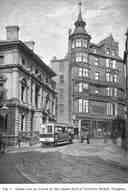
To spot the Upper Douglas Cable Tramway, look for tram tracks curling around the street corner beside two impressive old buildings. One building has beautiful stonework and columns; the other rises up like a castle turret, with lots of windows and a pointed rooftop. Right on the curve, you’d see a little tram car-more like a wooden box on wheels, painted with bold numbers and a strong dash of color. Picture it rattling along those shiny steel rails! Now, standing here today, imagine it’s a bright morning in 1896 and you’re waiting to hop on a tram. You hear the clatter of iron wheels on rails, the squeak as the cable car rounds the bend, and maybe a horse snorting a block away, impatient because these new-fangled trams keep stealing all the excitement! The Upper Douglas Cable Tramway wasn’t just any tram. This line conquered steep hills to connect Douglas’s bustling promenade with the quieter, breezy upper streets. At first, the local council begged for a way up those sharp slopes-maybe someone at the bottom just wanted to deliver their groceries up without breaking a sweat! So in 1896, the line opened, sending these narrow-gauge trams winding their way up and around town. But it wasn’t always smooth riding. Some sections were so steep, they had to close them because people thought the cars would go from “up the hill” to “up in the air!” And when the bank behind the tramway crashed, Douglas Corporation swooped in, taking the line under its wing. Later, the service went from daily to just summertime. By 1929, the last car rattled up the hill and clanged its bell goodbye. For years after, tracks would peek out from under the road like a secret waiting to be found-once, a 1980s road crew nearly fell into history when they dug up bits of old rail! Imagine the tram now-restored, painted bright Prussian blue, with creamy yellow stripes and chocolate-brown letters. It’s so eye-catching, it made it onto a stamp! People loved these trams so much, two were turned into a bungalow at Jurby. At least their owners had the most unique living room on the island. So, next time you’re stuck walking uphill, picture yourself jumping on a jingly cable car, bell ringing, wheels gliding. And count yourself lucky we don’t move our whole house by tram anymore!
Otwórz dedykowaną stronę →Right in front of you, standing tall against the blue sky and the shimmering sea behind, is the Douglas War Memorial. To spot it, just look for the towering grey stone column…Czytaj więcejPokaż mniej
Right in front of you, standing tall against the blue sky and the shimmering sea behind, is the Douglas War Memorial. To spot it, just look for the towering grey stone column rising from a base with flowerbeds and painted railings. At the very top, you'll see a proud, solid figure standing guard - that's “The Manxman,” a soldier made from Manx granite, keeping careful watch over the promenade. The memorial is decorated with a golden cross and detailed carvings, and flanked by the red Manx flag nearby, swaying gently in the breeze. Take a moment to feel the space around you. Picture Douglas as it once was - streets quiet, band music drifting from where you’re now standing, with townsfolk gathering in uneasy silence during the World Wars. Here, where the salty wind brushes your face and the hum of the town buzzes about, this memorial rises up, about 50 feet high, as if to say, “Remember us.” The inscriptions, carved carefully into the granite, speak of loyalty, courage, and sacrifice. Touch the cold stone and you can almost hear the names being read, each one its own story. The rolls of names, organized by service and year, remind us that these heroes were real people with hopes and dreams, maybe even as cheeky as your local postman or as heroic as your favorite movie star. The soldier atop - weighing in at three tons, so be glad you’re not the one lifting him up there - has watched over Douglas since 1924. He stands in a flower garden, surrounded by tributes and copper vases, marking a spot where the town used to gather for music and, later, for remembrance. Here’s a bit of local design drama for you: the memorial was cooked up by Ewart Crellin, who had a knack for dignified stonework, while the intricate sculptures came all the way from Harry Hems & Co. in Exeter. They even did the same job for St. Matthews War Memorial - clearly, they were good at carving more than Sunday roasts. As you stand here, listen to the waves, let the fresh sea air fill your lungs, and think of the words inscribed around you: “They shall be as the stones of a crown, lifted up as an ensign upon this land.” Every pebble under your feet might be a crown jewel in memory’s treasure box. So, if you feel an extra chill or a gentle tug at your heart, you’re not alone. Douglas remembers, and so do we, every time we pause here to look up to the Manxman standing guard over his beloved island. Ready for the next stop?
Otwórz dedykowaną stronę →


Pokaż jeszcze 2 przystankówPokaż mniej przystankówexpand_moreexpand_less
Look straight ahead and you’ll spot the Gaiety Theatre standing out with its fancy cream-colored facade, elegant arched windows, and twin towers on either side that look like…Czytaj więcejPokaż mniej
Look straight ahead and you’ll spot the Gaiety Theatre standing out with its fancy cream-colored facade, elegant arched windows, and twin towers on either side that look like something straight out of a fairy tale. Just above the entrance, you’ll see the words “Gaiety Theatre” proudly displayed. The building almost looks like a giant birthday cake-topped with decorative towers, swirls of stucco, and an upstairs balcony that’s perfect for dramatic waves to an invisible audience. If you see a row of old-fashioned lamps outside, you’re definitely in the right place. Now, as you stand in front of the Gaiety Theatre, imagine the year is 1900. The air is buzzing with excitement-ladies in flowing gowns and dapper gentlemen are lining up, chattering, tickets in hand. Back then, Douglas was packed with tourists looking for a bit of seaside magic, and this sparkling theatre, designed by the famous Frank Matcham, was the crown jewel of entertainment. But did you know it nearly didn’t survive? The spot where you’re standing once held not one, but several different venues. The very first “palace of entertainment” here opened in 1893 and flopped faster than a fish out of water. In just three months, the whole operation went bankrupt! Imagine the sound of a grand opening concert turning quickly into an awkward silence… Still, the show must go on! The building was renamed and repurposed more times than a magician pulls rabbits from a hat-hosting concerts, bazaars, and even a roller skating rink. Finally, when Frank Matcham waved his architectural wand, the Gaiety was born. Inside, there’s a dome with a stained glass ceiling and ornate decorations that make every visitor feel like royalty. There was even an old-school “air conditioner” - seven gas lamps under a glass dome that would suck out the hot air as they burned, so the audience didn’t melt before the end of the show. That’s some Victorian high-tech comfort! Imagine the thrill the audience felt on opening night, as the lights went up and the thick velvet curtain rose. So, as you stand here, take a breath and picture all the laughter, gasps, and applause that have filled these walls over the last hundred years. The Gaiety has survived boom and bust, war and peace-and thank goodness, so we don’t have to do this tour standing in front of a car park!
Otwórz dedykowaną stronę →

Najczęściej zadawane pytania
Jak rozpocząć trasę?
Po zakupie pobierz aplikację AudaTours i wpisz kod realizacji. Trasa będzie gotowa do natychmiastowego rozpoczęcia – po prostu dotknij \"Play\" i podążaj trasą z nawigacją GPS.
Czy potrzebuję internetu podczas trasy?
Nie! Pobierz trasę przed rozpoczęciem i korzystaj z niej w pełni offline. Jedynie funkcja czatu wymaga internetu. Zalecamy pobieranie przez WiFi, aby oszczędzać dane mobilne.
Czy to wycieczka grupowa z przewodnikiem?
Nie – to samodzielny audioprzewodnik. Zwiedzasz niezależnie, we własnym tempie, z narracją audio odtwarzaną przez telefon. Bez przewodnika, bez grupy, bez harmonogramu.
Ile trwa trasa?
Większość tras zajmuje 60–90 minut, ale to Ty kontrolujesz tempo. Wstrzymuj, pomijaj przystanki lub rób przerwy, kiedy chcesz.
Co jeśli nie zdążę ukończyć trasy dzisiaj?
Żaden problem! Trasy mają dożywotni dostęp. Wstrzymaj i wznów, kiedy chcesz – jutro, za tydzień lub za rok. Twój postęp jest zapisywany.
W jakich językach są dostępne trasy?
Wszystkie trasy są dostępne w ponad 50 językach. Wybierz preferowany język podczas realizacji kodu. Uwaga: języka nie można zmienić po wygenerowaniu trasy.
Gdzie znajdę trasę po zakupie?
Pobierz darmową aplikację AudaTours z App Store lub Google Play. Wpisz kod realizacji (wysłany e-mailem), a trasa pojawi się w Twojej bibliotece, gotowa do pobrania i rozpoczęcia.
Jeśli trasa Ci się nie spodoba, zwrócimy Ci pieniądze. Skontaktuj się z nami pod adresem [email protected]
Bezpieczna płatność przez 


