
Crotone Audiotour: Echo's van Kampioenen, Heiligen en Steen
Een fort rijst op boven de oude stad van Crotone, de oude stenen getuige van verraad, macht en gefluister van verdwenen rijken. Onder de zonovergoten straten wachten geheimen – verborgen passages, begraven helden en onwaarschijnlijke glorie. Deze zelfgeleide audiotour neemt je mee voorbij ansichtkaarten en in het verwarde verleden van de stad, en onthult verhalen die de meeste bezoekers nooit horen. Wie beraamde een middernachtelijke rebellie in de schaduw van het Kasteel van Karel V? Welke onschatbare relikwieën zijn spoorloos verdwenen uit het Nationaal Archeologisch Museum? Waarom weerklinkt het gebrul van het Ezio Scida Stadion zo fel in de ziel van Crotone? Wandel van kantelen naar rechtszalen, van glinsterende tentoonstellingen naar daverende menigten, en volg de rusteloze geest die Crotone heeft gevormd. Elke stap trekt je dieper in het hart van het oude Calabrië, levendig met drama en verborgen wonderen. Begin de reis waar steen en legende samenkomen. Het ware Crotone wacht. Luister mee.
Tourvoorbeeld
Over deze tour
- scheduleDuur 40–60 minsGa op je eigen tempo
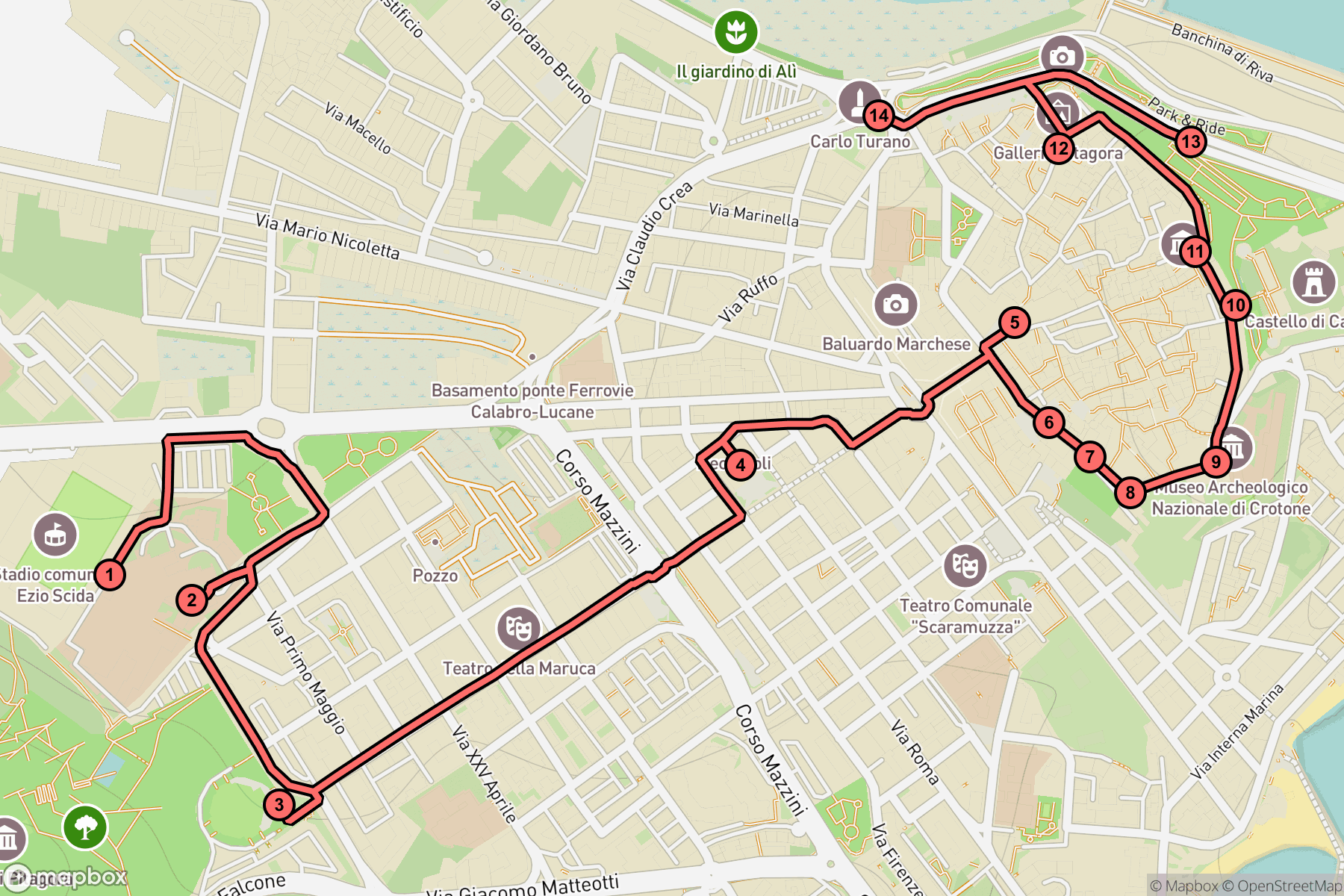
- straighten3.8 km wandelrouteVolg het geleide pad
- location_on
- wifi_offWerkt offlineEén keer downloaden, overal gebruiken
- all_inclusiveLevenslange toegangOp elk moment opnieuw afspelen, voor altijd
- location_onStart bij Ezio Scida Stadion
Stops op deze tour
Let’s take a step back in time to the mid-1930s, when construction on this monumental arena first began. Picture busy workers hammering and shouting, concrete mixing in the sun, a…Meer lezenToon minder
Let’s take a step back in time to the mid-1930s, when construction on this monumental arena first began. Picture busy workers hammering and shouting, concrete mixing in the sun, a city buzzing with anticipation. But then-just as the stadium’s foundations began to rise-the dark clouds of war swept in, silencing the hammers and freezing all progress. For years, the construction site sat in anxious suspense, like a football match stuck at a dramatic halftime. Finally, in 1946, the city’s dream came alive. The stadium was completed and opened its gates to fans who flooded through, brimming with pride and hope after the war. The stadium’s name, Ezio Scida, was chosen in memory of a young local footballer who tragically died in a car accident on his way to play for the city’s beloved team. You could say that the spirit of Scida has been running up and down the field ever since, rooting for every goal. At first, Ezio Scida Stadium only held about 5,000 fans-just enough to squeeze in Crotonesi of all ages, rain or shine. There was one covered stand, a second open stand, and a single curving terrace-the favorite spot for hardcore supporters to gather, shake banners, and sing at the top of their lungs. Over the years, those cheers grew louder, and so did the stadium. As Crotone’s football fortunes soared (and the team earned promotion after promotion, all the way up to Serie A!), more curves, seats, and stands were built. By 2016, after one last expansion with shiny new metal bleachers and a few modern touches, the stadium reached its current capacity of over 16,500. That’s enough space to fit almost all of Crotone inside-plus a few very loud away fans. Now, you might have noticed that this stadium isn’t just about football. Its very foundations are built atop the remnants of ancient Kroton, once a mighty city of Magna Graecia. For years, there was a struggle between honoring the past and celebrating the present. There were times, as recently as 2018, when the authorities declared the stadium off-limits because of the priceless archaeological treasures buried beneath. But, after a bit of back-and-forth-with the modern fans no doubt rooting just as hard as their ancient counterparts-the doors swung open once again. Football, history, and a healthy dose of bureaucratic drama-who says only what happens on the pitch is exciting? The stadium’s architecture has its own quirks. You’ll spot four bold sectors, each with a life of its own: the mighty main stand with over 6,800 seats, the always animated "Curva Sud" for the ultras-named after legendary fan Giorgio Manzulli, and a maxed-out giant screen perfectly placed for instant replays and dramatic countdowns. Forget running tracks and velodromes; here the stands hug the field so closely, you can practically hear the players’ heartbeats-or the referee’s whistle! And don’t worry-if you’re here to watch a match and the Calabria weather decides to join the fun, the main tribune now has a partial roof, finally keeping fans dry. That only took a few, erm, passionate complaints and some clever truss engineering. Ezio Scida Stadium isn’t just about sports, either. Over the years, it’s hosted rock legends, pop concerts, and grand festivals. Imagine Vasco Rossi, Rino Gaetano, and even the infamous Festivalbar shaking these stands, lights flashing, music bouncing under the starlit sky. So as you stand here, picture all those generations-fans, athletes, musicians, and dreamers-who’ve come together under these bright floodlights. For Crotone, the Ezio Scida Stadium is more than just a place to watch a match; it’s where the city comes alive. Now, if only these old walls could tell us which team is really the best... but I think they’d just chant, “Forza Crotone!”
Open eigen pagina →Picture Crotone in the 1100s: a walled town overlooking rolling Calabrian hills. Just outside those walls, the very first hospital appears, run not by doctors in white coats, but…Meer lezenToon minder
Picture Crotone in the 1100s: a walled town overlooking rolling Calabrian hills. Just outside those walls, the very first hospital appears, run not by doctors in white coats, but by Benedictine monks from the Abbey of Santa Maria della Matina. You’d find more prayers than pills, and the hum of chanting monks offering support to locals and travelers in need. Fast forward to the 1500s and the city had to face new challenges-a surge of Spanish soldiers stationed in Calabria meant the sick bay was rarely empty. This led to the foundation of what would eventually become San Giovanni di Dio. At first, it was called the hospital of San Jacobo, funded by just 70 or 80 ducats a year-a sum that could buy you a few horses, but probably not a luxury suite! In those years, the hospital offered not just medicine but spiritual care: the local bishop himself picked the priest who would listen to confessions and offer hope to patients. Religious and civic leaders soon wrestled for control, leading to several heated debates, and let’s face it, nothing brings people together like arguing over hospital management. In the early 1600s, the hospital got a boost. Not only did funds jump to about 100 ducats per year, but a small church was added-though this expansion led to some epic tug-of-war between city officials and the Church. Eventually, a compromise meant the city regained some say, with the community’s own trusted administrators back in charge by 1620. The next big innovation? The Congregation of Compunction, a group dedicated to charity and Friday gatherings for prayer and good deeds. Now that’s what I call a Friday night in! The hospital passed to the Fatebenefratelli, a religious order famous for their knack for medicine and, probably, great bedside manner. Under their watch, the hospital weathered quite a storm-sometimes literally. In the 1700s, earthquake tremors rattled Crotone, and the hospital had to be rebuilt and reorganized. The hospital changed hands again, and by the late 1700s, it transformed into a civic institution under King Ferdinand IV. This era saw a modern twist, with a management committee balancing both city and church input-think of it as the first-ever “hospital board meeting” with plenty of cappuccino. By the time the 19th century rolled in, the old building had seen better days: soldiers, laborers building the port, and almost everyone with a cough showed up needing help. The relentless earthquakes didn’t help the walls either. By 1883, the city decided it was time for a new beginning. The old hospital became part of city hall, and a brand new hospital opened, just like the one you see today, outside the bustling center, with more room for everyone. By the 20th century, San Giovanni di Dio Hospital modernized further, adding cutting-edge departments-Cardiology, Intensive Care, Infectious Diseases, you name it. Managed since 1995 by ASL No. 5, the hospital expanded to over 300 beds, ready to serve modern Crotone. What started with monks, ducats, and a sprinkle of prayer is now a beacon of advanced care-though if you ask, I bet there’s still a little luck, a lot of heart, and maybe the occasional monk-like patience! So whether you’re interested in history or just impressed by how many ducats it takes to run a hospital, you’re standing at a place where every moment has been dedicated to healing.
Open eigen pagina →Ah, welcome to the PalaMilone-the sporting heart of Crotone! Right in front of you stands a modern arena with a name rooted all the way back in the days of ancient Greece.…Meer lezenToon minder
Ah, welcome to the PalaMilone-the sporting heart of Crotone! Right in front of you stands a modern arena with a name rooted all the way back in the days of ancient Greece. PalaMilone pays tribute to Milone, the legendary wrestler from Kroton, a man who could crack ropes with his bare hands… and probably never skipped arm day! When you stand here, you’re standing in the shadow of a champion. This arena was born from a bold vision in the early 2000s, when the city decided it was time to give sport-and community pride-a brand new home. Under Mayor Pasquale Senatore, construction sprinted off the blocks in 2001 and crossed the finish line just two years later in 2003. With room for up to 3,000 cheering fans, PalaMilone has become a place where laughter, applause, and the occasional referee whistle fill the air. And if you listen for the faint echoes… well, just imagine the blast of music from concerts like Nek, Max Pezzali, or Giorgia, who all rocked this arena. Even Beppe Grillo, the legendary comic, performed his “Delirio Tour” here-I hear the seats are still recovering. But the PalaMilone isn’t just about slam dunks and guitar solos. In 2023, the arena opened its doors to support the community in a heartbreaking way, serving as a temporary resting place for the victims of a tragic migrant shipwreck off the coast. Moments like these show this place isn’t only for celebration-it’s also where Crotone gathers in both joy and sorrow. You might also remember the time politicians like Silvio Berlusconi took the center stage, or when the whole region buzzed for the ordination of Archbishop Antonio Giuseppe Caiazzo in 2016. In short? PalaMilone is where Crotone comes together, whether for a basketball showdown, a pop star’s encore, or standing together through tough times. That’s a true arena for everyone-and every mood.
Open eigen pagina →


Toon 11 stops meerToon minder stopsexpand_moreexpand_less
Here you are, right in front of the Town Hall of Crotone, the beating administrative heart of the city-and a place with more layers than a lasagna. This building isn’t just the…Meer lezenToon minder
Here you are, right in front of the Town Hall of Crotone, the beating administrative heart of the city-and a place with more layers than a lasagna. This building isn’t just the center of local government; it's built on a site where history has made itself comfortable for thousands of years. Imagine this: before the Town Hall took up residence here in the 1950s-a project spearheaded by Mayor Silvio Messinetti and designed by architect Luigi Gallo-the city’s leaders were working out of the San Giovanni Palace. But Crotone wanted something new, so in came this striking rationalist building, all neat lines, a big U-shape, and a central balcony, right on Piazza della Resistenza. Now, here's where things get juicy. In the 1990s, when the city decided on a little renovation and attic-adding action, archaeologists jumped at the opportunity. Down in the basements, they set about carefully poking through layers of soil, like curious chefs searching for a secret recipe. What they uncovered was a patchwork of ancient life: Greek homes from almost 2,400 years ago, complete with black-glazed ceramics that probably saw their share of spilled wine and impromptu philosophical debates. And check this out-a bronze coin from the time of the Hannibalic War, bearing Artemis herself and the local Greek inscription “KRO.” Talk about old money! Above those Greek homes, the Romans literally built a neighborhood for their dearly departed. They left behind tombs packed with coins-no contactless payment, but at least the afterlife had decent fare. Some tombs favored cremation, others full burial, and all of them shared a story of lives lived and lost. So right here, standing in the heart of the modern city, you’re balancing on a place that’s been part of ancient drama, everyday routines, and just maybe, a little bit of municipal mischief. Only in Crotone, right?
Open eigen pagina →You’re now standing in front of the Cathedral of Santa Maria Assunta, the star of Crotone’s skyline! Look at that neoclassical facade-three grand portals and a towering bell tower…Meer lezenToon minder
You’re now standing in front of the Cathedral of Santa Maria Assunta, the star of Crotone’s skyline! Look at that neoclassical facade-three grand portals and a towering bell tower that would make even church mice stand at attention. This spot isn’t just for sightseeing; since the 9th century, folks have gathered here for joy, sorrow, and the occasional impressive hat worn by an archbishop. In the 1500s, Bishop Antonio Lucifero rolled up his sleeves and rebuilt much of what you see. Legend has it, he borrowed stones from the ancient temple of Hera Lacinia-talk about recycling! Over the centuries, the duomo has survived repairs, renovations, and today, it’s actually closed for worship due to some structural hiccups. No choir practice inside for now, but you’re part of a very exclusive, front-row crowd. If you could wander inside, picture three broad aisles brimming with treasures: a stone baptismal font with animal carvings from the 1200s, a wooden choir from the 1600s, and not one but two wooden busts-San Gennaro and San Dionigi-likely keeping a close eye out for mischief. There’s even a terracotta crucifix and a marble pulpit dreamed up by Pietro Paolo Farinelli in 1898. But the true heart is the right-side chapel, which guards a Byzantine icon of the Madonna di Capocolonna. Shh! According to tradition, Saint Luke himself painted it. Don’t miss the shimmer of gold and silver: chalices gifted by royalty, a bishop’s staff crafted by mysterious Neapolitan artists, and elegant 1700s artwork, including a freshly restored painting of poor San Dionigi losing his head-literally. Outside, a bronze statue of Padre Pio stands sentry at the entrance, while the square in front got a facelift in 2004. This special place is lovingly called the heart and shield of Crotone, and it houses the tombs of two beloved bishops. Local legend? Maybe. But one thing’s for sure: it’s never just quiet prayer that echoes through these stones.
Open eigen pagina →But don’t let the calm fool you - this place has seen drama. In 1569, the monastery was at the center of a scandal hot enough to make a nun blush. Salomea Basoina and her daughter…Meer lezenToon minder
But don’t let the calm fool you - this place has seen drama. In 1569, the monastery was at the center of a scandal hot enough to make a nun blush. Salomea Basoina and her daughter Isabella, accused of a less-than-holy lifestyle, were hidden here by order of the authorities. The local bishop, the chaplain, and even the general visitor all protested, saying, “No way, not in our convent!” But the powerful Cardinal Alessandrino said, “She stays.” Imagine the whispers in the shadowy corridors and the nuns peeking through the arches, waiting to see what happened next. The site changed hands many times, so by 1916, only three nuns remained, shuffling through a monastery that was crumbling around them. When they finally left, perhaps the halls sighed in relief - “Finally, retirement!” In 1932, the place found its way back to church hands, and today, if you listen closely, you might just sense the secrets of the past fluttering beneath the tiles and echoing in the sandstone passages.
Open eigen pagina →Now, cast your eyes inside, if you can. You’ll find Baroque-style frescoes bursting with color and drama, and a wooden crucifix from the 1600s. Here’s a curious detail-a rare…Meer lezenToon minder
Now, cast your eyes inside, if you can. You’ll find Baroque-style frescoes bursting with color and drama, and a wooden crucifix from the 1600s. Here’s a curious detail-a rare depiction of Christ on the cross with open eyes, capturing the very moment before death. Not your everyday church art! Behind the altar, there’s an apse with three niches, each holding a statue of the Virgin Mary, shining out over centuries of prayer. But if you’re feeling brave, picture the crypt below: Christians once hid here from persecution. Inside, you’ll spot wooden statues, aged paintings, and a shimmering window filled with hundreds of skulls-watched over by a statue of the risen Christ. It’s a mix of devotion, mystery, and let’s be honest, a pinch of goosebumps. Isn’t history breathtaking… sometimes literally?
Open eigen pagina →Right in front of you stands the Church of San Giuseppe, a true character in the story of Crotone! Built in the early 1700s, the church was originally created as a home for the…Meer lezenToon minder
Right in front of you stands the Church of San Giuseppe, a true character in the story of Crotone! Built in the early 1700s, the church was originally created as a home for the Confraternity of Maria Addolorata-think of it as a kind of community club with a lot of soul. The big celebration came in 1756, when Domenico Morelli officially consecrated it, probably with a festive crowd and maybe a few distracted choirboys hoping for extra dessert afterward. But here’s a twist-this church wouldn’t even exist in its current form without a generous helping of elbow grease from diacono Onofrio De Sanda, a member of Crotone’s legendary family of master carpenters. He rallied the townsfolk for donations, and in 1719, they rebuilt the old structure bigger and better, dedicating it to San Giuseppe, who just happens to be the patron saint of carpenters. Look up at the entrance: the stone inscription is a proud shout-out to both Onofrio and all those who chipped in. Inside, the church glimmers with marble altars and houses precious wooden statues, including San Giuseppe himself. Local noble families sponsored the chapels lining the walls-perhaps a little friendly competition for the fanciest pew! The Gallucci-Zurlo chapel keeps a secret treasure: a beautifully sculpted Neapolitan crucifix from the 1700s. With its stucco-decorated interior, this church is more than a building; it’s a patchwork of devotion, craftsmanship, and a dash of civic rivalry. And let’s be honest, without those carpenters, none of it would hold together!
Open eigen pagina →Let’s travel back to 1968. Picture this: the doors swing open, and, for the first time, Crotone’s ancient relics see daylight after spending decades tucked away in a small civic…Meer lezenToon minder
Let’s travel back to 1968. Picture this: the doors swing open, and, for the first time, Crotone’s ancient relics see daylight after spending decades tucked away in a small civic collection. At first, these were mostly things found by curious hands-not always by the book!-and sometimes through the lively antiques market. Imagine the tension: which artifact had the most outlandish adventure before arriving here? As you step inside, the air almost tingles-a glass case to your left holds axes and obsidian scrapers from the distant Neolithic era. Petilia Policastro’s stone blades might look basic to us, but back then, they were the smartphone of their day! Then, the Bronze Age hits with a dramatic entrance. Two bronze axes-one showing off a stylish geometric design, almost like ancient graffiti-call out from the case. One of these is so unique, it’s literally one of a kind in the world. Move over, modern artists! The collection sweeps you into the world of Magna Graecia-when Greek settlers arrived, bringing style, drama, and better pottery. Don’t miss the small altar with Hercules wrestling centaurs, or the brooding face of the Gorgon from an old rooftop, ready to scare away… well, just about everyone. If those don’t lure you, how about Attic vases with red-figure paintings? What’s black and red and admired all over? Crotone’s ceramics! The museum throws in a dash of mystery, too-a marble stele with Greek inscriptions marking ancient boundaries, or the marble head of Apollo, discovered on a blustery day in the 1970s. The poor guy’s face is a little worse for wear, but he still radiates rockstar confidence. And for a little gossip: there’s a marble relief, maybe from 450 BC, showing Hera locked in conversation with another goddess-possibly city gossip or divine plotting. Imagine the drama! Let your gaze drift to the treasures from the sanctuary of Hera at Capo Colonna-cups, votive offerings, and fragments of monumental sculptures. Among these, check out the black-figured cup from the 6th century BC, with two bearded warriors ready for action. Not to be outdone, the “Treasure of Hera” adds glitter-gold diadems and a unique boat-shaped lamp from faraway Sardinia. Imagine the trade, the journeys, and the hands that passed these objects along. Don’t race past the stars of the museum: the bronze siren-shaped askoi. Returned from Malibu’s Getty Museum, these rare vessels-worldwide, there are only three-remind us even ancient treasures like an overseas holiday. And if you’re a fan of international intrigue, look for the Egyptian stele of Horus trampling crocodiles. Stolen, sold, vanished for 35 years, and finally back home in Crotone since 2012-a comeback almost worthy of an action movie. The tour wouldn’t be complete without a nod to Roman marble baths salvaged from a shipwreck on Punta Scifo or inscriptions uncovered when they built San Giuseppe Church. The museum even stretches into medieval times, displaying finds from local sanctuaries and the old city. So, whether you’re into warriors, gods, mysterious artifacts, or golden treasures, this museum weaves together thousands of years and a whole library of stories. Don’t be surprised if you start feeling a little more mythological yourself as you walk out!
Open eigen pagina →You’re standing before the formidable walls of the Castle of Charles V, one of the grandest and most battle-hardened fortresses in southern Italy. Imagine the sky bristling with…Meer lezenToon minder
You’re standing before the formidable walls of the Castle of Charles V, one of the grandest and most battle-hardened fortresses in southern Italy. Imagine the sky bristling with watchful sentries, flags snapping above the towers, while the scent of the Ionian Sea mingles with the earthy aroma of ancient stones and fresh-cut timber. This beast of a castle has seen over a thousand years of intrigue, battles, earthquakes, and the occasional peasant just looking for a new place to take a nap. Let’s rewind to the year 840. The streets were filled with whispers of incoming Saracen invaders. The people of Crotone, clearly not in the mood to share their olive oil or their city, built a rough, sturdy fortress right on the old Greek acropolis. This ancient stronghold overlooked the sea on one side and open countryside on the other, surrounded by sheer cliffs, pretty much saying, “Invaders, feel free to try, but maybe grab some insurance first.” Of course, even the best defenses didn’t always work. Dionysius the Elder, the cunning tyrant of Syracuse, managed to sneak in and capture the fortress during the epic war with Crotone around 380 BC. Over the centuries, with every siege and every loud complaint from the townsfolk, new walls and towers sprouted like mushrooms after rain. By 1192, it appeared in imperial records: no longer just a stone box, but a full-on military headache for any would-be conqueror. Fast forward to the time of the Angevins. King Charles I of Anjou took over in the 1270s, looked at the old battered towers, and said, “Hmm, let’s see what a construction budget overrun feels like!” Local lords were forced to chip in for repairs, and towers popped up everywhere, some with names like Mamunela and Barbacana-others sounding like they belonged in a medieval board game. The real plot twist, though, came in the late 1400s. Gunpowder and cannons arrived, making old fortresses about as useful as a chocolate teapot in a firestorm. The castle transformed again, gaining new round towers and thicker walls. The great “turri delo casi cavallo”-say that three times fast-became one of its most impressive watchtowers. Disaster struck in 1480 with the bloody sack of Otranto by Ottoman forces, and panic spread across Calabria. Everyone scrambled to shore up defenses. New taxes, new walls, more arguing, and one very tired group of laborers. The changes brought growing prosperity; Crotone buzzed with workshops and life as the city expanded around this mighty fort. But the biggest celebrity makeover happened in 1541, when Emperor Charles V, facing relentless Turkish raids, gave the ultimate order: “Rebuild this castle into the strongest fortress on the Ionian coast!” The master architect Gian Giacomo dell’Acaya, who was something like the Michelangelo of military buildings-though with more stone and fewer cherubs-invented the castle’s current polygonal shape. Over a thousand workers hammered, carved, and sweated, while Crotone became a hub of business and armaments. New towers like the massive Torre Aiutante and commanding Torre Comandante rose up, each with thick walls, gun slits, and enough space for a garrison strong enough to make pirates think twice. Inside, the castle was practically a village: the barracks, storehouses, artillery rooms, and even churches-San Dionisio, the New Church, and San Carlo. There were cells for prisoners-sorry, “guests”-and yes, at one point even a barracks for women. Entry was via a grand gate, reached by a bridge part stone, part wood, and part drawbridge, perfect for making any arriving messenger reconsider their life choices. The centuries rolled on. Earthquakes tumbled the towers, cannons cracked the stones, and Crotone’s fortunes rose and fell. Still, this castle adapted. In the 1800s, more expansions-guardhouses and barracks-were added. Today, you can still spot the proud forms of Torre Aiutante, Torre Comandante, and the Bastions of San Giacomo and Santa Caterina. This fortress is more than just an old military shell. Today, it houses part of Crotone’s archaeological museum, where treasures from the medieval days await curious explorers. There’s even a plan to turn the castle into a gigantic museum and laboratory hub, dedicated to the story of Crotone and its people-proof that even after a thousand years, some fortresses never stop evolving. So next time you look up at these mighty walls, remember: they weren’t just built to defend, but to shape an entire city’s destiny. And if you hear the faint creak of boots or distant clang of a drawbridge, don’t worry-it’s just the castle showing off its history for you.
Open eigen pagina →Picture this: The year is 1800, Napoleon is making Europe nervous, and Baron Alfonso Barracco is here striking deals-like the memorable time he agreed to deliver 1,700 tomoli of…Meer lezenToon minder
Picture this: The year is 1800, Napoleon is making Europe nervous, and Baron Alfonso Barracco is here striking deals-like the memorable time he agreed to deliver 1,700 tomoli of grain from the harvest of 1799. It involved legal contracts, Catanzaro partners, and a man named Antonio Casaburi running grain around the region faster than a pizza delivery scooter. A generation later, Alfonso’s son Luigi chips in his own flair-and, of course, family drama. Imagine an aristocratic wedding with Maria Chiara Lucifero, property swaps in the shadow of the Church of the Most Holy Savior, and a palace expansion that angered the bishop. When an earthquake in 1832 rattled the city, bold decisions had to be made: even the church was demolished-Louis, as headstrong as any sitcom dad, got his royal order and just did it. And why not? In 1833, King Ferdinand II of Bourbon popped by on a royal tour, probably checking if the palace ceilings were earthquake-proof. If these lovely stones have ever seemed a bit too quiet, it’s because the Barraccos soon wandered to Naples and later Rome, leaving the palace to slowly fade under the Calabrian sun. I can almost picture the noble silence, interrupted now and then by locals passing wild tales of Barraccos defeating rivals at elections, like the determined Giovanni clashing with Gaetano Cosentini or, after some heated contests, outwitting Raffaele Lucente. By the 20th century, the descendants still made appearances-Enrico Barracco, his wife Maria Doria, and beyond. Between 1995 and 2009, the old halls buzzed again: this time, not with royal secrets, but with the business of the Chamber of Commerce and colorful exhibitions at the MACK-Crotone’s contemporary art museum. So next time you eye this palace, remember: beneath that elegant façade was once a whirlwind of grain deals, family feuds, earthquakes, royalty, and modern art. And unlike any other house in town, in Crotone, you always had to keep an extra chair ready-just in case a king dropped by.
Open eigen pagina →Here you are, right in front of the Church of Santa Maria Prothospataris-a little slice of history tucked into the heart of Crotone’s old Jewish quarter, on the winding Via…Meer lezenToon minder
Here you are, right in front of the Church of Santa Maria Prothospataris-a little slice of history tucked into the heart of Crotone’s old Jewish quarter, on the winding Via Giuseppe Suriano. Back at the start of the 1500s, this compact church rose up, proudly bearing the name of the noble Prothospataris family, who hailed from Greece. Imagine those early years: the quiet chatter in the narrow streets, neighbors swapping fresh fish in the market, and the gentle toll of church bells announcing the birth of a new parish in 1525-a real headline event for Crotone! By the late 1500s, the church came under royal protection. Talk about getting a promotion! But it hasn’t always been sunshine and sermons; for a long spell, it closed its doors, only to make a comeback when Charles III of Bourbon was around. By 1777, it had two altars, devoted to Saint Aloysius Gonzaga and Saint Cajetan. A bit like a religious double feature! Fast forward to 1960, and the place got a facelift-but sadly, the two altars and their paintings were removed. Still, standing here today, you can sense the many chapters it’s lived through. Even a small church can have epic stories, right?
Open eigen pagina →Here you are, standing in front of the Monument to Carlo Turano, right at the gateway of Crotone and facing the sea breeze from the port. Imagine the year is 1919. The people of…Meer lezenToon minder
Here you are, standing in front of the Monument to Carlo Turano, right at the gateway of Crotone and facing the sea breeze from the port. Imagine the year is 1919. The people of Crotone were so fond of their local lawyer and political hero, Carlo Turano, that they started a public petition just to honor him with a statue. Quite a fan club, right? Fast forward to 1927, the talented sculptor Ezio Roscitano unveils this monument with much fanfare, as if Turano were about to make a grand courtroom entrance. Back in the day, this monument had more than just the lone statue. Bronze panels decorated the base: on one, three local sailors battled a furious storm, struggling to save their boat-a nod to Crotone’s enduring fight against rough seas; on the other, three strong men held up a crumbling column, symbolizing the city's drive to rebuild after hard times. Then came the 1930s, a time when official rules tried to sweep aside contemporary heroes for more 'fashionable' statues. But the people refused-they held on tight to Turano and his monument. Eventually, in 1989, city renovations reshuffled things, and the statue landed here, riding in style on a granite base in the middle of the roundabout. It’s not every day a statue gets the best parking spot in town! So, next time you pass by, remember: This isn't just bronze and stone-it's a city’s stubborn love brought to life.
Open eigen pagina →


Veelgestelde vragen
Hoe begin ik de tour?
Download na aankoop de AudaTours-app en voer je inwisselcode in. De tour is direct klaar om te starten – tik gewoon op afspelen en volg de GPS-geleide route.
Heb ik internet nodig tijdens de tour?
Nee! Download de tour voordat je begint en geniet er volledig offline van. Alleen de chatfunctie vereist internet. We raden aan om te downloaden via wifi om mobiele data te besparen.
Is dit een groepsrondleiding met gids?
Nee - dit is een audiotour met eigen gids. Je verkent zelfstandig op je eigen tempo, met audiovertelling via je telefoon. Geen tourguide, geen groep, geen schema.
Hoe lang duurt de tour?
De meeste tours duren 60-90 minuten, maar jij bepaalt het tempo volledig. Pauzeer, sla stops over of neem pauzes wanneer je wilt.
Wat als ik de tour vandaag niet kan afmaken?
Geen probleem! Tours hebben levenslange toegang. Pauzeer en hervat wanneer je wilt – morgen, volgende week of volgend jaar. Je voortgang wordt opgeslagen.
Welke talen zijn beschikbaar?
Alle tours zijn beschikbaar in meer dan 50 talen. Selecteer je voorkeurstaal bij het inwisselen van je code. Let op: de taal kan niet worden gewijzigd na het genereren van de tour.
Waar vind ik de tour na aankoop?
Download de gratis AudaTours-app uit de App Store of Google Play. Voer je inwisselcode in (verzonden per e-mail) en de tour verschijnt in je bibliotheek, klaar om te downloaden en te starten.
Als je niet tevreden bent met de tour, betalen we je aankoop terug. Neem contact met ons op via [email protected]
Veilig afrekenen met 


