

산타페 오디오 투어: 광장, 극장, 요새의 연대기
산타페의 어도비 벽에 햇살이 쏟아지지만, 숨겨진 그림자들은 부서진 왕좌, 무법자 사제들, 그리고 대성당 돌 아래 잠든 비밀들의 이야기를 들려줍니다. 이곳에서 권력과 신앙은 소수의 방문객만이 엿볼 수 있는 방식으로 한때 충돌했습니다. 이 신성한 거리를 따라 셀프 가이드 오디오 투어를 시작하세요. 발걸음마다 가이드북에는 없는 이야기들이 펼쳐집니다. 상징적인 랜드마크와 예상치 못한 골목길 사이를 거닐며 다른 사람들이 간과하는 것들을 발견하세요. 누구의 필사적인 도박이 뉴멕시코 주 의사당을 거의 파멸로 이끌었을까요? 산 미겔 미션의 고대 벽들 사이에서 어떤 기적이 속삭여졌을까요? 대성당 바실리카의 아치형 천장 아래에서 폭풍우 치던 밤, 어떤 스캔들이 펼쳐졌을까요? 매번 돌아서는 길마다 산타페의 얽히고설킨 과거의 드라마와 경이로움 속으로 더 깊이 빠져들게 됩니다. 사라진 반란의 메아리를 들어보세요. 권력, 희망, 배신의 발자취를 따라가 보세요. 지금부터 경청하며 산타페가 유명한 햇살 아래 숨겨진 도시의 모습을 드러내도록 하세요.
투어 미리보기
이 투어에 대하여
- schedule소요 시간 40–60 mins나만의 속도로 이동
- straighten3.1 km 도보 경로안내 경로 따라가기
- location_on
- wifi_off오프라인 작동한 번 다운로드, 어디서든 사용
- all_inclusive평생 이용언제든지 다시 재생 가능
- location_on바탄 기념관에서 시작
이 투어의 정류장
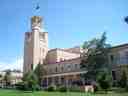
Look for the smooth, tan, adobe-style complex with a tall square tower topped by an open lantern and flags, rising above the trees and lawn. Alright, you’re standing by the…더 보기간략히 보기
Look for the smooth, tan, adobe-style complex with a tall square tower topped by an open lantern and flags, rising above the trees and lawn. Alright, you’re standing by the Bataan Memorial Building, and it’s got one of those Santa Fe talents: looking calm and earthy on the outside while carrying a whole lot of history inside. This was New Mexico’s capitol building for a long stretch-first as the Territorial Capitol starting in 1900, then as the State Capitol from 1912 until 1966, before the round, modern capitol took over nearby. But the story really kicks off with a little mystery. The territory’s earlier capitol building went up in the 1880s… and then burned down just six years later. People suspected arson. It wasn’t insured either, which meant the loss hit hard-over 200,000 dollars back then, roughly 7 million today. So when it came time to rebuild, New Mexico got practical. Architect Isaac Hamilton Rapp designed this new capitol, dedicated June 4, 1900, and it was built on less than 140,000 dollars-about 5 million today-using salvaged materials and unpaid convict labor from the state penitentiary. History can be efficient and uncomfortable at the same time. Originally, this place looked pretty different: three stories, a silver dome, and a fancy neoclassical front porch of sorts-a portico. Some pieces are still hiding in plain sight, like those arched third-floor windows. Over the decades, it kept growing: an annex in 1910, another addition in the early 1920s when the place got so cramped people worked in hallways like it was finals week. And in 1910, these rooms hosted the constitutional convention-New Mexico literally writing itself into statehood. Then, on January 6, 1912 at 1:35 in the afternoon, President Taft signed the paper that made New Mexico the 47th state. The tower you see now came after a big 1949 to 1952 remodel. The dome and original steps were removed, the style was shifted to Territorial Revival, and the tower solved one very practical problem: where to put the flagpole. In 1968, the building was renamed to honor more than 800 New Mexicans who died at Bataan and in the Bataan Death March. If you drift toward the southeast corner of the grounds, there’s a memorial with an eternal flame-quiet, direct, and hard to forget. When you’re set, the New Mexico Supreme Court is a 2-minute walk heading north, and it’ll be on your right.
전용 페이지 열기 →On your right is the New Mexico Supreme Court Building, and it has a very Santa Fe kind of presence: calm, sunlit, and quietly serious… like it’s about to tell you, in a polite…더 보기간략히 보기
On your right is the New Mexico Supreme Court Building, and it has a very Santa Fe kind of presence: calm, sunlit, and quietly serious… like it’s about to tell you, in a polite voice, that your argument needs “a little more support.” This is the highest court in the state-New Mexico’s last word on what the law means. Most of what happens here is appellate work, which is a fancy way of saying the justices review decisions already made in lower courts. They’re not usually calling witnesses or banging gavels for drama. Instead, they’re reading records, hearing arguments, and deciding whether the law was applied correctly. It’s the place where a case might arrive after a long, expensive journey through the system… and then get distilled down into sharp questions and even sharper writing. New Mexico’s relationship with courts starts with a real jolt of history. In 1846, during the Mexican-American War, the United States seized what’s now New Mexico. Santa Fe suddenly became the center of a brand-new American administration, and Brigadier General Stephen Watts Kearny-military governor at the time-set up a provisional civilian government. He appointed Joab Houghton as the first chief justice, alongside Antonio J. Otero and Charles Beaubien. Picture it: a dusty frontier capital, big political stakes, and a brand-new legal system trying to act confident while it’s still unpacking the boxes. When the New Mexico Territory was formally organized in 1850, Congress created a territorial supreme court: a chief justice and two associate justices, later expanded to five. Here’s the twist… those same justices also had to preside over trial courts in the territory’s judicial districts. So sometimes a justice would handle a trial, then later sit on the appeal of that same case. Because obviously that’s the best way to get a fresh, unbiased review. Not surprisingly, Congress eventually required justices to step aside in situations like that. Statehood came on January 6, 1912. Within days, the territorial court shut down and the new state Supreme Court took over under Article Six of the New Mexico Constitution. Over time, the court became not just a place to decide cases, but a backbone for the whole legal system-supervising courts statewide, handling attorney and judge discipline, and taking certain urgent matters directly, like habeas corpus cases and election challenges. Now, let’s talk about how you get one of these five seats. New Mexico does a hybrid of politics and quality control. Justices can be elected statewide, or appointed by the governor if there’s a mid-term vacancy. But after that first stretch, they face retention elections-nonpartisan, thumbs-up-or-down votes. And New Mexico doesn’t do “50 percent plus one.” Since 1994, a justice needs 57 percent to stay. That rule even got challenged in the 1990s, and the court-this court-heard it and dismissed it after only about forty minutes of deliberation. Efficient, if nothing else. If there’s an opening, a bipartisan nominating commission sends the governor a short list, and the governor has thirty days to pick. Miss the deadline? The chief justice gets to make the appointment. Somewhere, a calendar gets taken very seriously. When you’re set, Santa Fe Playhouse is about a 3-minute walk heading south.
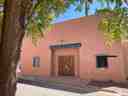
전용 페이지 열기 →Look to your right for a low, earthy-toned adobe-style building with a simple entrance and theater signage tucked close to the sidewalk. This is the Santa Fe Playhouse, and it’s…더 보기간략히 보기
Look to your right for a low, earthy-toned adobe-style building with a simple entrance and theater signage tucked close to the sidewalk. This is the Santa Fe Playhouse, and it’s been keeping the drama alive here since 1919… which, in theater years, is basically ancient. It started when writer and activist Mary Hunter Austin decided Santa Fe needed a “little theater” that wasn’t chasing big money or big ego-just bold, intimate work that could actually take risks. Imagine that. Their earliest shows popped up wherever they could squeeze in an audience: the St. Francis Auditorium over at the New Mexico Museum of Art, then tents at the rodeo grounds, then makeshift stages right on the Plaza. If you’re sensing a theme-yes, this troupe was basically theater’s version of “we’ll make it work.” For a while, they even leaned into melodramas outdoors at a market site that’s now… parking. Civilization is complicated. In 1962, they finally put down roots by leasing and renovating an old livery stable-so, a former home for horses became a home for humans pretending to be other humans. That building is what you’re standing by now, right here in the Barrio de Analco area at 142 East De Vargas Street. Over the decades it wore a few names-Santa Fe Little Theatre, Santa Fe Community Theater-until it landed on Santa Fe Playhouse in 1997. Today, it’s still a nonprofit professional stage, led by Artistic Director Robyn Rikoon and Executive Director Colin Hovde… keeping the experiment going, one night at a time. When you’re set, the Barrio de Analco Historic District is a 1-minute walk heading east.
전용 페이지 열기 →

11개 정류장 더 보기정류장 적게 보기expand_moreexpand_less
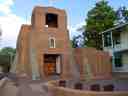
In front of you, look for the chunky, earth-brown adobe church with a squared-off bell tower and big wooden doors set into thick walls. Welcome to the Barrio de Analco Historic…더 보기간략히 보기
In front of you, look for the chunky, earth-brown adobe church with a squared-off bell tower and big wooden doors set into thick walls. Welcome to the Barrio de Analco Historic District... a small patch of Santa Fe that quietly refuses to act its age. This neighborhood sits just south of the Santa Fe River, and that river line mattered: for centuries, the power and money tended to cluster on the other side, while this side was where working people built lives with their hands. “Analco” comes from Nahuatl, the language spoken by Tlaxcaltec people who traveled with the Spanish. It basically means “place next to the water.” Practical naming, right? When your day depends on a stream, you don’t get cute about it. What makes this district special is how much time is stacked into a few short blocks. You’ve got buildings that show Santa Fe evolving in real materials: early native adobe forms, then Spanish Pueblo style homes in the 1700s, and later the Territorial look that started mixing in more Anglo-American ideas before New Mexico was even a state. Two heavy-hitters anchor the place: San Miguel Mission, dating to 1710 on a site used for worship since the 1610s, and the so-called “Oldest House,” an adobe home built around 1620 that’s now a museum. In 1968, this cluster earned National Historic Landmark status... which is the government’s way of saying, “Okay, yes, we should probably not mess this up.” Ready for San Miguel Mission? Just head east for 0 minutes.
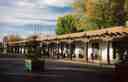
전용 페이지 열기 →On your right, look for the long, low adobe building with a deep wooden porch lined by chunky posts and dark beams, stretching almost the whole block like it’s calmly claiming the…더 보기간략히 보기
On your right, look for the long, low adobe building with a deep wooden porch lined by chunky posts and dark beams, stretching almost the whole block like it’s calmly claiming the Plaza. This is the Palace of the Governors, and if these mud-plastered walls could talk… they’d probably ask for a lozenge first. The Palace has been running Santa Fe’s “front desk” since the earliest days of Spanish rule-officially set up as the capital building in 1610, when Governor Pedro de Peralta got construction moving (some historians argue it really took shape closer to 1618). Either way, it’s old enough to make most American history feel like a new hobby. Stand here a moment and take in the Territorial Style-thick adobe, that long portal, the way the whole building sits low and wide, built for sun, wind, and the kind of high-desert weather that changes its mind before lunch. Archaeologist Jesse Nusbaum, brought in during a 1909 restoration, loved that the Palace didn’t fight the landscape. He wrote that it was shaped by the climate, matched to the “earth and sky.” In Santa Fe, blending in is kind of the flex. But the real drama is what this place has witnessed: the Pueblo Revolt in 1680, the Spanish return in 1693-1694, Mexican independence in 1821, the U.S. taking New Mexico as a territory in 1848, and finally statehood in 1912. For centuries, whoever held power tended to do it from right here-because nothing says “authority” like an adobe headquarters on the Plaza. And then there’s the moment that feels almost cinematic. In the late 1870s, Governor Lew Wallace-yes, the guy who wrote Ben-Hur-worked here. One night in spring 1879, after a tense meeting with Billy the Kid out in Lincoln County, a thunderstorm rolled in. Picture it: shutters closed, lamp shaded, Wallace writing the Crucifixion scenes… while worrying someone might put a bullet through the window. Productivity, Santa Fe style. From 1909 until 2009, this building served as the state history museum, and it’s been a National Historic Landmark since 1960-so beloved it even got its own turquoise postage stamp that same year. When you’re set, Soldiers’ Monument is a 1-minute walk heading west.
전용 페이지 열기 →On your right, look for the big adobe-colored hotel with stepped Pueblo-style walls, dark wooden beams sticking out like little eyebrows, and warm yellow-lit windows stacked up…더 보기간략히 보기
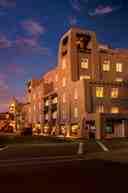
On your right, look for the big adobe-colored hotel with stepped Pueblo-style walls, dark wooden beams sticking out like little eyebrows, and warm yellow-lit windows stacked up several stories. This is La Fonda on the Plaza... and if Santa Fe hotels had a family reunion, this one would be sitting at the head of the table, quietly judging everyone’s remodeling choices. “La Fonda” just means “the inn” in Spanish, but don’t let the humble name fool you. Since 1609, travelers have been bedding down on this exact spot, which is kind of an impressive run for a corner of real estate. You’re standing where two legendary routes basically shook hands: El Camino Real, the long road linking Mexico City northward, and the Old Santa Fe Trail, an 800-mile trade line that hauled people and goods from Missouri all the way to Santa Fe... until the railroad showed up in the 1880s and changed the rules. There was an earlier hotel here called the United States Hotel, nicknamed “La Fonda Americana” by locals... and then it burned in 1912. Santa Fe being Santa Fe, the response was not “let’s build a boring box.” In 1920, a local builders group sold stock to fund a new hotel, and they hired Isaac Hamilton Rapp, the guy often credited with shaping what people now think of as the “Santa Fe style.” He went full Pueblo Revival-forms inspired by Indigenous Pueblo architecture-and the result is basically what you see now: rounded corners, thick-looking walls, and a silhouette that feels grown rather than constructed. After a rocky early stretch, the Santa Fe Railway bought the place in 1925 and doubled down on atmosphere. Local muralists started painting the interiors, and designer Mary Colter reworked the look with exposed vigas-those ceiling beams-and colorful Mexican tile, leaning into Spanish and Native Southwest design without turning it into a theme park. Later, the Fred Harvey Company ran La Fonda as a premier “Harvey House,” steering tourists into the Southwest with their famous “Indian Detours” starting in 1926-guided cultural trips to nearby Pueblos. The hotel kept that role until 1969, and it’s still a proud show-off about its art: docent-led tours here even won a Top HAT award in 2015. And yes, this place has a cinematic streak-film noir was shot here, and a thriller novelist even checked a murderer in. Just what you want from a luxury hotel: great service and excellent alibis. When you’re ready, Lensic Theater is a 4-minute walk heading west, and it’ll be on your right.
전용 페이지 열기 →On your left, look for the sturdy two-story stone courthouse with pale trim, arched window details near the roofline, and a small columned entrance porch tucked into the corner by…더 보기간략히 보기
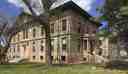
On your left, look for the sturdy two-story stone courthouse with pale trim, arched window details near the roofline, and a small columned entrance porch tucked into the corner by the lawn and trees. This is the Santiago E. Campos United States Courthouse… a building with the calm, official vibe of a place where arguments go to get organized. It started life with much bigger ambitions. Back in the early U.S. territorial days, this was supposed to be New Mexico’s “state house,” basically the capitol-to-be. After the Treaty of Guadalupe Hidalgo in 1848 brought this region under U.S. control, the territorial government showed up soon after, and Congress put real money behind the idea: first $20,000 in 1851, then another $50,000 in 1854… roughly about $800,000 and $1.9 million today. Not pocket change. Not exactly “sure, let’s see where this goes,” either. Plans came out of the U.S. Treasury’s architect, Ammi B. Young-one of those 19th-century federal guys who could drop a Greek temple look onto pretty much any American town. Construction began in 1853, and at first, things moved… then reality showed up. Funding was tight, skilled workers were hard to come by, and the Civil War years didn’t exactly help with focus or budgets. So the walls climbed to about a story and a half…and then the project just sort of sat here, half-finished, like a sentence with no period. Then comes one of my favorite Santa Fe twists. In 1883, the grounds around this unfinished shell became party central for the city’s “Tertio-Millennial” celebration. They slapped on a temporary roof, cleared the site, and even laid out an oval racetrack around it-about a third of a mile loop. If you’re noticing the stone wall and metal railings tracing an odd curve out there, that’s why. And yes, during the festivities, Indian participants were housed on the first floor. It’s a detail that lands heavy-celebration on the outside, complicated power dynamics on the inside. The building finally got finished in 1889… and promptly DID NOT become the state house. Instead, it became a federal court building, starting with a land claims court, and it’s hosted federal justice in different forms ever since. New Mexico didn’t become a state until 1912, and the actual territorial capitol got built somewhere else later on. Architecturally, it’s a handsome mash-up. You’ve got that Greek Revival confidence-pediments, porticos, classical symmetry-plus later touches that hint at the late-1800s taste for Renaissance-style window treatments. The stone itself is local muscle: rough-cut rock quarried up near Hyde Park in the Sangre de Cristo Mountains, with more neatly dressed stone brought in from the Cerrillos area. In 1929 and 1930, when the courts needed more space, the government added a north wing designed to match, connected by a vestibule with an elegant interlocking cantilevered stair-engineering that basically says, “Yes, we can float a staircase… and we’re going to.” Out front, there’s also history in monument form: an 1884 sandstone obelisk honoring Kit Carson, unveiled with around 5,000 people watching. Inside, near the entrances, six landscape murals went up in 1938-WPA-era public art by William Penhallow Henderson, a major figure in Santa Fe’s art world. By the early 2000s, the building needed serious care, and a major restoration cleaned stonework, revived those big bronze doors, and quietly reinforced the roof structure with hidden steel so it wouldn’t, you know… eventually collapse. Always a nice feature in a courthouse. When you’re set, the Scottish Rite Temple is a 4-minute walk heading east.
전용 페이지 열기 →On your right, look for the big pink stucco complex with a square tower and a deep arched entry, reached by a wide set of steps under a red tile roof. Alright, you’ve found one…더 보기간략히 보기
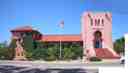
On your right, look for the big pink stucco complex with a square tower and a deep arched entry, reached by a wide set of steps under a red tile roof. Alright, you’ve found one of Santa Fe’s boldest architectural choices… and yes, it’s pink. Not “sort of rose in the sunset” pink-more like “we meant to do this” pink. This is the Scottish Rite Temple, sometimes called the Scottish Rite Cathedral, started in 1911 and finished in 1912, back when organizations like this were part social club, part civic network, and part “we’ve got a meeting tonight, wear something nice.” The fun twist is how it got designed. In 1909, the local paper announced architect Isaac H. Rapp got the job. Rapp was a big deal around here-offices in New Mexico and Colorado-so it sounded settled. The paper even ran a fancy drawing of his plan: grand, Neo-classical, all dignity and columns. Then… just a week later, the same paper reported his plans were, basically, “not satisfactory.” Ouch. So Santa Fe hired the Los Angeles firm Hunt and Burns instead. They leaned into a Moorish Revival look-loosely inspired by a gatehouse at the Alhambra in Spain, with that horseshoe-style arch and fortress-like tower. The idea was a kind of architectural family tree: Spanish traditions in New Mexico, traced back to Moorish Spain. And if the tower feels familiar, that’s because it echoes other Hunt and Burns work from the same era. The building’s had a second life too-Hollywood rolled cameras here for Tina Fey’s 2016 film Whiskey Tango Foxtrot. And in 1987, it landed on the National Register of Historic Places… officially confirming that yes, the pink stays.
전용 페이지 열기 →
자주 묻는 질문
투어는 어떻게 시작하나요?
구매 후 AudaTours 앱을 다운로드하고 교환 코드를 입력하세요. 투어를 바로 시작할 수 있습니다 - 재생을 탭하고 GPS 안내 경로를 따라가시면 됩니다.
투어 중 인터넷이 필요한가요?
아닙니다! 시작 전에 투어를 다운로드하면 완전히 오프라인으로 즐길 수 있습니다. 채팅 기능만 인터넷이 필요합니다. 모바일 데이터 절약을 위해 WiFi에서 다운로드하시는 것을 권장합니다.
이것은 가이드가 안내하는 단체 투어인가요?
아닙니다 - 이것은 셀프 가이드 오디오 투어입니다. 폰을 통해 오디오 나레이션을 들으며 나만의 속도로 독립적으로 탐험합니다. 투어 가이드도, 단체도, 일정도 없습니다.
투어는 얼마나 걸리나요?
대부분의 투어는 60-90분이 소요되지만, 속도는 전적으로 본인이 조절합니다. 원할 때 언제든지 일시정지하거나, 정류장을 건너뛰거나, 휴식을 취하세요.
오늘 투어를 끝낼 수 없으면 어떻게 하나요?
괜찮습니다! 투어는 평생 이용이 가능합니다. 원할 때 언제든지 일시정지하고 다시 시작하세요 - 내일, 다음 주, 또는 내년에도. 진행 상황이 저장됩니다.
어떤 언어를 이용할 수 있나요?
모든 투어는 50개 이상의 언어로 이용 가능합니다. 코드를 교환할 때 원하는 언어를 선택하세요. 참고: 투어 생성 후에는 언어를 변경할 수 없습니다.
구매 후 투어는 어디에서 이용하나요?
App Store 또는 Google Play에서 무료 AudaTours 앱을 다운로드하세요. 교환 코드(이메일로 전송됨)를 입력하면 라이브러리에 투어가 나타나며, 다운로드하여 시작할 수 있습니다.
투어가 마음에 들지 않으시면 환불해 드립니다. 문의: [email protected]
안전한 결제 


