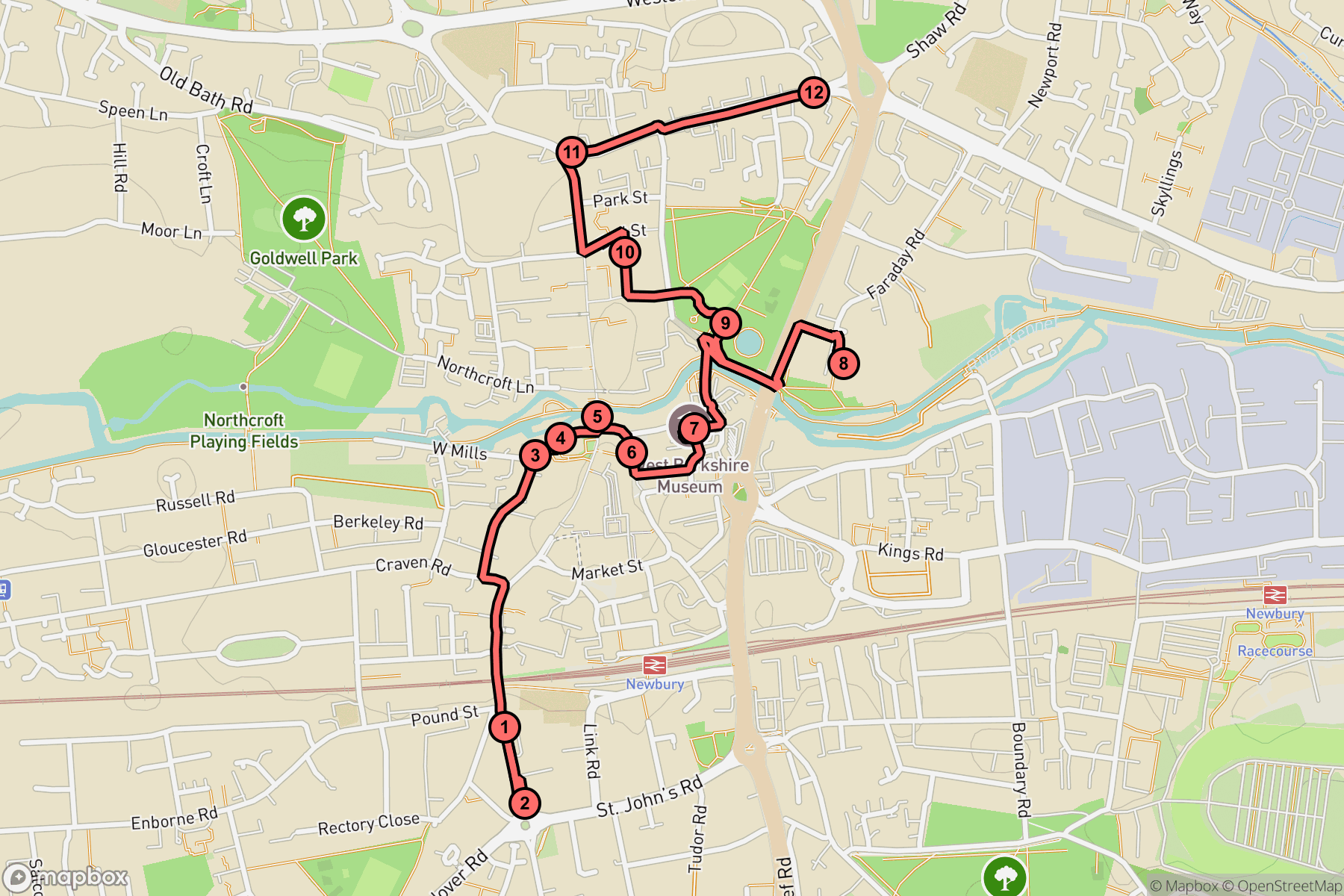
뉴버리 오디오 투어: 교회, 역사, 그리고 숨겨진 장소 투어
한때 대포 소리가 뉴버리의 조용한 골목을 가로질러 울려 퍼졌고, 수세기 동안의 자갈길 아래에 비밀을 남겼습니다. 일상의 번잡함 아래, 오래된 도시는 사라진 전투, 왕실의 음모, 그리고 묘지 그림자 속 속삭임으로 가득합니다. 이 셀프 가이드 오디오 투어는 여러분의 산책을 눈에 보이지 않는 숨겨진 이야기를 찾는 여정으로 바꿉니다. 한 걸음 한 걸음 내딛을 때마다 대부분의 사람들이 알아채지 못하는 미스터리에 더 가까워집니다. 왜 성 니콜라스 교회를 성난 폭도들이 횃불과 절박한 희망만으로 포위했을까요? 어둠이 내린 빅토리아 공원의 고요한 심장에는 어떤 잃어버린 메시지가 남아있을까요? 마을 중심의 표식 없는 돌이 귀족의 화려한 몰락 뒤에 숨겨진 진실을 밝혀낼 수 있을까요? 교회 종소리가 울려 퍼지는 동안 잊혀진 불화를 풀어보세요. 전설과 정치적 음모로 가득한 강둑을 건너세요. 역사가 예상치 못하게 뒤틀리고 비밀 통로를 통해 생명이 약동했던 길을 따라가 보세요. 지금 바로 모험을 시작하고 뉴버리의 알려지지 않은 드라마에 빠져들어 보세요.
투어 미리보기
이 투어에 대하여
- schedule소요 시간 40–60 mins나만의 속도로 이동
- straighten3.8 km 도보 경로안내 경로 따라가기
- location_on
- wifi_off오프라인 작동한 번 다운로드, 어디서든 사용
- all_inclusive평생 이용언제든지 다시 재생 가능
- location_on리튼 예배당에서 시작
이 투어의 정류장
Right, take a look at Litten Chapel-the old soul of Newbury hiding in plain sight. You’re standing before what looks, at first glance, like a humble building, but this place has…더 보기간략히 보기
Right, take a look at Litten Chapel-the old soul of Newbury hiding in plain sight. You’re standing before what looks, at first glance, like a humble building, but this place has been quietly collecting stories since the early 1500s. Litten Chapel was part of the medieval hospital of St Bartholomew-not the kind of hospital with x-rays and hand sanitizer, mind you, but a sanctuary for the poor, the sick, and the odd wandering soul. Back then, folks would come not just for a healing hand, but for a priest to sing prayers and keep the spiritual fires burning. Picture it: you’d have heard the soft murmurs of prayer, the shuffle of feet on flint rubble floors, the smell of old wood and perhaps, if we’re honest, a bit of must. The most impressive part, hidden up top, are those carved timber roof trusses-uncovered in the 1980s and still managing to outdo most modern carpentry. They survived centuries while Newbury outgrew narrow lanes, lost monarchs, and even-brace yourself-a road-moving project in the 1820s that lopped off half the chapel so the street could breathe. This whole place is protected now-Grade II* listed status and all-which means you’re legally not allowed to nick any bricks as souvenirs. The plan is to eventually turn it into a home, so, if you’ve ever dreamed of living in a medieval hospital with a Grade II* pedigree, you might want to get in early. When you’re ready, just stroll south for about three minutes and you’ll come to St John the Evangelist Church.
전용 페이지 열기 →Picture this: it’s 1943, the thick of World War II, and Newbury suddenly finds itself on the frontlines-not with soldiers, but with falling bombs. St John the Evangelist Church, a…더 보기간략히 보기
Picture this: it’s 1943, the thick of World War II, and Newbury suddenly finds itself on the frontlines-not with soldiers, but with falling bombs. St John the Evangelist Church, a grand Victorian beauty designed by William Butterfield, stood proud here… until a single German air raid turned it to rubble overnight. You can almost imagine the early morning hush, then chaos as history quite literally shattered. But Newbury’s folks, as stubborn as the River Kennet in flood season, didn’t give up. They rolled up their sleeves, raised funds-roughly several thousand pounds back then, which, if you’re counting, would crack six figures in today’s dollars-and rebuilt. The “new” St John’s rose from the ashes in 1955, thanks to Stephen Dykes Bower. Look close, and you’ll spot stained glass rescued from the ruins, and, believe it or not, more than 750,000 hand-made bricks-all set by hand, with every one a small act of hope. Grade II listed, St John’s is more than just a church-it’s a survivor’s story in stone and glass. When you’re ready, just head west for about eleven minutes to St Nicolas Church, Newbury.
전용 페이지 열기 →Alright, look to your right-St Nicolas Church casts an impressive shadow on Newbury’s story... and, frankly, on the pavement too. This isn’t your garden-variety parish church.…더 보기간략히 보기
Alright, look to your right-St Nicolas Church casts an impressive shadow on Newbury’s story... and, frankly, on the pavement too. This isn’t your garden-variety parish church. Standing here, squinting up at those towering pinnacles and the confident sweep of the nave, you’re seeing one of England’s finest examples of Perpendicular Gothic, all clean vertical lines and giant windows. In the old days, that was architectural code for: “we’re serious about God, and we might just outshine the neighbors while we’re at it.” The church is dedicated to Saint Nicholas-yes, that Nicholas, jolly inspiration for Santa Claus, except here he’s less about chimneys and more about 4th-century bishop duties. People have been worshipping on this spot since Norman times. There’s paperwork from 1086, back when “document” meant someone with a very steady hand and a lot of patience. By the early 1500s, the place you see now began to rise-thanks, believe it or not, to a local cloth merchant named Jack of Newbury. He’s rumored to have paid for everything from the pulpit to the tower. Considering the cost of stones, labor, and those intricately carved arches, Jack must’ve spent what would now be the modern equivalent of millions of dollars-quite a charitable investment, and one way to make your mark on history. Take a glance at the detailing overhead-the roof’s crenellated, with little battlements, and the bell tower is bristling with pinnacles. These details? Courtesy of Victorian restoration-because no era could resist putting its stamp on a local landmark. The bells themselves have their own genealogical tree, some cast centuries ago, some born younger, all ringing out in the key of D. There’s always something musical going on here, by the way-a tune originally called “Newbury” even sneaked its way into the English hymnal. You’ll find the big three-light stained glass windows on each side, glowing best when the sunlight cares enough to stop by. Check out the pulpit if you wander inside: it dates back to 1607, an honest piece of Jacobean craftsmanship, older than most countries. From royal marriages to local legend, St Nicolas has seen everything this town can throw at it, and it’s still bustling-some Sundays, it fills up with nearly 300 people. Not bad for a spot that’s survived reformations, restorations, and the odd pigeon invasion. If you’re ready for your next stop, Newbury Bridge is just a 2-minute walk heading northeast.
전용 페이지 열기 →
9개 정류장 더 보기정류장 적게 보기expand_moreexpand_less
Alright, take a good look at Newbury Bridge just to your left. Looks solid and unassuming, right? But this one’s done its fair share of heavy lifting. First, the basics: this is…더 보기간략히 보기
Alright, take a good look at Newbury Bridge just to your left. Looks solid and unassuming, right? But this one’s done its fair share of heavy lifting. First, the basics: this is what locals call the Town Bridge-or, if you’re feeling old-fashioned, Kennet Bridge. It connects the north and south bits of Newbury, taking you from Northbrook Street into Bartholomew Street, right across the River Kennet. Here’s where things get interesting. The spot you’re standing on has hosted a bridge since the Middle Ages. The earliest mention pops up in 1312-when King Edward II decided folks really ought to look after it. Imagine a royal decree just to keep your commute smooth. Back then, the bridge was made of wood, and by 1623, it was looking pretty busy... in fact, it had actual shops plonked on top. That little market set-up was all well and good until one February morning, when the whole thing promptly collapsed. Not exactly what you want from your local infrastructure. They rebuilt it-can’t keep a resilient market town down-but the Kennet always had its eye on unwary bridges. In 1726, yet another wooden version was swept clean away by floods, which must've been a real Monday-morning disaster. For context, a rebuild back then might set you back a few hundred pounds-a sum that’d be over $50,000 in today's money. What you see today is the upgraded model, put together in the late 1700s. Stone. Brick. Three arches, though only the center one is clear now-flanking buildings have hidden the rest like a magician’s trick. When the canal system rolled in, barges floated under this very bridge, and with no towpath underneath, crews had to improvise. They’d float long ropes down and reattach them on the other side. Over time, the ropes literally wore grooves into the stone-if you squint, you can still spot them. This spot’s seen its fair share of action, from civil war stand-offs in the 1600s to Second World War contingency plans. Back then, they feared a German bomb might take this bridge out-so they built a temporary American Bridge a short walk downstream, like having a backup plan for your backup plan. Alright, enough staring at this stoic workhorse. When you’re ready, Newbury Lock is just 2 minutes north. Let's wander that way.
전용 페이지 열기 →Alright, take a good look at Newbury Lock on your left - she’s not just a pretty bit of brickwork. Built in the late 1700s, this lock is part of the grand old Kennet and Avon…더 보기간략히 보기
Alright, take a good look at Newbury Lock on your left - she’s not just a pretty bit of brickwork. Built in the late 1700s, this lock is part of the grand old Kennet and Avon Canal. Think of this as the historic “elevator” for boats, raising and lowering them by just over a meter - about three and a half feet, for our American friends. Quite the feat for 1796, when it was all bricks, Bath stone caps, and not a whiff of modern machinery in sight. Engineered by John Rennie - a bloke who practically invented ‘big infrastructure’ in the age of bonnets and breeches - this lock made Newbury a gateway between London and Bristol. In today’s money, the original canal project cost millions of pounds - picture laying out enough cash to buy several modern mansions, just to shuttle boats and cargo along. Not your average weekend DIY, is it? And don’t miss Peter Randall-Page’s ‘Ebb and Flow’ sculpture nearby. As the lock fills, water whooshes underground and bubbles up in the granite bowl - a sort of modern art wink to the old engineering below. Ready for Newbury, Berkshire? Just head east for about 4 minutes.
전용 페이지 열기 →You’re looking at Newbury, the sort of town where the air is fresh but the stories are anything but old and dusty. Market town, council hotshot, a natural beauty tucked right into…더 보기간략히 보기
You’re looking at Newbury, the sort of town where the air is fresh but the stories are anything but old and dusty. Market town, council hotshot, a natural beauty tucked right into the River Kennet valley, it’s almost equidistant from Oxford, Winchester, and Reading-handy, if you want to flee from city traffic to somewhere pretty, but not too sleepy. Let’s set the scene. Newbury is perched on the edge of the Berkshire Downs... and I mean that in both a geographic and a “how much drama can one small town hold?” sense. Monarchs hunted and plotted here, the cloth trade spun fortunes and then collapsed, and legends like Jack of Newbury ran what was arguably England’s first factory, cranking out cloth by the yard in the 1500s. Now, imagine making a suit in a single day, starting with a sheep out in the field. Locals did exactly that, thanks to a wager-you could say “project management” was alive and well before Gantt charts were invented. Things heated up again in the English Civil War, with not one but two battles fought right around town. Cannon smoke, the sound of hooves-the kind of thing that leaves more than a mark. Donnington Castle, just north, still broods in ruins after the Second Battle of Newbury in 1644. Of course, Newbury didn’t get out of the industrial revolution unscathed. The canal brought boats, then the railways brought even more (and took away more than a few jobs). By the 1800s, the town’s coaching inns were bustling, especially the George & Pelican-look for that soon, big enough to stable 300 horses with rooms for travelers desperate for a break from London's grime. Around 1795, magistrates concocted the Speenhamland System there, tweaking poor relief payments to the price of bread. Not exactly the stuff of Netflix drama, but crucial if you liked eating. In today’s terms, those bread-based welfare payouts would be a pittance-think $30, maybe, for an entire week’s food. Newbury saw darker days too. During World War II, the skies weren’t always friendly. In 1943, a German bomber dropped eight bombs with barely a warning. St John’s Church was reduced to just its altar, and schools and almshouses suffered serious damage-fifteen dead, dozens more injured. But the town rebuilt and kept moving. Today, Newbury is headquarters for West Berkshire Council, codirector of high-tech corridors, and home to Vodafone's glass-palace offices. If all that’s too modern for your taste, there’s always the medieval Cloth Hall, the grandeur of St Nicolas Church, and a market square that still feels lively on a sunny Saturday. From ancient ploughs and ruined castles to telecommunication giants, Newbury wears its history close to the skin-maybe a little frayed at the edges, but that’s what makes it interesting. Whenever you’re ready, set off east toward West Berkshire Museum-it’s just steps away.
전용 페이지 열기 →Here it is-the West Berkshire Museum, where Newbury packs centuries into a surprisingly stylish blend of old and new. Picture this: The core building, called the Cloth Hall, has…더 보기간략히 보기
Here it is-the West Berkshire Museum, where Newbury packs centuries into a surprisingly stylish blend of old and new. Picture this: The core building, called the Cloth Hall, has stood here since 1627. Back then, Richard Emmes, a skilled carpenter from nearby Speenhamland, was putting the finishing touches on what was essentially a designer factory for handmade cloth. If you were peddling wool in the 17th century, this was your equivalent of Wall Street. But the place has done some serious moonlighting over the years-a workhouse, a hospital, even a school. In the 1800s, it swapped textiles for wheat, storing corn instead. Now, after an eye-watering renovation costing 2.2 million pounds (which would be about 3.5 million USD today), you’ve got vibrant galleries, a café, and a treasure trove of West Berkshire stories. Jack O’Newbury, a local cloth legend, even gets a mention. So, after a taste of history, ready for a bit of modern sport? Just walk north for 9 minutes, and you’ll hit Newbury F.C.
전용 페이지 열기 →Alright, on your left you’ll spot the home of Newbury Football Club-the kind of place where the cheers on a Saturday could rattle the windows of nearby kitchens, and half the town…더 보기간략히 보기
Alright, on your left you’ll spot the home of Newbury Football Club-the kind of place where the cheers on a Saturday could rattle the windows of nearby kitchens, and half the town seems to know who scored last week. Now, Newbury F.C. isn’t one of those old clubs with faded sepia team photos in every pub. It’s very much a 21st-century story-born in 2002, which in footballing years makes it basically a teenager. But, teenagers can be quite feisty, can’t they? This club proved it by winning their first league in their very first season, back when they were Old London Apprentice-the sort of underdog success that, in football legend, usually comes with a stirring soundtrack and a Hollywood montage. Within a few short years, they shot their way up the divisions-mixing ambition, local grit, and probably a fair bit of mud. By 2007, Newbury F.C. picked up the pieces from the folded A.F.C. Newbury, taking over its youth teams and, let’s be honest, keeping the dream alive for boot-clad ten-year-olds across town. In 2011-12, they had a golden run, winning their league and securing promotion. There were promotions, cup runs... and a few hard knocks too, like in 2015 when financial headwinds forced them down a tier. Money troubles in amateur football might sound dull, but back then, even a few thousand pounds-maybe $6,000 in today’s dollars-was enough to make or break a season. Then there’s the emotional bit-Faraday Road, their home ground. For decades, this was the patch where Newbury’s football heart beat loudest. It’s tough to imagine: in 2016 the team had to leave, and then in 2021, a fire scorched their old clubhouse. But after an eight-year campaign-think of it as a sporting epic-they finally returned home in November 2024. Makes a person want to believe in second chances. Records might mention reaching the FA Cup preliminaries in 2011, or a 7-2 thrashing of Eldon Celtic to seal a league title. But here, it’s really about community-kids in oversized kits, Saturday drama, and locals stubbornly defending a little square of grass on the edge of Newbury. When you’re ready for some green space, Victoria Park, Newbury is a 7-minute walk northwest.
전용 페이지 열기 →Alright, take a look to your left-here’s Victoria Park, Newbury’s green and lively playground. These days you’ll find all sorts: a bandstand where you might catch a brass band on…더 보기간략히 보기
Alright, take a look to your left-here’s Victoria Park, Newbury’s green and lively playground. These days you’ll find all sorts: a bandstand where you might catch a brass band on a sunny Sunday, neatly-lined tennis courts, and a boating lake that kids splash around in come summer. There’s even a skatepark if you fancy watching some questionable acrobatics......mixed with the sound of wheels rattling across the concrete. But if you rewind to the 1800s, this wasn’t Victoria Park at all-it was simply called “The Marsh.” Back then, it really earned its name; the area was swampy and, oddly enough, you had every right to graze your cow right here. That gave way to smarter landscaping, a name change, and eventually the addition of a rather regal touch: Queen Victoria herself. Well, her statue, anyway. She was moved here in the 1960s, after being shuffled about town since 1903. Now, let’s talk war and a bit of local improvisation. During World War II, fear of bombing made the main bridge in town seem a risky crossing. So, the town threw up a “temporary” bridge over the canal-blueprints stamped by the American Army, although the job was all local hands. The “American Bridge,” as folks stubbornly called it, was built worryingly low-at just seven feet. Apparently, the only thing it was good at keeping out was tall people......Still, the bridge stuck around until 2001. Not bad for something meant to last a few months. Alright, when you’re ready, Parkway Newbury is just a 2-minute walk heading southwest.
전용 페이지 열기 →Alright, on your left you’ve got Parkway Newbury-a modern splash of glass and style right in the heart of town. It’s hard to picture now, but back in 2004, this was just plans on…더 보기간략히 보기
Alright, on your left you’ve got Parkway Newbury-a modern splash of glass and style right in the heart of town. It’s hard to picture now, but back in 2004, this was just plans on paper and a jumble of aging buildings. The council actually had to buy up quite a bit of land-using compulsory purchase orders, no less. Property folks don’t exactly pop champagne over that sort of thing. Fast-forward to 2011: Parkway swings open its doors with nearly 50 shops, food spots, and a rather serious car park-enough spaces that even on the holiday rush, you can probably wedge in somewhere. It’s anchored by Marks & Spencer, which British folks will tell you is basically everything under one big roof-socks and salmon side by side. And above all that hustle? Over a hundred luxury flats-with terraces, balconies, and a few views that’d make even a Victorian tip their hat. So, whether you’re here to browse, eat, or imagine life above it all, Parkway is very much Newbury’s bold, new chapter. Alright, ready for a touch of history and maybe a pint
전용 페이지 열기 →Take a look at the George and Pelican Inn on your right - or what’s left of one of the most legendary pit stops along the old London to Bath road. Back in the seventeenth century,…더 보기간략히 보기
Take a look at the George and Pelican Inn on your right - or what’s left of one of the most legendary pit stops along the old London to Bath road. Back in the seventeenth century, this place was the “last chance saloon” for tired travelers, hungry riders, and anyone in need of a good story or a strong drink. It actually started as two competing inns: The George and The Pelican. Think of them as neighbors who never quite decided which fence was whose. Eventually, they joined forces, though each kept its own flavor: maybe one specialized in ale, the other in hearty pies - a sort of early British drive-thru if you like. In 1784, King George the Third himself dropped in - the kind of guest who didn’t exactly blend in. The place would have been buzzing, with locals craning their necks to catch a royal glimpse. A few decades later, radical William Cobbett attracted over 200 people for a meeting that spilled right out into the street, likely cutting into the inn’s profits on ale but raising a fair few voices for reform. Alright, ready to stroll again
전용 페이지 열기 →Right here on your right, you’ll spot St Joseph’s Church-handsome and quietly self-assured at the junction of London Road and Western Avenue. Even if you’re not in the habit of…더 보기간략히 보기
Right here on your right, you’ll spot St Joseph’s Church-handsome and quietly self-assured at the junction of London Road and Western Avenue. Even if you’re not in the habit of noticing church architecture, this place makes you pause. It’s a local landmark for good reason. So, what’s the story? Well, rewind to the mid-1800s. Back then, the Catholic population in Newbury was so small, they basically started out in a regular house-number 105 London Road-with their priest doubling up as both spiritual leader and, rather bravely, headteacher. Resourceful doesn’t even cover it. Soon enough, they managed to cobble together a church next to the house for £800-a princely sum in those days. If you adjust for inflation, that’s roughly £120,000 or $150,000 today. For a ‘small’ church, that was no small feat. But by the roaring 1920s, Newbury’s Catholics had outgrown their home. Enter Canon Francis Green-a man with the nerve to fundraise at the racecourse, collaring punters just as they were leaving the thrill of the track. Imagine that: “Hello, did you win big? Care to share with the Lord?”. The new church’s foundation stone went down in 1926, and just two years later, Wilfred Clarence Mangan’s Italianate masterpiece was complete-local firm Hoskings & Pond made sure it all stood the test of time. The final bill? Around £20,000 then-a jaw-dropping half a million pounds, give or take, in today’s money. Today the church is still a vibrant piece of local life, with Mass every day and the doors open to new stories and old souls alike. A cornerstone of the community-literally. Not a bad place to end our wanderings, wouldn’t you say?
전용 페이지 열기 →
자주 묻는 질문
투어는 어떻게 시작하나요?
구매 후 AudaTours 앱을 다운로드하고 교환 코드를 입력하세요. 투어를 바로 시작할 수 있습니다 - 재생을 탭하고 GPS 안내 경로를 따라가시면 됩니다.
투어 중 인터넷이 필요한가요?
아닙니다! 시작 전에 투어를 다운로드하면 완전히 오프라인으로 즐길 수 있습니다. 채팅 기능만 인터넷이 필요합니다. 모바일 데이터 절약을 위해 WiFi에서 다운로드하시는 것을 권장합니다.
이것은 가이드가 안내하는 단체 투어인가요?
아닙니다 - 이것은 셀프 가이드 오디오 투어입니다. 폰을 통해 오디오 나레이션을 들으며 나만의 속도로 독립적으로 탐험합니다. 투어 가이드도, 단체도, 일정도 없습니다.
투어는 얼마나 걸리나요?
대부분의 투어는 60-90분이 소요되지만, 속도는 전적으로 본인이 조절합니다. 원할 때 언제든지 일시정지하거나, 정류장을 건너뛰거나, 휴식을 취하세요.
오늘 투어를 끝낼 수 없으면 어떻게 하나요?
괜찮습니다! 투어는 평생 이용이 가능합니다. 원할 때 언제든지 일시정지하고 다시 시작하세요 - 내일, 다음 주, 또는 내년에도. 진행 상황이 저장됩니다.
어떤 언어를 이용할 수 있나요?
모든 투어는 50개 이상의 언어로 이용 가능합니다. 코드를 교환할 때 원하는 언어를 선택하세요. 참고: 투어 생성 후에는 언어를 변경할 수 없습니다.
구매 후 투어는 어디에서 이용하나요?
App Store 또는 Google Play에서 무료 AudaTours 앱을 다운로드하세요. 교환 코드(이메일로 전송됨)를 입력하면 라이브러리에 투어가 나타나며, 다운로드하여 시작할 수 있습니다.
투어가 마음에 들지 않으시면 환불해 드립니다. 문의: [email protected]
안전한 결제 



