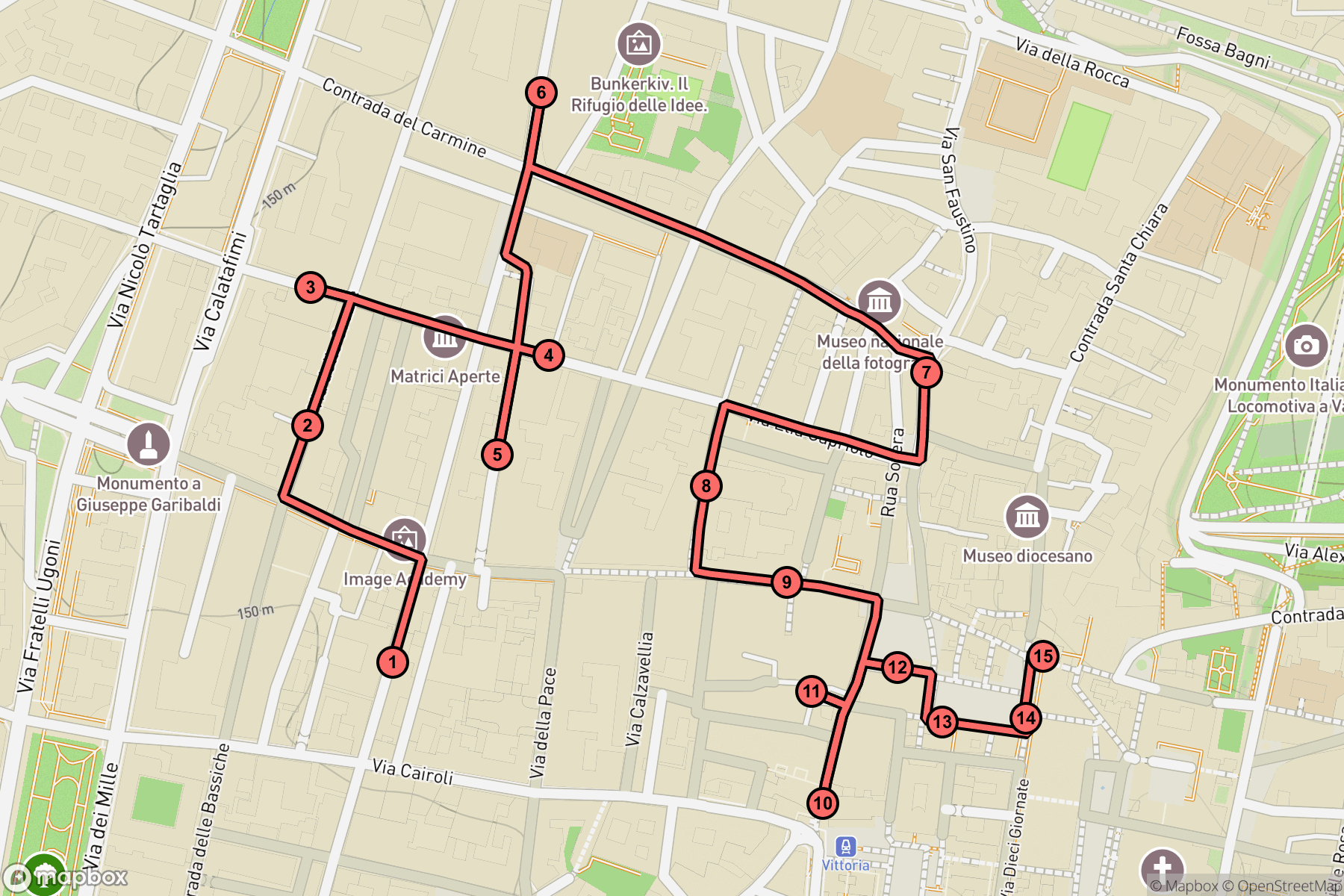
브레시아 오디오 투어: 성소에서 광장까지
프레스코화로 장식된 둥근 천장에서 돌 성인들이 내려다보고, 브레시아의 번화한 거리 아래로는 조용한 비밀들이 물결칩니다. 이 고대 돔 아래, 한때 촛불 밝힌 복도에서는 음모가 울려 퍼졌습니다. 이 셀프 가이드 오디오 투어는 붐비는 지도를 벗어나 알려지지 않은 이야기들이 머무는 숨겨진 성소로 여러분을 안내합니다. 모든 정류장은 대부분의 방랑자들이 간과하는 미스터리를 풀어줍니다. 산 조반니 에반젤리스타에서 어떤 치명적인 비난이 평화를 깨뜨렸을까요? 어떤 보이지 않는 힘이 마을 사람들을 산타 마리아 델레 그라치에의 그늘진 아치 아래로 피신하게 만들었을까요? 왜 한때 금지된 잔치가 산타가타의 신성한 홀 안에서 소란을 일으켰을까요? 잊혀진 스캔들에서 속삭이는 기도까지 굽이진 골목을 따라가 보세요. 각 챕터가 브레시아의 비밀스러운 과거로 여러분의 발걸음을 더 깊이 안내하는 동안, 닳아빠진 대리석과 채색된 돌 위에서 역사가 깜빡이는 것을 느껴보세요. 눈높이에서 올려다보는 천사들까지 도시의 비밀을 추적할 준비가 되셨나요? 재생 버튼을 누르고 브레시아의 전설이 여러분을 그들의 세계로 이끌게 하세요.
투어 미리보기
이 투어에 대하여
- schedule소요 시간 40–60 mins나만의 속도로 이동
- straighten2.4 km 도보 경로안내 경로 따라가기
- location_on
- wifi_off오프라인 작동한 번 다운로드, 어디서든 사용
- all_inclusive평생 이용언제든지 다시 재생 가능
- location_on산타가타 교회에서 시작
이 투어의 정류장
Take a look ahead! You'll spot the Church of Sant’Agata by its stone-washed, simple yet noble façade crowned with statues of stoic saints, and a tall marble base with a grandly…더 보기간략히 보기
Take a look ahead! You'll spot the Church of Sant’Agata by its stone-washed, simple yet noble façade crowned with statues of stoic saints, and a tall marble base with a grandly ornamented portal-so just follow the stone steps leading up from street level, and you can’t miss it. Now, let’s time-travel together outside this remarkable church. Imagine yourself centuries ago, standing exactly where the city outskirts once sprawled. The air is filled with the chatter of traders from the market, and perhaps the faint, flowery scent from the once bustling flower stalls nearby. It might not be the biggest church you’ve ever seen, but don’t let its modest size fool you-Sant’Agata has been part of Brescia’s life for more than a thousand years! It’s like the wise grandmother of the neighborhood, if grandmothers came with flying buttresses. According to legend, the church’s origin is shrouded in mystery-some say it was founded by Queen Teodolinda, others by Rodelinda, the queen of the Lombards. The only thing historians agree on is that…well, they don’t really agree at all. But let’s call it early medieval, and keep a little suspense alive for the next historian. What is certain is that the cult of Saint Agatha-the tough, fiery patroness against fire-spread through Italy from the fifth century, and believe me, having a protector against fire was no small perk in a part of town built mostly from timber and straw, where a carelessly tossed candle could turn your house into a fondue. The oldest written record of Sant’Agata comes from 1184, and-plot twist-it’s because of a huge fire! The flames tore through the medieval suburb, damaging the church and even earning the nearby city gate the not-so-reassuring nickname Porta Bruciata, meaning Burnt Gate. While those fires singed many buildings, Sant’Agata rose from the ashes, getting repaired, reborn, and finally taking its gorgeously gothic shape in the late 1400s. Walk along the wall, and you’ll still see those medieval stones and the dramatic, pointed windows bordered by glazed ceramic tiles-like an ancient houseplant pot, but for divine light. The area around you now buzzed with life in centuries past, from the medieval Cordusio district to the busy flower market of the 1930s, right under the southern portico of the church. Even a stone from the fiercely contested Adamello mountains was set into the porch-a silent tribute to Brescia's WWI fallen. If only those stones could talk, right? (Though, let’s be glad they don’t, or we’d never get a word in edgewise.) Now, peer up at the portal-it’s a harmonious blend of baroque splendor and classical elegance, with muscular columns holding up a grand cornice, and three statues: Agatha herself at the summit, flanked by Saint Lucy and Saint Apollonia, each subtly showing off the symbol of her martyrdom. Above them sits a giant oculus-a gothic-era “eye” to the heavens. If you walked around the outside, you’d spot traces of centuries layered together: gothic, baroque, even Renaissance, all squeezed into these stone walls like a historic sandwich. Imagine stepping inside and climbing ten stone steps-then another nine to reach the altar. Why so many steps? Maybe to give your legs some “holy” exercise, or maybe because this church stands on the bones of earlier centuries, raised above the street to command attention. Look down-under your feet once hid dozens of tombstones, relics of Brescia’s most influential families, although they resurfaced in the twentieth century, as if to say, "Hey, don’t forget us!" Even the floor is a piece of history here. Inside, your senses would be dazzled: the gothic ribs arching overhead, the illusionistic baroque frescoes leaping out from every wall, painted in the 1600s by Pietro Antonio Sorisene. And in the domes, bright tondi of the Madonna’s life, painted by Pompeo Ghitti, shine through a shower of trompe l’oeil architecture. It’s almost like looking up at a Renaissance comic book-if such things existed, which, honestly, I’d totally subscribe to. Let’s not forget music-the air sometimes trembles with the sound of the Bianchetti-Frigerio organ, pipes glimmering between gilded Corinthian columns as the notes echo from the presbytery. Breathtaking altarpieces and side chapels tell even more stories-masterpieces by painters like Francesco Prata da Caravaggio and Paolo da Caylina, elaborate Renaissance altars with little balconies as if the saints might sneak out for a midnight snack. So, standing here, you’re surrounded by layers of memory: fire and stone, mystery and art, laughter from old flower markets, and the quiet faith of countless generations. Welcome to Sant’Agata-a church where even the walls seem to whisper stories, as long as you pause to listen. Shall we head to our next stop?
전용 페이지 열기 →To spot the Church of San Zenone all’Arco, look down the narrow Vicolo San Zenone and keep an eye out for the old, rough stone walls and the arched architectural details set…더 보기간략히 보기
To spot the Church of San Zenone all’Arco, look down the narrow Vicolo San Zenone and keep an eye out for the old, rough stone walls and the arched architectural details set quietly in the alley just behind the Palazzo della Loggia-it’s so well hidden, you might wonder if you’re in the right place! Alright, welcome to one of Brescia’s best-kept secrets! Now, let’s set the scene. Imagine the year is about 1050. You’re wandering through a tight medieval street, and you suddenly stumble upon a compact church pressed between ancient stone houses. The air is cool in the shade of this narrow alley, and the rough brickwork feels a thousand years old under your fingertips. That’s the Church of San Zenone all’Arco! This little gem is more like a hidden treasure chest, tucked away just behind the buzz of the Loggia, almost invisible from the busy streets. You might hear a faint breeze sweep through the tiny passage, as you wonder how many people have walked this path, never knowing what stands right next to them. The church got its unusual name “all’Arco”-which means ‘by the arch’-from its proximity to a once-mighty Roman triumphal arch, now long gone but once towering at the end of corso Garibaldi. Imagine for a second, Roman soldiers marching under the arch, right next door to this small sanctuary. Even the great artist Giulio Todeschini took the time to sketch that famous arch, though today, only the stories remain! San Zenone’s life hasn’t been easy. Through the centuries, it’s been remodeled and repurposed so much, I wonder if the building has an identity crisis! Originally, there were just two short naves-picture them with ancient arches and thick walls battered by centuries of damp. A circular apse looked east, and the facade faced west, but over time, things got jumbled as new windows and walls appeared, segmenting the interior. At the north end is a room that was probably the sacristy, home to a magnificent fresco: the Annunciation, painted with such care that even now, the colors seem to whisper old prayers as you look. The church’s drama continues-imagine medieval neighbors crowding in, building their homes right up against these walls, even swallowing up the whole facade. That’s why the entrance is tucked around the side-blink, and you could miss it! At one point, some ambitious city planners wanted to rip everything open, revealing the old apse and even demolishing buildings to give San Zenone some room to breathe. Luckily (for this mysterious alley, at least), those big ideas stayed as blueprints; nothing got bulldozed. Step inside, and you’d see a patchwork of Byzantine-style frescoes from the thirteenth century-fragments and memories more than paintings, wrapping the brick pillars and arches in faded stories. Each painted shape seems to glow with secrets from the past. If you listen hard enough, maybe you can almost hear -the ghostly shuffle of monks and artists come and gone. Nowadays, San Zenone isn’t used for prayers and incense but for art exhibitions-creativity still echoes here, just with a bit less choir and a bit more canvas. Oh, and if you spot a charming old bell tower in brick peeking out over the roofs, that’s the church’s, barely visible from behind the Loggia-the last signal of its original purpose. So don’t be shy! Take a closer look at those walls, and remember: sometimes, the best stories are hiding in the narrowest alleys, waiting for curious adventurers like you.
전용 페이지 열기 →If you look straight ahead, you’ll see a stately Renaissance palace with a simple three-story front, wearing a row of delicate little arches on its upper gallery-like it’s…더 보기간략히 보기
If you look straight ahead, you’ll see a stately Renaissance palace with a simple three-story front, wearing a row of delicate little arches on its upper gallery-like it’s sporting an old Venetian crown, right here in Piazza della Loggia. Picture yourself standing in Brescia near the year 1489. The city is buzzing with merchants, artists, and townsfolk hustling through the square. The air is filled with the shouts of busy market traders, and somewhere a horse’s hooves clatter over old cobblestones. Right in the middle of all this action, a fresh, impressive palace rises-not just any building, but Brescia’s own Monte di Pietà Vecchio, designed with the grace of Renaissance Venice by Filippo Grassi. This place wasn’t built for fancy parties or noble families-it was the city’s official pawnshop! But don’t imagine dusty shelves and grumpy clerks. Back in the day, it was a revolutionary bit of kindness: people in trouble could trade a trinket or a tool for a fair loan, sparing them from greedy lenders in dark alleys. Talk about a five-star service for the 1400s! Take a closer look at that gallery above-the one stitched between two identical wings of the palace, held up by slender little columns. Peer through the seven arches (seven, a lucky number!) and spot the small balcony, intricately carved, like lace in stone. At the center, tucked into a niche, there stands Lady Justice herself, reminding everyone to keep things fair. On the wall just underneath, you can spot mysterious shields and even bits of carved Roman stone, dug up in centuries-old building works and now proudly displayed as Brescia’s own open-air mini-museum-the world’s oldest civic lapidary collection! Back in the 1500s, the gallery you see led to the old fishing quarter, echoing with calls of fishmongers. Today, it opens onto Piazza della Vittoria, thanks to a 20th-century makeover. So, as you stand here among marble fragments and ancient inscriptions, know you’re also standing at the crossroads of centuries of resilience, trade, and just a pinch of local drama. Isn’t history grand-and just a little bit mysterious?
전용 페이지 열기 →
12개 정류장 더 보기정류장 적게 보기expand_moreexpand_less
Straight ahead, look for a grand, white marble building with three huge arches at its base and a tall, rounded silver roof-just follow the line of lamp posts and you can’t miss…더 보기간략히 보기
Straight ahead, look for a grand, white marble building with three huge arches at its base and a tall, rounded silver roof-just follow the line of lamp posts and you can’t miss it! Now, while you stand in the heart of Brescia, let me bring the Palazzo della Loggia to life. Imagine the year is 1484. The city’s rulers decide it’s finally time to show off, and what better way than with a palace for the people? They wanted this building to stand tall as a symbol of good government... and, let’s admit, to make their neighbors a *tiny* bit jealous. So, they began plotting a brand new Loggia-one with arches wide enough for the biggest egos in Brescia and a look so dazzling that even the pigeons would pause to admire it. Early on, a carpenter named Tomaso Formentone had dreams of a wooden palace. But after looking at the size of his toolbox and realizing this project might require more than a few nails and a plank or two, the city quickly decided to switch to stone instead. Out went the wood, in came the marble from Botticino, sparkling white and bright enough to make sunglasses seem like a good investment. Picture the square filled with the clinks and clatters of stonemasons-Venetian and Lombard alike-busily building, their hammers echoing off the facades of other piazza buildings. Yet, just as things were ramping up, history stepped in with a dramatic twist. French invasions and the sack of Brescia brought everything to a grinding halt; the sounds of construction gave way to anxious whispers throughout the city. It took decades, and the help of several star architects of the time-Jacopo Sansovino, Andrea Palladio, and Lodovico Beretta-to finally get those arches finished. Filippo Grassi, a local expert stonecutter, managed the whole chaotic process. Rumor has it he never lost his cool, not even when someone suggested adding yet *another* column. The building’s elegant white Botticino marble facade is split in two, like a cake with two delicious layers. The bottom section boasts towering columns and a parade of stone Caesars-thirty in all, sculpted by the Michelangelos of Brescia, Gasparo Cairano and Tamagnino. If you squint, you can almost hear the Caesars debating who looks most heroic. The three grand arches that you see today are open and inviting, supported by those same stones that’ve survived centuries of dramatic Brescian weather. Step inside the portico and you walk beneath cross-vaults adorned with sculpted keystones. The Botticino marble fountains on either side glimmer in the afternoon, and the stairs-added in the 1800s, in case you brought your fancy shoes-invite you further up into history. In the early 20th century, as if things weren’t already decorative enough, artists like Arturo Castelli painted the ceilings with Brescia as a warrior, and others filled the place with mythological scenes. Oh, but there’s more! The roof-shaped like an upside-down ship’s hull-was originally crafted from wood and covered in lead. It survived only until a terrible fire in 1575, which didn’t just destroy the roof but also claimed three precious works by Titian. For nearly two centuries, the glorious hall below shivered under a makeshift ceiling until finally, architect Luigi Vanvitelli installed a new one in 1769-though the most recent roof is a 20th-century reproduction, put up in 1914. On the upper level, hidden above the commotion of the square, is the vast, octagonal Salone Vanvitelliano, with its eight massive columns and painted lunettes full of gods and victories, where the echoes of centuries of debates and celebrations still seem to hang in the air. And let’s not forget the mysterious Lodoiga statue, with its own stories, returning here in 2011 for another chapter of palace intrigue. And as you stand here, surrounded by centuries of echoes, maybe you’ll feel a little spark of that old civic pride-after all, you’re at the very heart of a city that always knew how to make a dramatic entrance!
전용 페이지 열기 →To spot the spot where the Piazza della Loggia bombing happened, look for the open square surrounded by elegant Renaissance-style arches-right at the east end, near the line of…더 보기간략히 보기
To spot the spot where the Piazza della Loggia bombing happened, look for the open square surrounded by elegant Renaissance-style arches-right at the east end, near the line of buildings, you’ll see a plain rubbish bin, almost invisible in its ordinariness, which marks the tragic point at the heart of this story. Alright, take a deep breath, because the ground beneath your feet holds a story brimming with both terror and courage-in fact, the very stones you’re standing on once rang out with hope and determination as thousands gathered for an anti-fascist protest one lovely May morning in 1974. Just imagine the buzz and bustle of the crowd, banners waving, voices rising-all the sounds of a community gathered in peaceful protest. Then, hidden in the shadows of the celebration, was a rubbish bin-a place where you’d toss away a crumpled sandwich wrapper or the remnants of yesterday’s newspaper. On this fateful day, though, it held something much more sinister: a bomb. The explosion jolted the square in a shudder of thunder and smoke. Eight lives vanished in the blast’s instant chaos, everyday people-teachers like Giulietta and Luigi, laborers like Bartolomeo and Vittorio, even a retired partisan, Euplo-just wiped away as if a cruel magician had snapped his fingers. Over a hundred others were left wounded, tossed into a confusion where the energy of hope was swallowed by dust, fear, and the wailing of sirens. Strangely enough, the rubbish bin at the east end of the square had become the pivot of history. You’d think, after a horror like that, justice would come swift and certain, but reality had other plans. The square that once echoed with outrage would echo with the footsteps of lawyers, judges, and investigators for over forty years. First came the suspicions-a local far-right figure was fingered, then freed. The case bounced from Brescia to Venice, names added and dropped as if they were players in a grim board game: Ferri, Latini, Stepanoff-acquitted for lack of evidence, the truth growing slipperier every year. Decades later, new suspicions clung to notorious members of a neo-fascist group called Ordine Nuovo-names like Carlo Maria Maggi and Maurizio Tramonte. It took until 2015 for the law to finally catch up, as Milan’s judges handed down a life sentence to those two shadowy figures. One of the convicted, Tramonte, was even tracked down years later by police in Portugal-caught praying in Fátima, as though he could wash away the stain of that terrible day. And, if you’re a fan of international intrigue (who isn’t, right?), a 2000 report even whispered that US intelligence knew about the plan before it happened, but did nothing. Talk about leaving a city hanging-rumors swirled of funding, spies, and political puppeteers, making the story twistier than a bowl of Brescia’s best pasta. So as you pause here, surrounded by passersby and pigeons, try to imagine the crackle in the air-the tension that never quite left these stones. In one moment, this ordinary square became the epicenter of loss, hope, and a tireless fight for justice that still echoes through the years. And remember: sometimes it’s the most ordinary-looking places that have the wildest stories to tell!
전용 페이지 열기 →Look for a small, almost hidden round stone building crowned with a curious brick cone-shaped roof-almost like a medieval hat peeking out from between the taller…더 보기간략히 보기
Look for a small, almost hidden round stone building crowned with a curious brick cone-shaped roof-almost like a medieval hat peeking out from between the taller residences-nestled tightly in a narrow lane just north of Piazza della Loggia, right beside the old Bruciata Gate. Welcome to the Chiesa di San Faustino in Riposo, also known as the Church of Santa Rita! If you’re wondering if you’ve taken a wrong turn into a wizard’s hideout, you’re not alone-this quirky, cone-topped church seems like a secret corner from a fairy tale, wedged tightly among the city’s medieval walls and houses. Let’s imagine ourselves back in the Middle Ages: the air is thick with the scent of stone and centuries-old stories, and you’ve stumbled across a narrow alley, with the sunlight just glancing off that distinctive conical roof. But why was such an unusual church built here? Legend comes alive on this spot. It’s said that, long ago, during the moving of the relics of Brescia’s beloved patron saints, Faustino and Giovita, the procession stopped right here-hence “in Riposo,” or “at rest.” The story goes that as the bodies of the saints paused, something astonishing happened: they began to seep blood! That’s right-enough to make even the most skeptical medieval duke, Namo of Bavaria, raise his eyebrows. In fact, it moved him so much that he converted to Christianity on the spot and gifted a sacred relic-the True Cross itself-to the abbot. You can still find that relic today, carefully guarded in Brescia’s Old Cathedral. The church, as you see it now, rose from the ashes (literally!) after a fire in the 12th century destroyed its earlier chapel. Since then, it’s been like a shy but stubborn neighbor, barely squeezing between other buildings, only fully visible if you know exactly where to look. Step closer and you’ll notice its four elegant arched windows peeking out from the upper cell of the roof-a bit like eyes watching over the centuries. Inside, everything was beautifully redone in the 18th and 19th centuries, but outside, it still guards the medieval mystery of Brescia’s hidden history. If these stones could talk, oh, the dramatic stories they’d share-bloody miracles, doubting dukes, and all!
전용 페이지 열기 →Our story begins way back in 1953, when a group of true camera enthusiasts-let’s call them the original “photo geeks”-formed the Cinefotoclub Brescia. Among them was Alberto…더 보기간략히 보기
Our story begins way back in 1953, when a group of true camera enthusiasts-let’s call them the original “photo geeks”-formed the Cinefotoclub Brescia. Among them was Alberto Sorlini, a man with an eye for images and a heart full of dreams. Their club meetings must have been lively: heated debates about shutter speed, arguments over tripod height, and maybe even the occasional “say cheese” contest. In those early days, the collection began modestly, with a precious donation of seven vintage cameras from filmmaker Alberto Cima. Little did they know, this small gift would be the seed for an immense collection. By the 1980s, the club’s obsession had grown… and grown. The idea of a museum blossomed: why stash all those treasures away when you could wow the public? So, they opened up their photographic vault. The museum could have been called the Sorlini Museum for a while, but alas, even camera clubs aren’t immune to a bit of drama. In 2013, after a behind-the-scenes shake-up that makes a soap opera look pale, Sorlini’s name was dropped. Now, it simply stands as the National Museum of Photography-ensuring the story goes beyond any single frame. Walk inside, and you’re instantly hit by the magic of innovation across four immersive rooms. The first is dedicated to the wild early days of cinema, where you can peer into the evolution of filmmaking. Picture this: the whirring click-clack of the Pathè Baby projector from 1921, the world’s very first family film night gadget. They even have historic cameras used by NASA-yes, even astronauts want to make sure the universe gets their good side! Wander over to the glass cabinets, and you’ll meet the mysterious ancestors of today’s cameras: the 16th-century camera obscura, the shadowy silhouettes, and the physionotrace from the 18th century-a device that basically allowed you to have your portrait sketch done by a machine (the original Instagram filter, perhaps?). There’s a replica of the world’s first photograph from 1826 and peculiar items like daguerreotypes, ambrotypes, ferrotipes-one-of-a-kind photographic treasures, some as rare as a smile in a passport photo. Among these, there’s a golden miniature, glass plates by the Lumière brothers, and albums of beautiful old visiting cards. They didn’t swipe right, but they sure knew how to pose. Keep exploring and you’ll find a dazzling lineup of cameras from the likes of Leica, Zeiss Ikon, Kodak, Agfa-famous names, big dreams. Don’t miss the wooden French camera from the 1800s, which used plates so huge you’d need biceps just to snap a family portrait. And there’s a whole case dedicated to stereoscopy-3D photos, 19th-century style. Into photographic technique? Marvel at the Zeiss Ikon photo-machine gun from 1930-perfect for anyone who believes taking pictures should be a contact sport. You’ll see everything from exposure meters to mysterious gadgets for developing and printing, enough to make any tinkerer drool. But don’t be fooled: the museum isn’t stuck in the past. With two special exhibition halls, fresh work appears every month by artists from around the world. And there’s a “drawer exhibit” where you can peek into the massive archive-over 60,000 unique pieces! Imagine opening a drawer and uncovering forgotten faces and moments, waiting for their next close-up. With around 8,000 photography and cinema books, this place is a paradise for story seekers. Don’t forget: if you want to see how far we’ve come from grainy shadows to high-res miracles, you’ve just clicked on the right stop.
전용 페이지 열기 →Right in front of you now, you’ll spot the Palace of Merchandise by its mix of old and new: look for the elegant Renaissance western facade with its tall, arched portal, then gaze…더 보기간략히 보기
Right in front of you now, you’ll spot the Palace of Merchandise by its mix of old and new: look for the elegant Renaissance western facade with its tall, arched portal, then gaze east and find five graceful arches above three ground-level ones forming a stately portico, now fenced and serving as the main entrance. Take a second and imagine it’s the 12th century: instead of today’s busy Corso Goffredo Mameli, you’re standing amid bustling shopkeepers, merchants peddling their wares, and the shouts of artisans at work. The Palace of Merchandise rises with an air of authority-a bit like the ancient city’s “headquarters of hustle”-and you might even hear the echo of wooden carts rumbling across the cobbles,, traders from all corners coming here, eager to protect their craft, settle disputes, and, perhaps, haggle over the price of the best wool cloaks in the town. Here, the Università dei Mercanti-the Merchants’ University-gathered hundreds of years ago to keep everyone honest. Despite the academic name, no one got a diploma here for knowing how to haggle over cheese; instead, the merchant guilds met to set the rules for trade, to establish fair measures, and, let’s be honest, probably to complain about the competition’s olive oil. Alongside commerce, this place hosted a blend of religious rituals and a secret club for mutual aid-a bit like medieval LinkedIn, but with less spam and more incense. Now, the street itself was chosen because it teemed with workshops and shops, which is a little like putting a pizza-tasting laboratory in the middle of Naples. For hundreds of years, the palace was the “courtroom” and “union hall,” and by the 16th century, it officially became the home of the guilds it once supervised. All those years, tradespeople streamed in and out, bringing city gossip straight through the Renaissance portal you’re looking at now. If you stand close to that western entrance, you’ll notice its unmistakable Renaissance flair-a strong, solemn doorway framed by Tuscan pilasters. Look up, because on the upper balcony’s ledge is a tiny niche with a statuette symbolizing Justice, flanked by stone reliefs: a set of balancing scales and a steelyard, reminders that here, everything from silk to sausage was weighed with (hopefully) honesty. Sure, the market could be cutthroat, but at least Justice was always keeping watch-though, rumor has it, she had a soft spot for fresh biscotti. In the 1920s, local architect Egidio Dabbeni gave the palace an upgrade, adding new arches and revamping the eastern wing. Suddenly, there was a striking new portico with five open archways above and three grand ones below. Picture walking beneath those arches in the rain, boots echoing on the old flagstones, as students and merchants alike hurried inside. Step through the iron gate (in your mind, at least) and you’d find the Sala di San Faustino on the ground floor-a soaring hall where guilds once bickered, debated, and struck deals. Look up at the richly carved wooden ceiling, decorated with painted shields and faces, each panel bursting with color. On one wall, windows framed with fancy painted details let in slants of light; on the other, fake red wallpaper (painted, but convincing) sparkled with golden swords and scales. In the middle, there’s a striking Renaissance fresco: Justice, flanked by two saints, painted by the famed Romanino. Along the upper edges of the walls? Shields of all the towns in the Brescia province, like a passport stamped with centuries of alliances and rivalries. And that’s just downstairs! Head up the marble staircase in the east wing, and you’d discover the Sala di San Giovita-a private club for the wool merchants, those masters of fabric and fashion. Their beamed ceiling divided into seven sections, each one holding shields and portraits of the city’s noblest, reminds you just how important those woolen wares were to Brescia. Scales appear again and again in the décor, a cheeky little reminder: buy fair, sell wisely. There’s even a 15th-century fresco depicting Saint Giovita, Christ in Pity, and angels on the wall. Over time, other treasures came and went-including a grand altarpiece by Vincenzo Foppa, and architectural fragments now housed in city museums. Today, the Palace of Merchandise serves the city’s legal community, training tomorrow’s lawyers. Justice still stands guard, but nowadays she just asks for a student ID-no bribes of cheese necessary. Standing here, you’re in the heart of Brescia’s economic-and legal-power, where every stone and fresco tells a story of people, goods, and the timeless art of keeping things fair. Now, ready to walk on to the next slice of history?
전용 페이지 열기 →To spot the Church of San Giovanni Evangelista, look for a striking brick-and-stone facade with both Gothic and Renaissance touches, a tall arched portal, and a chunky Romanesque…더 보기간략히 보기
To spot the Church of San Giovanni Evangelista, look for a striking brick-and-stone facade with both Gothic and Renaissance touches, a tall arched portal, and a chunky Romanesque bell tower rising nearby-it's usually set back from the street just off corso Mameli, giving the area a peaceful, almost hidden feel. Welcome, traveler! Here you stand before one of Brescia’s oldest treasures: the Church of San Giovanni Evangelista. If Brescia were a cake, this spot would be one of its earliest-and tastiest!-layers. The church dates all the way back to the time when emperors wore togas rather than triple-piece suits. Legend whispers that the first church here began around the fifth century. But if you listen closely, the roots go even deeper: in the year 390, returning from the Holy Land and loaded down with relics (imagine that baggage claim!), Bishop San Gaudenzio founded the third great basilica of Brescia right here, called the Concilium Sanctorum. He even invited a crowd of bishops and dignitaries for its dedication. Talk about a grand opening-if they’d had smartphones, you can bet the group selfie would be framed in the sacristy. Now, picture the chaos as the centuries rolled by. The church and its neighbor, another dedicated to Saint John, were destroyed by barbarian invaders. But faith is stubborn-like that one friend who always comes back for seconds-so a new church rose quickly from the ashes. It wasn’t smooth sailing, though. Fires in 1096 and 1144 left the place in ruins yet again. But each time, Brescians dusted themselves off and rebuilt. In 1173, San Giovanni got a promotion: not just a church, but a full parish, complete with an attached hospital to heal both souls and bodies. In the Middle Ages, the church was a bustling hive, home to a team of canons living by St. Augustine’s rules. Then, in the 15th century, the wealth and influence of this community led to the building of two peaceful cloisters nearby-just the place to practice your best mysterious-monk walk. Later, the powerful regular canons of San Salvatore of Venice breathed even more life into the place, and art began to flow in. Every century put its own stamp on these ancient walls, like kids doodling on a family recipe book. The Gothic facade you see before you wears layers of history: red brick and white stone from the 1400s, a Renaissance-style rectangular window (once a rose window), and a grand stone portal by Filippo Grassi of Milan. Keen eyes will notice arches that once served as noble tombs; look left for some dignified old bricks, and right for a lonely bit of marble from noble graves. The Romanesque bell tower, patched in stone and brick, watches over the whole scene like a stalwart medieval knight. Step inside, and the church stretches in a Latin-cross shape. Three naves run ahead, divided by massive pillars that cleverly hide their Gothic bones. The ancient polygonal apse miraculously survived every makeover. Down the left, you’ll spot the Chapel of the Madonna del Tabarrino, prized for its miraculous painting of Mary nursing the Child. This image was so beloved that it was paraded through the streets to end droughts; legend claims the rain always started before they got back, drenching the faithful so thoroughly they had to throw on their "tabarro" cloaks-for once, being wet was a blessing! But the real jewel is the Chapel of the Santissimo Sacramento. This was where two of Brescia’s great artists, Romanino and Moretto, went brush-to-brush in an artistic showdown. Called in by the local confraternity in 1521, they painted opposite walls, their frescoes practically dueling for visitors’ gaze. On the right, you’ll see Moretto’s scenes from the Old Testament, including the Gathering of Manna-imagine the hush as the faithful once entered here, their prayers blending with the colors of the Renaissance. On the left, Romanino chose moments from the New Testament, like the Resurrection of Lazarus and the lively Supper at the Pharisee’s house. The two artists may have disagreed on details, but together they painted the true dialogue between heaven and earth. The altar here holds a masterpiece by Bernardo Zenale, crowned above by the coronation of the Virgin by Moretto. There’s more: an ancient wooden eagle atop the ambo watches for new arrivals-don’t worry, it’s only wooden-and art abounds on every side altar. Organ music floats down from high above, sometimes echoing from an instrument that’s been rebuilt and enhanced for centuries, right up to a modern 1940s version. So take a deep breath and let the timelessness of San Giovanni Evangelista wrap around you. For in this church, every brick, every painting, every echoing step is a new chapter added to an epic story-a story that’s still unfolding, and today, you’re one of its characters. To delve deeper into the structure, works or the organ, simply drop your query in the chat section and I'll provide more information.
전용 페이지 열기 →To spot the Chiesa di San Rocco, keep your eyes peeled for a building that looks like any ordinary house-seriously, if not for a curious arched window above the door and a couple…더 보기간략히 보기
To spot the Chiesa di San Rocco, keep your eyes peeled for a building that looks like any ordinary house-seriously, if not for a curious arched window above the door and a couple of plaques on either side of the entrance, you might just walk by thinking you missed it. No grand towers, no dramatic statues, just a subtle mark in the city’s landscape-like Brescia’s very own incognito superhero lair. But don’t let its everyday looks fool you! This modest little church has a story that stretches through plagues, secret charities, and a dash of lost art. Picture Brescia in the late 1500s: narrow streets filled with anxious whispers as an epidemic ravaged the city. The people, desperate for hope, turned to Saint Roch-patron of the sick. And so, right here, a humble congregation decided to squeeze a church inside an existing medieval house. It was sort of the original “church conversion,” centuries before it was trendy to turn warehouses or barns into cool loft apartments. The early days of San Rocco were filled with drama and hope. The Confraternity of San Rocco, born out of the fear of the 1577 plague, built this little sanctuary as a spot where prayers rose like the scent of burning candles. While the outside kept its unassuming disguise, the inside was a different world, alive with color and faith. Artists Agostino Avanzo and Gian Giacomo Barbelli were called in during the 1600s to paint scenes from Saint Roch’s life on the barrel-vault ceiling. Sadly, time, dust, and probably a fair bit of pigeon-related vandalism have stolen much of their handiwork, but you can still spot faint traces of those vivid days on the presbytery wall. There, you’ll see an illusionist’s twist-an elaborate fake apse, painted to create the illusion of deeper space, framing what used to be a spectacular altarpiece. Want a little mystery? That main altar, crafted in veined red and white marble, once cradled a painting of the Madonna with Saints Martin and Roch by Grazio Cossali. The painting’s long gone now, like a magician’s disappearing act-replaced by the sense of something sacred lost but remembered. And above the presbytery, if you squint, you’ll discover an almost magical image: a painted dome, so convincingly rendered that for a moment, you might expect to hear the flutter of wings-because sitting in the center is a dove, the ancient symbol of the Holy Spirit, radiating hope. But San Rocco wasn’t just for prayer. This place was wired into Brescia’s social heart. In 1803, after the church was handed over to the nearby parish of San Giovanni, it became the “School of Charity of San Rocco.” Local women gathered here, not just to pray, but to learn-after all, knowledge is a kind of salvation too. This tradition lived on, transforming into the “School of the Good Housewife” in 1918, which taught young women the gentle art of running a household. Men everywhere were suddenly very nervous about burnt toast. Through all this, San Rocco managed to dodge the fate of many former churches-it never turned into a disco, a storeroom for cheese, or a parking lot. Even today, it serves as a lifeline, distributing clothes to those in need, run by the Caritas of San Giovanni’s parish. So the next time you walk past what looks like yet another anonymous address, remember: behind those sleepy walls, generations have found hope, learning, and maybe even the flutter of angel wings. Take a moment, step closer, and let the secrets peek back at you from Brescia’s quiet heart.
전용 페이지 열기 →Take a look just to your left-nestled quietly along via Francesco Lana, you’ll spot a modest façade blended almost like a shy neighbor into the row of surrounding buildings. If…더 보기간략히 보기
Take a look just to your left-nestled quietly along via Francesco Lana, you’ll spot a modest façade blended almost like a shy neighbor into the row of surrounding buildings. If you see a simple front with plain columns and a large arched window above the door, you’ve found the Chiesa di Santa Maria ad Elisabetta. The only hint it stands out from the homes around it is the gentle triangular pediment topping off the wall. Now, imagine yourself walking through this street in Brescia back in the 1600s. The city hums with life: the clatter of carts on cobblestones, echoes of prayers, and-some days-perhaps the cheerful chatter of the Disciplini, a confraternity with a heartfelt devotion to the story of Mary’s visit to Elizabeth. They were the ones who decided to give this corner of Brescia a new soul, founding a humble church right where you’re standing. Back then the city’s buildings pressed even closer than they do today-there might be the heavy scent of incense, the bright color of painted frescoes, and outside, the murmured prayers of locals lighting candles for their loved ones inside. But, as always in Italy, history is never just a calm stroll. Fast forward to the dramatic era of the early 1800s: Brescia has become a chessboard for powerful forces-the church is closed, the holy sounds of prayer replaced with the violent clang of industry. Hard to believe, but this peaceful church was once a cannonball factory! Just picture it: instead of soft hymns, the air inside rang with the pounding of metal, the pungent tang of smoke, and the shouts of workers forging weapons of war. Perhaps some of those ancient saints on the walls looked down in confusion, wondering where all the incense had gone. Salvation arrived, not in the form of armies or angels, but through two determined priests with names as grand as their mission: Giovanni Battista and Massimiliano Averoldi. In 1819, these local heroes raised the funds to reclaim the church for its original purpose-one can imagine a celebratory prayer echoing off walls thick with the ghosts of both prayers and cannonballs. Of course, after such adventures, the building was in need of serious care. Restoration projects came and went over the decades: by the late 1800s, Don Andrea Livragna had rallied enough support to give both the church and its oratory a significant facelift. Even in the 1950s, the church was growing, expanding into the neighboring Brunori home, merging two courtyards into one to create a little more space for the community. Take a breath and step closer to the door-imagine entering. The inside isn’t huge or grandiose; rather, it feels intimate and warmly lit, as the sunlight streams through that big arched window above the entrance. The green walls were a stylish update from the early 1900s, a cool retreat on a summer day like this one. The nave is open, all eyes led forward to the altar, while above, the ceiling is alive with curling floral baroque decorations, painted scrolls whispering Latin invocations to Mary, and the vision of her own Assumption soaring in the central panel. The cupola over the presbytery almost feels like a giant shell, ornately decorated, pretending to be carved from some grand Roman hall. Around you, every wall tells a story. There are monochrome paintings of papal symbols flanked by branches of vines and crosses-a little visual tour of the Catholic faith’s greatest hits. High up, paintings from the 1700s add a dash of drama: here, the Transfiguration of Christ, there, the Madonna with Child and a saint, each brushstroke layered with prayers and centuries of candle smoke. Some artworks are older than Napoleon’s favorite hat; others arrived later, borrowed from neighbors like San Giovanni Evangelista. A Saint Louis Gonzaga at prayer, the trek of Christ struggling up to Calvary, and the bustling faces of saints-sometimes I wonder if these paintings ever gossip at night about all the folks they’ve seen in here. And don’t miss the main event above the altar: a grand-though admittedly trimmed-altarpiece of Mary visiting Elizabeth, attributed to Sante Cattaneo, perhaps missing a toe or two after all those years, but still just as full of grace. So as you stand here, think of the endurance of this place. It’s a patchwork quilt of Brescia’s spirit: a holy site, a war factory, a home for lost art, a retreat for modern souls. And if you listen very, very carefully, you might just catch a faint echo-either a heavenly hymn or the clang of a cannonball. In Brescia, you can never quite be sure.
전용 페이지 열기 →Take a look ahead-if you see a grand, stone façade with four majestic columns and a massive, arched portal at number 8 Corso Matteotti, you’ve found Palazzo Martinengo Colleoni di…더 보기간략히 보기
Take a look ahead-if you see a grand, stone façade with four majestic columns and a massive, arched portal at number 8 Corso Matteotti, you’ve found Palazzo Martinengo Colleoni di Pianezza! You can’t miss it; it’s the one that makes the other palaces feel self-conscious. Imagine the year is 1671: the city is abuzz, horses clatter along cobblestones, and nobleman Gaspare Giacinto Martinengo Colleoni has a dream to build the most impressive house in all of Brescia. Did he want to outshine his neighbors? Of course! But, more importantly, he married Chiara Camilla Porcellaga-her inheritance included a stash of prime-city land, perfect for their new palace. The only catch? It was a jumble of tiny, rickety houses and narrow alleys. So, the Martinengo family set about buying, knocking down, and squaring up property after property, like a game of 17th-century Tetris, until they could finally lay the foundations for their monumental home. As you stand here, picture workers in breeches and waistcoats-many from the valleys of Intelvi and Ticino-hammering and chiseling on dusty scaffolds. The Martinengos were determined: by 1682, they’d cleared a space big enough for a palace shaped like a “U,” topped with elegant east and north wings and a grand front. Leading all this work was a certain Gian Battista Groppi, an architect known for having a keen eye and probably a very tired voice from yelling at builders all day. By the late 17th century, he’d even earned a promotion to “official architect,” although, as history tells us, he and Gaspare Giacinto never lived to see the palace truly complete. You might notice that the palace’s front reminds you more of a stately house in Turin than typical Brescia grandeur. That’s not a coincidence! In the 1700s, the Martinengo family mingled with the royals in Turin and, hungry for something fashionable, called in star architect Filippo Juvarra-yes, the same one who worked for the royal family in Savoy. His visit brought in fresh ideas for the palace’s entryway and monumental columns. There was only one problem: progress crawled by at a snail’s pace. It took until 1735-almost 65 years after construction started!-before Brescia allowed those four massive columns you see out front. Talk about Italian bureaucracy. When you step closer, picture a crowd gathering for the grand opening of the new ballroom-now an auditorium. The ceiling, painted in the 1740s, once shimmered with scenes of Romulus soaring towards the heavens, surrounded by a flurry of putti (angel-like children) while stories of Remus and Romulus’ escapades wrapped around the border. The artist Stefano Orlandi and Francesco Monti brushed these tales into the plaster. Later, in the 1800s, pride in Italy’s unity added another heroic mural. Even so, peek close at the edge and you might glimpse hints of the older painting-an angel, Neptune’s trident, Hercules tangling with the Hydra, or Mercury wielding his caduceus. Each piece is a faint whisper from the past. Now, follow the echoes up the grand staircase, which twists skywards with flamboyant Baroque flair. Archive notes from 1699 tell of sculptors laboring over its stucco decorations. If you could run your hand along its balustrade, you’d almost expect powdery chalk to brush off-proof of centuries of feet, from noble boots to modern school shoes. Why? Because, in 1819, the palace found new life as Brescia’s classical high school-the Liceo Arnaldo-for over a century, where students dashed through its hallways, perhaps trying to avoid gym class! Oh, and what’s that snug building next to the north side? That’s the old chapel, San Carlino. Originally intended for prayers, it was later turned into a gym by energetic schoolboys, then a university theater called “La Stanza.” It was reborn as a city auditorium in 1995-a chameleon, swapping roles as Brescia’s needs changed. Palazzo Martinengo Colleoni also played its part in national drama. During Brescia’s rebellious 10 Days, the city’s defense command was based inside, more hidden from Austrian cannon fire than other buildings. Listen closely-perhaps you’ll feel a distant tremor of footsteps, a rallying whisper, or the deep hush of hopeful resistance. So, here you are: right beside centuries of ambition, love, drama, and reinvention. If only these stone walls could talk! Until then, I guess you’re stuck with me. Now, onward to the next stop!
전용 페이지 열기 →Ahead of you, you’ll find a simple, sturdy building with a pale, almost creamy stone facade, an arched doorway in the center, and a wide window above it-peek through the gap…더 보기간략히 보기
Ahead of you, you’ll find a simple, sturdy building with a pale, almost creamy stone facade, an arched doorway in the center, and a wide window above it-peek through the gap between two taller buildings to spot its modest, Romanesque outline set back from the road. Now that you’re standing in front of the Chiesa di San Mattia alle Grazie, let’s step back in time-though, given how little changed here over the centuries, you might feel you haven’t traveled far at all! Imagine it’s the late 1200s, and Brescia’s streets aren’t clogged with cars but bustling with the cloaks and whispered vows of secret brotherhoods. The church was founded by a group of Disciplini, a kind of medieval “do-it-yourself holiness club.” These members weren’t high-ranking priests or wealthy patrons but everyday people seeking a bit more meaning, often gathering quietly after dark, their footsteps echoing off the same stone walls you see before you. San Mattia, from the start, was a bit of a local wallflower. While the mighty Santa Maria delle Grazie drew crowds of the devout and curious, here at San Mattia things were, well... quieter. No grand processions, no marble statues or golden chandeliers-just the soft glow of candles and the promise of peace in the plain, single-roomed church. Its exterior, with the milky-white local stone and the neat line of brick “teeth” under the roof, seemed to whisper, “Come in, but don’t expect any miracles in a hurry.” Over the centuries, San Mattia never got a fancy facelift or expanded wings. Perhaps it never invited enough attention, or perhaps the churches’ rivalry-if you can call it that-was a bit one-sided. With Santa Maria delle Grazie so close by, San Mattia was often overshadowed, like the shy sibling at a family reunion. Not much drama happened here. No storms, no fires, no shocking secrets, unless you count the local mystery of a missing oratory to the south-once the seat for city-dwelling monks, its memory now faded away like old chalk marks on stone. When the winds of change swept through in 1797, San Mattia’s quiet story took a turn. The church was closed, its religious items carried off, and after years gathering dust, it was repurposed. And today, can you believe it? The church hosts gym classes for the neighboring middle school! The sound of choir songs has been replaced by bouncing basketballs and the squeak of sneakers-perhaps not too different from the discplined marches of those medieval brothers! As you stand here, notice how the building still holds onto its original shape and charm-no side aisles or odd additions, just the solid promise of a place that’s seen centuries float past its pale stones, mostly unbothered. In Brescia, sometimes the most enduring things are the simplest: a small church with a big history and, in its own quiet way, a story worth stopping for-even if just to rest on your way to gym class.
전용 페이지 열기 →To spot Santa Maria delle Grazie, look for a simple but striking pale façade with a large round window above an ornately carved marble doorway, framed by a wrought iron…더 보기간략히 보기
To spot Santa Maria delle Grazie, look for a simple but striking pale façade with a large round window above an ornately carved marble doorway, framed by a wrought iron fence-right where two streets meet. Take just a moment where you’re standing-the breeze seems to carry a hint of something ancient here, doesn’t it? You’re outside Santa Maria delle Grazie, a place where the stories and secrets of centuries still linger in the air. Imagine yourself back in the early 16th century: this was the very edge of Brescia, outside the city’s old walls, where Hieronymite monks looked out over fields rather than bustling streets. Their first church stood just where you are now, but after the city’s brutal siege in 1512, only pieces of hope and devotion remained. But monks are nothing if not stubborn; ten years later, in 1522, the Hieronymites started building the new church, giving birth to what you’re facing today. Take a closer look at the façade-notice that bronze statue above you? That’s the Madonna della Pace, created by the local artist Emilio Magoni, watching over the city with a gentle but determined gaze. Under her watchful eye sits the grand rose window, dressed in stone petals and colored glass, depicting the nativity. Experiment with your imagination-can you see the light, around Christmas, streaming through that window, painting the pews inside with shards of color? Under the window stands the ornate marble portal, decorated and transplanted from another long-lost church, a piece of Venice’s story carried here when the original church outside the city was demolished in 1517 to make room for Venetian fortifications. The portal is crowned with a Latin inscription-a little mystery from another time: “MATTHEUS LEONEUS HANC PORTAM…” It’s a thank-you note, permanently etched in stone, to Matteo Leoni, the church’s devoted patron. Now, let’s hop a few decades forward. The monks built and decorated this place with all their faith, but in 1668, a papal thunderbolt struck: Pope Clement IX dissolved the Hieronymites and handed the complex to the Jesuits. Suddenly, this became much more than a church-it became a school, echoing with lessons, prayers, and maybe a little bit of mischief from the students. Even when the monastery closed in 1797, the church doors stayed open. People kept coming-drawn by faith, by art, or maybe by curiosity about the odd, mystical tales whispered among the pews. Imagine the sound of creaking wood as townspeople push open the heavy doors, their footsteps echoing through the Baroque interior. Step inside, at least in your mind for now, and picture a wonderland of art. Most of the interior decorations are pure Baroque drama-gold leaf, swirling frescoes, and dramatic altars. You’d see paintings from local masters like Moretto (one of his three famous canvases is still inside, while the other two now reside in Brescia’s art gallery). On the central ceiling, Francesco Giugno’s five medallion canvases explode with energy: Christ appearing to his mother, the celebration of Pentecost, the Assumption, Coronation, and the Death of the Virgin-honestly, you might want to look up and spin in a slow circle, if only for the dizzying effect! In the presbytery, you’d see Giovanni Mauro della Rovere’s brushwork, while the dome tells the tales of St. Jerome, with scenes alive in paint thanks to Girolamo Muziano. Let’s take a stroll down the right nave, where the air is thick with incense and whispers of adventure. The first altar on the right once displayed a martyrdom of Saint Barbara by Pietro Rosa-commissioned by the very artillerymen of the Venetian Republic. Further down, one altar used to honor Redeemer and saints but switched allegiance when the Jesuits took over: a new masterpiece appeared, Saint Francis Xavier with Japanese converts by Pietro Antonio Rotari, a nod to distant lands and far-off wonders. Every altar tells its own thrilling, sometimes quirky story-like Saint Francis Regis peering down, ever watchful, or paintings of the Nativity and Madonna, child and saints, whose expressions must have seen more secrets confessed than an entire city’s worth of diaries. Venture into the choir and you’d be greeted by dazzling canvases: marriages, visitations, royal scenes spun by Tiburzio Baldini, Grazio Cossali, and others. Even the organ holds stories-replacing the original work by Giangiacomo Antegnati is the big Serassi organ, filling the space with music grand enough to rattle the roofbeams. On the left nave, you might pause beside the marble mausoleum of Tommaso Caprioli, once a fearless condottiero, or stop to gaze at paintings of saints, mothers, and the wondrous Immaculate Conception, all cloaked in centuries of candle smoke and prayer. There’s even a relic-the putative heelbone of St. Jerome, just in case you needed an extra nudge to behave! And don’t forget next door: the little neo-gothic sanctuary, all that remains of the ancient Santa Maria di Palazzolo, where legends claim the Umiliati monks once quietly prayed. Here, echoing through the years, you might almost hear the faint whisper of footsteps on old stone and the distant ring of a bell. If these walls could talk, they would have quite a lot to say-of sieges and saints, of popes and painters, and of the unbroken thread of faith and beauty that ties yesterday to today. Would you like to step a bit closer, or shall we journey on to the next story?
전용 페이지 열기 →To spot the North Historic Center, just ahead you'll see a web of narrow, lively streets bordered by a mix of colorful old buildings, bustling shops, and the gentle curve of via…더 보기간략히 보기
To spot the North Historic Center, just ahead you'll see a web of narrow, lively streets bordered by a mix of colorful old buildings, bustling shops, and the gentle curve of via San Faustino guiding you right to the heart of Brescia’s historic north. Alright, you’ve made it-welcome to the North Historic Center of Brescia, a patchwork of past and present that’s as layered as a lasagna (and almost as delicious to explore)! Stand still for a moment and let your senses take it all in-see those historic churches peeking out among the rooftops, hear the slow rumble of the metro beneath your feet, and feel the pulse of generations all around you. Just imagine: hundreds of years ago, this district was an untamed area lying beyond the city walls. The mighty Church of Santa Maria del Carmine was once surrounded not by city buildings, but by countryside. Over time, people moved in, set up shops, and gradually stitched together a thriving neighborhood. By the 1200s, the quarter was finally invited to the city party, surrounded by the first set of city walls to protect it from, well, less-than-friendly neighbors. Brescia’s North Historic Center became a hub of activity, production, and day-to-day drama. Ever heard of Rua Confettora? Nope, that wasn’t a candy shop! It was the street where the smell of tanned leather once filled the air from the local tanneries. And Rua Sovera? That’s where they busied themselves building wooden tubs-yes, barrels and basins, right where you might now grab your morning espresso. In fact, if you close your eyes for a moment, you can still almost hear the craftsmen at work, their hammers echoing through the alleyways, and smell the faint traces of sawdust and new leather. But not everything here was all hustle and bustle. The north side was cradled by cool streams and canals, many now flowing beneath your feet, hidden away for hygiene and beauty’s sake. The Garza stream still snakes its way around the city’s old boundaries, a silent partner tracing the route of vanished Venetian walls. The winding path of via San Faustino? That’s the Garza’s ghostly blueprint, a gentle reminder every time you zigzag along its length. If you’re standing still, maybe you can imagine the gentle gurgle of water running just below street level, making Brescia’s belly rumble beneath your shoes. Fast-forward to the 19th century and this area wasn’t just home to bustling workshops-it was an administrative powerhouse too! From 1859 to 1923, the North Historic Center was the nerve center for one of Brescia’s big districts, complete with a courthouse. Sometimes, though, the biggest changes come in the name of “progress.” In the 1930s, part of the district was swept up in urban renewal plans that, like many ambitious city projects, ended up with some surprising side-effects-houses near the Palazzo della Loggia were demolished to make way for the mighty Formentone open space. If you have a big camera, now’s your chance! And what about the modern era? North Historic Center almost became its own thing, administratively speaking. In 1972, the district got its own council (cue the sound of a rusty key unlocking centuries-old bureaucracy ). The first neighborhood elections were held in 1974-imagine the excitement as locals gathered in crowded rooms, passionately voting for the future of their beloved quarter! The council evolved, was merged, split and shuffled by changing city laws, until finally, in 2014, the neighborhood representation was revived. Brescians are proud folks-they won’t let their local identity go quietly! All around you, faith and learning continue to flourish. The parishes of San Faustino and San Giovanni are busy with vibrant church life. Listen closely, and it’s easy to catch the echoes of schoolchildren from Muzio Calini primary school and the chatter of university students heading to class in lovingly restored old palaces. So, as you soak up the sights and sounds of the North Historic Center, remember: every old stone, each winding alley and every echo of water beneath the pavement is part of a centuries-long conversation between past and present. And now you’re part of that conversation too! Ready to explore deeper? Or maybe you need a gelato to fuel the rest of your adventure-you’ve earned it! Ready to delve deeper into the physical geography, monuments and places of interest or the society? Join me in the chat section for an enriching discussion.
전용 페이지 열기 →
자주 묻는 질문
투어는 어떻게 시작하나요?
구매 후 AudaTours 앱을 다운로드하고 교환 코드를 입력하세요. 투어를 바로 시작할 수 있습니다 - 재생을 탭하고 GPS 안내 경로를 따라가시면 됩니다.
투어 중 인터넷이 필요한가요?
아닙니다! 시작 전에 투어를 다운로드하면 완전히 오프라인으로 즐길 수 있습니다. 채팅 기능만 인터넷이 필요합니다. 모바일 데이터 절약을 위해 WiFi에서 다운로드하시는 것을 권장합니다.
이것은 가이드가 안내하는 단체 투어인가요?
아닙니다 - 이것은 셀프 가이드 오디오 투어입니다. 폰을 통해 오디오 나레이션을 들으며 나만의 속도로 독립적으로 탐험합니다. 투어 가이드도, 단체도, 일정도 없습니다.
투어는 얼마나 걸리나요?
대부분의 투어는 60-90분이 소요되지만, 속도는 전적으로 본인이 조절합니다. 원할 때 언제든지 일시정지하거나, 정류장을 건너뛰거나, 휴식을 취하세요.
오늘 투어를 끝낼 수 없으면 어떻게 하나요?
괜찮습니다! 투어는 평생 이용이 가능합니다. 원할 때 언제든지 일시정지하고 다시 시작하세요 - 내일, 다음 주, 또는 내년에도. 진행 상황이 저장됩니다.
어떤 언어를 이용할 수 있나요?
모든 투어는 50개 이상의 언어로 이용 가능합니다. 코드를 교환할 때 원하는 언어를 선택하세요. 참고: 투어 생성 후에는 언어를 변경할 수 없습니다.
구매 후 투어는 어디에서 이용하나요?
App Store 또는 Google Play에서 무료 AudaTours 앱을 다운로드하세요. 교환 코드(이메일로 전송됨)를 입력하면 라이브러리에 투어가 나타나며, 다운로드하여 시작할 수 있습니다.
투어가 마음에 들지 않으시면 환불해 드립니다. 문의: [email protected]
안전한 결제 



