프라이부르크 임 브라이스가우 오디오 투어: 예술, 신앙, 학문의 메아리
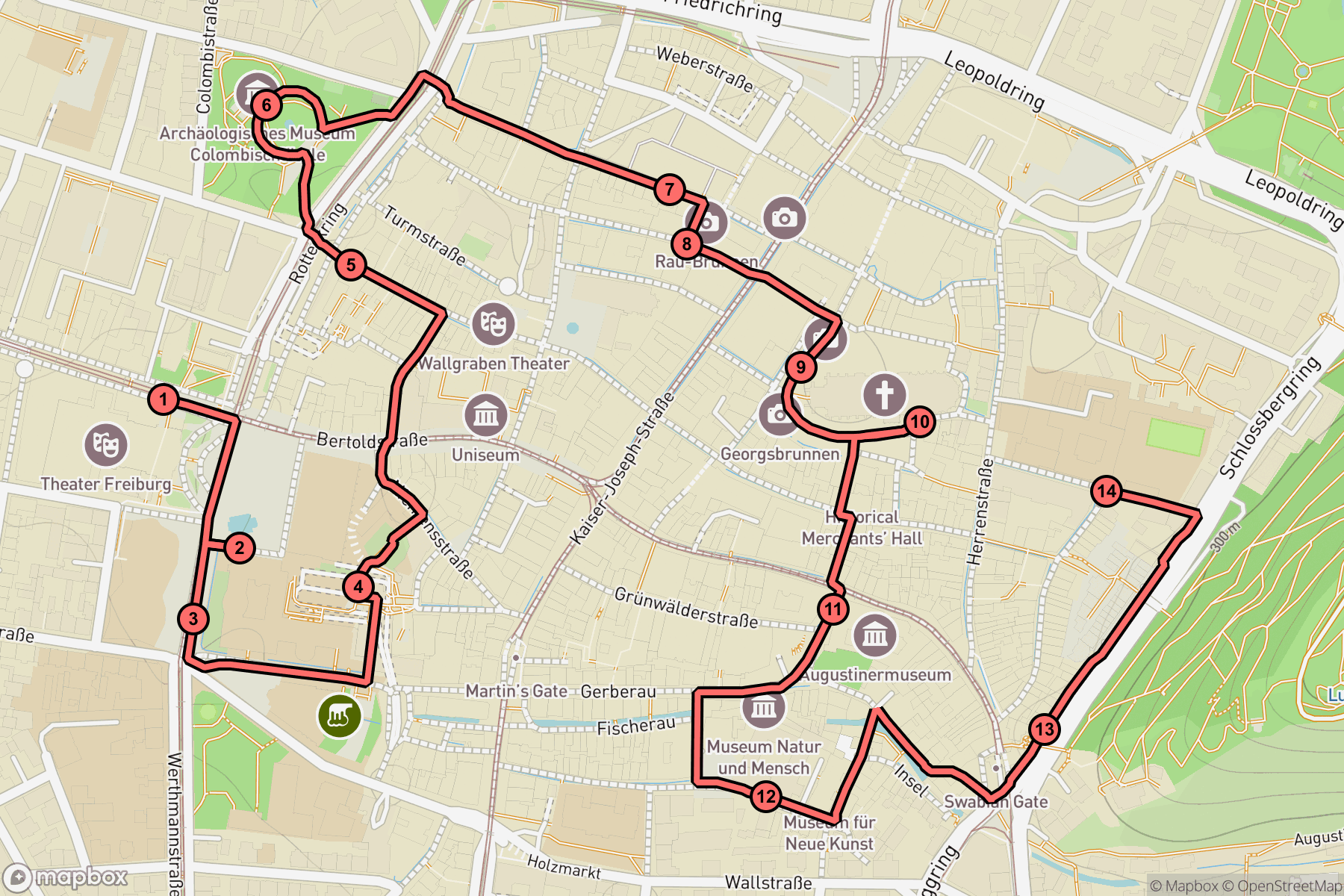
프라이부르크의 황금빛 첨탑과 유리 타워 아래에는 혁명, 음모, 그리고 수세기 동안 끊임없이 움직이는 정신에 의해 형성된 도시가 자리하고 있습니다. 고대 돌들은 교과서가 잊어버린 이야기들을 속삭이고, 모든 길모퉁이는 당신에게 더 가까이 다가와 보라고 속삭입니다. 이 셀프 가이드 오디오 투어는 프라이부르크의 심장부를 안내합니다. 이곳에서는 프라이부르크 대학교에서 학생들의 반란이 울려 퍼졌고, 광대한 대학 도서관에는 여전히 비밀들이 쌓여 있습니다. 현지인만이 아는 숨겨진 길을 따라가며 가이드 카탈로그의 틈새로 새어 나오는 이야기들을 들어보세요. 대성당에서 어떤 스캔들이 하룻밤 사이에 도시의 신앙을 산산조각 냈을까요? 어떤 금지된 필사본이 아무런 설명 없이 도서관에서 사라졌을까요? 왜 조용한 시장이 안개 낀 어느 아침 전장으로 변했을까요? 역사로 빛나는 광장을 지나고 기억으로 살아있는 안뜰을 거닐어 보세요. 발걸음마다 프라이부르크의 가장 유서 깊은 장소들이 진정한 모습을 드러내며 드라마와 발견의 또 다른 층을 열어줍니다. 도시의 비밀이 당신을 끌어당기게 하세요. 이야기들이 기다리고 있습니다—이제 걸으세요.
투어 미리보기
이 투어에 대하여
- schedule소요 시간 40–60 mins나만의 속도로 이동
- straighten3.2 km 도보 경로안내 경로 따라가기
- location_on
- wifi_off오프라인 작동한 번 다운로드, 어디서든 사용
- all_inclusive평생 이용언제든지 다시 재생 가능
- location_on성 우르술라에서 시작
이 투어의 정류장
To spot St. Ursula, look for a sunny yellow building that blends smoothly into the street corner, with green window shutters, plain doors, and a petite tower with an onion-shaped…더 보기간략히 보기
To spot St. Ursula, look for a sunny yellow building that blends smoothly into the street corner, with green window shutters, plain doors, and a petite tower with an onion-shaped dome perched on top-just at the edge of Rathausgasse. Welcome to your first stop: the enchanting St. Ursula, one of Freiburg’s most intriguing time capsules! Imagine you’re standing here over three hundred years ago, the air filled with the gentle clatter of horse hooves and the hammering of local craftsmen. Actually, that last part isn’t just for show! You see, back when this church and convent were built, the city insisted-no outsiders on the building crew! Only local Freiburg hands, please. Talk about keeping it in the family. You’re facing what was once the heart of the “Black Convent”-no goth drama here, just the color of the sisters’ habits, a sharp contrast to the white-robed Dominican nuns across town. These “black sisters” belonged to the Society of Saint Ursula, founded in the 1500s to educate girls when few others bothered. Their original patronage was quite a mouthful: the church was dedicated to the “Most Sacred Heart of Jesus and the Virgin Mary of the Snow”-but don’t worry, the nickname never stuck. Instead, the snow theme became an artistic twinkle on the high altar inside. Picture yourself in 1708: a fresh foundation stone has just thudded into the ground. Beneath your feet would grow a vibrant center for learning and faith, driven by women like Euphemia Dorer-a resourceful Swiss nun who broke the convent’s ties with Lucerne, oversaw construction right on this spot, and endured more drama than your average Netflix series. There were wars, sieges, and demolition explosions just outside the garden, with the sisters ducking under collapsing roofs and the reverberations from the fortifications making even the bravest jump. Not only fire and powder shook these walls. Arguments did too. When the local craftsmen discovered a sculptor from out of town-Johann Barger-was making altars here, they tried to stop his shipments, and even smashed his pulpit to bits! The city made them pay for a replacement, damages, and probably a couple of rounds at the inn. Once the dust settled, this church glowed inside with delicate white and gold rococo-the ceiling swirled with frescoes, an elegant high altar painted with miracles, and medallions showing strange and hopeful visions: a palm, a sunrise, a steadfast rock, all sparkling with secret meaning. Step closer in your imagination-if you peek inside, you’d see empora galleries above and a finely carved organ, its pipes silent until 1969, when a new organ burst forth with harmonious sounds. The convent wasn’t just a place for prayer. Like a school bell that refuses to be silenced, the sisters always came back to their roots: girls’ education. Even after the Kulturkampf closed schools, a plucky Superior named Pia Waßmer reopened classes in a nearby street, dodging government bans and surviving Nazi expropriation and wartime bombs. The building next door, with its soft-yellow walls, kept its original shape, though its fate swung with the fortunes of politics and piety. Today, classroom echoes mix with new voices-part of the site is now a community college. But slip down to the crypt on a tour, and you’ll find ancient graves, tombstones rescued from the Old Cemetery, and the bones of Euphemia Dorer finally brought home after years of exile. There’s no need to tiptoe-St. Ursula has survived worse! Over centuries, storms of war, taste in furniture, and changing times have battered these walls. But with every careful restoration (yes, even patching up war scars two centuries late) and every lesson taught, the spirit of the sisters lives on. Baroque gem, girls’ school, secret survivor-St. Ursula is a tiny but fierce piece of Freiburg history, proving once and for all: never underestimate the power of a schoolgirl dream-or a sturdy onion dome! Eager to learn more about the building, equipment or the sacristy? Simply drop your inquiries in the chat section and I'll provide the details you need.
전용 페이지 열기 →If you’re searching for the Colombischlössle, look straight ahead for a stately, light-bricked villa with towers, elegant gothic windows, and a welcoming fountain sparkling in the…더 보기간략히 보기
If you’re searching for the Colombischlössle, look straight ahead for a stately, light-bricked villa with towers, elegant gothic windows, and a welcoming fountain sparkling in the grassy park right in front of you-almost as if a miniature palace has landed in the middle of a lush English garden. Now, let’s step into the story! Imagine, for a moment, that it’s the year 1859, and-surprise!-you’re standing atop what was once the formidable Bastion Saint Louis of Freiburg’s old city walls. Suddenly, the clang of armor and shouts from soldiers are replaced by a steady thumping: tons and tons of earth are being brought in to transform this old military rampart into… well, a garden fit for a queen. Or, more precisely, a countess! Because right here, Gräfin Maria Antonieta Gertrudis de Colombi y de Bode had grand dreams-and a generous budget, I might add. With 300,000 Goldmarks in her pocket (about 750 Goldmarks per square meter-imagine the price per square meter today!), she set out to build her widow’s residence that would make the neighbors’ jaws drop. And did she ever. The mastermind behind this vision was architect Georg Jakob Schneider, who borrowed inspiration from his mentor Friedrich Eisenlohr and the gothic Tudor style of medieval England. Picture arched windows, intricate stonework, a dramatic glass dome that bathes the grand staircase in light, and parquet floors so beautiful you might hesitate to step on them. Yes, elegance and a bit of showing off go hand in hand! You can almost hear the clip-clop of elegant boots and the rustling of silk dresses gliding across those floors-if ghosts haunt anywhere, surely they’d choose such splendid surroundings. But life in a villa doesn’t always remain a fairy tale. After the countess’s death, the building passed to Johann Georg Thoma, an ambitious manufacturer, who wasn’t content just to enjoy the splendor-he parceled off parts of the land for new streets, including the Colombistraße and even the Rosastraße, cheekily named after his wife. By 1899, the city of Freiburg swooped in and took over the villa, and the place embarked on a new journey: from 1909 to 1923 it showed off the city’s finest art as a municipal museum before becoming a dignified (one might say slightly grandiose) administrative building for all sorts of civic duties. You might expect an old manor house to retire quietly after such a regal career, but not the Colombischlössle! After World War II, it even played host to the state government for a while, with the sounds of political debates echoing through rooms where silk curtains once fluttered. The building flexed its administrative muscles again as the seat of the Badischen Verwaltungsgerichtshof-a mouthful, but imagine gavel bangs ringing in those historic halls. It wasn’t until 1983 that the Colombischlössle embraced its final, most fitting incarnation: a museum, now housing the city’s archaeological treasures-fossils, artifacts, and secrets from deep beneath Freiburg’s cobblestones. The grand villa had become a time machine, ready to whisk visitors thousands of years back, all beneath its sparkling glass dome. But let’s not forget the garden, which is more than just a lovely green carpet for the villa’s feet. Around 1860, this slice of land was reimagined as a dreamy English landscape garden, sprinkled with palm trees, exotic plants, flower beds humming with bees, and-even in modern times-a bubbling fountain at its heart. Over the years, the park became a place of surprises: a stage for open-air dinnershows beneath a winter mirror tent, a rendezvous for the city’s colorful characters, and yes, at times, even a backdrop for some of Freiburg’s more unusual nightlife (the stories these trees could tell!). Always evolving, the park has faced more than a few growing pains, from bold renovations to community battles over playgrounds and its role as a meeting place for everyone-from families and dog-walkers to people seeking help or simply a moment of peace. By Christmas 2021, while the world wrestled with a pandemic, the park shimmered in festive lights, wrapping both villa and garden in a warm winter embrace. So, as you stand outside the Colombischlössle, take in the scent of the flowers, the shimmer of water on the fountain, and maybe even the echo of a countess’ laughter on the breeze. Every stone here has a tale to tell, and just like a proper castle, its best secrets are waiting for curious adventurers-just like you! Ready for the next stop, or shall we linger a bit longer and check for hidden trapdoors?
전용 페이지 열기 →Right in front of you, you’ll see an open square with a wide and shimmering water basin-if you look for the rectangular pool on the ground, that’s actually where the old synagogue…더 보기간략히 보기
Right in front of you, you’ll see an open square with a wide and shimmering water basin-if you look for the rectangular pool on the ground, that’s actually where the old synagogue once stood! Now, time for a step into the past-so, take a deep breath, feel the breeze around you, and let’s imagine Freiburg over a hundred years ago. Picture yourself not in a modern square, but before a striking building raised on a gentle hill, towers at either side of its grand entrance like two watchful sentinels, and a beautiful inscription announcing, “My house shall be called a house of prayer for all peoples.” That was the Old Synagogue, standing proudly from 1870-its design was a marvelous mix: some bits looked like Italian palaces, others like something from a story of Arabian Nights. The story of Jewish life in Freiburg actually goes way back to the Middle Ages, when there was already a synagogue here by 1300. But trouble was never far off. In 1349, almost the entire Jewish community was killed during the horrors that followed the plague. Over the centuries, the winds of acceptance and exclusion kept blowing-sometimes harsh, sometimes hopeful-sometimes blowing the whole population right out of the city, as happened in 1424 when Jews were forced out for hundreds of years. Fast-forward to the 1800s: after centuries of bans, the Jewish community got a second chance. Bit by bit, families returned and, finally, in the 1860s, pooled their courage and savings to build a new synagogue. The plans were drawn by Georg Jakob Schneider, who was sort of like the superhero of synagogue-building in Baden-he looked to the great synagogues of the time and wanted this one to shine. The Old Synagogue became one of Freiburg’s jewels: sand and brick, bold arches, a beautiful rose window, and two little towers at the entrance that almost looked ready for lift-off. There was even a separate bathhouse just for ritual baths, tucked next to the main building. When the synagogue opened in September 1870, the whole city joined the celebration. Even the Protestant ministers and city authorities came to see what all the fuss was about. Not bad for a building that-ahem-some city officials thought would look better somewhere else. Apparently, the town planners were never quite sure if it should be upstaged by the new university and theater next door, but the community held their ground. But history can take a dark corner faster than you can walk from here to the next tram stop. In the 1930s, while the city outside was busy growing, storm clouds gathered. On the night of November 9th, 1938-a date burned into memory as the Reichspogromnacht or Kristallnacht-SS and SA men broke into the synagogue, doused it in gasoline, and set the building ablaze. The fire brigade showed up, but they weren’t there to save the synagogue-just to keep the flames from spreading to the new university nearby. Inside, everything was destroyed-except a few treasures like the great wooden doors and a beautifully painted piece from the Torah Shrine, which amazingly survived and found a new home in Freiburg’s newer synagogue. But most of the synagogue, and the lives it touched for generations, vanished in smoke and rubble. By the next day, the SS were already tearing down what was left, and the city covered it up with a fence, as if trying to hide both the ruins and the shame. In the years since, this patch of ground became a battleground of memory and forgetting. For a long time, there was nothing but a dusty lot and then, dare I say, a very undignified parking lot. Survivors and descendants begged for a memorial, but it took decades-and more than a few strongly worded letters-before a bronze plaque finally arrived. Even then, it kept getting lost under the grass. The city bought the land, dreamed up elaborate plans, discussed what should happen here until, I suspect, every single person in Freiburg had an opinion. Excavations in 2016 unearthed pieces of the original foundations-amazing, right?-and there were fierce debates about whether to keep those old stones, or to cover them so children could play freely again. In the end, they created the water basin here, a peaceful mirror that quietly outlines the synagogue’s original footprint. Children splash where worshippers once prayed, university students lounge, and sometimes a heated debate still ripples across the surface, as people ask-how should we remember, and how should we go on? So now as you stand here, you’re not just in a square, or beside a fountain. You’re on a living memory. You’re where sorrow and resilience, loss and renewal, all flow together. Look around-there’s a whole city continuing to write its story, right here on the water’s edge-sometimes splashing, sometimes arguing, always remembering. And if you ever want to remember the Old Synagogue, just dip your fingers in the basin, and ripple the past awake for a moment. To expand your understanding of the predecessor synagogues, construction and expansion or the destruction, feel free to engage with me in the chat section below.
전용 페이지 열기 →
10개 정류장 더 보기정류장 적게 보기expand_moreexpand_less
Look for a grand, curved, neobaroque façade with three towering arched windows and strong stone columns guarded by statues-Theater Freiburg stands right at the edge of the old…더 보기간략히 보기
Look for a grand, curved, neobaroque façade with three towering arched windows and strong stone columns guarded by statues-Theater Freiburg stands right at the edge of the old town, across an open square. Alright, take a deep breath and prepare to step into a world where drama happens both on and off the stage! You’re now standing before Theater Freiburg, a true heavyweight in the city's cultural life and, I must say, probably the only place in town where you can be a little dramatic and nobody will judge you for it. With its sandy-colored stone, majestic arches, and statues peering down like strict but friendly theater critics, this building is impossible to miss. But this theater wasn’t always the dazzling centerpiece you see now. Let’s go back in time, all the way to May 1770-so long ago, people thought Mozart was a new trending artist! Picture Freiburg bustling with anticipation because Marie Antoinette, soon to be Queen of France, was rolling through on her wedding tour. The local bigwigs hired a troupe called the Korn’sche Theatergesellschaft to put on a show, and the acting bug bit Freiburg for good. Of course, they didn’t have this stunning building yet. Early performances took place in a Jesuit school-talk about improvising! Later, they set up stage in an old grain warehouse, the Kornhaus, on Münsterplatz. Imagine dusty barrels on one side and a rip-roaring performance of Mozart on the other. In 1793 they staged “The Abduction from the Seraglio,” and, just a year later, “The Magic Flute.” Who knew Mozart’s notes would echo through these medieval nooks? Fast forward to the early 19th century: the old Kornhaus became too creaky for all the drama. So, what do you do when the grain warehouse gets old? Simple: you turn an abandoned monastery church into the town’s theater! The creative spirit of Freiburg was truly unstoppable (and maybe a little bit desperate for good acoustics). By 1823, performances found their home in the converted monastery, and the city formally took over in the 1860s. The only problem? The times were changing, and so were theater tastes. The city needed something modern, something bold. Cue 1905, when the mayor and the city architect decided it was time to build big-really big-right here on the former bastion of the city's fortress. The neobaroque monument you see before you sprang to life, adorned with glorious sculptures by local artists. When it opened in 1910 with Schiller’s “Wallenstein’s Camp,” the night was buzzing, illuminated by the glow of anticipation and possibly a few frustrated actors backstage. The 20th century brought its own share of real-life plot twists. The World Wars cut the curtain short more than once-imagine, you buy a ticket to see a classic, but all you get is the sound of silence as performances are suspended. In 1917, a bomb hit the southern part of the theater, giving everyone an unscripted intermission that lasted until 1919. And after heavy bombing in 1944 destroyed much of the building, the mayor played piano concerts to raise money for the theater’s resurrection-a fundraising strategy worthy of a standing ovation. Throughout all this, Freiburg’s theater folk never let the show stop. They put on plays in intact halls and, in a move that would make any multitasker proud, operated cinemas in the rebuilding years to keep the money flowing. From postwar reconstruction to bold renovations, every stone tells a story of grit, passion, and more than a dash of improvisation. Whether you love opera, dance, or edgy political plays-theatergoers here have always found something to inspire, provoke, or simply entertain. Did you know that in recent years, the letters on the façade have changed? At one point, a giant “Heart of the City” sign twinkled above the entrance, glowing at night to display either “Heart” or “Art,” switching between the two. I guess you could say this place puts the “art” in “heart.” Today, Theater Freiburg draws over 190,000 visitors every season. It's not just a stage, it's a living experiment-a place for children, for dreamers, for thinkers, and sometimes even for a bit of garden gnome mischief. Yes, there was once urban gardening on these green patches! So, as you stand in front of these grand arches and columns, imagine the centuries of applause, gasps, and laughter. Who knows-maybe the air is still tingling from the last standing ovation! For a more comprehensive understanding of the contents, artistic directors or the connection, engage with me in the chat section below.
전용 페이지 열기 →To spot the Freiburg University Library, look for a futuristic, mirrored glass building shimmering like a giant, angular chess piece right beside a sea of bicycles-its glimmering…더 보기간략히 보기
To spot the Freiburg University Library, look for a futuristic, mirrored glass building shimmering like a giant, angular chess piece right beside a sea of bicycles-its glimmering façade reflects the city all around you. Take a moment to gaze at this building-it almost looks like a spaceship has landed right in the heart of Freiburg, doesn’t it? But fear not, you haven’t wandered into a science fiction film-unless, of course, you count the Netflix series “Biohackers,” which actually filmed right here, inspired by the library’s otherworldly looks. Now, let’s step back in time-imagine you’re wandering the medieval streets of Freiburg in the year 1457, and libraries are just tiny book collections attached to the university’s old faculties. If you wanted to borrow a book, you probably needed to know a secret handshake! Over the centuries, things changed bit by bit-by 1755, the scattered books were brought under one roof. Imagine the dusty scramble as thousands of books from closed monasteries, old Jesuit halls, and private homes poured into the library, each page bringing the echoes of monks, scholars, and curious students. By 1903, the library moved into a fancy new gothic revival building-think high arches, twinkling reading lamps, and the whoosh of a water-powered turbine lighting the halls. For a library, that was pure magic. Now, the winds of time weren’t always kind. During World War II, the old gothic library was badly damaged-the south wing simply didn’t survive. But just in time, countless precious books had been evacuated to safety, saving the heart and soul of the collection. After the war, librarians put on their wizard hats (well, metaphorically), rebuilt, reorganized, and expanded the collection-no easy feat with millions of pages to sort and stacks taller than you could climb! Fast forward to the present: the mirrored marvel before you opened in 2015, after years of construction (and quite a few hiccups, which I’ll tell you about in a second). Designed by Degelo Architekten from Basel, its glass-and-chrome skin was meant to blend with Freiburg’s energy-saving and modern ambitions. There are more than 1,700 places to study inside, and if you’re after inspirational views while you flip through books, this might just be your paradise. Some say it’s so popular that students invented the “Pausenuhr”-an ingenious system like a parking disc, so if you leave your study spot for a break, you’ve only got 60 minutes before someone else swoops in! If you walk inside, you’d find the reading rooms are tucked along the bright outer walls, while the real treasure-millions of books-waits in the center stacks, almost like a hidden hoard. There’s a group parlatory where students can chat, brainstorm, and even use big display screens-or you can retreat to the southern side, where silence reigns. And, speaking of treasure, the library is home to over 4.6 million media units: rare books, ancient scripts, scientific journals, and even glass-plate papyrus fragments, each with their own story to whisper. But not everything glitters as smoothly as the library’s facade-unless you count the blinding glare on sunny days that sometimes shines right into people’s eyes. There are stories of sun sails being rolled out like giant capes just to stop the reflections from dazzling drivers or passersby. And as with many great buildings, this one had its share of construction snafus-falling metal sheets, leaking rainwater, and a mysterious pressurized floor that sometimes creaked or broke under too much weight. At least it keeps the librarians on their toes-and gives the building stories for future generations! So next time you see students rushing into this shimmering palace, remember: you’re looking at over 560 years of bookish adventure-Gothic arches, hidden papyrus, rescue missions, and a building that can leave even the sun itself a little awestruck. Pretty impressive for a place full of people who just want to read quietly, don’t you think? Exploring the realm of the building, service and organization or the volumes and media? Feel free to consult the chat section for additional information.
전용 페이지 열기 →Alright, get ready-because you are standing at the front door to more than five centuries of stories, characters, and a whole lot of academic drama. Welcome to the University of…더 보기간략히 보기
Alright, get ready-because you are standing at the front door to more than five centuries of stories, characters, and a whole lot of academic drama. Welcome to the University of Freiburg, or as locals lovingly call it, "Uni Freiburg." Before you get too dazzled by the grand old buildings and the swirl of youthful energy around you, let’s take a leap back to the year 1457. Imagine the city shrouded in the mists of the Middle Ages, students in heavy cloaks, and the air buzzing with philosophical debates (and probably the odd medieval body odor). The university’s story began when the mighty Habsburg dynasty-the “It” family of Europe back in the day, all royal crests and carefully curled mustaches-decided that Vienna shouldn’t be having all the fun. Archduke Albert VI of Austria founded this place, planting the seeds of wisdom with a hearty dose of land, financial endowments, and jurisdiction. As you breathe in, imagine the shadowy figures of bishops and scholars pacing the cobblestones under the gaze of the church, for the university was very much a creature of the church at first. Its fate mingled with popes, emperors, and local rulers, the stamp of papal authority literally pressed into the very first university seal-which, by the way, is still used in a slightly altered form. And speaking of seals: the original features Christ holding a gospel, with a flurry of Gothic arches, the Habsburg eagles, and even the city’s proud St. George’s Cross. Who knew diplomas could be so artistic? The early curriculum? Only the essentials for an up-and-coming scholar-philosophy, law, theology, and medicine. Chances are, in those lecture halls, hair-raising debates between hotheaded humanists like Geiler von Kaysersberg and more traditional thinkers echoed off the stone walls well into the night. As you skip through the centuries, you’ll find this university facing all sorts of plot twists. In the 1600s, the Counter-Reformation swept through, and the Jesuit order took control of two faculties, attempting to steer Freiburg's intellectual ship firmly towards Rome. That explains why there’s a beautiful old Jesuit Church nearby-today’s University Church. If walls could talk, the stories they’d tell! Picture lively Jesuit priests striding around, debating theology, pausing perhaps for the occasional dramatic sigh. But oh, the drama didn’t stop there. In 1679, King Louis XIV of France snatched up Freiburg and handed the university straight to the Jesuits, sprinkling in a French vibe and launching a bilingual program. For over a decade, professors actually fled to Konstanz to continue teaching, keeping their academic flame alive through exile. Fast forward a bit and, as the Enlightenment dawned, reform was in the air. Empress Maria Theresa opened university doors to non-Catholics, a radical move in 1767, and added natural sciences and public administration. The Jesuits were eventually sent packing by papal decree in 1773, breaking the church’s grip and bringing in the first ever Protestant professor, Johann Georg Jacobi, in 1784. Rumor has it, the other professors spent weeks just adjusting to the novelty. With the 1805 arrival of Napoleon and the birth of the Grand Duchy of Baden, Uni Freiburg’s future teetered on the edge. There was talk of shutting it down altogether-can you imagine? But the city and the university’s supporters rallied, and thanks to the generosity of Ludwig I, Grand Duke of Baden, the doors stayed open. The late 19th and early 20th centuries saw the campus burst with new buildings, and the university blaze new trails: in 1900, it was the first in Germany to admit female students. Suddenly there was a real revolution in the lecture halls! The university began to magnetize legendary minds: giants like Edmund Husserl, Martin Heidegger, Max Weber, and Edith Stein-all thinkers whose ideas still pulse through philosophy books today. Now, not all of the stories from here are happy ones. During the Nazi era, Uni Freiburg, like all German institutions, suffered under “political alignment.” Faculty were ousted, and ideas were policed. It was a dark chapter, but after World War II, the university rebuilt-physically and morally. New science institutes rose from the rubble, and the ideas cooked up here, especially the “Freiburg School” of economic thought, helped launch Germany’s social market economy. Nobel laureate Friedrich Hayek even steered an economic think tank right here. Today, Uni Freiburg is a vibrant family of 11 faculties, drawing clever minds from over 120 countries. Some come for the teaching. Others might just be lured by the promise of hikes in the Black Forest or the fabled campus cafés. And yes, the university still embraces the spirit of its founders: eager to innovate, quick to open doors (at least metaphorically-some of those old doors really are quite heavy). Take a deep breath-can you almost hear the hum of centuries of debates, discoveries, and dreams? You’re standing in a place not only of learning, but of survival, transformation, and the kind of human curiosity that outlasts empires. Now, let’s keep walking-you never know what remarkable stories you’ll find around the next corner. And who knows, maybe one day they’ll add your name to that impressively long list of famous alumni. Start working on your legendary mustache just in case! To delve deeper into the campus, students and admission or the academic profile, simply drop your query in the chat section and I'll provide more information.
전용 페이지 열기 →Now, close your eyes for a moment and imagine yourself standing in Freiburg about 800 years ago. The city is smaller, its streets muddier, and the world feels a little wilder.…더 보기간략히 보기
Now, close your eyes for a moment and imagine yourself standing in Freiburg about 800 years ago. The city is smaller, its streets muddier, and the world feels a little wilder. Back then, outside the original city walls, five separate Dominican convents dotted the countryside-each sheltering communities of nuns from noble, mysterious, and sometimes downright legendary backgrounds. One story even claims the convent’s founder was a high-ranking countess and the emperor’s own sister-though, between you and me, local historians suggest it was actually some helpful chap named Heinrich Vasser and a Benedictine abbess who got things started. Well, who doesn’t love a good founding myth? The original Adelhausen Convent was established in 1234 in a village that’s long since become part of modern Freiburg. Its nuns lived quietly, cultivating gardens, tending vineyards, and penning mystical tales. Have you ever heard of a nun named Anna von Munzingen? She led twice as prioress in the early 1300s and created a "Sister's Book" filled with stories of 36 nuns-women who were said to experience mystical visions and divine visits. If that's not a bestseller waiting to happen, I don’t know what is. But life for the nuns wasn’t all peaceful meditation and gardening. The convents moved and merged as wars swept through the region. During the Thirty Years’ War, soldiers and cannons thundered across Europe, leaving convents in ruins. Nuns from destroyed houses found themselves shuffling between private homes and temporary lodgings, all the while insisting on their right to continue their work and preserve their traditions. Eventually, city leaders put their foot down: “With so much of Freiburg in ruins, you get one new convent-no more!” And so, in 1687, the surviving nuns-and the spirit of five ancient houses-combined forces here, on the grounds of the old urban manor near the Gerberau. That alone would be impressive-but the new convent was built with the help of none other than King Louis XIV of France. I suppose even the Sun King had a soft spot for nuns! He sent funds, soldiers, and a French master builder. Still, nothing ever goes exactly to plan: halfway through construction, part of the church collapsed, and the poor master mason met a very unfortunate end. In spite of setbacks and more repairs, the nuns moved in-19 strong, full of hope, and probably keeping an eye on the ceiling. Through the centuries, the convent became a wellspring of learning for girls. By the 1850s, there were about 650 students here, squeezed into three classrooms-the original school was so busy, they had to build a new wing. But the winds of change never stop blowing: the convent weathered Joseph II’s reforms and the upheavals of secularization. In an era when monasteries everywhere were being shuttered, Adelhausen survived-thanks to its school. As the nuns' ages climbed and new admissions slowed, the last novice took her vows here in 1861, then moved on to found a school by Lake Constance. A few years later, with the Kulturkampf-a struggle between church and state-the city officially dissolved the community. Their endowment, however, still supports girls’ education in Freiburg today. The Abbey’s story doesn’t finish there. These walls have housed classrooms, museums, and even offices. If you listen closely, you might hear the whispers of students from the past or perhaps catch a few notes from the church’s old organ. Today, the former convent is home to the Museum of Natural History, and its treasures are scattered throughout Freiburg-in the Augustiner Museum, you’ll find ancient relics: a traveling altar from the 9th century, statues of mystical nuns, and golden objects as dazzling as the imagination of any medieval artisan. There are rich tapestries, gilded reliquaries, even a legendary skull of Saint Bertha-the supposed founder herself-snuggled up on a velvet pillow. Apparently, even after death, the nuns of Adelhausen knew how to rest in style. So, as you stand here, take in the simple brickwork and the sturdy cloisters-echoes of centuries-old whispers, footsteps, and laughter. The only thing missing is a spectral nun keeping everyone in line. But don’t worry-if you feel a sudden chill, it’s probably just the Freiburg breeze, not a ghostly reprimand for talking too loudly! Let's continue our adventure-after all, history waits for no one.
전용 페이지 열기 →To spot the Augustiner Museum, just look ahead for a large, bright yellow building with a classic sloped roof, tall rectangular windows, and a modern glass entrance on the…더 보기간략히 보기
To spot the Augustiner Museum, just look ahead for a large, bright yellow building with a classic sloped roof, tall rectangular windows, and a modern glass entrance on the left-right where the busy crowd and market tents gather. Welcome to the Augustiner Museum, where old monks’ footsteps echo just beneath your own! Imagine standing here centuries ago, surrounded not by art lovers or tourists, but by the quiet shuffling of brown-robed Augustinian monks as they hurried to prayer-or possibly to sneak an extra bowl of soup in the cloister. This mighty yellow building began as a monastery and was reborn as a museum, having survived more drama than your average Netflix series. So, let’s step back into time… The story kicks off in the 1880s, when Freiburg’s city collectors eyed treasures spanning the Middle Ages to the Baroque. But the real transformation began in 1914, when plans for a grand museum conversion took off-until the First World War threw in a plot twist. Imagine workers rushing about, then suddenly… construction halted, and dreams of a central museum stayed as unfinished as a half-eaten slice of Black Forest cake. It wasn’t until after the war, with fresh hope in 1919, that the building was completed. Well, sort of. Budget cuts meant the museum was thrown together with a dash of creative improvisation-let’s call it Freiburg’s version of “Project Runway: Museum Edition.” Finally, in 1923, the doors swung open, ready to welcome visitors to a collection that still had that “work-in-progress” feel for almost a century. Now, take a deep breath and picture wandering inside. The first thing you’d notice is an enormous hall filled with carved stone prophets from the Freiburg Cathedral-these stern statues seem ready to judge your choice of museum snacks. Walk a bit further and you’ll pass cabinets glowing with medieval stained glass, glinting among the shadows. In the chancel, baroque statues and golden altars crowd together, each whispering centuries-old secrets. Want to hear a joke straight from the paintings upstairs? “Why don’t landscape portraits ever get lost? Because they always know which way the grass is greener!” But it’s not all glittering treasures and friendly ghosts here-the museum has faced its own epic battles. By the early 2000s, museum staff became unwilling experts in woodworm, mold, and mysterious toxins that closed wings for decades. Enter the massive renovation saga: specialists in white coveralls came stomping in, stripping out contaminated roof beams and straightening up ancient rafters like old bones in a chiropractor’s office. Thanks to their efforts, spaces became barrier free, a shiny new elevator appeared, and the painting gallery found an unlikely home up in the attic. Pro tip: even the old treasury and cloister now host a cozy café-perfect for artful cake breaks. Peek behind the scenes, and you’ll find this museum still brimming with untold stories-prints and drawings tucked away, Black Forest household quirks, medieval carpets hiding their feet from the sun, massive collections of coins and clocks, and even a dazzling treasure chamber with gold and silverwork stretching back over ten centuries. Oh, and let’s not forget the organ in the chancel! With a casing from the 1730s and 20th-century pipes by M. Welte & Sons, this instrument is so precious it’s treated like royalty. When it was time for restoration, teams carefully polished away layers of brown 19th-century boredom, restoring its gleaming Baroque bling and giving back its powerful, resonant sound-just imagine the cascading echo of notes as they fill this ancient space. So, as you stand here in the lively marketplace, take a moment to watch sunlight play on the yellow walls. Remember, this peaceful façade hides a treasure vault of human creativity and a saga of stubborn survival. The Augustiner Museum is a place where medieval saints, world wars, crumbling rafters, and art-lovers’ dreams all come together for one big, colorful history party. Shall we see what other surprises Freiburg has in store? For further insights on the the museum, exhibition or the library, feel free to navigate to the chat section below and inquire.
전용 페이지 열기 →To spot St. Martin, look for a large, light-colored church with striking red trim around its tall pointed windows and entrance, standing confidently right on the edge of…더 보기간략히 보기
To spot St. Martin, look for a large, light-colored church with striking red trim around its tall pointed windows and entrance, standing confidently right on the edge of Rathausplatz-if you see those tall, slim Gothic windows and an inviting old stone doorway ahead, you’re in the right place. Welcome, traveler, to St. Martin! I promise, standing here, you’re not just looking at a church-you’re peeking into a time machine. Imagine the year is 1226: monks from the Franciscan order, brown-robed and a bit travel-weary, come trundling into Freiburg. At first, they set up just outside the city walls, but as word spreads and more brothers arrive, they need something bigger, something right in the heart of the action. So, with a little medieval networking, they receive the local St. Martin’s chapel, plus a decent patch of land, as a gift from Konrad I, the Count of Freiburg. Cavemen had rocks, but these monks had connections! Soon enough, the small chapel is bursting at the seams, so they build a proper church-one so old that beneath its choir, you can still find bits of Romanesque stonework from those early days. By 1286, the choir is finished, the cloister begins to wrap peacefully around the church, and by 1318, the main hall is finally done… though legend says the builders had to make a sharp turn with the north wall to avoid accidentally trespassing on someone else’s medieval garden. Talk about “measuring twice, cutting once!” Over its long life, this church has played host to a parade of history. During the Thirty Years’ War, St. Martin suffered just as the city did-badly battered, and then touched up with a grand, sweeping baroque interior. Picture gilded altars, plump cherubs, and a ceiling worthy of a French chateau. Even the outside got a Baroque-style portal, complete with the Immaculata, St. Francis of Assisi, and Anthony of Padua keeping watch above. The church’s collection of art and relics grew over the centuries-if only the choir could talk, it would have tales for days. But it wasn’t all golden altars and smooth marble. By the early 1800s, tastes changed-suddenly, the Baroque was “out,” and a certain Pfarrer Johann Nepomuk Biechele decided St. Martin needed to be brighter and simpler. Goodbye, ornate baroque stucco; welcome, fresh white walls and newly revealed gothic windows! Rows of stone from the famous Freiburg Cathedral found new life as the church floor. The church got a bit of a facelift again at the end of the 19th century, when Freiburg’s beloved local writer, Heinrich Hansjakob-more famous with a pen than from the pulpit, I’ll tell you-became its priest. Under his watch, a new, proud Gothic tower finally rose in 1893, changing the city’s skyline. Yet, not even thick stone walls were safe in the chaos of the 20th century. In November 1944, as bombs fell from the sky, a fire tore through St. Martin’s, collapsing that proud tower roof into the nave below. The church, burned and broken, stood as a quiet ruin until careful hands put it back together after the war. When it was rededicated on St. Martin’s Day in 1951, the air surely tasted a little sweeter for those who remembered the old days. In recent years, St. Martin has had yet another glow-up. The Dominicans moved in, sharing the space with Freiburg’s vibrant Ukrainian Greek-Catholic community-you’ll spot their icons if you peek inside. Modern renovations have brought soft LED lighting, freshly painted walls and columns, and an organ so new that until its arrival, the church made do with a digital stand-in (rumor has it that even the saints on the altar tapped their feet to the substitute music). The new main organ, celebrated in 2021, is a marvel-a mighty mix of old artistry and modern craft, echoing through the tall, bright nave. Oh, and fun fact: out in the parish yard, you’ll find a bell from 1729, made by two legendary bell-makers. It’s got a big sound for such a little relic. Inside, the church stretches a full 65 meters and is filled with slender Gothic windows, an atmosphere of clear, harmonious light, and even an ancient wall painting of St. Martin himself. So as you stand here, imagine centuries of monks, soldiers, townspeople, and students bustling across this square-all leaving their mark, as this church continues to ring out its story across Freiburg. And here’s my challenge to you: see if you can spot the statues or even catch a whisper of organ music-because in St. Martin, there’s always something just waiting to surprise you. Well, unless you’re measuring a medieval wall… then you’re just hoping not to knock over a neighbor’s garden gnome!
전용 페이지 열기 →To spot the Haus zum Walfisch, look for a striking deep red building right in front of you with golden window frames and a beautifully ornate, late Gothic bay window jutting out…더 보기간략히 보기
To spot the Haus zum Walfisch, look for a striking deep red building right in front of you with golden window frames and a beautifully ornate, late Gothic bay window jutting out above the main doorway-if the sun’s out, those golden details practically glow. Now, welcome to the Haus zum Walfisch-one of Freiburg’s grandest and most mysterious old houses, with a name that literally means “House of the Whale.” No whales here, I’m afraid, but a whale of a tale! Imagine you’re walking down Franziskanerstraße in the early 1500s: horse hooves clopping on cobblestones, merchants shouting, and somewhere nearby, a man named Jakob Villinger, who’s become rich enough to be Maximilian I’s treasurer, has decided he needs a house as fabulous as his fortunes. He tears down three older houses, and, after a bit of bureaucratic wrestling with the town council-they sure didn’t want anyone turning the Altstadt into one big garden-he finally gets the go-ahead in 1516 to build his dream home right here. Imagine the commotion! Workers hammering, stones being hauled, and ambitious walls rising from the sausage-scented air of the market. The finished house-well, mostly finished-was ready by 1517, just in time for the town’s most important visitors. And oh, what visitors! The legendary humanist Erasmus of Rotterdam himself stayed here over Christmas 1529, probably shivering a bit in the unfinished rooms and clashing over rent agreements (note to self: always check who controls the keys before moving in). With other writers, thinkers, and at least one grumpy downstairs neighbor involved, the house must have been buzzing with ideas, books, and maybe the occasional heated argument about who used all the firewood. But Erasmus didn’t buy the house-his eye for a bargain wasn’t quite up to the Freiburg market, it seems. Over time, the Haus zum Walfisch passed through generations of nobles, each adding their own dramas. At one point, it even featured a secret walkway for Emperor Ferdinand I, who stayed here in the winter of 1562; gotta love VIP access to the local church, especially when it’s cold outside! By the 18th century, the house changed hands so often that even soap-opera writers would get dizzy-through inheritances, bankruptcies, and a few scandalous family disputes thrown in for good measure. As you gaze up, notice the grand Gothic oriel window on the front-local legend says it’s the finest north of the Alps, and it’s true! See those little stone creatures, like the grumpy lion and the wrinkly old lady clutching a scroll? Those are the house’s original gargoyles, but the real ones have been safely tucked away in the Augustiner Museum since they aged faster than Erasmus’ patience. Even the roof tells a story; after the building was nearly destroyed in WWII, only the facade survived-the inside was entirely rebuilt, and the building’s transformation was a matter of heated debate among locals. At one point, the striking red color on the facade was so bold that the local newspaper joked about needing sunglasses! Later, the Haus zum Walfisch became a bank, and its halls echoed with the jingle of coins and bustling townsfolk instead of noble banter. Some say, in a twist worthy of a Gothic novel, that the ghost of Christoph Anton von Schauenburg, once forced under house arrest here, paces the halls on stormy nights. And in the 1970s, Hollywood found its way to Freiburg: the creepy exterior you see right now inspired the ballet school in the famous horror movie “Suspiria.” If you get a little goosebumpy, blame the Gothic arches and not the draft! Today, it’s home to offices-and the odd squeaky bicycle-but the Haus zum Walfisch wears its history with pride. From emperors and eccentrics to scholars and scandals, this red beauty on Franziskanerstraße has truly seen it all. Don’t forget to check the balcony; who knows, maybe Erasmus himself is still up there, pondering his next move or just enjoying that unbeatable Freiburg view!
전용 페이지 열기 →If you’re looking for the Freiburg Cathedral, just gaze above the rooftops for the giant, reddish sandstone church with its lacy, spire-like tower that seems to poke the sky,…더 보기간략히 보기
If you’re looking for the Freiburg Cathedral, just gaze above the rooftops for the giant, reddish sandstone church with its lacy, spire-like tower that seems to poke the sky, almost as if it’s trying to pick a fight with the clouds! Now as you stand before the mighty Freiburg Cathedral, let’s travel back in time. Imagine the year is 1200: artisans are busy chiseling stone, the sound of hammers ringing out as the first stones for this church were laid right where you stand. Originally started in the Romanesque style, the construction switched to the dramatic soaring lines of Gothic architecture-the kind that makes you subconsciously look up and go, “Wow, how did they build THAT?” Well, it took them over 300 years, so patience was definitely a virtue here! This cathedral has weathered everything history could throw at it-from the power struggles of the Zähringer dukes (one of them wanted this place to be his eternal nap spot), to medieval builders squabbling over vaults and towers, all the way to surviving the bombings of WWII, when, believe it or not, the buildings all around the Münster crumbled, but the cathedral herself stood tall, like a stubborn old grandparent refusing to move-even her windows made it out unbroken because someone had the foresight to hide them away safely. One could almost say this church has more lives than a cat. The tower you see, rising 116 meters into the air, was called by one famous art historian “the most beautiful spire on earth.” And it’s not just pretty-it’s quite the architectural acrobat, too. The builders managed to switch shapes from a square to a twelved-sided gallery, then to an octagon, and finally to that iconic openwork spire. Try not to get dizzy just imagining the masons clambering up all that scaffolding. The real bonus? There’s a weather vane with both a sun and a crescent moon up there, to show Christ rules by day and night. When thunder rumbles, I like to picture it as the cathedral flexing its muscles. Inside, wonders await. The main altar is a masterpiece by Hans Baldung Grien, remarkable for its vibrant colors and lifelike scenes. During Christmas, you’d find it gleaming with nativity scenes, but for the rest of the year, it displays the crowning of Mary, surrounded by twelve apostles-Peter and Paul get front row seats, naturally. Look closer, and you’ll spot the largest surviving Lenten veil in Europe, over ten meters long, covering the altar each spring like a sacred curtain. All around the choir, the who’s who of medieval Freiburg-rich citizens, nobles, even the university itself-each snapped up a family chapel. Imagine them quietly competing, secretly hoping to have the brightest stained glass or the most elaborate ironwork gate, just to keep up with their neighbors. One family hired the finest artists they could afford, and others followed suit, sparing no expense for the afterlife (trendsetter points for St. Nicholas appearing in one window with, believe it or not, a loaf of bread). But here’s the twist: the cathedral didn’t belong to the Church for centuries. Instead, the people of Freiburg took charge. When the town’s rulers ran out of cash, ordinary citizens started pitching in, donating, and making sure the mighty Münster kept growing. Talk about a community project-no bake sale required, just a few centuries of shared effort. If you’re still not impressed, maybe this will do the trick: with a total length of over 125 meters and a nave height that rivals mighty castles, the cathedral has stood as inspiration for many other churches across Europe-even as far as Warsaw. And through everything, the thin, delicate spire bent but never broke, even when bombs shook the city. So next time you see Freiburg’s skyline, remember this cathedral is the stubborn overachiever that’s seen more stories than most libraries. Go on, take a breath, and listen-the walls have seen crusaders, jazzed-up bishops, and probably more than one distracted tourist who walked into a pillar while looking up. Will you be next? Seeking more information about the architecture, equipment or the monument preservation? Ask away in the chat section and I'll fill you in.
전용 페이지 열기 →To spot the Collegium Borromaeum, just look for a long, pale yellow building with rows of white shutters and a red roof, stretching along the corner with a peaceful courtyard…더 보기간략히 보기
To spot the Collegium Borromaeum, just look for a long, pale yellow building with rows of white shutters and a red roof, stretching along the corner with a peaceful courtyard lined with trees and rose bushes-like a stately palace with a scholarly twist! Imagine you’re standing here nearly 200 years ago, in the same footprint, but instead of today’s stately yellow walls and red roof, you’re surrounded by the modest buildings of a Capuchin monastery. Then, in a bustling flurry of progress, in the years 1823 to 1826, the first stones of this grand structure-the Collegium Borromaeum-were laid by Cristoph Arnold, who was a disciple of the famous architect Friedrich Weinbrenner. And Arnold certainly knew how to make an entrance: four wings surrounding a peaceful inner courtyard that, if you squint just right, might still echo some monkish footsteps! But what really makes this spot more than just another pretty building is the river of history flowing through it. The Collegium Borromaeum became the heart of priestly education for the entire Archdiocese of Freiburg. For nearly two centuries, young men arrived-some anxious, some excited, perhaps a few wondering if they’d ever really get used to the early mornings-hoping to become future priests. Their days weren’t all incense and choir singing; they studied hard at the Albert-Ludwigs-Universität but returned here each night, hoping to shape their souls as well as their Latin declensions. Of course, things weren’t always tranquil and scholarly. As you stand outside, close your eyes for a second and picture November 1944-Freiburg was under heavy bombardment, and this building, like many others, suffered devastating destruction. The interiors were nearly wiped away. But out of these ashes (and a lot of post-war plaster dust) the Collegium Borromaeum was rebuilt, stone by stone, between 1950 and 1951, a testament to resilience and faith. In fact, every so often, new waves of renovations and modernization would arrive-as recently as 1997 to 2004, the creak of scaffolding and the chatter of builders must have echoed through these very halls! Now, that’s not all. Behind these doors, it’s not just future priests brushing up on their theology. The building is alive with all sorts of people: regular university students who probably never dreamed they’d share a cafeteria line with tomorrow’s parish leaders, priests working on their doctorates, and even church administrators solving holy puzzles in hidden offices. Once, the separation of theological studies and practical training existed-in part up in the mountains of St. Peter’s former Benedictine monastery. But by 2006, everything came together right here-like theological peanut butter and jelly-making this a fully fledged seminary. Oh, and if you think these hallowed grounds are just about paperwork and prayer, let’s not forget that the Pope himself, Benedict XVI, visited in 2011. Imagine the excitement: nervous seminarians, security agents scanning every inch, and the world’s media outside just hoping someone would trip over their cassock. There’s even a special inscription on the seminary church door to remember that moment-a little spiritual star power for your visit! And if you wander around to the Andlauhaus, just outside, you’d have caught sight for many years of an empty, bomb-damaged lot-a ghostly reminder of war’s scars-until in 2020, the long-awaited new building emerged, complete with a Münster forum and an inclusive café. Much better than rubble, and definitely better for morning coffee. Step inside the Konviktskirche, the seminary’s own church, and you’re surrounded by simplicity mixed with artistry. Here’s a spot that’s seen nearly everything-from Lutheran prayers to a catastrophic bombing, to solemn seminarians reflecting by stained glass. Look for the Madonna sculpture, possibly from 14th-century Northern Italy, and the bold mural of Christ by Richard Seewald, with Christ looking sternly over a scroll as if he’s grading an exam. There’s also a bronze Karl Borromäus-patron of seminaries-and six colorful windows inspired by the Hebrews, crafted by Emil Wachter, who himself once lived and studied here. There has even been a bit of controversy-like the relocation of the monument to Alban Stolz, who was director here, due to his public views. All this, and we haven’t even rung the church’s beautiful three bells or sounded the mighty organ, with its 29 stops ready to rock the faithful or scare the pigeons off the roof! The Collegium Borromaeum is not just a building-it’s a tapestry of hopeful beginnings, night study sessions, brush-with-history moments, and all the echoes of those who dreamed, doubted, and marched bravely towards the future. Want to explore the priestly training in freiburg, building or the other in more depth? Join me in the chat section for a detailed discussion.
전용 페이지 열기 →Directly in front of you, you’ll spot a vintage poster with bold letters spelling out LUWE above a sleek, old-fashioned automobile-just look for the striking mix of large text and…더 보기간략히 보기
Directly in front of you, you’ll spot a vintage poster with bold letters spelling out LUWE above a sleek, old-fashioned automobile-just look for the striking mix of large text and a smiling driver in a classic car! Now, imagine it’s the roaring 1920s in Freiburg. The air is thick with the scent of machine oil, gasoline, and ambition. This is where Ludwig Weber, a true jack-of-all-trades-engineer, pilot, and all-around tinkerer-began his adventure. Ludwig didn’t just have a knack for building things; he was practically fueled by curiosity and that wild urge to make things go fast (and sometimes even fly). After World War I, the streets and skies of Germany were crackling with new ideas. Every big name in vehicles at the time was trying their hand at motorcycles, but Ludwig, ever the maverick, wanted to put Freiburg on the automotive map. What better way to do that than to slap the first letters of your own name-L-U-Wei-onto every automobile or motorcycle you build? Thus, LUWE was born. His first workshop was tucked into the cool, echoing Felsenkeller on Schlossbergstraße. Picture the scene: in those workshop halls, tools clanged, engines sputtered, and there was Ludwig, often with grease on his fingers, eyes sparkling as he pieced together his dream. His first creation was a tiny car, pieced together in 1919, inside hangars that once held fighter planes protecting the city. Talk about reusing space-one day you’re fighting in the skies, the next you're figuring out how to fit a car engine where a propeller used to sit! Soon, though, Ludwig had bigger dreams. He wanted to build not just commuter cars but grand automobiles-so he bought a stash of enormous 12-liter airplane engines from Benz. These things were so massive that any car powered by them would have been more beast than vehicle, so he tinkered and trimmed them down to a “dainty” 6 liters. Even then, when you fired up the engine, the whole block probably vibrated. He even brought in experts-bodywork made in Offenburg, sporty lines built by Schlenker & Zeller in Freiburg, and engines from all over Europe. But making cars in post-war Germany was no picnic. Hyperinflation hit hard-you needed a wheelbarrow of cash to buy a loaf of bread, let alone a luxury automobile. Despite all odds, Ludwig kept tinkering. His operation moved between addresses, buying up properties with old cider presses or inherited machinery-every bit as patchwork as his racing team. Speaking of racing, LUWE’s motorcycles weren’t just good for getting around town: they started to win races, fast and loud. Ludwig himself was a race pilot on land as well as in the air, and local heroes like Franz Islinger zipped across the finish line astride LUWE bikes. Can you imagine the thrill of a roaring crowd at the "Exi"-Freiburg’s own parade ground-turned racetrack-cheering as shiny LUWE machines dashed towards victory? Prizes piled up: firsts, seconds, and thirds, all driven by that special Freiburg magic and plenty of elbow grease from Ludwig’s team. But the world wasn’t always on LUWE’s side. Business competition was tough, and when Ludwig’s brother Anton ran off not only with the business but also with Ludwig’s fiancée-well, let’s just say the family dinners got awkward. As fortunes shifted, Ludwig went back to his other love: flying. Eventually, he became chief pilot for the Black Forest air service. Before long, other hands took up the making of LUWE bikes, building them right through to the early 1930s. So standing here, imagine Ludwig-a pioneer with oil under his nails and wind in his hair-cheering on every battered, beautiful machine that bore the LUWE name. His workshop doors closed, but the echo of engines, the thrill of races, and the dreams of a city daring to go faster still hum quietly in the Freiburg air. If you listen very carefully, maybe you’ll hear it too. Curious about the origin, the beginning or the automobile manufacture? Don't hesitate to reach out in the chat section for additional details.
전용 페이지 열기 →
자주 묻는 질문
투어는 어떻게 시작하나요?
구매 후 AudaTours 앱을 다운로드하고 교환 코드를 입력하세요. 투어를 바로 시작할 수 있습니다 - 재생을 탭하고 GPS 안내 경로를 따라가시면 됩니다.
투어 중 인터넷이 필요한가요?
아닙니다! 시작 전에 투어를 다운로드하면 완전히 오프라인으로 즐길 수 있습니다. 채팅 기능만 인터넷이 필요합니다. 모바일 데이터 절약을 위해 WiFi에서 다운로드하시는 것을 권장합니다.
이것은 가이드가 안내하는 단체 투어인가요?
아닙니다 - 이것은 셀프 가이드 오디오 투어입니다. 폰을 통해 오디오 나레이션을 들으며 나만의 속도로 독립적으로 탐험합니다. 투어 가이드도, 단체도, 일정도 없습니다.
투어는 얼마나 걸리나요?
대부분의 투어는 60-90분이 소요되지만, 속도는 전적으로 본인이 조절합니다. 원할 때 언제든지 일시정지하거나, 정류장을 건너뛰거나, 휴식을 취하세요.
오늘 투어를 끝낼 수 없으면 어떻게 하나요?
괜찮습니다! 투어는 평생 이용이 가능합니다. 원할 때 언제든지 일시정지하고 다시 시작하세요 - 내일, 다음 주, 또는 내년에도. 진행 상황이 저장됩니다.
어떤 언어를 이용할 수 있나요?
모든 투어는 50개 이상의 언어로 이용 가능합니다. 코드를 교환할 때 원하는 언어를 선택하세요. 참고: 투어 생성 후에는 언어를 변경할 수 없습니다.
구매 후 투어는 어디에서 이용하나요?
App Store 또는 Google Play에서 무료 AudaTours 앱을 다운로드하세요. 교환 코드(이메일로 전송됨)를 입력하면 라이브러리에 투어가 나타나며, 다운로드하여 시작할 수 있습니다.
투어가 마음에 들지 않으시면 환불해 드립니다. 문의: [email protected]
안전한 결제 



