
생말로 오디오 투어: 인트라무로스 요새의 전설과 골목
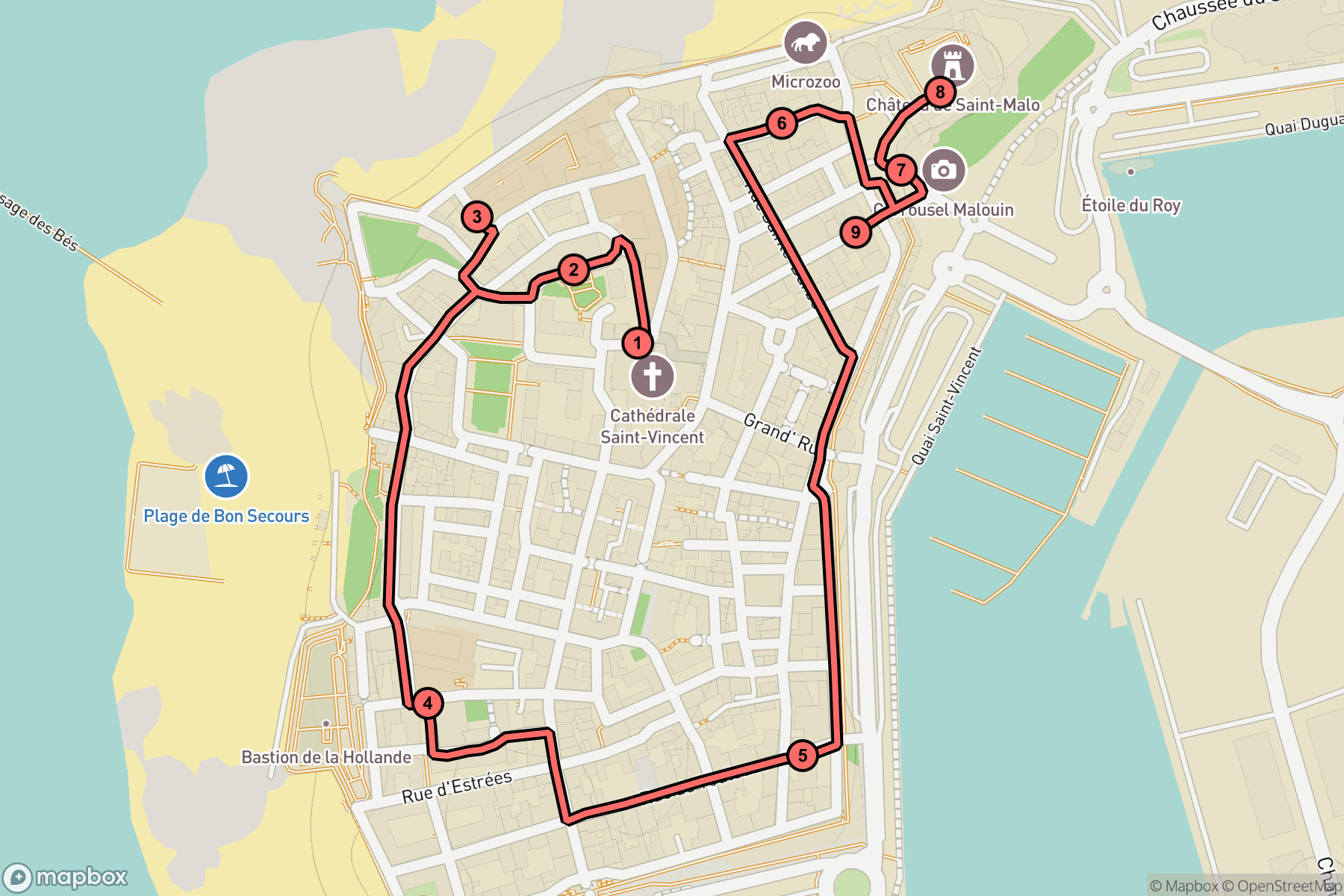
해적이 바다를 배회하기 훨씬 전부터 생말로의 돌담은 비밀과 폭풍으로 울려 퍼졌고, 그 흔적은 모든 고대 골목에 여전히 새겨져 있습니다. 이 셀프 가이드 오디오 투어는 인트라무로스의 심장부로 깊숙이 들어가 대부분의 행인들이 놓치는 전설적인 이야기와 숨겨진 구석을 드러냅니다. 인파를 피해 도시의 유서 깊은 외관 뒤로 숨어보세요. 절박한 반란 행위로 생뱅상 대성당에 불을 지른 사람은 누구일까요? 왜 한때 귀족의 피가 생말로 성 계단을 물들였을까요? 도시 역사 박물관에서 사라진 보물은 무엇이며, 왜 다시 찾을 수 없었을까요? 해적들이 음모를 꾸미고 왕들이 왕위를 걸었던 곳에 발자국을 따라 음모와 포위 공격을 추적해 보세요. 거리마다 수세기의 역사가 벗겨지면서 생말로의 격동적인 영혼과 잊을 수 없는 아름다움이 새롭게 드러납니다. 그림자 속으로 뛰어들어 성벽 뒤의 도시를 파헤쳐 보세요. 이제 비밀이 시작됩니다.
투어 미리보기
이 투어에 대하여
- schedule소요 시간 30–50 mins나만의 속도로 이동
- straighten2.0 km 도보 경로안내 경로 따라가기
- location_on
- wifi_off오프라인 작동한 번 다운로드, 어디서든 사용
- all_inclusive평생 이용언제든지 다시 재생 가능
- location_on생말로의 생뱅상 대성당에서 시작
이 투어의 정류장
If you’re trying to spot the Saint-Vincent Cathedral, just look for a grand stone building with a wide neoclassical façade, tall arched windows, and an impressive spire peeking…더 보기간략히 보기
If you’re trying to spot the Saint-Vincent Cathedral, just look for a grand stone building with a wide neoclassical façade, tall arched windows, and an impressive spire peeking straight up into the sky-right at the heart of Intra-Muros, you can’t miss it! Now, step a little closer-can you feel the past echoing in the stone? This cathedral isn’t just the heart of Saint-Malo, it’s practically the city’s memory palace, with every brick and arch whispering stories from nearly a thousand years of history! Imagine the year is 1145; this spot wasn’t always such a grand scene. Back then, it was just a humble monastery dedicated to Saint Malo himself, nestled by the seashore and probably trying to keep warm when the Breton wind whipped through. For a while, that’s all it was. But along came Bishop Jean de la Grille, with a dream as big as his bishop’s hat-he got permission from the Pope to move the seat of the diocese right here, and that’s how this place leveled up from “nice little monastery” to “cathedral central.” The first church was a bit cozier than today, mostly Romanesque with thick walls and rounded arches. Still, a church is like a teenager-always changing! Over the centuries, Saint-Vincent Cathedral added more layers, from regal Gothic arches to a grand transept and even a chapter house for the canons, who probably had the best choir gossip in town. The tower started low and chunky but by 1422 it was reaching for the skies, and chapels and corridors bloomed at its sides like springtime daffodils-one even became the final resting place for the explorer Jacques Cartier, the guy who knelt here for a big prayer before sailing off to “discover” Canada. By the seventeenth and eighteenth centuries, things got especially wild! Cannons from an Anglo-Dutch fleet knocked out the great rose window. Don’t worry, it was patched up (though probably not with chewing gum, but who knows?). The south chapel popped up in the 1700s and the belltower was crowned with a dome and later a spiky stone spire-just to tell the weather who’s boss. Could the drama stop there? Of course not. When World War II swept through in 1944, the cathedral became the unwilling star of a dramatic action sequence. Bombs rained down, glass exploded, and even the great spire was shot off by a German destroyer, terrified it might help the Americans land a winning punch. The spire collapsed dramatically onto the chapel below, and Saint-Malo’s heart was broken, but not for long-restorers got to work before the dust even settled. The job was so huge, it outlasted both the war budget and the original plans, and there were so many fundraising efforts that even Canadians joined in to help rebuild the spire! That’s international teamwork for you. With its new spire up in 1972 and a fresh rose window sparkling in the sunlight, the cathedral was reborn-just in time for a grand party with bishops and even the Canadian ambassador. By then, the cathedral rose 77 meters from its stone foundation to the shining cross on top. Today’s spire is simpler, streamlined, but every bit as determined as its ancestor. Inside-maybe you’ll go in later!-it’s a blend of power and elegance: thick Romanesque columns meet soaring Gothic windows, colorful glass floods the walls with shifting light, and you’ll see a mosaic on the floor remembering that Cartier prayer. The cathedral holds three different pipe organs, all crafted after the devastation of war, but one little organ in the Saint-Sacrament chapel still holds the job of keeping choral music alive every Sunday morning. Right now, above you, are five bells, the biggest named "Malo" and weighing as much as two small cars! Every night since the 16th century, “Noguette” has rung out to declare a peaceful “nighty-night” for old Saint-Malo. So, as you gaze up at this mix of stone and stories, picture the centuries of hope, disaster, music, and laughter-these walls have truly heard it all. And if you hear a bell or two while you stand here, that’s just the city’s way of saying, “Welcome to Saint-Malo, where legends are louder than the seagulls!”
전용 페이지 열기 →Look ahead for a painted stone statue of the Virgin Mary holding a child, set just above the Great Door-you’ll spot her by her flowing robes, serene face, and the little crown…더 보기간략히 보기
Look ahead for a painted stone statue of the Virgin Mary holding a child, set just above the Great Door-you’ll spot her by her flowing robes, serene face, and the little crown resting on her head. Now that you’re standing here, let me whisk you back to the times when Saint-Malo was a city of corsairs, storms, and more than a few legends! This, dear listener, is Our Lady of the Great Door-a statue nicknamed “Notre-Dame des Miracles” for some very good reasons. She’s not just a pretty face; she’s a centuries-old protector molded from painted limestone. Imagine the hustle of the 15th or 16th century-sailors packed inside the walls, prayers in the air, all eyes on Our Lady watching over the grand entrance to Saint-Malo. Nobody knows for sure if she came from Normandy, Touraine, or even Spain, but one thing’s certain: she didn’t start her journey in Saint-Malo. Some say Our Lady once floated into port on the water-imagine mariners finding her bobbing on the waves and carrying her joyfully ashore, probably with a lot of relieved laughter! The suspense gets better: legend tells of a young boy in 1378 seeing her point fiercely at the ground-right as English soldiers were secretly tunneling toward the city. Thanks to her “divine” directions, the tunnel was discovered, giving Saint-Malo an escape from disaster! And that’s not her only miracle. In 1661, when the town blazed with fire, people claimed they saw her spring up and halt the flames-though she lost part of her hand to the heat. They called her “Our Lady of Miracles” ever after. She wasn’t always safe from humans, either. During the Revolution, she lost her head-yikes!-but thankfully was restored, and in 1944, a bomb blast knocked her from her perch. Each time, she was lovingly pieced back together, earning her place now inside Saint-Vincent Cathedral where she’s safe from wild weather and wild history alike. So as you gaze up, imagine all the hopes, fears, and secret wishes whispered here-she’s seen it all, and kept Saint-Malo on its toes!
전용 페이지 열기 →To spot Rue du Chat-qui-Danse, look just past the round stone tower-right ahead you’ll see a narrow lane edged with sturdy, old stone buildings and red-trimmed windows. Now, let…더 보기간략히 보기
To spot Rue du Chat-qui-Danse, look just past the round stone tower-right ahead you’ll see a narrow lane edged with sturdy, old stone buildings and red-trimmed windows. Now, let me whisk you back a few centuries, right here along these ancient stones. Rue du Chat-qui-Danse, or “Dancing Cat Street,” might sound like somewhere you’d find a parade of playful kitties, and in a way, you wouldn’t be far off! Though today it’s a quiet lane tucked behind the northern ramparts of Saint-Malo, its name is tied to a very explosive piece of local history-literally. Picture it: The year is 1693. The people of Saint-Malo are nervously watching the sky as threatening English ships approach. Suddenly, the calm is shattered-cannonballs whistle through the air, and the town comes under heavy bombardment. But the English aren’t content with just a few broken windows. Next, they unleash their “infernal machine,” a truly diabolical contraption: a ship loaded with explosives, aimed straight for the city walls-specifically at the powder storage in the Bidouane tower. Imagine the tension, the fear, the sense that one wrong move could erase this street forever! Fate, however, had other plans. Instead of smashing into the walls, the infernal ship ran aground on the rocks. The fuse was lit, the town held its breath…and BOOM! The explosion was mighty, but only one “inhabitant” lost its life that day-a poor, unsuspecting cat. The townsfolk, with their wicked sense of humor, named this street “Rue du Chat-qui-Danse”-not in honor of a heroic feline ballerina, but to poke fun at the English. Can you imagine the locals, smirking and winking as they told visitors, “Yes, the only casualty of English firepower was a cat!?” Whispers say this street once ended in a dead end, and was a secret haunt for the neighborhood’s cats. And for a bonus fact: the infamous corsair Robert Surcouf is said to have been born at number 2, perhaps adding a little extra mischief and maritime magic to every corner. So as you stand here, listen closely-maybe you’ll hear the faint echo of a paw, or perhaps the ghostly meow of Saint-Malo’s bravest cat!
전용 페이지 열기 →
6개 정류장 더 보기정류장 적게 보기expand_moreexpand_less
To spot the Church of Saint-Sauveur, look straight ahead for a tall, imposing stone building with large arched windows and a steep, slate-roofed bell tower perched on…더 보기간략히 보기
To spot the Church of Saint-Sauveur, look straight ahead for a tall, imposing stone building with large arched windows and a steep, slate-roofed bell tower perched on top. Welcome! You’re now standing in front of the Church of Saint-Sauveur, one of Saint-Malo’s most quietly dramatic treasures. If these stone walls could talk, oh, the stories they’d tell-don’t worry, you’ve got me for that! Imagine yourself here in the early 1700s, the salty breeze whipping in from the ramparts as builders hammered away, following the designs of architect Thomas Poussin. The plans for this place were actually drawn up by Siméon Garangeau, the same engineer who worked closely with Vauban, France’s star fortress builder. That’s why this chapel is just bursting with historic flair. But let’s set the scene even further back. Where you’re standing now was once the yard of the Hôtel-Dieu, Saint-Malo’s medieval hospital, founded all the way back in 1253 by Bishop Geoffroy-talk about ancient healthcare! The original chapel served as a quiet sanctuary for the sick and weary. But over time, the Hôtel-Dieu moved locations and the whole site evolved, with the present-day church being completed in 1744 after six years of dust, sweat, and a whole lot of stone hauling. Now, here’s where the plot thickens-during World War II, Saint-Malo was heavily bombed as the Allies fought to liberate the city. The Hôtel-Dieu complex was almost entirely destroyed in the inferno of 1944, leaving this very chapel as the only survivor. Imagine the sound of glass shattering and walls crumbling under the assault, while this resilient church stood its ground! Afterwards, instead of rebuilding the hospital, two apartment buildings sprang up nearby, and the Saint-Sauveur church was left to watch over memories and ghosts. By 1974, the church had traded sermons for symphonies and paintings, as it was lovingly restored and converted into a buzzing cultural venue. Today, if you peek inside, you might find anything from classical concerts to cutting-edge art expositions. Over the years, its walls have been graced by orchestras, exhibitions of sailing art by Marin Marie, the playful universe of Gotlib’s comics, and even birthdays-remember Spirou, the cartoon character? He celebrated his 80th here! There’s always something exciting going on behind these sturdy stone walls. You might come across watercolor landscapes, avant-garde installations, or concerts that make the stained-glass windows tremble just a bit. Not bad for a building that started as a haven for the poor and sick, turned survivor of war, and now a cultural hero. So next time you hear someone say, “If these walls could talk…” you can wink and say, “Oh, they do. Especially in Saint-Malo!” Ready to continue our journey? There’s so much more history just around the next corner!
전용 페이지 열기 →Directly ahead, you’ll see a grand, sturdy stone mansion topped with tall chimneys and a row of elegant white windows, standing proudly behind a thick wall and striking red…더 보기간략히 보기
Directly ahead, you’ll see a grand, sturdy stone mansion topped with tall chimneys and a row of elegant white windows, standing proudly behind a thick wall and striking red doors-just look out for those doors and you can’t miss it! Welcome, traveler, to the Hotel d’Asfeld! Now, as you stand in front of this magnificent granite mansion, close your eyes for a second-can you hear a faint echo of merchant boots and carriage wheels? Three centuries ago, this wasn’t just any rich person’s house-this was the showpiece of François-Auguste Magon de la Lande, a shipowner who helped make Saint-Malo buzz with tales of the sea, fortunes hauled across oceans, and secrets traded behind closed doors. Back in the day, just getting an invitation to step inside one of the sixty rooms-thirty with fireplaces, to keep out the biting sea chill-meant you’d “made it” in Saint-Malo society. Through these very windows, you’d catch glimpses of grand dinners under glinting candlelight, where plots were whispered and thunderous laughter sometimes turned into heated arguments about ships and treasure. The air was thick with the scent of roasted meat, a little sea salt, and, perhaps, just a whiff of jealousy. After all, who wouldn’t envy a family living in a home with its own courtyard, polished shops on the ground floor, and a grand staircase fit for a royal entrance? Even the building itself is a survivor, standing tall while so many others were destroyed in World War II. If these walls could talk, I bet they’d spill stories of heroic deals, secret heartbreaks, and one or two practical jokes involving powdered wigs. So take a moment-look up at those stern stone lines, feel the cool breeze, and imagine what it was like here 300 years ago, when the house and the city buzzed with adventure and ambition.
전용 페이지 열기 →To spot the Hôtel de la Gicquelais, look up at the tall stone building with its many large white-framed windows, looming solidly right along the narrow lane in front of you. Now,…더 보기간략히 보기
To spot the Hôtel de la Gicquelais, look up at the tall stone building with its many large white-framed windows, looming solidly right along the narrow lane in front of you. Now, let’s dive into a secret from these sturdy walls! Imagine it’s a grey September morning in 1768, and the salty air of Saint-Malo is swirling through these very streets-suddenly, a baby’s first cry echoes out from inside this grand house. That’s no ordinary baby, though, but François-René de Chateaubriand, who would grow up to become one of France’s most famous writers. Back in those days, the building was the pride of a wealthy family, its rooms filled with wood creaking under fancy shoes and the distant clatter of horse-drawn carriages bumping over cobblestones. If these walls could talk, they’d probably whisper stories of elegant parties and perhaps a few juicy secrets-after all, who knows what little Chateaubriand got up to as a boy? And just think, this very building was deemed so special that in 1964, it was officially declared a historic monument. It stands silently, watching the world change, never giving up the full story of what’s gone on behind those many, many windows. Keep an eye out, you never know if a ghostly poet is peeking out to see who’s passing by!
전용 페이지 열기 →To spot the Museum of the History of the City and the Pays Saint-Malo, look for a tall, rugged stone fortress with red shutters, chunky medieval walls, and a French flag waving…더 보기간략히 보기
To spot the Museum of the History of the City and the Pays Saint-Malo, look for a tall, rugged stone fortress with red shutters, chunky medieval walls, and a French flag waving over the entrance marked “Hôtel de Ville” and “Musée”-it’ll be hard to miss! Welcome, my adventurous friend, to what was once the gateway to centuries of Saint-Malo’s most riveting secrets! Imagine standing here in front of thick stone walls that once echoed with the marching footsteps of guards, and the whispers of daring seafarers who set sail from this very town. This building wasn’t just a museum; it was the castle’s proud donjon, rising over three dramatic levels, holding stories as deep as the dungeon’s shadows-and as fantastic as the city’s wildest tides! Back in 1862, the people of Saint-Malo decided their epic saga needed a proper home; so in swept this museum, gathering together over 8,000 treasures-paintings, ship models, old maps, captain’s chests, and relics from the days of pirates and explorers. Picture rooms filled with tales-from Roman-era finds to the bold journeys of Jacques Cartier, who could turn the Atlantic into his own watery highway. There were entire rooms dedicated to salty fishermen daring icy Newfoundland waters, mysterious relics from underwater shipwrecks, and portraits of local legends like Surcouf (who could sail rings around his enemies with a wink and a grin). Oh, and the view from the highest tower? Panoramic magic! You’d look over the city, the harbor, the endless sea-just as medieval watchmen once did, maybe using the same excuse to skip work: “Sorry, I was distracted by the scenery!” Sadly, the museum within these walls closed in 2019, but the collections are preparing to set sail for a new home-a future maritime museum on the docks, with shipwreck treasures and all. For now, let your imagination run wild through these ancient corridors, where every stone and echo tells a salty tale of Saint-Malo’s unstoppable spirit!
전용 페이지 열기 →To spot the Castle of Saint-Malo, just look ahead for a tall, sturdy stone fortress with an impressive, steep roof, little red windows, a waving French flag above the arched…더 보기간략히 보기
To spot the Castle of Saint-Malo, just look ahead for a tall, sturdy stone fortress with an impressive, steep roof, little red windows, a waving French flag above the arched entrance, and an aura that says, “I’ve seen some things!” Welcome to the mighty Castle of Saint-Malo! Right in front of you is a true fortress of stories-get ready to travel through time with a shout of “Allons-y!” Imagine the walls echoing with the footsteps of dukes, daring townsfolk, and, let’s be honest, some very annoyed pigeons. Our journey begins in the 15th century. The castle’s construction was ordered by the Dukes of Brittany, those stylish power-players determined to keep Saint-Malo firmly under their thumb. For almost two centuries, the dukes tinkered and added more parts, turning what used to be a simple fort into the impressive stronghold you see now. But here’s a twist: before it became a castle, Saint-Malo itself was caught in a royal tug-of-war. First snatched by the King of France, then handed back to the Duke of Brittany in 1415-a peace offering to lure the Bretons into a battle they… didn’t even attend. Easy win for them, eh? Enter Jean V, the crafty duke. In 1424, he started building the “Grand Donjon”-think of it as the ultimate medieval panic room, placed right where the land meets the walled city. This was the only gateway between Saint-Malo’s cozy chaos and the looming Breton countryside. The design wasn’t just for looks. With its horseshoe shape and thick walls, Jean V was sending a message: “Try me.” If castles could talk, this one would definitely sound a bit smug. The castle didn’t stop growing. François II, another duke, added the brooding “La Générale” tower in 1475-stout and serious, less height but more bulk, clearly skipping leg day in favor of upper body strength. Then came Anne, his daughter, better known as Queen of France, who left her mark by building “Quic-en-Groigne” between 1498 and 1501. The locals weren’t too thrilled, as you can guess from the name, which basically means, “Grumble if you want, it’s happening anyway.” Apparently, someone scratched this motto into the stone, although the inscription faded during the Revolution. I guess even graffiti isn’t safe from politics here! The towers “des Dames” and “des Moulins” soon followed-giant bastions with just a few cannon mouths, but enough muscle to stare down any artillery. And the drama doesn’t end there! In 1590, the castle was actually stormed by the people of Saint-Malo. When rumors flew that the governor might betray the city to King Henri IV’s Protestant army, the locals broke in, and let’s just say the governor didn’t make it out. Talk about passionate city pride! Through the centuries, the castle changed with the times. During the reign of Louis XIV, the famous military engineer Vauban got involved. He had the upper portions of the towers altered to hold bigger, better cannons. By the 18th century, two grand barracks for soldiers lined the inner courts, and a triangular bastion known as “La Galère”-shaped like a ship’s prow-was reinforced to defend Saint-Malo like a stone battleship. And yes, the castle saw more than its fair share of action. In the Revolution, its walls shook with another siege by townsfolk demanding change. Later, it became a proper barracks until the 1920s. Picture bustling soldiers, the clang of boots, the echo of orders. In 1927, a whole new chapter began when the city moved its museum inside, filling these ancient halls with tales and treasures of Saint-Malo’s epic past. Today, the castle hosts both the town hall and the museum of local history. Step inside and you’ll discover wood-paneled mayor’s offices, old artifacts, and, if you listen closely, maybe the faintest whispers of dukes, rebels, and royalty with very strong opinions. And don’t worry-nobody’s going to assault the castle today. Unless you count the tourists hungry for history!
전용 페이지 열기 →To spot Hotel Hay, look for a grand, stately stone building with rows and rows of tall white windows and elegant black iron balconies rising above a bright red awning-it's hard to…더 보기간략히 보기
To spot Hotel Hay, look for a grand, stately stone building with rows and rows of tall white windows and elegant black iron balconies rising above a bright red awning-it's hard to miss, right ahead! Now, let’s step back in time, right here on this cobblestone corner. Imagine the salty breeze of the 1700s swirling around you as Saint-Malo thrummed with merchants, sailors, and the chattering of secrets. This remarkable mansion was built at the start of the eighteenth century by Guillaume White, an ambitious shipowner from Ireland. Imagine Guillaume pacing these very stones, plotting daring adventures across the wild Atlantic-maybe even with a twinkle in his eye, thinking of all the treasures he might bring back. The house echoed with laughter, tales of stormy seas, and maybe even the stomp of impatient boots as he waited for news of his ships. After Guillaume, the house saw another colorful character-Nicolas White de Boisglé-adding even more layers to the stories within its walls. Over centuries, Hotel Hay has played witness to Saint-Malo’s dramas: storms, victories, and everyday life. Since 1942, it’s enjoyed a special honor: it’s protected as a historic monument, a standing memory chest filled with whispered legends
전용 페이지 열기 →
자주 묻는 질문
투어는 어떻게 시작하나요?
구매 후 AudaTours 앱을 다운로드하고 교환 코드를 입력하세요. 투어를 바로 시작할 수 있습니다 - 재생을 탭하고 GPS 안내 경로를 따라가시면 됩니다.
투어 중 인터넷이 필요한가요?
아닙니다! 시작 전에 투어를 다운로드하면 완전히 오프라인으로 즐길 수 있습니다. 채팅 기능만 인터넷이 필요합니다. 모바일 데이터 절약을 위해 WiFi에서 다운로드하시는 것을 권장합니다.
이것은 가이드가 안내하는 단체 투어인가요?
아닙니다 - 이것은 셀프 가이드 오디오 투어입니다. 폰을 통해 오디오 나레이션을 들으며 나만의 속도로 독립적으로 탐험합니다. 투어 가이드도, 단체도, 일정도 없습니다.
투어는 얼마나 걸리나요?
대부분의 투어는 60-90분이 소요되지만, 속도는 전적으로 본인이 조절합니다. 원할 때 언제든지 일시정지하거나, 정류장을 건너뛰거나, 휴식을 취하세요.
오늘 투어를 끝낼 수 없으면 어떻게 하나요?
괜찮습니다! 투어는 평생 이용이 가능합니다. 원할 때 언제든지 일시정지하고 다시 시작하세요 - 내일, 다음 주, 또는 내년에도. 진행 상황이 저장됩니다.
어떤 언어를 이용할 수 있나요?
모든 투어는 50개 이상의 언어로 이용 가능합니다. 코드를 교환할 때 원하는 언어를 선택하세요. 참고: 투어 생성 후에는 언어를 변경할 수 없습니다.
구매 후 투어는 어디에서 이용하나요?
App Store 또는 Google Play에서 무료 AudaTours 앱을 다운로드하세요. 교환 코드(이메일로 전송됨)를 입력하면 라이브러리에 투어가 나타나며, 다운로드하여 시작할 수 있습니다.
투어가 마음에 들지 않으시면 환불해 드립니다. 문의: [email protected]
안전한 결제 


