
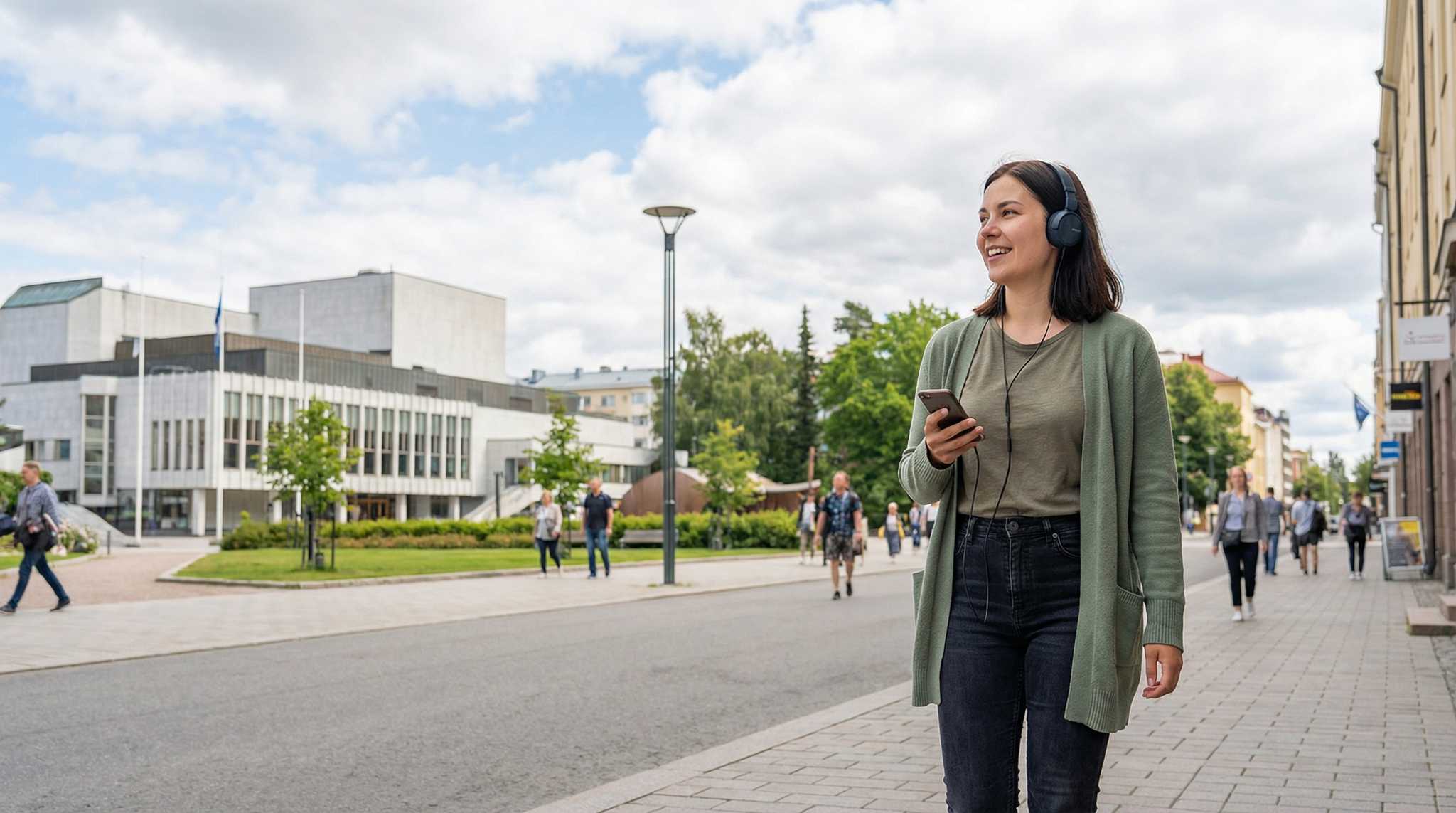
탐페레 오디오 투어: 숨겨진 방앗간, 궁전의 흔적 & 시장의 메아리
최첨단 지속 가능한 포장재가 탄생하는 혁신적인 메차 보드 타코(Metsä Board Tako)부터 탐페레의 풍부한 건축 유산을 증명하는 유서 깊은 보안관 건물(Security House)까지 안내하는 특별한 투어를 통해 활기찬 탐페레 도시를 탐험하세요. 도시의 문화적 과거를 엿볼 수 있는 숨겨진 보석 같은 우아한 수멜리우스 궁전(Sumelius Palace)을 탐험하세요. 이 매혹적인 여정은 현대 산업과 시대를 초월한 매력을 조화시켜 탐페레의 다양한 정신을 보여주는 독특한 경험을 선사합니다. 영감을 주고 잊을 수 없는 투어에 참여하세요!
투어 미리보기
이 투어에 대하여
- schedule소요 시간 30–50 mins나만의 속도로 이동
- straighten1.2 km 도보 경로안내 경로 따라가기
- location_on
- wifi_off오프라인 작동한 번 다운로드, 어디서든 사용
- all_inclusive평생 이용언제든지 다시 재생 가능
- location_on렌포르스 바늘 공장에서 시작
이 투어의 정류장
Now, Victor had a sharp idea-literally. He started making needles! Soon, this tiny island was dubbed “Neulasaari” or Needle Island. Needles were flying off the production…더 보기간략히 보기
Now, Victor had a sharp idea-literally. He started making needles! Soon, this tiny island was dubbed “Neulasaari” or Needle Island. Needles were flying off the production lines-well, hopefully not literally or it would have been a prickly business for anyone walking by! But fate has a habit of threading twists into any good story. In 1863 the factory went bankrupt, the machines fell silent, and the needles stopped dancing. Yet, this is Tampere, where even old factories get second chances! In 1871, Henrik Liljeroos, the dye master, took over. Instead of needles, he spun wool and wove new dreams on the island-now called Kehräsaari, or Spinning Island. From machines to textiles, the hum of industry carried on until the 1980s. Today, as you stand here, you’re at the crossroads of time where sharp ideas and spinning threads once ruled the day. All that’s missing is the sound of old machinery-and maybe a stray needle or two on the ground, so watch your step!
전용 페이지 열기 →To spot Laukontori, just look ahead for the hustle and bustle-you’ll see an open square lined with bright tents and market stalls, surrounded by colorful old buildings, and lively…더 보기간략히 보기
To spot Laukontori, just look ahead for the hustle and bustle-you’ll see an open square lined with bright tents and market stalls, surrounded by colorful old buildings, and lively people drifting between them. Welcome to Laukontori, the heart of lakeside trading and stories! Imagine you’re standing on the cobblestones in the middle of this lively square, with the crisp air blowing in from Lake Pyhäjärvi behind you. In the summer, the waters just beyond the square are alive with the gentle rocking of cruise boats headed to distant islands and far-off towns, their horns cutting through the morning air. But the real magic of Laukontori stretches far back-named after the first steamboat, the mighty Laukko, which sailed these waters back in 1859. The ship was so famous that this very square became known as the place where Laukko landed, marking a vibrant new era for Tampere. Now, picture this: in the early 1900s, this area was where the wealthy of Tampere liked to set up their fine city homes right on the square’s edge, because being close to the market and harbor meant you were right in the center of it all-where gossip and deals, laughter and business, mixed together like cream in coffee. Back in those days, nearly half of the Nalkala neighborhood’s people were considered top of the social ladder, though I bet not one of them could handle a modern smartphone! Every morning, especially up to the 1950s, the square filled with the calls of vendors selling fresh produce straight off boats gliding in from lake villages. And if your nose is feeling adventurous, Laukontori is famous for Tampere’s legendary black sausage, mustamakkara-a snack that’s as dark as a winter’s night but tastier by far. If you wander across the Vuolteensilta or the newer Laukonsilta bridge, you’ll find yourself drifting into new neighborhoods, but rest assured, Laukontori’s pulse remains the same, a living memory of Tampere’s busy soul. So, take a look around-can you smell the fresh bread, hear the chatter, and sense the echoes of steamships from days gone by? This is more than a market; it’s a meeting place for souls, both old and new.
전용 페이지 열기 →To spot the Trading Society House, look for the striking two-story building with a grand stone lower floor, a wooden upper floor, a castle-like tower on the corner, and a wide…더 보기간략히 보기
To spot the Trading Society House, look for the striking two-story building with a grand stone lower floor, a wooden upper floor, a castle-like tower on the corner, and a wide balcony-right at the junction of Laukontori and Kirkkokatu. Welcome! You’re now at the spot where the magnificent Trading Society House once stood. Imagine standing here over a hundred years ago, maybe on a crisp summer morning in 1905, when Tampere was buzzing with excitement over this brand-new building. Designed by August Krook, it was unlike any other house in the city: sturdy granite at the bottom, and above it, cheerful timber walls crowned by a quirky, castle-like tower. Locals used to joke that the building looked ready for a fairy-tale knight-or maybe a business meeting with Rapunzel! Inside, the Trading Society members gathered in a grand hall that felt more like a country lodge than a stuffy boardroom. The hall was big and open, with balconies overlooking the floor, a crackling soapstone fireplace, and a ceiling painted like the night sky. Tiny electric lights twinkled down at the club members, turning every meeting into a starry affair. The lower floor was all about business, with a lively market hall where sellers hawked their goods-imagine the blend of fresh bread, spices, and a bit of local gossip. The odd shapes of the windows and roof made the outside look playful, while inside was warm, welcoming, and just a little bit magical. But, as the years passed, the house faced a battle with time. Roof repairs became a yearly event, and one dramatic New Year’s Eve, part of the roof actually crashed down! Some said it was time to tear the old building down, while others wanted to save their quirky, beloved clubhouse. In the end, the modern world won, and in 1956 the house came down-making way for the sleek new Trading Society House seen today. So now, looking at this spot, picture the laughter, the debates, the twinkling lights-and remember, every building has its own story, and this one was truly “the funniest social hall” in Tampere.
전용 페이지 열기 →
7개 정류장 더 보기정류장 적게 보기expand_moreexpand_less
Look for a series of red-brick industrial buildings and a very tall, round smokestack standing proudly alongside the river-just follow the water’s edge and you can’t miss…더 보기간략히 보기
Look for a series of red-brick industrial buildings and a very tall, round smokestack standing proudly alongside the river-just follow the water’s edge and you can’t miss it! Welcome to Metsä Board Tako, a real heavyweight in Tampere’s industrial history! Imagine this place back in the late 1800s-steam rising, machines humming, and the echo of logs tumbling into a great metal chute. Back in 1865, this was the brainchild of Fredrik Idestam, who saw Tammerkoski’s west bank as the perfect place for a wood grinding mill. The factory quickly grew, sounding like a beehive on full throttle, and soon the Takon site was cranking out not only cardboard, but even roofing felt and corrugated boxes. Yes, this spot wasn’t just about paper, it was about making life a little bit more...well, packaged! Through the decades, Tako’s machines got bigger, faster, and noisier-at its peak, one of their paper machines was literally the largest in Finland. But the heart of the action was always the wood. Logs would roll in, and if you listened closely, you could almost hear Tampere’s residents sighing at the booming racket! Even after the 1923 fire, which tragically claimed four workers and gutted the old wooden mill, Tako’s people rolled up their sleeves and got right back to work. By the 1960s, over 1,000 folks worked here, producing mountain after mountain of cardboard. And though the log grinding faded out and Tako’s last board rolled off in June 2025 (not so long ago!), the giant red-brick halls and that sky-poking chimney still stand, holding stories of invention, noisy nights, and a spirit that helped shape Tampere. Don’t worry-the factory might be quiet now, but these walls still have plenty to say if you listen close!
전용 페이지 열기 →To spot the Tampere Telephone Cooperative Building, look for a four-story corner building covered in gray paneling and large windows, right at the intersection with a rounded edge…더 보기간략히 보기
To spot the Tampere Telephone Cooperative Building, look for a four-story corner building covered in gray paneling and large windows, right at the intersection with a rounded edge facing the street. You’re standing outside a building with a lot more history than its muted gray panels might let on! Imagine it’s the early 1930s: the streets are buzzing, cars occasionally honk as horse-drawn carts clatter by, and Tampere’s growing fast-fast enough that everyone seems to be getting a telephone. Well, almost everyone; gossip still travels quicker at the market! Now, in 1933, this building was brand new and covered in beautiful light plaster, designed by the talented architect Bertel Strömmer. And what was its big job? Housing the machinery that was about to revolutionize how people in Tampere talked to each other. Before this place existed, phone calls depended on patient operators, sitting with big switchboards and plugging in wires. If you want a sound to imagine, picture the steady click-clack of cords and connections all day long:. But the phone cooperative outgrew their old home and, with automation on the way, needed something modern-this four-story marvel. On March 31, 1934, the switch was thrown inside this very building, and 3,500 numbers could now ring automatically, powered by the latest from L. M. Ericsson. Suddenly, you didn’t need to charm an operator for your conversation! In 1882, Tampere had just 50 numbers and one was claimed by the newspaper Aamulehti-talk about being first with the news. By the time this building opened, there were nearly 3,000 phones. If you listen closely, maybe you can almost hear echoes of ringing phones and proud footsteps of engineers. Over time, the sparkling look faded as new panels were added in the 1960s, hiding those pure architectural lines-but the legacy of connecting a city lives on. In 1979, the cooperative upgraded again, but every buzz and ring here helped Tampere leap into the future. If only the walls could talk-actually, they’d probably ask you to “please leave a message after the beep!”
전용 페이지 열기 →To spot the Tampere Market Hall, just look ahead for a long, cream-colored building with tall arched windows and a grand entrance right in the center-its old-world charm makes it…더 보기간략히 보기
To spot the Tampere Market Hall, just look ahead for a long, cream-colored building with tall arched windows and a grand entrance right in the center-its old-world charm makes it stand out on the street. Now, let’s step into the bustling heart of Tampere’s history-and no, I don’t mean the center of a cinnamon roll, though those might be inside! Imagine the year is 1901: horses clop the streets, peddlers shout their daily deals, and the city smells like fresh bread and rain on cobblestones. Tampere desperately needed a proper place to bring together all the chaos of its townsfolk-the loud traders, the butchers, the bakers, and yes, probably a few cheeky candlestick-makers. By order of the city’s leaders who’d had quite enough of muddy open markets (think more “cattle stampede” than “Pinterest farmers’ market”), construction began. And what an enormous feat! Designed by the architect Hjalmar Åberg, the hall grew until it covered 2,100 square meters. That’s a lot of sausages, pastries, and strong Finnish coffee under one very fine roof. At first, people thought this massive hall was a gamble-would Tampereans really trade their wild, outdoor hustle for a building? But step inside today, and the answer is clear. The market hums with 174 stalls, echoing stories from all walks of life. In fact, more than a third of those are dedicated to cafes and restaurants. The crowning jewel? A little place called Four Seasons, where everyone whispers you haven’t really been to Tampere until you’ve eaten there. The hall has survived arguments and even an 11-year debate over its very existence-at one point, the fight over keeping its original office building got almost as heated as a fresh batch of pulla bread. But in the end, tradition won, and the market stands today as the largest in the Nordics-a lively, scented, story-filled time capsule. So while you’re standing here, imagine all the laughter, arguments, and secret recipes that have passed under these arched windows. And maybe, just maybe, treat yourself to a pastry-you’re practically walking through history with every bite.
전용 페이지 열기 →To spot Syrjänen's Mausoleum, look for a boxy, pale structure with simple tiled walls-it stands boldly in the middle of a busy square, quite different from the older, ornate…더 보기간략히 보기
To spot Syrjänen's Mausoleum, look for a boxy, pale structure with simple tiled walls-it stands boldly in the middle of a busy square, quite different from the older, ornate buildings around it. So, here you are standing where one of Tampere’s most “unloved” landmarks once stood-Syrjänen’s Mausoleum! Imagine the wartime streets of Tampere, muddy and bustling, with this tall, pale, windowless box suddenly appearing near the southern edge of the main square, sandwiched right between old shops and busy people. The locals couldn’t help but raise their eyebrows. Some said it looked more like a giant Lego brick dropped into the city than an entrance to an underground air-raid shelter! Tampereans, with their fantastic sense of humor, quickly nicknamed it “Syrjänen’s Mausoleum”-not because anyone was buried here, but because it popped up while K. V. Syrjänen was the city council chairman. City legend has it that nobody ever took family photos in front of this boxy “colossus.” One local writer even claimed it was the ugliest building ever put up in Tampere, calling it both unlucky-looking and downright monstrous. As you soak in the atmosphere, picture anxious wartime citizens darting inside its doors for shelter, maybe giving it an extra suspicious side-eye as they hurried past. By the 1950s, with the war long over, the mausoleum took its final bow and quietly disappeared. But stories-and the legend of this “Lego gone wild”-still linger right where you’re standing!
전용 페이지 열기 →To spot Sumelius Palace, look across the riverbank for a striking three-story mansion with elegant arches, decorative balconies, and a pale stone façade nestled right next to the…더 보기간략히 보기
To spot Sumelius Palace, look across the riverbank for a striking three-story mansion with elegant arches, decorative balconies, and a pale stone façade nestled right next to the bridge. Ah, you’ve found the grand old Sumelius Palace! Picture yourself here in the late 1800s, right beside Tammerkoski, where this lavish, neo-Renaissance stone palace shimmered with style. The influential merchant Gustaf Oskar Sumelius built this home for his family-a place so fancy, it made even the ducks in the river do a double take. As you stand here, imagine the clatter of horse carriages arriving at the door, and the lively laughter of Tampere’s elite echoing from those ornate balconies. Sumelius was so prosperous, his income topped everyone in town-and his palace was proof, filled with the kind of luxury most Finns had only seen in storybooks. But just when you think the story is all silk and parties, here's the twist: in 1938, the beloved palace was demolished-poof, like magic!-to make way for a new six-story department store designed by Bertel Strömmer. The grand old palace was gone, but if you listen really closely, you might still hear the faint notes of a piano drifting on the breeze, reminding you of the golden days when Sumelius Palace ruled the riverside. So, one big lesson: in Tampere, even the fanciest houses can vanish, but their stories linger on!
전용 페이지 열기 →Look up at the corner of Hämeenkatu and Kuninkaankatu, and you’ll spot the tall, bold stone façade of the Otra House-its rounded corner, huge windows, and striking granite walls…더 보기간략히 보기
Look up at the corner of Hämeenkatu and Kuninkaankatu, and you’ll spot the tall, bold stone façade of the Otra House-its rounded corner, huge windows, and striking granite walls really set it apart from everything else on the street. Now, picture Tampere in 1914-a city buzzing with excitement, the smell of fresh mortar in the air, and men in flat caps gesturing proudly while steel frames rise skyward. This was no ordinary building project! The Otra House was a real celebrity in its day, strutting onto the scene as one of Tampere’s very first steel-and-concrete constructions. Thanks to that fancy new technology, the ground floor windows could be huge, letting every shopper peek in with wide-eyed wonder. The mastermind here was Georg Schreck, an architect and one of the founders of the company, who decided to dress his building in proud, rugged granite in a romantic national style-though by then, most folks had already swapped romance for modernism. But, like some people I know who add an extra scoop of ice cream to an already perfect sundae, the 1960s brought an extra floor and a changed roof. That upgrade, designed by Harry W. Schreck (Georg’s own son!), left the old building’s charming Art Nouveau hat a bit ruffled. In the 1980s, Otra House got a makeover inside and out, closing off its courtyard. Still, you can feel the building’s original ambition and style-plus, who can resist a place that’s seen more facelifts than a soap opera star?
전용 페이지 열기 →Look for a tall, light gray building with six stories and a black granite base, right along Hämeenkatu-just where the street feels especially lively and the shops invite you…더 보기간략히 보기
Look for a tall, light gray building with six stories and a black granite base, right along Hämeenkatu-just where the street feels especially lively and the shops invite you in. You’ve made it! Welcome to the Security House, or as the locals call it, Turvan talo. Take a deep breath and imagine it’s 1940-right here, people are buzzing with excitement as this brand-new building rises higher than its humble wooden predecessor. Picture the grand opening, the sound of men in hats and women in dresses clattering over the sidewalk. Designed by the ever-stylish Jaakko Tähtinen, this house was the first true home for Insurance Company Turva. Back in the day, folks would have spotted the famous Hällä Cinema below, where the magic of sound films thrilled Tampere’s moviegoers. In fact, this was the very spot where Finland first saw a widescreen film-can you hear the gasp from the audience in 1954?. Even now, the old Hällä sign throws a nostalgic wink at anyone passing by. Now, the building hosts not only insurance offices but also dances and laughter thanks to the theater inside. As you stand here, know that you’re finishing your adventure at a true Tampere treasure-where history isn’t just remembered, it’s alive and kicking!
전용 페이지 열기 →
자주 묻는 질문
투어는 어떻게 시작하나요?
구매 후 AudaTours 앱을 다운로드하고 교환 코드를 입력하세요. 투어를 바로 시작할 수 있습니다 - 재생을 탭하고 GPS 안내 경로를 따라가시면 됩니다.
투어 중 인터넷이 필요한가요?
아닙니다! 시작 전에 투어를 다운로드하면 완전히 오프라인으로 즐길 수 있습니다. 채팅 기능만 인터넷이 필요합니다. 모바일 데이터 절약을 위해 WiFi에서 다운로드하시는 것을 권장합니다.
이것은 가이드가 안내하는 단체 투어인가요?
아닙니다 - 이것은 셀프 가이드 오디오 투어입니다. 폰을 통해 오디오 나레이션을 들으며 나만의 속도로 독립적으로 탐험합니다. 투어 가이드도, 단체도, 일정도 없습니다.
투어는 얼마나 걸리나요?
대부분의 투어는 60-90분이 소요되지만, 속도는 전적으로 본인이 조절합니다. 원할 때 언제든지 일시정지하거나, 정류장을 건너뛰거나, 휴식을 취하세요.
오늘 투어를 끝낼 수 없으면 어떻게 하나요?
괜찮습니다! 투어는 평생 이용이 가능합니다. 원할 때 언제든지 일시정지하고 다시 시작하세요 - 내일, 다음 주, 또는 내년에도. 진행 상황이 저장됩니다.
어떤 언어를 이용할 수 있나요?
모든 투어는 50개 이상의 언어로 이용 가능합니다. 코드를 교환할 때 원하는 언어를 선택하세요. 참고: 투어 생성 후에는 언어를 변경할 수 없습니다.
구매 후 투어는 어디에서 이용하나요?
App Store 또는 Google Play에서 무료 AudaTours 앱을 다운로드하세요. 교환 코드(이메일로 전송됨)를 입력하면 라이브러리에 투어가 나타나며, 다운로드하여 시작할 수 있습니다.
투어가 마음에 들지 않으시면 환불해 드립니다. 문의: [email protected]
안전한 결제 


