Halifax Audio Tour: Tracing Time from Industry to Innovation
ハリファックスの壮大な石造りの塔と燃えるような赤レンガの下には、反乱、スキャンダル、そして発明の秘密があらゆる通りに刻まれています。このセルフガイドオーディオツアーは、ほとんどの旅行者が見過ごしてしまう物語を明らかにし、産業の伝説、大胆な反乱行為、そしてかつて歴史が勃発した静かな場所へとあなたを導きます。 なぜ一つの赤レンガの礼拝堂がハリファックスの現状を脅かしたのでしょうか?物議を醸す日記とともにミニスターに眠るのは誰で、その日記は今も議論を巻き起こしているのでしょうか?カルダーデール産業博物館にあった、姿を消した機械は、地域全体にどのような足跡を残したのでしょうか? 影の多い中庭に足を踏み入れ、そびえ立つ尖塔と鉄の匂いがする空気を通り過ぎましょう。伝統と進歩の間の戦いをたどります。一歩ごとに、物語ごとにハリファックスが新たな姿を見せるにつれて、足元に過去の野心の鼓動を感じてください。 ハリファックスの表面の奥を見たいなら、再生ボタンを押してください。冒険は目の前に隠されています。
ツアーのプレビュー
このツアーについて
- schedule所要時間 40–60 mins自分のペースで進める
- straightenウォーキングルート 3.2kmガイド付きパスに沿って進む
- location_on
- wifi_offオフライン対応一度のダウンロードでどこでも使える
- all_inclusive無期限アクセスいつでも、ずっと再生可能
- location_onカルダーデール産業博物館から開始
このツアーのスポット
Keep your eyes to the right as you walk along the pavement-you’re looking for a tall, sturdy building made of red brick, with striking blue doors and window frames. It almost…もっと読む折りたたむ
Keep your eyes to the right as you walk along the pavement-you’re looking for a tall, sturdy building made of red brick, with striking blue doors and window frames. It almost looks like a classic old factory straight out of a storybook about the Industrial Revolution. The windows are big and arched at the top, as if they’re peeking over the street to see who’s coming. The entrance is behind a chunky blue metal fence, so you can’t miss it. Welcome to the Calderdale Industrial Museum! Take a breath, imagine the smell of oil and iron, and the hum of machines at full tilt. This whole place was once alive with the clatter of industry-steam, gears, and grit. Between these walls you’ll find massive working machines, some built as far back as 1850, all rattling away just as loudly now as they did when Queen Victoria was on the throne. In those days, if you stood here, you’d see workers with rolled up sleeves, faces smeared with coal dust, and maybe hear the boss’s stern shout over the thump and chug of pistons. Now, it’s thankfully a lot quieter, unless you count the cheerful volunteers who keep all the gears turning! The museum first swung open its big blue doors in 1987, with a bit of help from the council. But like any good soap opera, it had a twist-closed for a while, given a fresh start, and reopened in 2017 by a bunch of local heroes who run the place for the love of Halifax’s history. The place is kept alive by volunteers, not big company wallets, so every ticket helps keep another machine clicking. If you’re brave enough, you can even look a steam engine in the eye-or rather, in the gear! So, are you ready to step inside and see the machines that once powered an entire town? Or would you rather just stand back and listen… in case the ghost of an old mill worker decides to shout instructions? Either way, this old red-brick building is Halifax’s industrial heart-beating just a little slower these days, but still thumping with stories.
専用ページを開く →Take a look up ahead-straight in front of you, you’ll see a tall, pointy steeple soaring skyward, almost like it’s tickling the clouds. It has a clock on its face, with serious…もっと読む折りたたむ
Take a look up ahead-straight in front of you, you’ll see a tall, pointy steeple soaring skyward, almost like it’s tickling the clouds. It has a clock on its face, with serious stone features and spiky details that make it look a bit dramatic. Just to the left of the tower, there’s a low red-brick building-that’s the actual Square Chapel. To spot it, focus on the bright, different red bricks next to all that grey Yorkshire stone. If you hear people laughing or music faintly floating out, you’re definitely in the right place. Now, imagine you’re standing here back in 1772. Instead of cars and phones, you’d hear the clip-clop of horses and maybe the excited chatter of folks coming to hear Titus Knight, the local preacher who decided Halifax needed something special. Titus didn’t just want another gloomy chapel-he wanted a place where everyone could see and hear the message loud and clear! So, this chapel was built without any pillars inside. It meant nothing blocked your view-nobody missed a word, not even the folks in the cheap seats. And by the way, you’re standing in front of one of the rare red-brick buildings in Halifax. Most places around here are made of the local stone, which is a bit, let’s say, moodier in color. But here? It’s like the architects wanted to stand out from the crowd… or maybe they just fancied a change! The Square Chapel later became a Sunday school and ended up right next to a huge, grand church with that still-standing steeple you see poking straight up like a stone finger. The rest of the church was sadly demolished in the 1970s, but the steeple survived-like the last piece of cake at a family gathering. Today, it’s part of the library next door, helping guard stories old and new. Since 1992, the Square Chapel has been an arts centre, filling Halifax with music, theatre, films, and more. If you’re lucky, you might just catch the rumble of distant applause or the faint strum of a guitar wafting on the breeze. Who knew a plain old square could pack in so many surprises? Let’s keep exploring!
専用ページを開く →If you’re looking ahead, you’ll see a grand stone building just across the grass, with tall, pointed arch windows and a sturdy square tower. The walls look weathered and ancient,…もっと読む折りたたむ
If you’re looking ahead, you’ll see a grand stone building just across the grass, with tall, pointed arch windows and a sturdy square tower. The walls look weathered and ancient, with spikey decorations along the roof that almost look like a row of chess pieces. Just to your right, the main entrance might be drawing you in-if you’re not sure, look for the tallest building with all those dramatic windows and the mysterious, mossy stones. Now, as you’re standing in front of the Halifax Minster, just imagine-over 500 years ago, the people of Halifax stood right where you are and watched this tower being built, stone by stone. Back then, the building was meant to hold the entire community, who’d come together to hear news, sing, argue, and-of course-try to sit in the front pew. This church is dedicated to St John the Baptist and has so many stories, it could probably write its own diary. Speaking of diaries, inside lies the tombstone of Anne Lister, a famous diarist who wrote about everything from weather to romance. If these walls could talk, they’d have some juicy tales! The Minster stands on the remains of a Norman church from around 1120, run by monks who probably spent a lot of time making sure the chevron stones in the north wall were straight. Some of those original stones are still here, as if the past just refuses to let go. The windows might look serious, but even they have their secrets! Some stained glass was called "an abomination" by the town’s Puritan leaders, so they swapped it for plain glass. You can still spot a patchwork of medieval, Victorian, and plain designs if you peek up at the clerestory windows. Inside, Jacobean box pews fill the nave-you can almost hear the creak of old wood as parishioners squeezed in. Some pews are so old, they have nameplates from folks who claimed their seat centuries ago. Imagine trying to save a seat at church for 400 years! The mighty organ has been making music here since 1766, so if you hear a ghostly tune drifting out, don’t worry, it’s just the spirit of a good Yorkshire singalong. All around, you’re in a place built for big moments: heart and bowels of past vicars buried beneath chapels, great windows telling stories in coloured glass, and the constant tick-tock of history carrying on. Halifax Minster isn’t just a building-it’s like Halifax’s own time machine, and right now, you’re part of its never-ending story.
専用ページを開く →
さらに10件のスポットを表示表示するスポットを減らすexpand_moreexpand_less
Look straight ahead and you’ll spot Eureka! right away-it’s the building with that large, bright, colourful “EUREKA!” sign splashed boldly on the stone wall. The front stretches…もっと読む折りたたむ
Look straight ahead and you’ll spot Eureka! right away-it’s the building with that large, bright, colourful “EUREKA!” sign splashed boldly on the stone wall. The front stretches out in a jagged, zig-zag of glass panels, almost as if it’s waving at you to come inside. The big panes of glass catch the sunlight, and if you peer beyond them, you might even spot a few excited kids and some playful grown-ups. There’s a wide green lawn in front, spotted with chunky boulders and crazy curving play structures, and a shaded seating area with green poles out front just waiting for a family picnic. Welcome, explorer! You’re standing at Eureka! The National Children’s Museum-aka Halifax’s loudest, wildest classroom. Here, learning isn’t about listening quietly. Oh no, it’s about getting your hands sticky, your mind buzzing, and sometimes even your socks sandy. Picture this: since 1992, kids (and let’s be honest, parents who wish they were kids) have poured through these glass doors to touch, twist, pedal, build, dig, and shout, “I get it!” Inspired by a magical visit to Boston, Vivien Duffield thought, “Why not Halifax?” With a whopping £9 million-thank you, Prince Charles and friends-she turned an empty bit of railway land into a kingdom bursting with curiosity. Today, Eureka! thrives as a not-for-profit, powered by the idea that play is the best way to learn. Inside, every corner tells a story. You can wander into a pretend town square, splash in the giant sandpit (possibly Yorkshire’s biggest!), or take a trip with Orby the Alien in SoundSpace, where even your sneezes become music. And if you listen closely, you might just catch the mysterious sounds from the Archimedes water display at the entrance. So, are you ready to unlock your inner inventor, doctor, or rockstar? Don’t worry-at Eureka!, you never have to “act your age.” Just don’t lose track of your grown-up, or we’ll turn them into a science experiment! Shall we see what’s next on our Halifax adventure?
専用ページを開く →If you’re looking straight ahead, you can’t miss this one! The Piece Hall stands like a giant stone treasure chest in the center of Halifax. It’s a massive square courtyard…もっと読む折りたたむ
If you’re looking straight ahead, you can’t miss this one! The Piece Hall stands like a giant stone treasure chest in the center of Halifax. It’s a massive square courtyard surrounded on all four sides by rows of tall, neat arches, like a giant sandstone jewelry box with balconies. Just look for the rows of arched doorways and walkways-almost like a castle’s inner courtyard-and you’ll know you’ve found it. Alright, take a moment to soak up this grand view. Imagine it’s a chilly morning in 1779, and Halifax is buzzing with excitement. You can almost hear the echo of footsteps on stone. The air is thick with chatter, the smell of fresh wool, and the anticipation of a busy trading day. The Piece Hall wasn’t built for kings and queens-it was built for hard-working weavers and traders. Each tiny room around you once belonged to someone dreaming of making their fortune selling cloth, called “pieces,” made right here in Halifax. Every Saturday, from ten to twelve, merchants wandered these spacious walks, poked their heads into arched rooms, and haggled over prices. Back then, there were over 300 rooms-imagine the noise and the bargains bouncing off these stones! Here’s the plot twist: after the Industrial Revolution swooshed in and big mills took over, the Piece Hall started to fade. For a while, it became a wholesale market. The courtyard filled with sheds and, yep, even public toilets-imagine how that must’ve smelled on market day! By the 1970s, the old building was looking a bit worse for wear. They almost tore it down and turned it into a car park, but at the last minute, the town said, “Not so fast!” Now, thanks to a massive £19 million facelift, you’re standing in one of the most unique and elegant spaces in all of England-a place built plain and simple for people, their hard work, and their dreams. If the stones here could talk, I bet they’d have a few good stories. Or maybe just some juicy gossip from the old days! You go ahead-take a walk around that huge courtyard, peek into a few doorways, and picture what it would’ve been like with crowds of traders and merchants filling these echoing halls. And whatever you do, don’t forget: this isn’t just a building, it’s a survivor-one with a lot more history left to make!
専用ページを開く →Right ahead of you is the Prescott Street drill hall. To spot it, look for a big, welcoming building made of light brown stone. The front is almost like a giant triangle, and at…もっと読む折りたたむ
Right ahead of you is the Prescott Street drill hall. To spot it, look for a big, welcoming building made of light brown stone. The front is almost like a giant triangle, and at the top, you’ll see a large circular window with stone framing and smaller circle windows around it, almost like a flower made from glass. Lined up in two neat rows beneath, there are tall, narrow windows with rounded tops, giving it a bit of a fairytale castle vibe. And right in the centre, there’s a stone archway above the main door - if you’re standing in front of the red wooden doors, you know you’re in the right place. Now, close your eyes for a second and listen to the echo of boots on stone floors. This place isn’t just a building - it’s a piece of Halifax’s military tale. Imagine, all the way back in the late 1800s, this was the headquarters for local volunteer soldiers gearing up for action. Richard Coad, the architect, designed it like a fortress for community heroes: first, the 4th West Yorkshire Rifle Volunteer Corps, then transforming into the famous Duke of Wellington’s Regiment. 1914? You’d have heard the hurried voices of soldiers, the clink of buttons and, maybe, the nervous laughter before heading off to the Western Front of World War One. Come 1938, it was all about anti-tank training. Picture drills, officers shouting, soldiers practicing to fight things much bigger than their boots - tanks! It’s like Halifax’s own action movie set, just with more Yorkshire tea and less Hollywood glamour. As the years rolled by, new battalions, new patches on uniforms, old stories echoing louder with every footstep in these halls. By the end of the 20th century, things quieted down. The drill hall stopped being a hub for soldiers and started offering cozy shelter for Halifax locals, turning from drills and uniforms to duvets and pyjamas. So, as you stand here, you’re soaking in the memory of a place that trained brave souls, heard laughter and fears alike, and still stands strong - though probably a lot quieter than when it rattled with marching boots. And now, if you ever hear strange creaks or distant footsteps, don’t worry… it’s probably just the memories marching by!
専用ページを開く →You’re here at the famous Borough Market of Halifax, right in the town centre! Look straight ahead for a long row of grand stone buildings with big, arched windows and proud…もっと読む折りたたむ
You’re here at the famous Borough Market of Halifax, right in the town centre! Look straight ahead for a long row of grand stone buildings with big, arched windows and proud little turrets reaching for the sky. See those spiky baroque turrets and the shimmer of glass and wrought iron above the entrances? That’s your cue-you’ve found the market! To your left and right, you’ll spot the ornate facades that wrap around Southgate and Market Street. The corner you see is home to shops on the ground level, and you might notice “Merrie England Coffee Shops” in bold red-bright and unmissable! Now, let’s spin back in time for a second. It’s the late 1800s. Stallholders and horses fill the street, and builders hammer away on these tall, stone-faced buildings that will soon become Borough Market. Picture it: towering walls go up, ironwork gleams under morning sun, and everyone’s hoping the new market will finally stop the chaos of street trading. When it opened, crowds flocked in as the Duke and Duchess of York-who’d later rule as King George V and Queen Mary-cut the ribbon. Rumor has it the butchers cheered so loud that fishmongers on Albion Street nearly dropped their mackerel! Speaking of which, back then, all along these sides were butchers’ shops, and if you stood outside on Market Street, you would’ve seen three public houses buzzing with local chatter. Wondering what those pub names were? Here’s a local joke: “The Wheatsheaf, The Peacock, and The Saddle walk into a market-one comes out as the Portman and Pickles!” (I promise it was funnier after a pint.) Step inside (if you dare), and you’ll discover a massive canopy of glass and iron floating overhead, casting patches of sunlight and a few dramatic shadows. In the middle, an octagonal lantern rises 60 feet up, held high by iron columns that make it look like a fancy circus tent for vegetables and clockmakers. People still use the central clock (spruced up with flashes of gold leaf) as a classic meeting spot. Want a tip? “Meet me under the clock” here could set you waiting beside a cheese stall or even by the world’s juiciest tomatoes. Markets have been trading on this spot since Georgian days, but trust me, it’s never looked this elegant. The original flagstones under your feet are from Southowram-probably tougher than some of the butchers’ best cuts! And don’t worry, thanks to the clever sloping floors, you’ll never trip over a single step. No surprise Borough Market snatched the title of best market in Britain just a few years ago. It’s open six days a week, bursting with about 125 stalls, each one a little world of scents and sounds-from the fresh fish once sold outside, to the cheerful banter of traders, to the sizzle of Saturday breakfast. So take your time, have a wander, and see how Halifax’s past and present meet in the lively, golden glow of Borough Market. And maybe grab a sausage roll-just don’t make any fishy bargains near Albion Street!
専用ページを開く →Okay, take a look at what used to be Halifax Power Station. I know, I know-these days it’s not exactly a buzzing powerhouse, but picture this: It’s the late 1800s, and electricity…もっと読む折りたたむ
Okay, take a look at what used to be Halifax Power Station. I know, I know-these days it’s not exactly a buzzing powerhouse, but picture this: It’s the late 1800s, and electricity isn’t something you just plug in. Back then, people were still having deep debates over whether electricity could ever be as reliable as gas lamps, and some folks thought a flickering bulb was the work of wizards! It all kicked off in 1894, right here, when Halifax took a bold step into the future. Steam engines chugged away, spitting clouds into the air, as long, snaking belts powered a row of generators. Those first engines sounded a bit like a herd of agitated cows-moaning, groaning, and absolutely relentless. Now get this: In 1893-just a year before flicking the big switch-the Halifax refuse destructor (that’s a fancy name for a particularly ambitious rubbish burner) was actually the first in Britain to generate electricity from rubbish! Talk about recycling ahead of its time. The smell in the air was a mix of coal smoke and progress; the hum of the machines must have been a shocking change from the usual town quiet. Imagine the faces of Halifax folks, seeing their homes suddenly illuminated-some probably thought it was magic, some probably accused their neighbor of summoning spirits. The operators here had all sorts of engines and alternators with equally confusing names-basically, big, noisy machines that did one job: churn out as much electricity as possible. By the 1920s, this place was buzzing with energy-huge boilers, dizzying turbo-alternators, and enough switches and levers to confuse even the savviest inventor. At its peak, the power station could light up every street in Halifax, and still have enough left over for a few midnight cups of tea. But the story isn’t without its sparks of drama. When the Yorkshire Power Company came around offering a simpler solution-just use their cables!-Halifax and Huddersfield dug up the road and laid their own underground line. Call it civic pride-or maybe just stubbornness. If power had a soap opera, this would be prime-time viewing. By the end, six giant wooden cooling towers handled millions of gallons of water, and the once-skeptical town was bright, loud, and more alive than ever. The power station’s heart has stopped, but its energy, you could say, still runs through Halifax-and maybe, just maybe, you’ll feel a little spark while you’re standing here. Just don’t stick your finger in any sockets, okay?
専用ページを開く →Keep your eyes peeled ahead for a low, sleek building dressed in lots of glass and pale stone, with a light green roof that stretches out almost like a welcoming awning. You’ll…もっと読む折りたたむ
Keep your eyes peeled ahead for a low, sleek building dressed in lots of glass and pale stone, with a light green roof that stretches out almost like a welcoming awning. You’ll see “Halifax Bus Station” shining across the top in bold white letters with a big red Metro symbol-if you spot that, you’re in the right place! With neat, modern fencing and patches of new trees around, the station stands out like a giant’s modern living room in the middle of Halifax. Welcome to Halifax Bus Station-where people, buses, and destinations gather in a hustle and bustle of motion. Imagine the steady rumble of engines, the hiss and whoosh of bus doors opening and closing, and the low chatter of travelers plotting their journeys. This isn’t just a place to catch a bus-it’s the beating heart of Halifax’s daily adventures! Halifax’s bus station, newly reopened in all its glory in October 2023, offers 19 reversal bays, four accessible entrances, and a whole lot of curious travelers wondering why their bus never seems quite on time. If you’re wondering how to get here, you’ve probably come down Northgate, Winding Road, or Wade Street-no matter which way, you’re here now! The bus station stretches out like a big, shiny puzzle-buses glide in, buses roll out, and the energy never quite stops. Buses from here zigzag all over Calderdale: Barkisland, Brighouse, and Sowerby Bridge. They’ll even take you as far as Bradford, Leeds, or Keighley-for those who like their journeys with a hint of adventure. The past few years have seen the bus station transform bit by bit-stands moved, old structures gone, and the site buzzing with construction. If you were a regular, you probably felt a bit like you were playing musical chairs with bus stands. Now, the station is enclosed, with glass walls and a green-topped roof that hosts solar panels-yes, this is a bus station that can beam with pride about its environmental smarts. Phase by phase, stand by stand, it’s become a place built for the future, with smoother connections to Halifax’s best spots like Piece Hall and the Sixth Form College. And hey, with a price tag of £15.4 million, you’d hope there’d be a comfortable seat while you wait, right? Today, you’re standing in front of a launchpad for countless comings and goings. Halifax’s stories start and finish here every day. So, next time you’re late catching a bus, you can at least say you were admiring one of the coolest-looking bus stations in Yorkshire!
専用ページを開く →To spot Halifax Town Hall, look for a big, grand, honey-coloured stone building right across the street. You can’t miss its tall clock tower - it rises way above the rooftops and…もっと読む折りたたむ
To spot Halifax Town Hall, look for a big, grand, honey-coloured stone building right across the street. You can’t miss its tall clock tower - it rises way above the rooftops and looks a bit like something out of a Victorian fairy tale. The building has rows of arched windows and sculpted decorations along the roof. If you look up, you might notice some fancy stonework and even a few figures peering down at you. Now, picture yourself right outside this impressive place, feeling the buzz of history. Halifax Town Hall is not just any old building - it’s the headquarters for the Calderdale Council, but it’s also a work of art by the famous Charles Barry and his son. They’re the same creative minds behind the Houses of Parliament in London! If you look closely, you’ll spot detailed stonework and grand statues by John Thomas, all part of the magic. The story of the town hall is almost like a soap opera. The people of Halifax wanted a shiny new headquarters way back in 1847. They asked…and asked…and asked again, until finally, someone said, “Alright, let’s do it!” Turns out, it took three tries-maybe the third time’s the charm! The town finally got permission (and the money) to build, and then a big-name architect, Charles Barry, was asked to judge design ideas. Apparently, he thought the choices were a bit dull, so the council asked him to draw up his own plan. He did-but sadly, he never saw it finished. His son Edward took over, and together with builders and artists, they created this masterpiece. Imagine the excitement when it finally opened in 1863. Trains packed with people came from everywhere-over 70,000 visitors in just two days! The whole town was decorated with flags and fresh flowers, and people packed the streets to celebrate. Prince Albert Edward himself, who would later become King Edward VII, was the guest of honor. Of course, being Halifax, the weather had to cause a bit of trouble-it rained so hard it felt like all of Yorkshire was getting washed away. But that didn’t stop anyone. To top things off, there was a service in the Piece Hall with thousands of children singing, a huge banquet, a balloon flying into the sky, and fireworks lighting up the rainy night. All for this magnificent building right in front of you! Queen Victoria didn’t make it-she was deep in mourning-but the show carried on with a royal opening, and the town hall became the beating heart of Halifax. So, as you stand here, take in these arched windows, the tall clock tower, and imagine the soggy excitement in the air that day. After all those years of asking and planning, Halifax finally had its palace-complete with a touch of royal drama and a downpour you’ll be glad you missed!
専用ページを開く →If you look just ahead, you’ll spot an impressive jumble of bridges - concrete highways towering above, and a striking red iron bridge running low across the scene, with its bold…もっと読む折りたたむ
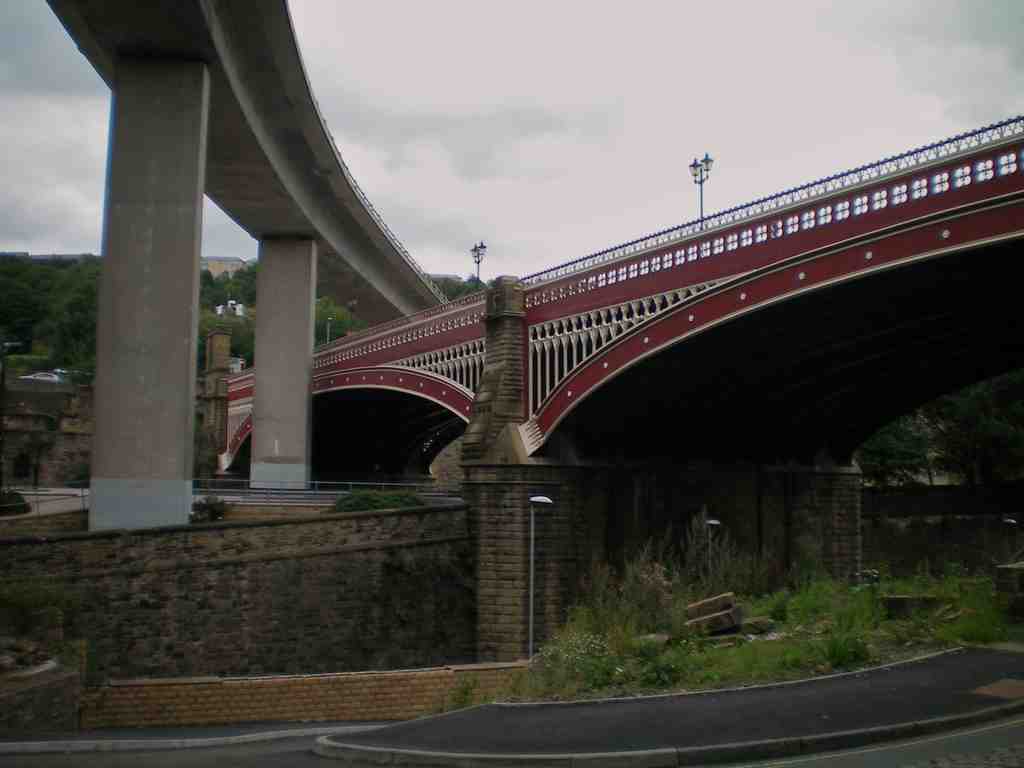
If you look just ahead, you’ll spot an impressive jumble of bridges - concrete highways towering above, and a striking red iron bridge running low across the scene, with its bold arches and white trim. The path you’re on gives you a good view of the layered bridges overhead and below. If you follow the railings and look down, you’ll see the sweeping line of the old iron bridge; that’s your best clue that you’re right where the old North Bridge railway station once buzzed with steam and noise. Now, take a moment and picture this spot nearly a hundred years ago. Instead of the busy roads and empty car parks, you’d be standing amidst clanging bells, hissing steam, and the shouts of porters. North Bridge railway station - or Halifax North Bridge, as it was also called - was the doorway for folks coming in on the Halifax and Ovenden Junction line. There was a time when trains whistled right under this iron bridge, so important that they actually had to raise the whole bridge by 11 feet. I always say, who knew Victorian engineering could be so dramatic? Sadly, trains stopped pulling in here back in 1955. These days, the station buildings are long gone, replaced by a leisure centre. But here’s a secret for you: not everything has vanished. Look for the old footbridge hanging on, a quiet survivor from those days, and nearby, you might catch a glimpse of the mysterious Old Lane Tunnel - a leftover hint of steam-filled journeys and adventure. Imagine your shoes tapping the same ground where passengers hurried to catch trains, hearts pounding: “Will I make it?” Maybe someone missed their train because they got distracted by the sight of that bright red bridge! So, while the whistle and rumble are gone, a little piece of railway magic lingers here. You just have to know where to look - and now, you do. Ready for our next stop? Let’s keep chugging along!
専用ページを開く →Right in front of you is the North Bridge-a real showstopper in Halifax’s skyline! It’s hard to miss: look for the bold, deep red iron arches stretching out above you, decorated…もっと読む折りたたむ
Right in front of you is the North Bridge-a real showstopper in Halifax’s skyline! It’s hard to miss: look for the bold, deep red iron arches stretching out above you, decorated with fancy pierced patterns and cross shapes. The bridge’s stone piers and gothic buttresses make it look like a piece of a grand castle plonked right over the valley. Just glance up and you’ll spot the ornate railings, the high central pier, and those classic Victorian lamp posts completing the scene, with the modern flyover running alongside it like a concrete companion. Now, imagine you’re standing here in 1871. It’s opening day, and the crowd is restless, eager to see Halifax’s newest wonder. Suddenly, the sound of horses’ hooves and chatter fills the air. People swarm the bridge-so many that even the mayor can hardly reach the ribbon for the grand ceremony! Townsfolk push and squeeze, with soldiers and even dragoons on horseback trying to keep the peace. You can just picture the chaos and anticipation. But it wasn’t always this grand. Long before this iron beauty, there was a rather humble wooden bridge-records go all the way back to 1277. Fast forward a bit, and you get the stone bridge of 1719. Unfortunately, it met its end in rather dramatic fashion during a local tradition: the bridge collapsed right under the townsfolk’s feet on Rogation Day, the crowd dunked straight into the River Hebble! No one was expecting a bath that cold, I’m sure. After a few more disasters-including one poor chap being pushed off (yikes!) and a bridge-wrecking flash flood-Halifax decided it needed something swankier, sturdier, and a lot more dramatic. Enter John and James Fraser, railway bridge experts with a flair for the gothic. They made this bridge taller, grander, and just the right shape for railway tracks to pass underneath. There’s even a secret tucked away here: if you look at the south west turret, you’ll find a drinking fountain dedicated to James Oates, a local who worked on the bridge-try spotting it, a little nod to the people who made this place possible. North Bridge was once the lifeblood of Halifax traffic, so busy that trams rattled and rumbled above the river. Steep hills and heavy trams don’t always mix-one day in 1906, a tram lost control on the slope and overturned right here, creating a scene of chaos and heroics. And let’s not forget, the bridge’s intricate ironwork and gothic arches were the talk of the town, all for the bargain price of seventeen shillings and six pence a square foot! Apparently, even bridges could be a good deal back then. So as you’re standing here, let yourself drift back through time. Hear the clang of tram bells on iron rails and the buzz of everyone’s curiosity. North Bridge isn’t just a way over the valley-it’s a slice of Halifax drama and a reminder that even something as simple as crossing the river can be an adventure. Shall we continue on our journey? For a more comprehensive understanding of the earlier bridges, design and construction or the opening ceremony, engage with me in the chat section below.
専用ページを開く →As you walk forward, keep your eyes peeled for a bold, fiery sign that almost looks like it’s crackling with energy-a big word “phoenix” in flames, with the words “96.7 FM” below…もっと読む折りたたむ
As you walk forward, keep your eyes peeled for a bold, fiery sign that almost looks like it’s crackling with energy-a big word “phoenix” in flames, with the words “96.7 FM” below and a tiny red sun dotting the “i.” That brilliant burst of colour practically leaps out from the building, so you can’t miss it. If you spot those blazing letters, you’re right outside one of Halifax’s most vibrant hubs-Phoenix Radio! Now, imagine standing here when the radio waves are humming through the air, day and night, carrying voices and music across Halifax and far beyond. Phoenix Radio 96.7 FM isn’t just a radio station; it’s the beating heart of Calderdale’s community spirit! What started off back in 1998 with little more than a dream and a few short bursts on the airwaves, grew into a full-time station by 2007-after a few licensing battles and lots of hopes and headaches. This was Calderdale’s first and only local radio station, celebrated with a launch at 7am (hope they had some strong coffee ready for that early start!) and a ribbon cut by the Mayor. Here’s where the magic happens. Inside, the studios are tucked away in the Dean Clough complex, filled with the buzz of presenters, guest chatter, and the occasional frantic dash to answer the phone before it rings off the hook. Phoenix Radio is run by real people, not just faceless voices-people who truly listen to what the community wants to hear. If you ever fancied yourself as a DJ spinning tracks from the 50s all the way to today’s hits, or maybe just wanted to hear your favourite tune or a proper shout out, this was-and still is-your place. But Phoenix Radio is more than music and chat. It’s helped people learn the ropes of broadcasting, interview skills, editing, and more. There were young folks rolling up their sleeves, learning how to handle all the techy bits, and earning Youth Achievement Awards-maybe some nervous hands on the mixing desk, maybe a few giggles when someone pressed the wrong button, but always with encouragement all around. Of course, Halifax isn’t the only one tuning in. Their transmitter sits up on Beacon Hill, sending out signals not just to Halifax, but to homes in Bradford, Kirklees, Leeds, and even further thanks to their online stream. Imagine people all over Yorkshire and way beyond, bobbing their heads to the same beat or laughing along with a local story as you are right now. Saturday nights, you’d hear ‘Phoenix FM Dance’ thumping out, as local DJs got a chance to turn up the energy. Sometimes the presenters had a bit too much fun with prank shout-outs-listeners trying to sneak in silly names or daft messages, all live on air. You never quite knew what might happen, and that’s half the fun. Behind the scenes, the station had help from charities and the Prince’s Trust, and all through the years, Phoenix Radio has worked to give something back-skills, support, and a platform for everyone’s voice. So, if you pause here for a second and listen, I bet you can almost feel the buzz in the air-a mix of music, laughter, and the sound of Halifax’s heart, always beating, always broadcasting. And just think: the voices you hear might be just around the corner… or halfway across the world, all brought together by that glowing phoenix on the wall. That’s some serious Halifax magic, don’t you think?
専用ページを開く →
よくある質問
ツアーはどうやって始めますか?
購入後、AudaToursアプリをダウンロードして引き換えコードを入力してください。ツアーはすぐに開始できます。再生ボタンをタップして、GPSガイド付きルートに従うだけです。
ツアー中にインターネットは必要ですか?
いいえ!開始前にツアーをダウンロードしておけば、完全にオフラインで楽しめます。チャット機能のみインターネットが必要です。モバイルデータを節約するため、WiFi環境でのダウンロードをお勧めします。
これは団体ツアーですか?
いいえ、これはセルフガイド式のオーディオツアーです。ガイドや団体、決まったスケジュールに縛られることなく、スマホから流れるナレーションを聴きながら自分のペースで自由に探索できます。
ツアーの所要時間は?
ほとんどのツアーは60〜90分で完了しますが、ペースは完全に自由です。好きな時に一時停止したり、スポットを飛ばしたり、休憩を取ったりできます。
今日中にツアーを終えられない場合は?
問題ありません!ツアーには無期限でアクセスできます。明日、来週、あるいは来年でも、好きな時に再開できます。進行状況は保存されます。
どの言語が利用可能ですか?
すべてのツアーが50以上の言語に対応しています。コードを引き換える際にお好みの言語を選択してください。注意:ツアー生成後に言語を変更することはできません。
購入後、どこからツアーにアクセスできますか?
App StoreまたはGoogle Playから無料のAudaToursアプリをダウンロードしてください。メールで届いた引き換えコードを入力すると、ライブラリにツアーが表示され、ダウンロードして開始できるようになります。
もしツアーを楽しめなかった場合は、返金いたします。お問い合わせ先: [email protected]
以下の決済で安全にチェックアウト