
スコータイオーディオツアー:寺院と歴史
千年前の仏塔が空を突き刺し、スコータイの隠された中心部で、レンガと石の静かな守護者たちに影を落とされている。このセルフガイドオーディオツアーは、あなたを秘密の場所や聖なる遺跡へと導き、他の人々がただの古い壁としか見ない場所で、鮮やかな物語を明らかにします。 ワット・チェーディー・ユンにある堂々たる仏塔は、なぜ政治的権力闘争の象徴となったのでしょうか?医師の日に、ワット・チャーン・ロムの石像の象たちの監視の下で、かつてどのような神秘的な儀式が繰り広げられたのでしょうか?そして、ワット・ムム・ランカで失われた基礎碑文は、忘れ去られた王室のスキャンダルを示唆しているのでしょうか? 響き渡る堀や絡み合った緑の中を進むと、失われた君主たち、巡礼者の幽霊、反抗的な僧侶たちがあなたの周りで生き生きと動き出します。一歩ごとに、何世紀もの石の下に埋もれたドラマや謎が明らかになります。 スコータイの秘密を解き明かす準備はできましたか?そびえ立つ仏塔が未解決の疑問と出会う場所で、あなたの旅を始めましょう。
ツアーのプレビュー
このツアーについて
- schedule所要時間 30–50 mins自分のペースで進める
- straightenウォーキングルート 5.4kmガイド付きパスに沿って進む
- location_on
- wifi_offオフライン対応一度のダウンロードでどこでも使える
- all_inclusive無期限アクセスいつでも、ずっと再生可能
- location_onワット・チェーディー・スーンから開始
このツアーのスポット
As you approach วัดเจดีย์สูง (Wat Chedi Yung), keep an eye out for a large, towering structure with a distinctive, stupa-like shape. The chedi, or stupa, stands tall against the…もっと読む折りたたむ
As you approach วัดเจดีย์สูง (Wat Chedi Yung), keep an eye out for a large, towering structure with a distinctive, stupa-like shape. The chedi, or stupa, stands tall against the sky and is built with reddish-brown bricks. You'll notice it has a multi-tiered base, narrowing as it rises, culminating in a spire that points directly upwards. Alright, you’re standing next to the Wat Chedi Yung! This ancient site is located on the eastern side of the Sukhothai Historical Park. Fun fact: it’s situated southeast of the Broken Gate, or ประตูหัก in Thai. Just imagine the grandeur of this place back in the 20th century of the Buddhist era! Let’s talk about the main attraction here: the stunning bell-shaped chedi. This isn’t your everyday backyard shed; this chedi is constructed with bricks and has impressive dimensions. Its base is decorated in a unique twelve-indented-corner style, and measures about 14 meters on each side. And above that, it extends up with tiered bases leading to the bell-shaped body, which is quite well-preserved, considering its age. Just look up - that spire reaches 33 meters high! On top of that, you'll notice that the chedi stands on a very high base, nearly kissing the sky. Surrounding the main chedi are seven smaller, diverse-sized stupas, all paving the way to the centerpiece. These additional stupas are no less impressive, with their wide bases made of bricks. So, take a moment to marvel at the architecture and imagine the historical significance this place holds. And watch your step - don’t trip in that moat surrounding it! Off we go to the next stop. Get ready for some more historical wonders and probably one or two more cheesy jokes!
専用ページを開く →As you're walking along, keep an eye on your right - that's where you'll spot the Wat Chang Lom within the Sukhothai Historical Park. Look for a remarkable sight: a central stupa…もっと読む折りたたむ
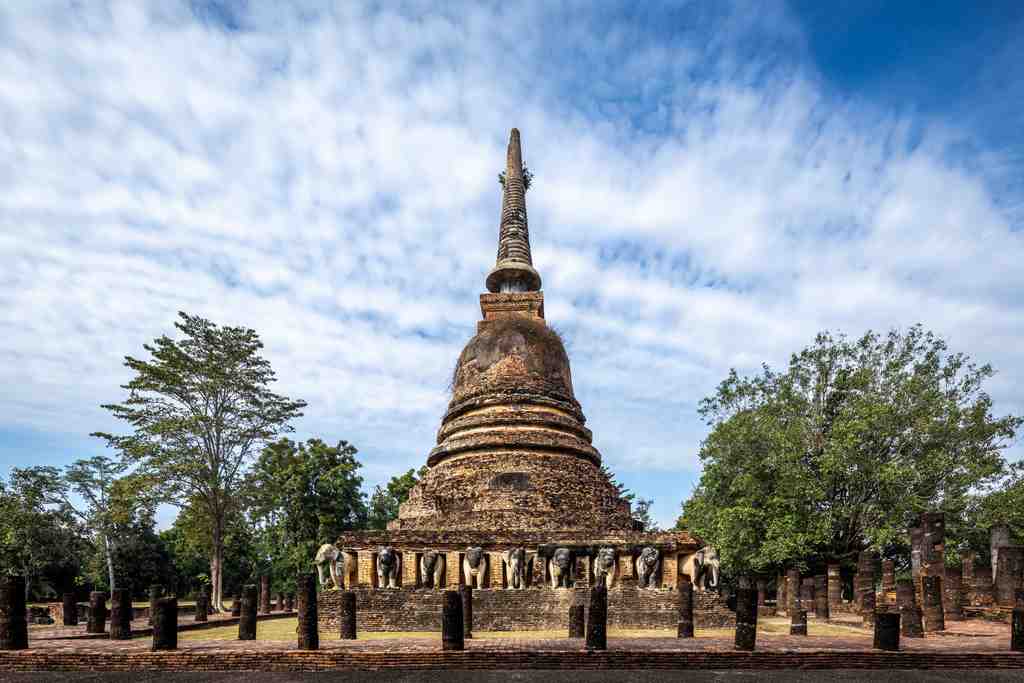
As you're walking along, keep an eye on your right - that's where you'll spot the Wat Chang Lom within the Sukhothai Historical Park. Look for a remarkable sight: a central stupa encircled by 39 majestic elephant statues standing guard. These elephants almost seem to be marching out from the base, ready for some ancient royal parade. Quite the spectacle, isn't it? Now, about Wat Chang Lom - "Chang Lom" translates to "encircled by elephants." This grand temple is a fabulous example of Sukhothai architecture and dates back to the 14th century. Those elephant statues? They're symbolic guardians, representing strength and protection. Imagine having a herd of elephants safeguarding your place - surely, nobody would dare trespass! Built during the reign of King Ramkhamhaeng the Great, this site reflects the era’s creativity and spiritual dedication. The central bell-shaped stupa, or chedi, is believed to enshrine relics of the Buddha, making it a significant pilgrimage spot. Here's a fun fact to tickle your historical fancy: elephants were considered extremely important in ancient Thailand, symbolizing power and sovereignty. So, in a way, Wat Chang Lom serves as a monumental zoo - only with stone elephants that won’t need feeding! Take your time to soak in the majestic sights and the tranquil atmosphere. Up next, we’ll be heading to another historic gem. Shall we continue our journey?
専用ページを開く →

さらに4件のスポットを表示表示するスポットを減らすexpand_moreexpand_less
As you approach Wat Traphang Thong (you can see it on your left), you'll notice a charming wooden bridge adorned with vibrant yellow lanterns that cross over a reflective lotus…もっと読む折りたたむ
As you approach Wat Traphang Thong (you can see it on your left), you'll notice a charming wooden bridge adorned with vibrant yellow lanterns that cross over a reflective lotus pond, leading you directly to the temple grounds. The scene is quite picturesque, especially with palm trees waving in the background, and an impressive chedi rising above the lush greenery. The gleaming orange roof of the Vihara building also stands out amidst the palm trees and traditional structures. Wat Traphang Thong is nestled on Jarodwithithong Road, in the Old Town Mueang district of Sukhothai. It spans an expansive 44 rai of land. To the north, it borders Jarodwithithong Road; to the south, there’s a communal banana orchard; to the east lies a village, and to the west, the Ramkhamhaeng National Museum. Encompassing ancient ponds and a large reservoir in the northwest corner, the temple premises blend seamlessly with the surrounding village. In the temple compound, there’s an ordination hall (Ubosot), built in 2007 with a faux naga theme for its ornate finials. You’ll also find a spacious sermon hall from 1956, a prayer hall from 1983, and seven monastic residences. One notable highlight is the principal Buddha image called "Luang Pho Thong," a breathtaking statue in the subduing Mara posture. There is also a replicated footprint of the Buddha, intricately carved into a stone slab, with 54 floral designs encircling it. Created circa 1283, Wat Traphang Thong draws its name from the golden reservoir within its vicinity. Originating in King Ramkhamhaeng’s era and later revived by King Maha Thammaracha I in 1359, the temple has seen numerous renovations, including significant efforts around 1907 led by Phaya Ronachai Chanyut. In 1930, Phra Ratchaprasitthorn brought the Buddha's footprint from Khao Phra Bat Yai to reside here, an event celebrated annually. Granted the "Visung Kamsee" rights in 1287, Wat Traphang Thong currently houses 20 monks and 34 novice monks. It has been a hub for religious education since 1932 and has had a succession of notable abbots over the years. Fun Fact: Wandering through the serene ambiance of Wat Traphang Thong, it's easy to feel like you've stepped into a serene bubble of history, far from the hustle and bustle of modern life!
専用ページを開く →As you approach Sukhothai Historical Park, you'll notice an expansive area marked by ancient ruins and large, open spaces. It's hard to miss, as you'll see the remains of ancient…もっと読む折りたたむ
As you approach Sukhothai Historical Park, you'll notice an expansive area marked by ancient ruins and large, open spaces. It's hard to miss, as you'll see the remains of ancient structures, stupas, and walls emerging from the green surroundings. To spot the park, just look for the area on your left with a concentration of historical ruins. The entrance will be quite distinct with information boards and possibly a ticket booth. Sukhothai Historical Park, which means "dawn of happiness," spans an impressive 70 km² and houses the remnants of Sukhothai, the capital of the Sukhothai Kingdom during the 13th and 14th centuries. This park is filled with history, offering 193 ruins to explore, including 26 temples and the significant Wat Mahathat. Originally a Khmer outpost called Sukhodaya, Sukhothai rose to prominence under the Tai leadership of Si Indradit in the mid-13th century and became the cradle of the Thai nation. Picture this: You’re walking through a city whose walls form a neat rectangle, stretching 2 km east-west and 1.6 km north-south. Each side has a grand gate, and inside, you can find the royal palace ruins and countless temples. For centuries, Sukhothai was an important center for trade and culture, attracting thousands of visitors each year. In fact, it was so significant that UNESCO declared it a World Heritage Site. Back in the day, the Sukhothai Kingdom expanded its influence and gathered neighboring cities under its wing, demonstrating its might and cultural richness under the reign of King Ramkhamhaeng. This king wasn't just a ruler; he was also a connoisseur of culture, helping to spread Theravada Buddhism with the help of monks from Sri Thamnakorn. As you walk around, imagine the bustling trade center it once was, the vibrant cultural hub that laid the foundational bricks for modern Thailand. From grand temples like Wat Mahathat to surviving Khmer monuments such as the Ta Pha Daeng shrine, the park narrates a story of historical grandeur and cultural evolution. Enjoy exploring this dawn of happiness!
専用ページを開く →As you're approaching the เมืองประวัติศาสตร์สุโขทัยและเมืองบริวาร, you’ll want to keep an eye out to your left. You'll notice an expansive area marked by ancient ruins, with a…もっと読む折りたたむ
As you're approaching the เมืองประวัติศาสตร์สุโขทัยและเมืองบริวาร, you’ll want to keep an eye out to your left. You'll notice an expansive area marked by ancient ruins, with a series of tall, weathered columns standing proudly. In front of these ruins, there's a picturesque body of water that beautifully reflects the old structures. This serene reflection is a sure sign you’re in the right place. Now, get ready to step back in time! The Historic Town of Sukhothai and Associated Historic Towns is one of Thailand’s first three UNESCO World Heritage sites. It stands proudly alongside the Historic City of Ayutthaya and the Thungyai-Huai Kha Khaeng Wildlife Sanctuaries, which was Thailand’s first natural World Heritage site. This cultural treasure trove includes the Sukhothai Historical Park, Si Satchanalai Historical Park, and Kamphaeng Phet Historical Park. All these historic spots were bundled into one heritage listing under the name “Historic Town of Sukhothai and Associated Historic Towns” during the 15th UNESCO World Heritage Committee session back in 1991. It’s amazing to think that these ruins, which now stand serenely among the greenery and water, once bustled with the activities of daily life in the Sukhothai Kingdom. Imagine the chatter of locals, the clinking of ancient coins, and the grand ceremonies taking place. It’s like unlocking a giant time capsule! So, take a moment to soak in the history surrounding you-it's not every day you get to walk through a World Heritage site!
専用ページを開く →Wat Sorasak is a storied historical site nestled within the walls of the Sukhothai Historical Park, close to the Royal Court Gate on the northern side of the ancient city. The…もっと読む折りたたむ
Wat Sorasak is a storied historical site nestled within the walls of the Sukhothai Historical Park, close to the Royal Court Gate on the northern side of the ancient city. The complex is home to a prominent stupa and a vihara. The stupa is a classic Ceylonese-style, featuring a round shape surrounded by elephant sculptures-a design deeply rooted in the Sukhothai era. Elephants were long believed to be royal animals suitable to support Buddhism for 5,000 years. Originally, the stupa had succumbed to the ravages of time, leaving only its foundation and the encircling elephants. However, it was reconstructed in 2003 by the Fine Arts Department of Thailand. Just in front of this main stupa, towards the east, there once stood a vihara. Judging by the remaining base and pillars, historians believe it had a gable roof with surrounding corridors. The temple was constructed according to royal decrees, indicating it was likely the work of royalty or high-ranking nobles, who needed royal permission to build such temples. An intriguing part of Wat Sorasak’s history lies in the Sorasak Inscription, an ancient slate inscribed in the Sukhothai script. The inscription tells of an individual named Intharak and his land request to build the temple. Remarkably, it's also recorded that in 1955 AD, the young King Ramkhamhaeng II visited the temple to perform royal duties, accompanied by his mother and aunt. The inscription reveals the potential location of the royal residence of Sukhothai’s rulers, believed to be west of Wat Sorasak. Additionally, it offers insight into the image of the "Phra Lila" - a Buddha statue depicted in a walking posture, confirming its existence, or at least its recognition, in the 13th century AD. Quite the historical treasure trove, isn’t it? Thanks for joining the tour. Who knew ancient temples could elephant everything before wrapping up!
専用ページを開く →


よくある質問
ツアーはどうやって始めますか?
購入後、AudaToursアプリをダウンロードして引き換えコードを入力してください。ツアーはすぐに開始できます。再生ボタンをタップして、GPSガイド付きルートに従うだけです。
ツアー中にインターネットは必要ですか?
いいえ!開始前にツアーをダウンロードしておけば、完全にオフラインで楽しめます。チャット機能のみインターネットが必要です。モバイルデータを節約するため、WiFi環境でのダウンロードをお勧めします。
これは団体ツアーですか?
いいえ、これはセルフガイド式のオーディオツアーです。ガイドや団体、決まったスケジュールに縛られることなく、スマホから流れるナレーションを聴きながら自分のペースで自由に探索できます。
ツアーの所要時間は?
ほとんどのツアーは60〜90分で完了しますが、ペースは完全に自由です。好きな時に一時停止したり、スポットを飛ばしたり、休憩を取ったりできます。
今日中にツアーを終えられない場合は?
問題ありません!ツアーには無期限でアクセスできます。明日、来週、あるいは来年でも、好きな時に再開できます。進行状況は保存されます。
どの言語が利用可能ですか?
すべてのツアーが50以上の言語に対応しています。コードを引き換える際にお好みの言語を選択してください。注意:ツアー生成後に言語を変更することはできません。
購入後、どこからツアーにアクセスできますか?
App StoreまたはGoogle Playから無料のAudaToursアプリをダウンロードしてください。メールで届いた引き換えコードを入力すると、ライブラリにツアーが表示され、ダウンロードして開始できるようになります。
もしツアーを楽しめなかった場合は、返金いたします。お問い合わせ先: [email protected]
以下の決済で安全にチェックアウト 


