AudaTours logoAudaTours

Tour Audio di Budapest: Leggende e Labirinti della Collina del Castello

Audioguida10 tappe

Un corvo una volta sorvolò i tetti di Buda mentre il fuoco dei cannoni scuoteva la città—e i suoi echi sussurrano ancora dietro le facciate intagliate e le guglie gotiche della Chiesa di Mattia. Questo tour audio autoguidato ti permette di passeggiare al tuo ritmo, svelando storie nascoste e segreti inauditi intessuti nel leggendario quartiere di Budapest. Scopri il dramma che la maggior parte dei visitatori non sente mai sotto la bellezza da cartolina della città. Perché un gruppo di pescatori difese il Bastione dei Pescatori con le loro vite quando le mura crollarono? Quale tesoro reale scomparso infesta ancora le cripte sottostanti? Chi dipinse messaggi proibiti sulle pietre a mezzanotte e sfuggì alla cattura per decenni? Traccia i sentieri di ribelli, visionari ed eroi improbabili mentre il Danubio luccica accanto a te. Ogni passo rivela nuove prospettive, dipingendo l'antica Budapest in una luce vivida ed emozionante. Premi play e segui il volo del corvo—i segreti della città ti aspettano.

Anteprima del tour

map

Informazioni su questo tour

  • schedule
    Durata 30–50 minsVai al tuo ritmo
  • straighten
    1.7 km di percorso a piediSegui il percorso guidato
  • location_on
    PosizioneBudapest, Ungheria
  • wifi_off
    Funziona offlineScarica una volta, usa ovunque
  • all_inclusive
    Accesso a vitaRiascolta quando vuoi, per sempre
  • location_on
    Parte da Istituto e Museo di Storia Militare

Tappe di questo tour

  1. You are standing before a grand, classicist building characterized by its pale, neatly structured stone facade, orderly rows of rectangular windows, and a prominent arched…Leggi di piùMostra meno
    Institute and Museum of Military History
    Institute and Museum of Military HistoryPhoto: Misibacsi, Wikimedia Commons, CC BY-SA 3.0. Cropped & resized.

    You are standing before a grand, classicist building characterized by its pale, neatly structured stone facade, orderly rows of rectangular windows, and a prominent arched entryway framing dark, heavy wooden double doors.

    This is the Institute and Museum of Military History... or rather, it was until quite recently. What you see before you is a perfect example of how the grand, official exteriors of power often mask a much more complex, unsaid reality. In 2023, the museum was suddenly closed to the public and its vast collections were packed away, making room for the Ministry of Defense to move their administrative offices into the space. While the official reasoning cited a need for a more accessible, twenty-first-century museum facility elsewhere, a widely reported underlying truth was much simpler. The Minister of Defense reportedly wanted this exact building for the spectacular, sweeping panoramas of the Buda hills visible from the upper offices. It is a striking reminder of how heritage can easily be reshuffled behind closed doors, a move the professional museum community called barbaric and arbitrary.

    The museum was originally founded in 1918, driven largely by the passion of an early collector of these military memories named Kamil Aggházy. Aggházy was an autodidact, meaning a self-taught scholar, who practically invented the field of military archaeology in Hungary. When this former barracks was renovated in 1926, he went so far as to permanently conserve the authentic 1848 cannonballs lodged within the masonry, turning the very walls of the building into a living exhibit.

    Before the sudden eviction, the museum held staggering collections. Take a glance at your screen to see what the grand exhibition halls looked like before the doors were locked, housing an astonishing array of over thirty thousand historical military uniforms. The archives also held more than twenty-eight thousand military medals. If you check your app again, you can see a close-up of the Hungarian Order of Military Merit from the 1848 revolution, a beautiful piece of craftsmanship that rewarded immense bravery. They even possessed a sixteenth-century Turkish steel cannon shaped like an elephant head, an incredibly rare metallurgical marvel from an era when European smiths could not forge anything close to that quality.

    An interior view of the museum's exhibition hall, showcasing part of its vast military uniform collection, which includes over 30,000 items.
    An interior view of the museum's exhibition hall, showcasing part of its vast military uniform collection, which includes over 30,000 items.Photo: 12akd, Wikimedia Commons, CC BY-SA 4.0. Cropped & resized.

    Now, all of that is in storage or scattered to temporary exhibits. Curiously enough, the government announced the museum will eventually move to the Honvéd High Command building in Dísz Square. That is a building that was bombed into a ruin in 1949 and is only now being entirely reconstructed, while this perfectly intact, historical barracks was claimed for bureaucratic offices. It makes you wonder about the stories we choose to project on the surface, and the motives that operate quietly out of sight.

    As we leave this administrative fortress behind, keep that questioning eye open to the layered narratives of Buda Castle, and let us take a short three-minute walk to our next stop, the Mary Magdalene Church. Just note that while the museum exhibits here are permanently closed, the military archives and library inside remain open to researchers Tuesday through Sunday from 10 AM to 6 PM.

    This image displays the Hungarian Order of Military Merit from 1848-49, part of the museum's extensive 28,000-piece medal collection.
    This image displays the Hungarian Order of Military Merit from 1848-49, part of the museum's extensive 28,000-piece medal collection.Photo: Petitpeton, Wikimedia Commons, CC BY-SA 4.0. Cropped & resized.
    Apri pagina dedicata →
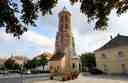
  2. On your left stands the Mary Magdalene Church, recognizable by its tall, multi-tiered tower of exposed brick and stone, topped with a distinctive green bell-shaped dome and…Leggi di piùMostra meno
    Mary Magdalene Church
    Mary Magdalene ChurchPhoto: Thaler, Wikimedia Commons, CC BY-SA 3.0. Cropped & resized.

    On your left stands the Mary Magdalene Church, recognizable by its tall, multi-tiered tower of exposed brick and stone, topped with a distinctive green bell-shaped dome and fronted by a small classical portico.

    What you are looking at is merely a fragment, a lone structure reaching into the sky that masks a much deeper, buried history of stubborn endurance. When the vast Ottoman forces swept through Buda in the sixteenth century, their sheer dominance was absolute, systematically replacing the local culture and skyline with their own imperial administration. Yet, by some miracle, this specific church survived the initial wave of confiscations.

    It became an unprecedented act of cultural survival, serving as the sole functioning Christian sanctuary in the entire Castle District. Necessity forced a remarkable compromise in this single building. Catholics celebrated mass in the sanctuary, the enclosed holy area around the main altar, while Protestants simultaneously held their services in the nave, the expansive central hall of the church. They shared the space peacefully, their overlapping hymns rising to the rafters in a desperate bid to preserve their faith.

    This fragile tolerance lasted until 1594. The ongoing wars made the Ottomans suspicious of the Christian population, and they finally seized the building, transforming it into a mosque. Because of the timepiece running in its tower, they called it the Clock Mosque. If you check your screen, you can see a 1598 engraving of this exact structure standing during that long occupation.

    An engraving from 1598 depicts the Church of Mary Magdalene with a prominent clock in its tower, earning it the name 'Szaát' (Clock) Dzsámi during the Ottoman occupation, when it was the only Christian place of worship in the castle for decades.
    An engraving from 1598 depicts the Church of Mary Magdalene with a prominent clock in its tower, earning it the name 'Szaát' (Clock) Dzsámi during the Ottoman occupation, when it was the only Christian place of worship in the castle for decades.Photo: Peter Zimmermann, Wikimedia Commons, Public domain. Cropped & resized.

    The church survived centuries of conflict, only to face its greatest threat long after the wars had ended. Despite sustaining severe damage in World War Two, the true destruction came in 1950 under the communist regime. The dictatorial leadership despised the church's past political associations and ordered it torn down. The only reason this tower still stands is because a clever architect named József Csemegi bluffed. He suggested to the dictator that the Gothic spire would make a perfect centerpiece for a grand monument honoring the communist labor movement. The monument never materialized, but the lie halted the bulldozers.

    Over the decades, the surrounding ruins were excavated to reveal the original footprint of the building. You can see how this lone medieval survivor has been stabilized into the poignant monument before us by checking out the before and after image on your app.

    Take a moment to imagine the desperate, overlapping prayers whispered in this lone sanctuary centuries ago, keeping a flicker of hope alive against impossible odds. When you are ready, we will transition to our next stop, the National Archives of Hungary, which is just a two minute walk away. By the way, if you wish to go inside the tower, it is open every day from 9 AM to 7 PM.

    The solitary Gothic tower, restored with pointed-arch windows after its 1950s demolition, stands beside the ruin garden, created in 1986 to outline the original church's footprint and feature a reconstructed Gothic sanctuary window.
    The solitary Gothic tower, restored with pointed-arch windows after its 1950s demolition, stands beside the ruin garden, created in 1986 to outline the original church's footprint and feature a reconstructed Gothic sanctuary window.Photo: Jörg Blobelt, Wikimedia Commons, CC BY-SA 4.0. Cropped & resized.
    Apri pagina dedicata →
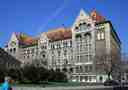
  3. You should be looking at a massive gray stone building crowned with a steeply pitched roof of colorful patterned tiles and defined by its tall, arched windows. Up here, it is…Leggi di piùMostra meno
    National Archives of Hungary
    National Archives of HungaryPhoto: Karelj, Wikimedia Commons, Public domain. Cropped & resized.

    You should be looking at a massive gray stone building crowned with a steeply pitched roof of colorful patterned tiles and defined by its tall, arched windows.

    Up here, it is easy to get distracted by grand monuments, but the true, hidden history of this city isn't carved in stone at all. It is written on fragile paper. This is the National Archives of Hungary.

    Keeping that paper safe has been a desperate, centuries-long struggle. Go back to August 1526. The Battle of Mohács went disastrously wrong for the Hungarians, and the Ottoman army was marching closer. Queen Maria frantically packed the kingdom's most vital documents into wooden chests and loaded them onto boats to escape down the Danube river. But in the thick fog and the sheer panic of the retreat, boats capsized, and scavengers broke open the chests that made it ashore. A huge portion of early Hungarian history was swallowed by the river or simply scattered to the wind.

    They eventually built this grand Neo-Romanesque fortress, an architectural style reviving heavy medieval arches and thick walls, to finally keep things secure. Take a look at your screen to see an aerial view of the building today. Notice how flat the roofline is. Originally, it featured a towering 75-meter spire. People thought it was a water tower, but it was actually just a giant chimney for the central heating. After it took heavy damage in World War Two, the city decided to blow it up. Not just for safety, but mostly because urban planners thought the skyline looked cleaner without it.

    But the ultimate trial came in November 1956, during the Hungarian Revolution. An artillery shell hit the building, sparking a massive blaze. The local fire department arrived, but they were completely helpless. A Soviet tank had literally rolled over and crushed the fire hoses laid out on the street.

    Inside, it was chaos. A retired archive director named Béla Kossányi and his family were trapped in the deep underground cellar, listening to the fire rage above them. Above ground, a group of local university students defied a strict military curfew, broke into the burning building, and formed a human chain. As flames consumed the upper floors, these students desperately passed bundles of ancient documents down the stairs, saving whatever they could before the smoke forced them out.

    Over eight thousand meters of stacked records turned to ash that day, but thanks to those students, the core of the nation's memory survived.

    If you ever want to do your own historical digging, the archives are open to the public Monday through Thursday.

    For now, let us leave the fragile papers behind and walk toward a place carrying the weight of lost history in its stones. We are heading to Matthias Church, which is about a six-minute walk from here.

    Apri pagina dedicata →
Mostra altre 7 tappeMostra meno tappeexpand_moreexpand_less
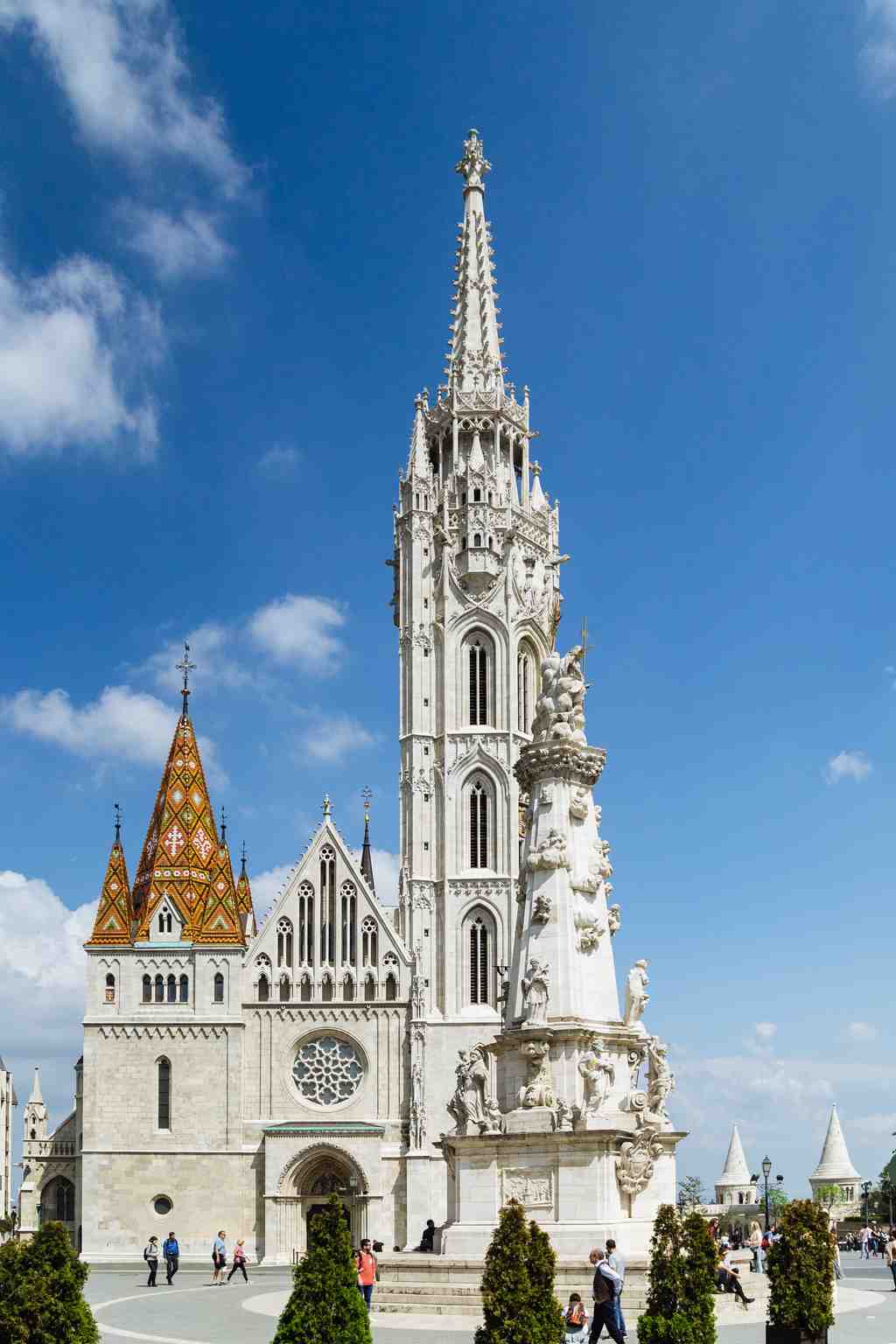
  1. On your right stands a towering white stone church, defined by its soaring Gothic spire and a brilliantly colored roof of diamond-patterned ceramic tiles. This is Matthias Church.…Leggi di piùMostra meno
    Matthias Church
    Matthias ChurchPhoto: Stefan Schäfer, Lich, Wikimedia Commons, CC BY-SA 4.0. Cropped & resized.

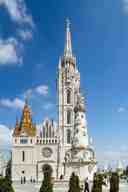
    On your right stands a towering white stone church, defined by its soaring Gothic spire and a brilliantly colored roof of diamond-patterned ceramic tiles. This is Matthias Church.

    We have spent time looking at the visible landmarks of this district, but here, the most powerful story isn't about what was built for everyone to see. It is about what was deliberately hidden away beneath the surface. But before we dig into that, take a quick look at your screen to see how this area has evolved over the last century, while that spectacular spire has remained a constant.

    The defining moment for this church actually begins with a national tragedy. Following the devastating Battle of Mohács in the sixteenth century, the Ottomans eventually seized Buda in fifteen forty-one. Almost immediately, this grand Catholic sanctuary was converted into the city's main mosque. Sultan Suleiman himself gave thanks within these walls, which were quickly plastered over to hide their Christian frescoes.

    But right before the takeover, the local faithful committed a desperate act of preservation. Terrified that their sacred objects would be desecrated, they took a beloved votive Madonna... a special statue offered to God to fulfill a religious vow... and placed it inside a small alcove in the wall. Then, they bricked it up completely.

    Talk about keeping a secret. For one hundred and forty-five years, the statue sat in total darkness. It was mere inches from the Ottoman garrison, who used the space to pray, completely unaware of the silent guardian waiting just behind the plaster.

    The miraculous payoff to this hidden truth came in sixteen eighty-six, during the siege of Buda by the Holy League. The fighting was fierce, and cannon fire battered the walls of the church. During one massive explosion, a section of the mosque's interior wall simply crumbled away. As the dust settled, the praying Muslim soldiers looked up and saw the long-forgotten sculpture of the Virgin Mary suddenly staring back at them.

    You can check your app for a detail of the main altar, the focal point where this very statue re-emerged.

    To the Ottoman defenders, this was not just a lucky cannon strike. It was a terrifying omen. The sudden appearance of the Lady of the Hungarians was taken as a sign that she was physically reclaiming her home. It was a psychological blow so severe that the garrison's morale shattered, and the city fell that exact same day.

    It is incredible to think about that moment... a violently crumbling wall, a cloud of stone dust, and a hidden face emerging from the darkness to change the course of an entire war.

    You can explore the interior yourself if you like, as the church is open to visitors every day from nine in the morning until five in the evening. Whenever you are ready to continue, we will head toward the Fisherman's Bastion, which is just a brief one-minute walk away.

    Matthias Church illuminated at night, highlighting its distinctive Neo-Gothic architecture in the heart of Buda's Castle District.
    Matthias Church illuminated at night, highlighting its distinctive Neo-Gothic architecture in the heart of Buda's Castle District.Photo: jsamwrites, Wikimedia Commons, CC BY-SA 4.0. Cropped & resized.
    A panoramic view of Budapest from Gellért Hill, featuring Matthias Church and the Buda Castle District, demonstrating its prominent location.
    A panoramic view of Budapest from Gellért Hill, featuring Matthias Church and the Buda Castle District, demonstrating its prominent location.Photo: Christian Mehlführer, User:Chmehl, Wikimedia Commons, CC BY 3.0. Cropped & resized.
    A close-up of the iconic diamond-pattern Zsolnay ceramic roof tiles, a controversial but striking addition by architect Frigyes Schulek.
    A close-up of the iconic diamond-pattern Zsolnay ceramic roof tiles, a controversial but striking addition by architect Frigyes Schulek.Photo: John Samuel, Wikimedia Commons, CC BY-SA 4.0. Cropped & resized.
    A wide interior view showcasing the extensive and vibrant Neo-Gothic wall paintings and frescoes by Bertalan Székely and Károly Lotz.
    A wide interior view showcasing the extensive and vibrant Neo-Gothic wall paintings and frescoes by Bertalan Székely and Károly Lotz.Photo: Jakub Hałun, Wikimedia Commons, CC BY-SA 4.0. Cropped & resized.
    Matthias Church around 1900, standing proudly next to the Fisherman's Bastion after Frigyes Schulek's comprehensive Neo-Gothic reconstruction.
    Matthias Church around 1900, standing proudly next to the Fisherman's Bastion after Frigyes Schulek's comprehensive Neo-Gothic reconstruction.Photo: Fortepan / Budapest Főváros Levéltára. Levéltári jelzet: HU.BFL.XV.19.d.1.08.121, Wikimedia Commons, CC BY-SA 3.0. Cropped & resized.
    A detail of the southwest Virgin Mary Gate, also known as the Bride's Gate, where King Matthias Corvinus held both of his royal weddings.
    A detail of the southwest Virgin Mary Gate, also known as the Bride's Gate, where King Matthias Corvinus held both of his royal weddings.Photo: Globetrotter19, Wikimedia Commons, CC BY-SA 3.0. Cropped & resized.
    Apri pagina dedicata →
  2. On your left is a sprawling structure of pale stone, defined by its grand sweeping staircases and distinctive, cone-shaped towers. This is Fisherman's Bastion. It looks like…Leggi di piùMostra meno

    On your left is a sprawling structure of pale stone, defined by its grand sweeping staircases and distinctive, cone-shaped towers. This is Fisherman's Bastion.

    It looks like something plucked straight out of a fairy tale. Built between 1895 and 1902 by the architect Frigyes Schulek, its seven towering stone peaks symbolize the seven chieftains of the Magyars who settled this land back in 895. But do not let the whimsical exterior fool you. Beneath this romanticized surface lies a much darker history. For centuries, persistent legends have spoken of a subterranean Buda, a hidden network of secret passages woven directly beneath and behind these very walls. Officially, historians say this stretch was guarded by the medieval guild of fishermen, but local lore claims these tunnels were used by those same fishermen to smuggle their catches into the castle market unseen. A darker version of the tale insists the hidden route was an attempted, and ultimately failed, escape path for a doomed royal brother right before his execution in 1457.

    Whether folklore or fact, the earth here does hold secrets. When Schulek was digging the foundations for this bastion in 1899, he stumbled into a grim discovery... a massive hidden cavity packed with human skull fragments and intact skeletons. He initially thought he had uncovered a medieval dungeon, and he actually redesigned his plans to build around and protect the hollow space. It wasn't until decades later that experts realized he had accidentally found the lost Saint Michael's Chapel, an underground cemetery chapel from the fourteen hundreds.

    And uncovering the past here has always been dangerous work. After the bastion was heavily damaged in the Second World War, the task of restoring it fell to Schulek's own son, János. But before János could lay a single stone, firefighters had to sweep the grounds centimeter by centimeter to clear unexploded mines left behind by retreating armies.

    Creating this perfect, panoramic view also came at a severe architectural cost. Schulek's intense foundation work accidentally destabilized the neighboring thirteenth-century church of the Dominican Order. It was a structure that had survived countless medieval sieges, but it simply could not survive nineteenth-century urban planning. Take a look at your screen to see what that magnificent lost church looked like before it had to be pulled down. You can also check out the before and after view on your app to see how this dramatic overlook has anchored the hill over the last century.

    Take a moment to look closely at the sprawling walls of the bastion, which happens to be open twenty-four hours a day. Can you imagine the hidden subterranean passages supposedly woven right behind those pale stones?

    When you are ready, keep a close eye on the ground beneath your feet as we move on to our next stop, the Old Buda Town Hall, just a three-minute walk away.

    The Fisherman's Bastion glows at dusk, showcasing its Neo-Romanesque architecture and its conical roofs, symbolizing the seven chieftains of Hungary.
    The Fisherman's Bastion glows at dusk, showcasing its Neo-Romanesque architecture and its conical roofs, symbolizing the seven chieftains of Hungary.Photo: David Spigiel, Wikimedia Commons, CC BY-SA 4.0. Cropped & resized.
    This intricate neo-medieval capital is one of many architectural details designed by Frigyes Schulek, who built the current structure between 1895 and 1902.
    This intricate neo-medieval capital is one of many architectural details designed by Frigyes Schulek, who built the current structure between 1895 and 1902.Photo: Paolo Villa, Wikimedia Commons, CC BY-SA 4.0. Cropped & resized.
    See the illuminated Fisherman's Bastion at night, offering a breathtaking panorama of the Danube and Pest, a view it's famous for since its completion in 1905.
    See the illuminated Fisherman's Bastion at night, offering a breathtaking panorama of the Danube and Pest, a view it's famous for since its completion in 1905.Photo: Paolo Villa, Wikimedia Commons, CC BY-SA 4.0. Cropped & resized.
    An aerial view from 1986 shows the Buda Castle District, highlighting the Fisherman's Bastion's strategic location as a UNESCO World Heritage Site.
    An aerial view from 1986 shows the Buda Castle District, highlighting the Fisherman's Bastion's strategic location as a UNESCO World Heritage Site.Photo: Jörg Blobelt, Wikimedia Commons, CC BY-SA 4.0. Cropped & resized.
    Enjoy the unique panorama of Budapest from the Bastion's lookout terraces, featuring the iconic Parliament building across the Danube.
    Enjoy the unique panorama of Budapest from the Bastion's lookout terraces, featuring the iconic Parliament building across the Danube.Photo: Jörg Blobelt, Wikimedia Commons, CC BY-SA 4.0. Cropped & resized.
    This view from the Fisherman's Bastion showcases the historic Chain Bridge spanning the Danube, connecting Buda and Pest.
    This view from the Fisherman's Bastion showcases the historic Chain Bridge spanning the Danube, connecting Buda and Pest.Photo: Jörg Blobelt, Wikimedia Commons, CC BY-SA 4.0. Cropped & resized.
    The controversial Hilton Hotel, built in 1976, ingeniously incorporated the ruins of the Jesuit college and Dominican church, whose foundations were destabilized during the Bastion's construction.
    The controversial Hilton Hotel, built in 1976, ingeniously incorporated the ruins of the Jesuit college and Dominican church, whose foundations were destabilized during the Bastion's construction.Photo: Jörg Blobelt, Wikimedia Commons, CC BY-SA 4.0. Cropped & resized.
    Apri pagina dedicata →
  3. Look to your left at the two-story white building with a red-tiled roof, an enclosed corner balcony projecting outward, and a small copper-domed clock tower crowning the eastern…Leggi di piùMostra meno
    Old Buda Town Hall
    Old Buda Town HallPhoto: Vadaro, Wikimedia Commons, Public domain. Cropped & resized.

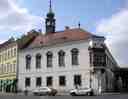
    Look to your left at the two-story white building with a red-tiled roof, an enclosed corner balcony projecting outward, and a small copper-domed clock tower crowning the eastern wing.

    It looks like a perfectly unified piece of architecture, a neat administrative center built in the highly decorative Baroque style of the eighteenth century. But appearances in this city love to lie.

    This structure is actually a jigsaw puzzle. It was not built from the ground up as a single, unified town hall. Instead, the architects merged five separate, pre-existing medieval plots together. If you were to walk through the ground floor or explore the cellars today, you would find a chaotic, tangled maze of spaces. The heavy walls you are looking at rest directly on the stone foundations of citizen homes that stood here long before the Ottoman Empire took the city. The neat geometry above ground is entirely dictated by Subterranean Buda below.

    See the statue standing in the corner niche? That is Pallas Athena, the Greek goddess of wisdom, holding a shield stamped with Buda's coat of arms. She has not had an easy time here. The original statue from 1785 was retired in the early twentieth century and moved to a waterworks yard. The caretaker's family nicknamed her Aunt Bábi and routinely draped their wet laundry over her to dry. Eventually, the yard workers got tired of tripping over her, so in 1920, the waterworks sold her to a private citizen for twelve thousand korona... which, thanks to intense post-war inflation, is roughly equivalent to just a few hundred US dollars today.

    An art historian tracked the original down decades later, but the copy left here did not fare much better. During the 1956 revolution, scrap metal collectors stole her bronze spear, which had to be remade.

    The building itself is also a survivor. In 1723, a massive fire started in a nearby barrel-maker's house. Gale-force winds pushed the flames to a military bastion, detonating over forty thousand pounds of stored gunpowder. The shockwave shattered windows across the river in Pest, and the blast sent up a cloud of ash so thick that witnesses described it as daytime darkness. The town hall's roof collapsed, incinerating the irreplaceable city archives stored inside.

    This building is a masterclass in adaptation, a place where layers of disaster and governance sit literally atop a medieval maze. And speaking of ancient mazes... it is time to leave the tangled cellars of governance behind and head into an even deeper, darker network. Our next stop is the Buda Castle Labyrinth, just about a three-minute walk away.

    Apri pagina dedicata →
  4. As you look toward the entrance of the Buda Castle Labyrinth, picture the rough-hewn limestone walls dropping away from the street, opening into pale, low-ceilinged chambers…Leggi di piùMostra meno
    Buda Castle Labyrinth
    Buda Castle LabyrinthPhoto: Elelicht, Wikimedia Commons, CC BY-SA 3.0. Cropped & resized.

    As you look toward the entrance of the Buda Castle Labyrinth, picture the rough-hewn limestone walls dropping away from the street, opening into pale, low-ceilinged chambers decorated with striking, primitive animal paintings.

    Up above, we admire the neat architecture and quiet elegance of the castle district, but right beneath our feet lies a completely different, shadowy reality. This is Subterranean Buda, a sprawling three-kilometer network of natural caves originally carved out by ancient thermal springs. At the dawn of time, prehistoric humans sought shelter in these very pockets of limestone and marl, a soft, crumbling sedimentary rock. But over the centuries, medieval residents connected these natural hollows to their own cellars, creating a massive, disorienting maze twelve meters below the cobblestones.

    These winding passages are famous for a much darker guest. According to local legend, in fourteen sixty-two, King Matthias imprisoned the notorious ruler of Wallachia, a historical region in modern-day Romania, right here in the freezing dark. His name was Vlad Tepes. You probably know him by his other name, Dracula.

    Imagine being sealed beneath the earth, the heavy darkness pressing in from all sides, listening to the endless drip of freezing water. What kind of mind emerges from over a decade in an underground cell?

    The myth claims the cruelty of this labyrinth forged the true monster we know from the stories. But the reality is a masterpiece of political spin. King Matthias had embezzled a massive fortune sent by the Pope to fund a military campaign against the Turkish empire. He needed a convenient scapegoat to explain where the funds went, so he arrested his former ally Vlad, locked him away, and actively spread the vicious Dracula legends throughout Europe to justify his betrayal. The monster was, essentially, created for a medieval public relations campaign.

    Yet, these caves have always been a repository for hidden histories. In the nineteen thirties, a speleologist, which is a scientist who studies caves, named Ottokar Kadic waded through knee-deep mud in total darkness to properly map the labyrinth. At the bottom of a fifty-foot medieval well, he made a gruesome discovery. He found several female skeletons. Local folklore insists they were members of the local Ottoman Pasha's harem, the private household of a high-ranking Turkish official. They were either thrown to their deaths or jumped to escape capture when the castle was violently retaken in sixteen eighty-six.

    The psychological weight of these caverns is heavy, holding centuries of desperation within their stone walls. Let us leave the shadows behind and step back into the comfort of the surface streets. If you feel brave enough to wander the depths yourself, the labyrinth is open every day from eleven in the morning until six in the evening. For now, we will shake off the chill and head toward Dísz Square, which is just a brief two-minute walk away.

    Apri pagina dedicata →
  5. You are looking at a curving row of historic multi-story stucco facades, defined by their steeply pitched clay tile roofs punctuated by small dormer windows and classic,…Leggi di piùMostra meno
    Dísz Square
    Dísz SquarePhoto: Vadaro, Wikimedia Commons, CC BY-SA 4.0. Cropped & resized.

    You are looking at a curving row of historic multi-story stucco facades, defined by their steeply pitched clay tile roofs punctuated by small dormer windows and classic, multi-paned rectangular windows. This is Dísz Square, the historic core of the Buda Castle District.

    Near the center stands the Honvéd statue, an intricate bronze monument featuring an angel holding a laurel wreath over a soldier. It only took twenty-six years to raise this tribute. It honors the soldiers who retook Buda in 1849, but political friction with the Austrians and a chronic lack of funds stalled the project for decades. Eventually, local theater actors hosted charity performances to crowd-fund the remaining costs, and the sculptor had the monument cast in Brussels from melted-down cannons just to push it over the finish line.

    It is fascinating how much time and treasure was spent raising these proud monuments into the light, while some of the square's most gripping history unfolded completely out of sight. During the Second World War, the elegant residences around you became a high-stakes theater of shadows. Over at number twelve, the family of the Regent's daughter-in-law operated a secret radio transmitter down in their cellar, desperately trying to organize an exit from the war. Across the square at number seven, the Gestapo set up a local headquarters, quietly using their own equipment to listen in on those basement broadcasts.

    When German forces finally occupied the castle area, the family at number twelve made a frantic escape. They fled through a concealed subterranean passage connecting their home to the Papal Nunciature, the Vatican's diplomatic embassy, at number four. They banked on finding safety under Vatican protection. Instead, German soldiers simply tracked them through the dark subterranean passage and arrested them on the other side.

    Above ground, the devastation of that conflict was absolute. Take a look at your screen for a glimpse of the Honvéd High Command building as it stood in its original grandeur back in 1890. It was a towering, neo-Renaissance masterpiece crowned with a massive dome. But architecture is tragically fragile. What took years of painstaking labor to construct was shattered in a matter of days during the siege. You can see how drastically the skyline was sheared off if you pull up the before and after comparison on your device. For over half a century, the majestic High Command building sat as a jagged, two-story stump, a raw and visible scar. Only recently have the surviving lower levels been thoughtfully conserved.

    A historical view of the Honvéd High Command building (Dísz tér 17) in its original grandeur, designed by Mór Kallina and completed between 1895-1897, before it suffered severe damage in WWII.
    A historical view of the Honvéd High Command building (Dísz tér 17) in its original grandeur, designed by Mór Kallina and completed between 1895-1897, before it suffered severe damage in WWII.Photo: Unknown authorUnknown author, Wikimedia Commons, Public domain. Cropped & resized.

    It leaves you with a heavy kind of pride. This space holds the memory of both quiet subterranean resistance and the sudden, violent erasure of grand achievements. Let us continue moving toward the palace ruins, carrying this intricate legacy of destruction and memory with us, as we head to the Archduke Palace of Joseph, just a three-minute walk away.

    A general view of Dísz Square in 2006, a bustling central point in the Buda Castle District, characterized by its historic residential buildings.
    A general view of Dísz Square in 2006, a bustling central point in the Buda Castle District, characterized by its historic residential buildings.Photo: Bahnfrend, Wikimedia Commons, CC0. Cropped & resized.
    Apri pagina dedicata →
  6. You are looking at an imposing, multi-story stone exterior characterized by its prominent, square corner towers and an arched gateway structure connecting to the right. For…Leggi di piùMostra meno
    Archduke Palace of Joseph
    Archduke Palace of JosephPhoto: Mór Erdélyi, Wikimedia Commons, Public domain. Cropped & resized.

    You are looking at an imposing, multi-story stone exterior characterized by its prominent, square corner towers and an arched gateway structure connecting to the right.

    For decades, this spot was an empty field, a stark reminder that what stands proudly in the light of day is often fleeting, while the earth below quietly hoards the truth. This is the Archduke Palace of Joseph, originally built in the seventeen eighties.

    Oddly enough, it was not built as a royal residence. Count József Teleki constructed it as a twelve apartment rental property to generate income for his family. It only became a true palace in nineteen oh two, when Archduke Joseph Karl Ludwig gave it a massive historicist makeover. Historicist architecture basically means reviving and mixing older, classical styles to make a building look incredibly grand and established. During that renovation, engineers used a pioneering reinforced concrete technique that was considered so risky, the lead university professor had to personally guarantee it would not collapse.

    The palace survived World War Two, damaged but entirely repairable. Yet, its ultimate downfall was a movie. In nineteen sixty seven, a film crew intentionally set the roof on fire to shoot a dramatic scene. The staged blaze burned completely out of control, causing so much structural damage that the government decided to demolish the building entirely the following year.

    You can check your screen to see the tragic state of the ruins as they stood in nineteen fifty eight, ten years before the explosives were brought in. And while you have your phone out, take a look at the before and after comparison to see the palace in its original nineteen oh six glory, contrasted with its recent, meticulous reconstruction from the ground up.

    The substantial ruins of Archduke Joseph's Palace in 1958, a decade before its controversial demolition, despite experts believing the war damage was repairable.
    The substantial ruins of Archduke Joseph's Palace in 1958, a decade before its controversial demolition, despite experts believing the war damage was repairable.Photo: FOTO:Fortepan — ID 51552: Adományozó/Donor: Nagy Gyula. archive copy at the Wayback Machine, Wikimedia Commons, CC BY-SA 3.0. Cropped & resized.

    But the most fascinating part of this site is what survived underneath. When excavation began for the recent rebuilding, archaeologists dug past the massive foundation of the demolished palace. Down in a natural rock cave used as a cellar in the Middle Ages, they uncovered a layer sealed since the Ottoman Occupation. There, buried in the darkness for centuries, sat an almost perfectly intact copper jug. Someone, hundreds of years ago, used that very vessel to serve coffee. Nearby, they found a silver coin from the fifteenth century reign of King Matthias.

    All those towering walls and concrete innovations were blasted away, yet a simple copper coffee pot slept safely in the dirt, waiting to tell its story.

    We have reached the end of our journey. Our final destination, St. Sigismund Provost's Church, is just a few steps directly ahead of you. Let us head over and reflect on the layers of life left behind in the rubble.

    The 1837 lithograph shows the palace in its original Zopf style, built as a 12-apartment rental property by Teleki József between 1787-89, rather than a family residence.
    The 1837 lithograph shows the palace in its original Zopf style, built as a 12-apartment rental property by Teleki József between 1787-89, rather than a family residence.Photo: Carl Vasquez Pinos, Wikimedia Commons, Public domain. Cropped & resized.
    The Archduke Joseph Palace in 1906, showcasing its new historicizing style with prominent corner towers and oriental decorations added during the extensive 1902 reconstruction.
    The Archduke Joseph Palace in 1906, showcasing its new historicizing style with prominent corner towers and oriental decorations added during the extensive 1902 reconstruction.Photo: Mór Erdélyi, Wikimedia Commons, Public domain. Cropped & resized.
    A 1936 view of the Archduke Joseph's Palace from Krisztina körút, highlighting its western facade before it sustained severe damage in World War II.
    A 1936 view of the Archduke Joseph's Palace from Krisztina körút, highlighting its western facade before it sustained severe damage in World War II.Photo: FOTO:Fortepan — ID 55592: Adományozó/Donor: Magyar Bálint. archive copy at the Wayback Machine, Wikimedia Commons, CC BY-SA 3.0. Cropped & resized.
    The Archduke Joseph Palace in 1905, just a few years after its groundbreaking 1902 renovation, which famously incorporated Hungary's first Hennebique-style reinforced concrete structure.
    The Archduke Joseph Palace in 1905, just a few years after its groundbreaking 1902 renovation, which famously incorporated Hungary's first Hennebique-style reinforced concrete structure.Photo: Brück & Sohn Kunstverlag Meißen, Wikimedia Commons, CC0. Cropped & resized.
    A German Panzer VI tank positioned in front of the Archduke Joseph Palace on October 15 or 16, 1944, during the critical moments when the Arrow Cross Party seized power.
    A German Panzer VI tank positioned in front of the Archduke Joseph Palace on October 15 or 16, 1944, during the critical moments when the Arrow Cross Party seized power.Photo: Faupel, Wikimedia Commons, CC BY-SA 3.0 de. Cropped & resized.
    St. George Square in 1945, showing the extensively damaged Archduke Joseph's Palace (left) and the ruined Sándor Palace, illustrating the widespread devastation of the Siege of Buda.
    St. George Square in 1945, showing the extensively damaged Archduke Joseph's Palace (left) and the ruined Sándor Palace, illustrating the widespread devastation of the Siege of Buda.Photo: FOTO:Fortepan — ID 30897: Adományozó/Donor: Military Museum of Southern New England. archive copy at the Wayback Machine, Wikimedia Commons, CC BY-SA 3.0. Cropped & resized.
    The ruins of the Royal Palace stables in 1945, with the distinctive roof ornaments of Archduke Joseph's Palace visible in the background, both severely damaged during the Siege of Buda.
    The ruins of the Royal Palace stables in 1945, with the distinctive roof ornaments of Archduke Joseph's Palace visible in the background, both severely damaged during the Siege of Buda.Photo: FOTO:Fortepan — ID 5832: Adományozó/Donor: Mészöly Leonóra., Wikimedia Commons, CC BY-SA 3.0. Cropped & resized.
    A 1959 view of Buda Castle from Tabán Park, featuring the heavily ruined Archduke Joseph's Palace (left), which stood in disrepair for over two decades after the war.
    A 1959 view of Buda Castle from Tabán Park, featuring the heavily ruined Archduke Joseph's Palace (left), which stood in disrepair for over two decades after the war.Photo: Gyula Nagy (1922-1990), Wikimedia Commons, CC BY-SA 3.0. Cropped & resized.
    The ongoing reconstruction of Archduke Joseph's Palace in 2023, a significant project under the National Hauszmann Program, aiming to restore the building based on its 1902 appearance.
    The ongoing reconstruction of Archduke Joseph's Palace in 2023, a significant project under the National Hauszmann Program, aiming to restore the building based on its 1902 appearance.Photo: Carl Ha, Wikimedia Commons, CC BY-SA 4.0. Cropped & resized.
    A detailed view of the 2023 reconstruction of Archduke Joseph's Palace, meticulously recreating the historicizing architectural elements that were added during its 1902 renovation.
    A detailed view of the 2023 reconstruction of Archduke Joseph's Palace, meticulously recreating the historicizing architectural elements that were added during its 1902 renovation.Photo: Carl Ha, Wikimedia Commons, CC BY-SA 4.0. Cropped & resized.
    Apri pagina dedicata →
  7. Directly in front of you, look for the flat, white stone foundation walls forming the shape of a cross set into the wide green lawn. What you are looking at is the ghost of Saint…Leggi di piùMostra meno
    St. Sigismund Provost's Church
    St. Sigismund Provost's ChurchPhoto: Civertan, Wikimedia Commons, CC BY-SA 4.0. Cropped & resized.

    Directly in front of you, look for the flat, white stone foundation walls forming the shape of a cross set into the wide green lawn. What you are looking at is the ghost of Saint Sigismund Provost's Church. Back in the early fifteenth century, King Sigismund poured thousands of gold florins into this project, an amount easily equal to millions of dollars today. He wanted a magnificent royal church. Being a provost's church, it was run by a provost, a high-ranking cleric just below a bishop, meaning this site held immense religious and political power.

    It stood proud for centuries, but like so much of this city, what we see on the surface rarely tells the whole story. The prominent church above ground was converted into a mosque during the Ottoman era, only to be ultimately destroyed by siege and the devastating 1723 gunpowder explosion. The rubble was cleared, the church was eventually dismantled, and the site was buried and forgotten until archaeologists finally unearthed these exact stones in the twentieth century. Yet, the most profound truth hidden below this soil is not architectural. It is human.

    This was a royal burial site, and it holds a deeply heartbreaking history. It became the final resting place for two young queens who suffered the same tragic fate. The first was Katalin Podjebrád. In 1464, she died of childbirth fever. She was only fourteen years old. Her newborn infant died as well, and they were likely buried together right here in this earth. The loss cast a dark shadow over her husband, King Matthias, who was suddenly a twenty-four-year-old widower, forced to proceed with his coronation just weeks after burying his young wife.

    Then, in 1506, history repeated itself. Queen Anna passed away just weeks after giving birth to the future King Louis the Second. Her death absolutely shattered the royal court. Her husband, King Vladislaus the Second, was so thoroughly paralyzed by grief that when her funeral mass was held in this very church, he could not bring himself to attend.

    We spend so much time looking up at the stately palaces and towering monuments that define this district. But sometimes, the heaviest history is entirely invisible, resting quietly out of sight. These modest white stones are the only markers left of an immense royal project, and the only reminder of the profound, life-altering grief of the young queens who were laid to rest below them. This brings our journey through Buda Castle to a close. Thank you for walking with me today.

    Apri pagina dedicata →

Domande frequenti

Come inizio il tour?

Dopo l'acquisto, scarica l'app AudaTours e inserisci il tuo codice di riscatto. Il tour sarà pronto per partire immediatamente – tocca play e segui il percorso guidato dal GPS.

Ho bisogno di internet durante il tour?

No! Scarica il tour prima di iniziare e goditelo completamente offline. Solo la funzione chat richiede internet. Ti consigliamo di scaricare tramite WiFi per risparmiare dati mobili.

È un tour guidato di gruppo?

No – è un tour audio autoguidato. Esplori in autonomia al tuo ritmo, con la narrazione audio riprodotta dal tuo telefono. Nessuna guida, nessun gruppo, nessun orario.

Quanto dura il tour?

La maggior parte dei tour richiede 60–90 minuti, ma sei tu a controllare il ritmo. Metti in pausa, salta le tappe o fai pause quando vuoi.

E se non riesco a finire il tour oggi?

Nessun problema! I tour hanno accesso a vita. Metti in pausa e riprendi quando vuoi – domani, la prossima settimana o il prossimo anno. I tuoi progressi vengono salvati.

Quali lingue sono disponibili?

Tutti i tour sono disponibili in oltre 50 lingue. Seleziona la lingua preferita quando riscatti il codice. Nota: la lingua non può essere cambiata dopo la generazione del tour.

Dove accedo al tour dopo l'acquisto?

Scarica l'app gratuita AudaTours dall'App Store o Google Play. Inserisci il codice di riscatto (inviato via email) e il tour apparirà nella tua libreria, pronto per essere scaricato e avviato.

verified_user
Soddisfazione garantita

Se il tour non ti piace, ti rimborseremo l'acquisto. Contattaci a [email protected]

Pagamento sicuro con

Apple PayGoogle PayVisaMastercardPayPal

AudaTours: Tour Audio

Tour a piedi autoguidati, coinvolgenti e convenienti

Prova l'app arrow_forward

Amato dai viaggiatori di tutto il mondo

format_quote Questo tour è stato un ottimo modo per vedere la città. Le storie erano interessanti senza sembrare troppo scriptate, e mi è piaciuto poter esplorare al mio ritmo.
Jess
Jess
starstarstarstarstar
Tour Tbilisi arrow_forward
format_quote Un ottimo modo per conoscere Brighton senza sentirsi un turista. La narrazione aveva profondità e contesto, senza esagerare.
Christoph
Christoph
starstarstarstarstar
Tour Brighton arrow_forward
format_quote Ho iniziato questo tour con un cornetto in mano e zero aspettative. L'app ti accompagna tranquillamente, niente pressione, solo tu, le tue cuffie e delle storie interessanti.
John
John
starstarstarstarstar
Tour Marseille arrow_forward

Tour Audio Illimitati

Sblocca l'accesso a OGNI tour nel mondo

0 tour·0 città·0 paesi
all_inclusive Esplora Illimitato