
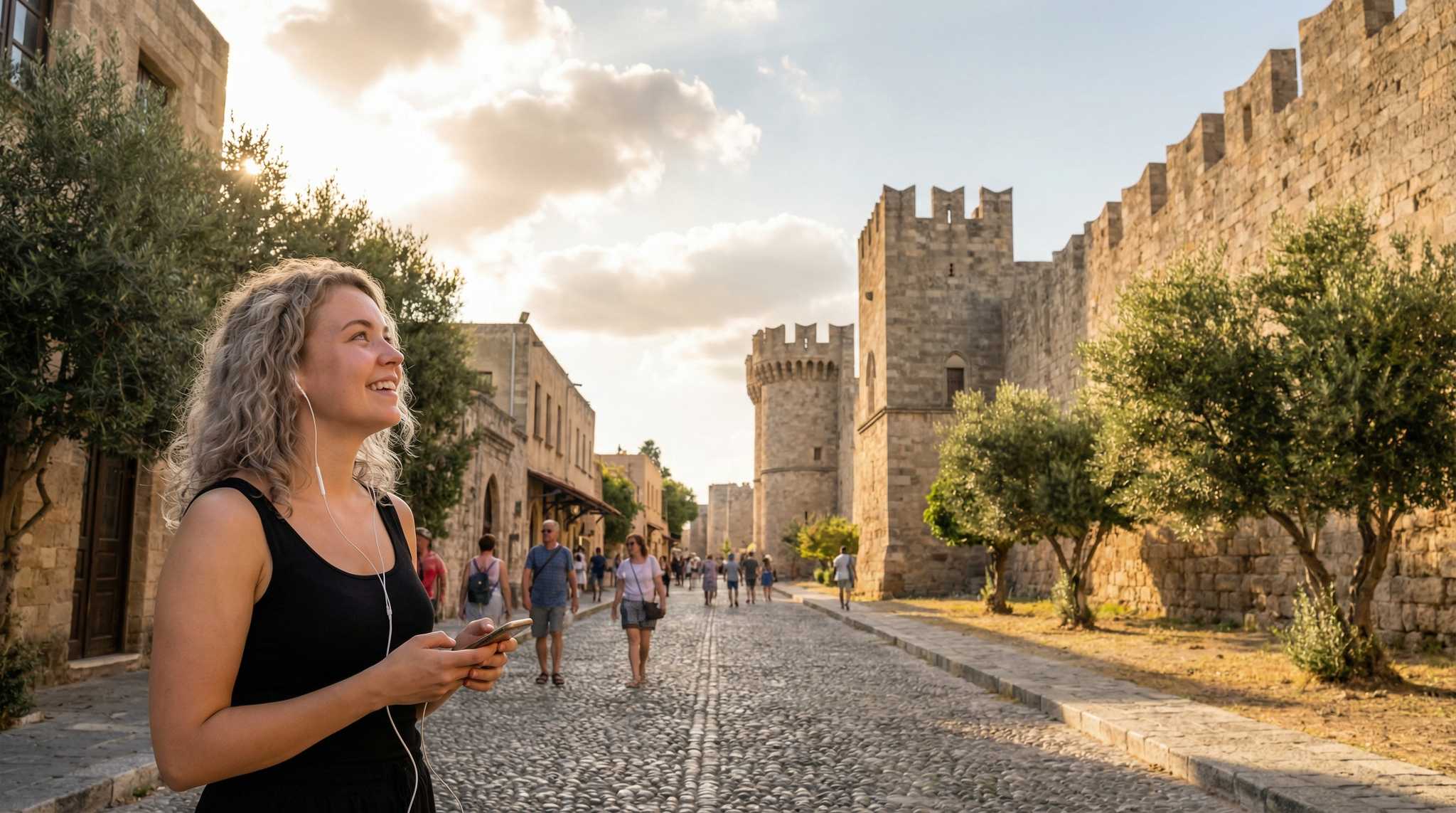
Tour Audio di Rodi: Echi di Imperi e Mura Cittadine Senza Tempo
Scopri l'affascinante storia di Rodi in questo tour immersivo, dove gli echi del passato prendono vita. Esplora il leggendario Assedio di Rodi (1522), testimoniando lo scontro epico che ha plasmato il destino dell'isola. Ammira il leggendario Colosso di Rodi, una delle Sette Meraviglie del Mondo Antico, e passeggia attraverso le imponenti Fortificazioni di Rodi, che si ergono alte come guardiani del ricco patrimonio della città. Questo viaggio indimenticabile nel tempo ti invita a scoprire le storie, le leggende e le meraviglie architettoniche che rendono Rodi un vero gioiello del Mediterraneo.
Anteprima del tour
Informazioni su questo tour
- scheduleDurata 40–60 minsVai al tuo ritmo
- straighten2.8 km di percorso a piediSegui il percorso guidato
- location_on
- wifi_offFunziona offlineScarica una volta, usa ovunque
- all_inclusiveAccesso a vitaRiascolta quando vuoi, per sempre
- location_onParte da Sinagoga Kahal Shalom
Tappe di questo tour
To spot the Kahal Shalom Synagogue, look for a modest stone building nestled among the narrow lanes of the Jewish Quarter-La Juderia-marked out by arched windows and a traditional…Leggi di piùMostra meno
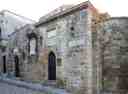
To spot the Kahal Shalom Synagogue, look for a modest stone building nestled among the narrow lanes of the Jewish Quarter-La Juderia-marked out by arched windows and a traditional facade that almost whispers its centuries-old secrets. Alright, traveler, you’ve just found yourself outside the oldest synagogue in all of Greece! Imagine the air filled with a mix of anticipation, soft chatter, and maybe some sea breeze wafting through these historic streets. Take a good look around-if these walls could talk, they’d have some stories that would knock your sandals off! The Kahal Shalom Synagogue was completed way back in 1577, which means this impressive little building has seen the world change for over 400 years. Back then, Rhodes was bustling, and the Jewish community here was thriving, thanks in part to the relatively peaceful times under Ottoman rule. Dazzle your senses for a second and picture rows of candles flickering, voices singing prayers, and a language called Ladino weaving through the air-a language born of centuries of Jewish history across Spain and the Mediterranean. There were once six synagogues right here in La Juderia, a symbol of just how vibrant this community was. But times weren’t always gentle-Romans, the Knights Hospitaller, and others tried their best to make life difficult for the Jewish families of Rhodes. Yet, under the Ottomans, things looked up, and the Sephardim-Jews who fled Spain after the Inquisition-turned Rhodes into a new home, bringing their customs, languages, and amazing food, too. I mean, who doesn’t like a good pastry, right? Inside, as you’ll notice if you peek through the windows, the synagogue’s design is quite special. The central bimah is where the Torah is read, surrounded by a lovely black-and-white mosaic floor made from local stones. Here’s a cool twist-there are two Torah arks instead of the usual one, and in the courtyard, you’ll spot a traditional fountain, where hands are ritually washed before blessings. Don’t miss the many plaques, each telling tales of those who kept the faith alive and remembering members lost during World War II. That’s when tragedy struck: deportations, bombings, and heartbreak nearly erased this community, except for a handful of survivors-and this synagogue, the lone one left standing from the war’s destruction. Today, Kahal Shalom lives on, bustling with joyful sounds during the summer as visitors and descendants return, if only for a short time. And of course, it now hosts the Jewish Museum of Rhodes, keeping these powerful stories alive for all who pass through its doors. So, breathe in the atmosphere-old stones, new hopes, and enough history to fill your backpack. Ready for our next chapter?
Apri pagina dedicata →Right ahead of you, rising powerfully against the blue sky, you’ll spot the massive, honey-colored stone walls of the Fortifications of Rhodes, with their thick, uneven blocks and…Leggi di piùMostra meno
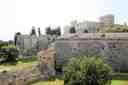
Right ahead of you, rising powerfully against the blue sky, you’ll spot the massive, honey-colored stone walls of the Fortifications of Rhodes, with their thick, uneven blocks and notched towers curling protectively around the medieval town-just look for the immense, ancient ramparts stretching out along your path, almost impossible to miss. Ready for a trip back in time? Imagine yourself standing here centuries ago, heart pounding, as defenders peer out from these very ramparts, scanning the horizon for distant sails-a fortress straight out of a knight’s tale. These fortifications form a great defensive crescent around Rhodes. Built from layer upon layer of stone and earth, the walls aren’t just thick-they’re nearly impenetrable, with bastions and towering walls that once dazzled even the ancient engineers of Byzantium. The outer faces are so smooth you’d need a miracle (or at least a very fancy ladder) to climb them. The Knights Hospitaller, those legendary crusaders in black cloaks emblazoned with white crosses, took over the island in 1309. And what did they do first? Well, they beefed up the old Byzantine walls to turn Rhodes into the medieval world’s toughest nut to crack. Picture the sounds: as knights and masons worked day and night, their armor glinting in the Mediterranean sun, all to create a fortress that could withstand anything-even gunshots from the dreaded new siege cannons. Each stretch of wall had its own garrison, named after the “tongue,” or langue, of knights defending it; you’ll find the Bastion of Italy, the terreplein of Spain, and even mighty posts for France, Germany, and England. Inside these walls is the largest living medieval town in Europe-with over 6,000 people still calling it home! But why all this fuss? Well, Rhodes sat perfectly on trade routes between east and west, making it a glittering prize for anyone who controlled the seas. Powerful armies came knocking-the Sultan of Egypt besieged for forty days in 1444, and in 1480, Mehmed II, conqueror of Constantinople, landed with a staggering 100,000 men and 170 ships. Now imagine the sound of distant war drums and shouts echoing along the battlements:. But the walls-and the brave knights-held firm, turning back the invaders against all odds. Yet nature sometimes proved as fearsome as any enemy. In 1481, an earthquake hammered Rhodes, crumbling walls and taking thousands of lives. You can almost hear the low rumble and falling stones if you listen close. But the knights, never ones to let a little disaster stop them, quickly rallied their resources-calling in the best architects from Italy to rebuild and strengthen the defenses with the new technology of gunpowder warfare. Each Grand Master left his mark, transforming the old medieval walls into state-of-the-art fortifications for the age of cannons. The Ottomans finally succeeded in 1522 after another epic siege. But oddly enough, they didn’t tear the walls down once they’d taken over; instead, they kept them in good repair for hundreds of years. These fortifications are remarkable because they were “frozen” in time in 1522, showing us a rare glimpse of both classic medieval defenses and the coming age of artillery-right here, side by side. There are 11 gates piercing the walls, each with its own story-some grand, like the imposing Gate d’Amboise with its triple ring of defenses, and some much quieter, like the tiny Arnaldo Gate that now leads you toward the Archaeological Museum. And let me tell you a little secret: thanks to its iconic, fairy-tale looks, Rhodes has even starred in films like “The Guns of Navarone.” But these walls hold tales much stranger than anything in the movies. Here, streets twist past churches, hammams, and mosques. Gothic arches stand beside Ottoman domes, and you can almost sense the ghosts of knights and sultans lingering in the cool shade of the ramparts. So take a deep breath-smell the wild thyme from the moat below, feel the heat of the stones beneath your hand, and imagine just how many footsteps-marching, running, racing for cover-these ancient battlements have known. Welcome to the fortress of Rhodes: a place where history isn’t just written, it’s built right into the stone. And don’t worry: the only sieges happening these days are from eager tourists! Intrigued by the the gates of the old town of rhodes, bastions and towers or the the medieval town of rhodes? Explore further by joining me in the chat section below.
Apri pagina dedicata →
Mostra altre 10 tappeMostra meno tappeexpand_moreexpand_less
To spot the site of the Siege of Rhodes (1522), look for massive stone walls with geometric patterns and soldiers painted in Ottoman uniforms; you’ll see knights standing above…Leggi di piùMostra meno
To spot the site of the Siege of Rhodes (1522), look for massive stone walls with geometric patterns and soldiers painted in Ottoman uniforms; you’ll see knights standing above the walls and Ottoman soldiers marching below-almost like a scene frozen mid-battle. Now, take a deep breath and let’s time travel back to 1522, right here where dust once mingled with gunpowder and tension was so thick you could slice it with a sword. Imagine the hot Mediterranean sun beating down on hundreds of Ottoman soldiers in dazzling uniforms, with gleaming cannons and grim determination in their eyes. All around you, the city is ringed by gigantic, almost impossible-to-breach stone walls-these are the last stand of the legendary Knights of St. John, also called the Knights Hospitallers. This isn’t their first rodeo! The Ottomans had tried to take Rhodes back in 1480 and failed, but now they’d returned with a mighty vengeance. In fact, you could say they brought the house down with them-by six months of non-stop bombardment! The walls, thickened and modernized after a major earthquake in 1481, echoed with the sound of thunderous artillery day and night. The defenders above, knights from every corner of Europe, peered anxiously over new angled battlements made to resist the latest cannons-a real “cutting-edge” design, quite literally! For the Knights, their castle had become both fortress and prison. With the walls wrapped around the city like layers of armor, and each sector defended by a different group (called Langues), the air was thick with the stench of gunpowder, sweat, and fear. Outside, 400 Turkish ships blackened the horizon while 100,000 men-yes, that’s right, enough to fill a football stadium and then some-prepared to storm your stronghold. Surely, the biggest gatecrashers in medieval history! And what did the little city do in response? It doubled the width of its dry ditches, sharpened its spikes-called tenailles-and even strung a massive iron chain across the harbor to keep enemy ships out. Picture every single muscle, brain, and brick bent toward survival, with Christian knights digging beside Muslim slaves, all racing the clock. Grand Master Philippe Villiers de L’Isle-Adam had called for reinforcements from Europe, but the world was busy. The only answer to his pleas? An Irishman named Sir John Rawson who showed up alone-talk about Irish luck! Then, under the relentless July sun, the Ottoman sultan himself, Suleiman the Magnificent, arrived to personally command the siege. The action reached fever pitch. The sultan’s men lobbed endless artillery, tried to tunnel under the walls, and even packed explosives below to blast open breaches. On the 4th of September, the ground shook as two massive gunpowder mines erupted beneath the English bastion-sending 12 yards of thick wall tumbling into the moat in a cloud of dust and panic. The Ottomans surged forward into the gap, only to be driven back three times by the desperate Knights and their banners barely holding. It was the medieval equivalent of sudden-death overtime! Attacks came almost daily. Mustafa Pasha, Suleiman’s brother-in-law, kept ordering mass assaults. Once, after a particularly fierce failure, Suleiman was ready to execute him-only to be persuaded to show mercy. (What, no family discount in the Ottoman army?) The real breakthrough, though, wasn’t in brute force, but in patience. The Turkish miners, maybe even using forgotten ancient tunnels from the Hellenistic city buried below your feet, focused on blowing up the ramparts. November saw yet another huge attack, and by then both sides were running out of strength and hope. Disease crept through the besieging army’s camp. In the town, food and courage dwindled. At last, with the city nearly shattered, Suleiman offered a deal: surrender and live, or fall and face ruin. The defenders negotiated hard, but eventually, the battered bastion of Spain fell, and with most of the walls gone, it all ended. On January 1, 1523, imagine the last knights-still proud, drums beating-marching out with their armor shining, heading for their ships and new destinies. The Ottomans took the city, their control over the Eastern Mediterranean locked into place. The Knights would later find a new home-Malta-but Rhodes would never be the same. Even 150 Jewish families from Thessaloniki were settled by the Ottomans here after the conquest. And just think: this epic clash even inspired the very first English opera, “The Siege of Rhodes.” All around you, the stones and silence remember. If you listen close, you might almost hear that distant echo of drums, boots, and banners-the final goodbye of the Knights, leaving a city forever changed. Intrigued by the setting, invasion or the end? Make your way to the chat section and I'll be happy to provide further details.
Apri pagina dedicata →Look just ahead for a weathered stone building with a large rounded dome and a stubby minaret, partially hidden by trees-the Recep Pasha Mosque stands quietly with a patchwork of…Leggi di piùMostra meno
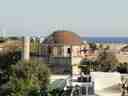
Look just ahead for a weathered stone building with a large rounded dome and a stubby minaret, partially hidden by trees-the Recep Pasha Mosque stands quietly with a patchwork of scaffolding along its sides. Standing here in Dorieos Square, imagine yourself whisked back to the late 1500s, right after the Ottomans took Rhodes and began reshaping the city with grand mosques and minarets. The mighty Grand Vizier Reçep Pasha decided in 1588 to leave a legacy on the island, which is why you're now gazing at this mosque-a remarkable blend of crumbling charm and faded glory. Back then, the area was alive with the sounds of merchants, calls to prayer, and the clang of hammers as skilled builders crafted the mosque’s three elegant cornice levels and its magnificent dome. While the minaret base still hints at the mosque’s former grandeur, you’ll notice intricate arches over the lower windows, and if you could peek inside, you’d spot breathtaking 16th-century Iznik tiles, colored like a painter’s wildest dreams, spelling out Quranic verses in swirling calligraphy. Above the doorway, an inscription from Reçep Pasha himself wishes for spiritual uplift-a fancy way of saying, “Hope you feel awesome in here!” But time hasn’t been kind to this place. After centuries of neglect, some sections, like the portico, have sadly collapsed-the mosque is now closed, both to the public and for prayers, waiting for its own sequel. Restoration costs soared, and despite a million-euro budget, the rest remains a dream, with even whispers of it becoming an Islamic art museum one day. Yet, the mosque’s octagonal fountain still survives, and out back sits Reçep Pasha’s own mausoleum, peeking from under wild greenery. Many say that despite its sorry state, Recep Pasha Mosque is the most beautiful of all Rhodes’ mosques, a quiet, mysterious gem holding centuries of history-waiting, maybe, for another chapter. So, who knows? Perhaps your footsteps here are the start of its next story!
Apri pagina dedicata →To spot the Mustafa Pasha Mosque, just look ahead for a large, pale yellow rectangular building with a slightly weathered dome on top, standing out among the surrounding rooftops…Leggi di piùMostra meno
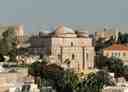
To spot the Mustafa Pasha Mosque, just look ahead for a large, pale yellow rectangular building with a slightly weathered dome on top, standing out among the surrounding rooftops and framed by medieval stone walls-right in Arionos Square near the hammam. Alright, take a moment and breathe in the scene-this is no ordinary building! Imagine the year is 1764, and the air is filled with the scent of spices and steam drifting from the hamam next door. Sultan Mustafa III, the Ottoman ruler with a knack for architecture and maybe a love for baths, decided to give Rhodes a new centerpiece. That’s the magnificent Mustafa Pasha Mosque you see before you, built right here at the heart of the old walled town. Back then, you’d hear the lively echoes of shoes shuffling over cool marble as people bustled through the bustling square. This mosque isn’t just a simple place to visit-it’s one of Rhodes’ great time travelers! In its prime, a grand marble portico stretched in front, with arches so wide you could almost park a camel caravan underneath. The call of the muezzin once rang out from its towering minaret, now long gone since the 1970s, like a ghost of the past. You might notice the bright yellow façade, newly spruced up in the last decade, keeping the building looking chipper among the ancient stones. And here’s a curious twist: while many Ottoman mosques on Rhodes have gone quiet, this one gets called back into action for special moments-like weddings! So, if you’re lucky, you might just see someone dressed to the nines slipping through the doors, ready to start a new life. The inside is no less intriguing: step in and you’d see a rectangular space crowned by one big dome and two smaller ones. Unlike other mosques, this one uses special roof vaults-a real architectural rarity for Rhodes. There’s the prayer-niche decorated with a crescent-shaped arch, flanked by Corinthian-topped columns doing their best impression of ancient Greek pillars. The marble minbar is among the biggest survivors on the island, covered in swirling Arabic ornaments-if only marble could talk! Despite wars, Italian rule, and a shifting cityscape, the mosque was preserved by the Greek Ministry of Culture in 1948. And today, it stands as a reminder of Rhodes’ rich, overlapping layers of history-Ottoman elegance, community spirit, and the gentle sound of wedding laughter that sometimes echoes through its halls.
Apri pagina dedicata →To spot the Archdiocese of Rhodes, look for a grand stone building with tall, narrow windows and a striking statue of a hooded friar in front of a rectangular bell tower-standing…Leggi di piùMostra meno
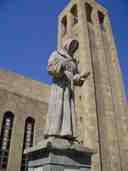
To spot the Archdiocese of Rhodes, look for a grand stone building with tall, narrow windows and a striking statue of a hooded friar in front of a rectangular bell tower-standing right ahead of you. Right in front of you is the Archdiocese of Rhodes, a place whose wow-factor comes not just from its sturdy stone walls and towering presence, but from its epic journey through time. Imagine going back to around the year 200-yes, two thousand years ago, before Wi-Fi and even before pizza delivery! Back then, this very spot was the heart of a newly established Christian diocese, a beacon for every believer on the island. By the 400s, it had already been promoted to the status of Metropolitan Archdiocese, and if titles were given like candy, this one would’ve needed a very big bag. Now, take a deep breath and picture the era of the mighty Knights Hospitaller arriving in 1308, fresh from their conquest of Rhodes, clanking around in their shining armor (well, probably not so shiny after a battle, but you get the idea). These knights made the Catholic Church here their spiritual HQ, filling the air with hope, prayer, and probably a fair share of sword-clanging. But history in Rhodes loves a plot twist! In 1523, after a dramatic siege, the Ottomans took over, and suddenly this mighty Catholic seat lost its official bishop. Instead, it became a "titular see,"-now that’s just a fancy way of saying it kept the title but didn’t have much happening inside. Through centuries of change, the buildings around you saw it all: the former cathedral of “Our Lady of the Castle” transformed from a church, to a mosque, and finally into a museum-talk about changing careers! The cathedral of St. John switched from Catholic to Greek Orthodox, never letting the stones gather dust. Fast forward to 1928, with the world rapidly changing, the Vatican officially restored this Archdiocese, giving it new life and a fresh start. So as you stand here, under the gaze of the friar’s statue and the soaring bell tower, you’re at the crossroads of empires, faiths, and stories. If only the walls could talk-they’d need more than one language!
Apri pagina dedicata →To spot the Mehmet Agha Mosque, just glance above the bustling crowd on Sokratous street and look for a striking pink-red building with a tall, polygonal wooden minaret and a…Leggi di piùMostra meno
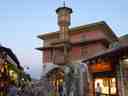
To spot the Mehmet Agha Mosque, just glance above the bustling crowd on Sokratous street and look for a striking pink-red building with a tall, polygonal wooden minaret and a balcony, standing proudly at a key intersection right above the street’s archway. As you stand here, close your eyes for just a moment and let yourself drift back to the sizzling summer of 1819. Imagine traders calling out their prices, their voices bouncing off these walls of deep red tuff stone, and the sweet, herby smell of spices curling in the market air. This is where the Mehmet Agha Mosque was born-built right on the ruins of a much older, crumbled mosque left behind, like a forgotten idea, from centuries earlier. But then-bam!-an earthquake shakes things up in 1856, making everyone in the bustling medieval streets look up with wide eyes. The mosque had to be rebuilt-again. Fast forward a bit, and World War II bombs rain down, leaving another round of damage. Like a cat with nine lives, the mosque comes back with a face-lift in 1948, and again in 2004, when the wooden minaret and the balcony you see today were lovingly restored. It’s like this place refuses to quit! And here’s a quirky twist-the mosque isn’t lined up square with the street. Built to face Mecca, it’s slightly rotated, which meant someone had to add a crafty little column right on the pavement to keep it all upright. The mosque’s wooden gable roof is unusual-no dome here, just timber beams creaking with stories. Walk up to the fountain in the yard and picture families pausing here, scooping cool water with their hands-one part prayers, one part refreshment, as this fountain was both for washing before prayer and as a lifeline for thirsty townsfolk. Each marble panel is decorated with pointed, arched symbols, echoing the medieval flair of the Knights Hospitaller who once built right here. Today, the Mehmet Agha Mosque is like a friendly ghost in the heart of Rhodes-quiet, watching over the crowds on Sokratous street, its every stone humming with the laughter, drama, and resilience of Rhodes across centuries. If its walls could talk, oh the stories they’d shout!
Apri pagina dedicata →Look for a small, sturdy stone building right on the Street of the Knights, with two pointed arch doorways and a statue perched above one entrance-it almost looks like a medieval…Leggi di piùMostra meno
Look for a small, sturdy stone building right on the Street of the Knights, with two pointed arch doorways and a statue perched above one entrance-it almost looks like a medieval storybook scene set into the wall, so keep an eye out for the detailed carvings and old coats of arms on the façade. Welcome to the Church of the Holy Trinity, or as the locals call it, Agia Triada! Imagine yourself stepping into a street bustling with knights, the clinking of armor echoing as the sun blazes on weathered stones. Built way back between 1365 and 1374 by the famous Knights Hospitaller, this church wasn’t always dedicated to the Holy Trinity-in fact, it first honored Archangel Michael. So, if you’re feeling a sudden urge to strike a heroic pose, it’s the medieval aura working its magic! Back in its early days, this church was simple-a single room, likely filled with whispered prayers and the soft glow of candlelight under a single arch. Outside, if you peer high above the entrance, you’ll see the coats of arms: the Holy See’s emblem, snuggled right up next to that of England. You can thank the Knights Hospitaller for these traces of chivalric power plays. Yet history had other plans! When the Ottomans took over, they swooped in and transformed this little church into a mosque called Khan Zade Mescidi. They even plopped an elliptical dome on top, which still sits there today, keeping centuries of stories under one roof. Step closer-imagine the vibrant murals that once covered the walls, though barely a handful have survived. These paintings, some dating from the very end of the 15th or beginning of the 16th century, featured rare scenes, like the Throne of Grace with the Ancient of Days on his throne, flanked by the Virgin Mary and Saint John the Baptist. These days, you’d have to squint to see what’s left, as Italian conservators stepped in for a touch-up (so maybe don’t try licking the frescoes!). After the Dodecanese islands were united with Greece following World War II, the church came full circle, transforming back into an Orthodox church. So, standing here, you’re really on a spot where faith, conquest, art, and a dash of drama have been mixing for over 650 years. Not too shabby for a stop on your walk!
Apri pagina dedicata →To spot Panagia tou Kastrou, look for a grand, ancient stone church with thick walls and arched windows, standing tall on the left side of the square just ahead of you. You’re…Leggi di piùMostra meno
To spot Panagia tou Kastrou, look for a grand, ancient stone church with thick walls and arched windows, standing tall on the left side of the square just ahead of you. You’re now standing in front of Panagia tou Kastrou, which-if these old stones could talk-would have quite a few stories to tell you! Imagine it’s the eleventh century and this spot is already buzzing. You’d hear whispers in Greek as villagers pass by, their sandals tapping softly on the cobblestones. This church, the largest surviving Byzantine church of Rhodes, started life as a proud Orthodox sanctuary. But if you look carefully, you’ll spot hints of some of the wild transformations it has survived. Picture 1303: a powerful earthquake shakes the island and the mighty dome of this church tumbles down, leaving townsfolk in shock. With money tight, the local archbishop sent out an S.O.S. to the Pope all the way in Rome. And what do you know-Pope John XXII actually answers! Thanks to his help, the church is restored, and guess what? The Hospitaller Grand Masters’ coats of arms, as well as the Pope’s, were proudly put on display to show who saved the day. Well, who says your friends can’t be from all over? Then comes the 15th century, and the Knights Hospitaller, with their shiny armor, hustle to defend Rhodes against sieges; the church is damaged in the fighting and gets rebuilt, with another friendly donation or two, judging by all the coats of arms you’ll see tucked here and there. Religious processions pass by, and you might even hear knights planning their next big defense. Fast-forward to 1522-suddenly, the voices you’d hear echo in Turkish. The Ottomans conquer Rhodes, and Panagia tou Kastrou transforms into Enderun Mosque. Listen up for the call to prayer as a minaret is built and a portico rises, turning the church into a mosque where the community gathers and the air buzzes with a new rhythm. Then, after World War II, it’s time for another twist: the Italians ruling Rhodes turn back the clock, and Panagia tou Kastrou becomes a church once more, the minaret vanishes, and morning light pours in over ancient arches instead of Islamic domes. Today, if you glance around, you’ll spot some faded murals-look out for the Virgin Mary, a child tucked in her arms, and Saint Lucia watching from the wall, surviving centuries of change. As you stand here, know you’re at the crossroads of empires, religions, and real-life dramatic plot twists. I wouldn’t blame you if you half-expected to see a knight, a sultan, and a priest walk into the square for a quick coffee together!
Apri pagina dedicata →If you look ahead, you can spot the Archaeological Museum of Rhodes by its grand, medieval stone building with powerful arches and a shady courtyard surrounded by ancient…Leggi di piùMostra meno
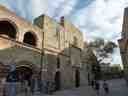
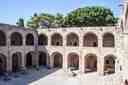
If you look ahead, you can spot the Archaeological Museum of Rhodes by its grand, medieval stone building with powerful arches and a shady courtyard surrounded by ancient relics-just follow the fortress-like walls and the sound of history calling to you! Alright, you’ve arrived at the Archaeological Museum of Rhodes, but don’t worry, it’s perfectly safe-no mummies jump out here, just lots of fascinating stories! Imagine you’re standing in a place that began life not as a museum, but as the grand Hospital of the Knights. Back in 1440, the mighty Grand Master De Lastic began construction over the ruins of a Roman building, and it took almost fifty years and another Grand Master, D’Aubusson, to finally complete it. These thick medieval walls have seen knights caring for the sick and plotting defense against sieges, and now they guard treasures from all over Rhodes and the Dodecanese. Step into the cool air and listen-a world of ancient secrets whispers from every stone. The museum’s halls are packed with discoveries from Mycenaean vases to Hellenistic statues, Roman sculptures, and things the Italians dug up during their rule. Each artifact is an ancient tweet from the past, telling you what life was like centuries ago. Walk slowly and picture yourself in the past, hearing the clank of armor, the chants of prayers, and maybe the complaints of patients! Today, the only thing you might need a cure for is curiosity. Ready to go treasure hunting through time?
Apri pagina dedicata →Stand in front of the grand stone gate with twin round towers-if you see a massive, castle-like entrance that looks like it belongs in a fairy tale, you’ve found the doorway to…Leggi di piùMostra meno
Stand in front of the grand stone gate with twin round towers-if you see a massive, castle-like entrance that looks like it belongs in a fairy tale, you’ve found the doorway to the Medieval Town of Rhodes. Alright, adventurer, as you step under this imposing gateway, imagine the clatter of knights’ boots echoing on cobblestones, the warm Mediterranean sun above you, and the salty breeze drifting in from the sea. This isn’t just any old town-it’s a living, breathing slice of medieval history! Starting life after a massive earthquake way back in 515, the city wrapped itself defensively around its acropolis like a medieval security blanket. The town eventually split: up north was Kollakio, with the famous Street of the Knights, the enormous Palace of the Grand Master, a hospital that’s now an awe-inspiring museum, and, of course, churches galore. To the south, in Chora, things got a bit livelier with a bustling Turkish bazaar near the Suleiman Mosque and lively old marketplaces-just imagine merchants shouting and spices wafting through the air. For over two centuries, the Knights Hospitaller (the coolest order you’ve probably never met) ruled from here, turning Rhodes into an unbeatable fortress to face off against all sorts of invaders-talk about home security! Later, the town changed hands, passing to Turkish and then Italian rule, and through it all, different cultures left their marks-Arabic echoes, Italian flair, and a sprinkle of Greek magic. Nowadays, Rhodes’ Old Town is still alive with footsteps on stones that have seen a thousand years of fairs, festivals, and the odd medieval brawl. Welcome to one of the oldest living medieval towns in the world-try not to lose your head to a jousting knight!
Apri pagina dedicata →To spot the Colossus of Rhodes in front of you, just look above the harbor entrance for a giant bronze statue of a man with a radiant crown and outstretched arm, towering high…Leggi di piùMostra meno
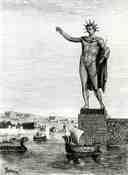
To spot the Colossus of Rhodes in front of you, just look above the harbor entrance for a giant bronze statue of a man with a radiant crown and outstretched arm, towering high over ancient Rhodes-with ships gathering below him and the city stretching into the distance. Alright, traveler! Picture the harbor bustling with ships, seagulls calling overhead, the sun glinting off the sparkling water-and standing right before you, rising above it all, is the legendary Colossus of Rhodes, the bronze giant of the ancient world. Imagine it’s 280 BC; the city is alive with excitement as people gather to admire the newest wonder, a statue so tall-around 33 meters, or 108 feet-that you’d have to crane your neck so far back you might spot what Helios had for breakfast! This enormous statue of Helios, the sun god, wasn’t just built for fun or to show off their metalworking skills. It was a triumphant thank-you to the gods after the people of Rhodes held off Demetrius I’s massive army and navy in a year-long siege. When the invaders finally retreated, they left behind heaps of weaponry and siege towers, which-never to waste a good bit of bronze-the Rhodians sold off or melted down to create this mammoth figure. So in a way, the Colossus was the ultimate recycling project! Chares of Lindos took charge of making this giant, constructing it section by section, casting the bronze and building up with stone for over twelve years. To support its weight, especially around those mighty ankles, Chares and his workers used iron bars and rings, piecing huge bronze plates together like a gigantic metallic jigsaw puzzle. All this rested on a marble pedestal near the harbor-though, no, despite those wild medieval drawings, the Colossus didn’t actually straddle the entrance for boats to sail under its legs. If they’d tried, the only thing that would have "straddled" the harbor was a big pile of twisted metal! Still, people were awestruck-even in its fallen state, centuries later, visitors gaped at the statue’s broken hands: just the thumb could take two strong men to wrap their arms around it. The Colossus stood proud as the ancient world’s tallest statue, glimmering in the sunlight, with his curly-headed face-think Helios meets a Rhodian coin-watching over sailors and citizens. They say he held his hand above his eyes, as if scanning for even more incoming enemies (or maybe just looking for the nearest lemonade stand on a hot day). But the story has its shadows. Just fifty-six years after this achievement, disaster struck. In 226 BC, a massive earthquake rocked Rhodes. The statue, along with much of the city, toppled to the earth. It broke at the knees, and there it lay-its head in the dust, bronze shattered, looking like a sleeping giant in a metal suit. Even so, the remains were still so impressive that for the next 800 years, travelers came from afar just to marvel at the ruins, some barely able to grasp the colossal thumb with their arms. The Rhodians never rebuilt their famous statue-not out of laziness, but because the Oracle of Delphi told them the gods had given a sign (and let’s be honest, you don’t want to anger the sun god, right?). Later tales claim the fallen bronze was eventually hauled off by invading armies, sold, and carried away on hundreds of camels. Quite the yard sale! But much of that is probably legend; by the time the Arab raiders came in 653, there may not have been much metal left to haul away anyway. The real mystery? No one’s quite certain where the Colossus stood, though some believe it was here at the entrance to Mandraki Harbor, while others argue for a hilltop temple site. So every time you walk by those two proud pillars at the harbor, you might just be standing on the shattered toes of a titan that once inspired poets, travelers, and even Shakespeare himself. So, as the breeze blows in from the sea and you stand here, let your imagination soar, because you’re in the shadow of one of the ancient world’s greatest wonders-even if the giant himself is now just a legend told in the sunlight of Rhodes. Wondering about the siege of rhodes, construction or the collapse (226 bc)? Feel free to discuss it further in the chat section below.
Apri pagina dedicata →
Domande frequenti
Come inizio il tour?
Dopo l'acquisto, scarica l'app AudaTours e inserisci il tuo codice di riscatto. Il tour sarà pronto per partire immediatamente – tocca play e segui il percorso guidato dal GPS.
Ho bisogno di internet durante il tour?
No! Scarica il tour prima di iniziare e goditelo completamente offline. Solo la funzione chat richiede internet. Ti consigliamo di scaricare tramite WiFi per risparmiare dati mobili.
È un tour guidato di gruppo?
No – è un tour audio autoguidato. Esplori in autonomia al tuo ritmo, con la narrazione audio riprodotta dal tuo telefono. Nessuna guida, nessun gruppo, nessun orario.
Quanto dura il tour?
La maggior parte dei tour richiede 60–90 minuti, ma sei tu a controllare il ritmo. Metti in pausa, salta le tappe o fai pause quando vuoi.
E se non riesco a finire il tour oggi?
Nessun problema! I tour hanno accesso a vita. Metti in pausa e riprendi quando vuoi – domani, la prossima settimana o il prossimo anno. I tuoi progressi vengono salvati.
Quali lingue sono disponibili?
Tutti i tour sono disponibili in oltre 50 lingue. Seleziona la lingua preferita quando riscatti il codice. Nota: la lingua non può essere cambiata dopo la generazione del tour.
Dove accedo al tour dopo l'acquisto?
Scarica l'app gratuita AudaTours dall'App Store o Google Play. Inserisci il codice di riscatto (inviato via email) e il tour apparirà nella tua libreria, pronto per essere scaricato e avviato.
Se il tour non ti piace, ti rimborseremo l'acquisto. Contattaci a [email protected]
Pagamento sicuro con 


