AudaTours logoAudaTours

Tour Audio di Karlsruhe: Innovazione, Birre e Tesori Nascosti di Oststadt

Audioguida14 tappe

Un corridoio di innovazione illuminato al neon si snoda attraverso la vecchia Karlsruhe, dove potere e protesta hanno plasmato le fondamenta di Oststadt per generazioni. Questo tour audio autoguidato svela storie mai raccontate e angoli segreti, mentre ogni strada pulsa di racconti che pochi visitatori sentono mai. Perché le scintille sono letteralmente volate in una corsa all'ultimo sangue nel centro nevralgico di EnBW? Quali incontri clandestini sotto il tetto del Corps Friso-Cheruskia hanno spostato il potere studentesco per decenni? Quale rivalità dimenticata all'interno dell'Istituto Fraunhofer ha cambiato il percorso della tecnologia tedesca con una singola decisione sussurrata? Attraversa giardini nascosti e cortili universitari, oltre reliquie di drammatici scontri e silenziose rivoluzioni. La città sfreccia via in strati di mistero e rivelazione. Aspettati intrighi ad ogni angolo e una nuova prospettiva sullo spirito irrequieto di Karlsruhe. Collegati e cammina nel cuore di Oststadt, dove la trasformazione crepita nell'aria. C'è di più qui di quanto sembri: inizia il viaggio ora.

Anteprima del tour

map

Informazioni su questo tour

  • schedule
    Durata 40–60 minsVai al tuo ritmo
  • straighten
    5.1 km di percorso a piediSegui il percorso guidato
  • location_on
  • wifi_off
    Funziona offlineScarica una volta, usa ovunque
  • all_inclusive
    Accesso a vitaRiascolta quando vuoi, per sempre
  • location_on
    Parte da Chiesa Luterana

Tappe di questo tour
  1. You are standing in front of a monumental church built from rough yellow sandstone, dominated by a towering fifty-three-meter square belfry and anchored by a massive stone figure…Leggi di piùMostra meno
    Luther Church
    Luther ChurchPhoto: Ikar.us, Wikimedia Commons, CC BY 3.0 DE. Cropped & resized.

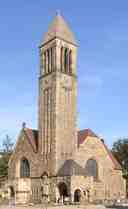
    You are standing in front of a monumental church built from rough yellow sandstone, dominated by a towering fifty-three-meter square belfry and anchored by a massive stone figure carved directly into its base.

    Welcome to the Luther Church. Designed by the architects Robert Curjel and Karl Moser between 1905 and 1907, it marks the starting line of a neighborhood that underwent a massive shift. Take a glance at the photo on your app to see the full scale of the exterior. You will notice elements of Art Nouveau, an architectural style from the turn of the twentieth century that favored organic, flowing lines over strict classical rules. But the architects faced quite a battle here.

    The Luther Church, completed in 1907, is a protected cultural monument distinguished by its monumental Art Nouveau exterior and its imposing 53-meter-high tower made of yellow Palatinate sandstone.
    The Luther Church, completed in 1907, is a protected cultural monument distinguished by its monumental Art Nouveau exterior and its imposing 53-meter-high tower made of yellow Palatinate sandstone.Photo: Flocci Nivis, Wikimedia Commons, CC BY-SA 4.0. Cropped & resized.

    Step back and look up at the massive Luther relief right in front of you. Notice his raised arm and stern expression, and see if you can feel the heavy weight of his absolute certainty. This colossal statue measures nearly ten feet tall on its own, resting on a five-foot pedestal while clutching a closed Bible in a severe, unyielding posture. That stern, forward-looking gaze is not just a casual artistic choice. It radiates a heavy, dogmatic authority, projecting a rigid, almost intimidating certainty that demands absolute compliance from anyone standing below. In a neighborhood that would eventually become a breeding ground for radical engineering and creative disruption, this uncompromising guardian of tradition feels like a deliberate warning.

    It almost was not here. Originally, the building committee wanted a highly traditional crucifixion scene carved at the base of the tower. But in April 1905, the architects threw their weight around. They insisted the church's artistic program needed to be modern and unified. They forced a radical change, hiring sculptor Oskar Kiefer to carve this giant reformer instead. The reaction went about as you would expect. When it was unveiled, architectural critics begrudgingly admitted it was powerful, but complained it was far too stylized, harsh, and coarse.

    It is harsh, but it is also exceptionally tough. During a devastating bombing raid in April 1944, the roof and the beautifully painted interior were completely destroyed by fire. Yet, these massive walls made of Palatinate sandstone, a notoriously durable rock quarried from the nearby hills, absorbed the shockwaves and survived.

    Today, we are going to trace how this district evolved from this exact kind of strict, unbending dogma into an engine of modern progress. From the weight of religious authority, we will walk toward a different kind of ambition just down the street. Our next stop, the Private Brewery Hoepfner, is a nine-minute walk away. If you want to peek inside the church, it is only open on Sundays for an hour in the morning and a couple of hours in the afternoon.

    Apri pagina dedicata →
  2. Look to your left and you will see an imposing fortress built of dark red sandstone, anchored by a soaring round keep with a steeply pointed roof and ringed by crenelated turrets.…Leggi di piùMostra meno
    Private Brewery Hoepfner
    Private Brewery HoepfnerPhoto: Dumontcedric, Wikimedia Commons, CC BY-SA 3.0. Cropped & resized.

    Look to your left and you will see an imposing fortress built of dark red sandstone, anchored by a soaring round keep with a steeply pointed roof and ringed by crenelated turrets.

    Built between 1896 and 1898, this is the Hoepfner-Burg, or Hoepfner Castle. It was born from the mind of Friedrich Hoepfner, a powerful industrialist whose obsession with the Bavarian fairy-tale castle Neuschwanstein led him to demand a direct architectural copy for his brewery. Naturally, he hid state-of-the-art brewing technology behind this wild medieval and Renaissance facade.

    But his romantic, top-down vision of dogmatic authority collided violently with reality. In 1893, right before construction began, a massive brewery workers' strike erupted, igniting a fierce spirit of rebellion that shattered the fairy-tale illusion. The men demanded a ten-hour workday and a weekly wage of 24 Marks, which is roughly two hundred dollars in today's money. Above all, they wanted to abolish the Zwangsküche, an exploitative system of forced room and board that was automatically deducted from their pay. The strike dragged on for months and mostly failed to raise wages, but it successfully killed that mandatory kitchen system.

    The castle's history only got grittier from there. During the strict Allied brewing ban after World War Two, the company survived by making ice. When they finally reopened in 1947, ingredients were so scarce that the brewmaster proudly engineered a beer entirely without malt... which is essentially just sad, bitter water. Later on, locals started calling the actual beer Friedhofsbräu, or graveyard brew, because the deep wells supplying the water are located right next to the city's main cemetery.

    In 2005, the Hoepfner family sold the brewing operations to an international conglomerate but kept the real estate, meaning the brewery now has to pay rent to occupy its own historic fortress. This site perfectly captures the clash between grand tradition and cold industrial reality.

    Speaking of rigid dogma, we will see how that plays out in the academic world as we transition to the Max Rubner Institute, which is a five-minute walk away. If you want to explore the brewery grounds, they are open Monday through Thursday from 8:00 AM to 4:30 PM, Fridays until 3:30 PM, and closed on weekends.

    Apri pagina dedicata →
  3. Ahead on your left stands the Max Rubner Institute, a sprawling modern complex defined by a sweeping curved stone facade, a large attached glass greenhouse on the right wing, and…Leggi di piùMostra meno
    Max Rubner Institute
    Max Rubner InstitutePhoto: Voskos, Wikimedia Commons, CC BY 3.0. Cropped & resized.

    Ahead on your left stands the Max Rubner Institute, a sprawling modern complex defined by a sweeping curved stone facade, a large attached glass greenhouse on the right wing, and a long, diamond-patterned paved walkway leading to the main entrance.

    This is the headquarters of the Federal Research Institute of Nutrition and Food, named after the medical doctor and physiologist Max Rubner. Rubner was an unquestioned pioneer of modern nutrition science. He was one of the first to map out the exact caloric and protein needs of the human machine. But he was also a tyrant. He was intensely dogmatic and tolerated zero contradiction. If a theory did not fit perfectly into his strict physiological worldview, he did not just disagree with it. He used his influence to scientifically bury it.

    Consider his reaction to the great chewing debate of the Weimar Republic. At the time, a populist health craze called Fletcherism had taken off. The core philosophy was that if you chewed every single bite of food exhaustively until it practically dissolved into liquid, your body would extract more value from it, allowing you to survive on significantly smaller portions. Rubner despised this. He relied completely on his clinical, unyielding math. To him, the body was simply a mechanical ledger of calories in and calories out. He publicly condemned Fletcherism as dangerous nonsense and actively campaigned to crush the movement, attempting to silence any competing doctrine that challenged his exact calculations.

    It is a revealing look into the old guard of this area. For a long time, the scientific establishment was heavily anchored in this kind of rigid, clinical authority. There was one accepted truth, handed down from above, and intellectual dissent was treated like heresy. But progress requires breaking the rules. To build a modern landscape of creative problem-solving, you have to eventually step out of that shadow and stop worshipping the pioneers.

    This building still bears his name, but the era of scientific dictators demanding absolute conformity could not last forever. The generations of researchers who followed would learn that real innovation requires challenging the manual entirely. They would prove to be far less obedient than Rubner would have tolerated. We will see exactly how that boundary-pushing mindset evolved next. Let us move to the Fraunhofer Institute of Optronics, System Technologies and Image Exploitation, which is just a one minute walk away.

    Apri pagina dedicata →
Mostra altre 11 tappeMostra meno tappeexpand_moreexpand_less
  1. Look straight ahead to spot the long, rectangular building defined by its prominent horizontal bands of windows, punctuated by a taller, blocky tower section bearing a small green…Leggi di piùMostra meno
    Fraunhofer Institute of Optronics, System Technologies and Image Exploitation
    Fraunhofer Institute of Optronics, System Technologies and Image ExploitationPhoto: Voskos, Wikimedia Commons, CC BY 3.0. Cropped & resized.

    Look straight ahead to spot the long, rectangular building defined by its prominent horizontal bands of windows, punctuated by a taller, blocky tower section bearing a small green logo near the roofline.

    This is the Fraunhofer Institute of Optronics, System Technologies and Image Exploitation, though thankfully everyone just calls it the IOSB. Today, it stands as a fortress of high-tech innovation, but this institute did not arrive in Karlsruhe quietly. It moved here in 1968, right into the teeth of a massive political firestorm.

    During the late nineteen sixties, fierce student protests swept across the country, with young people passionately pushing back against the establishment and aggressively targeting any academic institutions involved in defense and military research. The Fraunhofer Society, deeply intertwined with government defense contracts, found itself directly in the crosshairs.

    When the institute relocated to Karlsruhe with forty-five employees, the climate was incredibly tense. Across the nation, anti-war students were attempting to physically occupy Fraunhofer facilities, and in many places, only heavy police intervention kept the laboratory doors open. To make matters worse, 1968 was also the year of the infamous Petras Case. An employee from a different Fraunhofer institute abruptly defected to East Germany, where he commanded the media's attention to accuse his former employer of secretly preparing for atomic, biological, and chemical warfare. Not exactly the welcome wagon you hope for when setting up a new research center.

    Despite that incredibly chaotic beginning, the scientists dug in. They transitioned from their early, somewhat quirky origins of studying mechanical vibrations and how animals process biological signals, into the sharp edge of the digital age. They began pioneering what are known as dual-use technologies. This is a polite engineering term for systems developed for civilian industries that also happen to be highly effective for military operations.

    Today, the institute is deeply involved in machine vision, autonomous systems, and advanced military reconnaissance. They are developing radical concepts like non-line-of-sight imaging, which uses scattered light to literally see around corners. They also experiment with public surveillance. Recently, they tested an artificial intelligence camera system in a nearby city, designed to automatically detect criminal behavior by analyzing people as simplified digital skeletons. The rollout had a few hiccups. The complex algorithm reportedly had a very hard time distinguishing between a violent attack and two friends giving each other a warm hug.

    From dodging student barricades in the sixties to training algorithms to understand human behavior today, this place perfectly maps the local shift toward complex digital networks. If you happen to be a brilliant engineer looking for work, the building is generally open Monday through Friday from seven in the morning until eight at night.

    Now, let us continue tracking this digital evolution with a short four minute walk over to the Telecooperation Office.

    Apri pagina dedicata →
  2. On your right is the Telecooperation Office, better known as TECO. Not so long ago, this neighborhood was defined by the deafening crash of heavy machinery and the acrid smell of…Leggi di piùMostra meno

    On your right is the Telecooperation Office, better known as TECO. Not so long ago, this neighborhood was defined by the deafening crash of heavy machinery and the acrid smell of industrial exhaust. Today, the massive steel presses have been replaced by silent servers and invisible wireless signals, as the district morphed from an epicenter of heavy industry into a sleek proving ground for digital innovation. The area threw off its traditional, rigid past to embrace this kind of technological disruption.

    And TECO has been driving that disruption since 1993. This research facility, tied to the Karlsruhe Institute of Technology, specializes in ubiquitous computing. That is an academic term for cramming a tiny computer into absolutely everything you own.

    They have been wildly ahead of the curve. In 1994, before the general public even knew what a dial-up internet connection was, TECO programmed PocketWeb for the Apple Newton. It was the world's first mobile web browser. They were surfing the mobile internet years before commercial networks caught up.

    But the most brilliant experiment happened in 1998, involving a basic staple of research... coffee. Researchers Hans-W. Gellersen, Michael Beigl, and Holger Krull created the MediaCup. They secretly equipped the bottom of a standard coffee mug with a temperature sensor, a two-axis accelerometer to track motion and tilt, and a tiny microchip. Powered by a standard lithium battery, the cup did not just gather raw data. It actually deduced what was happening. It knew if it had just been filled, if it was cooling down, if someone was carrying it, or if it was currently being sipped.

    Every two seconds, the cup beamed an infrared signal to a receiver on the ceiling. Here is the brilliant part. The digital signs on the office doors were wired into this network. When the system noticed that several hot, full coffee cups had migrated into the same room, the door signs automatically changed to read Meeting in Progress. Nobody pushed a button. The room just figured it out.

    That success fed into a visionary European initiative called the Disappearing Computer. TECO developed Smart-Its, matchbox-sized devices packed with sensors for audio, pressure, light, and motion. You could slap them onto anything, like a digital Post-it note, instantly turning a dumb object into a smart one. They tested them on office binders and even festive tablecloths, letting everyday items form local wireless networks to communicate and react to their environment.

    Today, TECO is still taking massive, overwhelming streams of raw big data and turning them into smart, usable data, modeling everything from industrial energy use to urban air quality. It is a masterpiece of digital networking. But of course, networking existed long before microchips. Let us pivot back to a much older, slightly more archaic form of student networking. Our next stop, the Corps Friso-Cheruskia, is just a two-minute walk away.

    Apri pagina dedicata →
  3. Look for the distinctive emblem representing the fraternity, an elaborate black cursive monogram formed by intertwined looping letters that finishes with a sharp exclamation mark.…Leggi di piùMostra meno
    Corps Friso-Cheruskia
    Corps Friso-CheruskiaPhoto: Wolfgang Ihloff, Wikimedia Commons, Public domain. Cropped & resized.

    Look for the distinctive emblem representing the fraternity, an elaborate black cursive monogram formed by intertwined looping letters that finishes with a sharp exclamation mark. You are standing before the home of Corps Friso-Cheruskia, a traditional student fraternity with roots stretching back to 1860.

    This organization is what Germans call pflichtschlagend, meaning its members are required to participate in academic fencing. It is a highly regimented form of dueling with sharp blades where the participants are essentially rooted to the spot and flinching is strictly forbidden. Relaxing stuff.

    But the real fascination of this place is how it has navigated the extreme turbulence of German history. Behind these walls is a masterclass in bureaucratic problem-solving. During the National Socialist era, independent student fraternities were pressured, banned, or absorbed into party organizations, and their properties were routinely confiscated. The members of this fraternity realized they needed a shield, and they found one in corporate law. They transferred the ownership and operation of this building into a standard limited liability company, or GmbH. By legally transforming their fraternity home into a corporate asset, they built an impenetrable administrative firewall. This brilliant legal chess move prevented the regime from seizing the property, making this entity the oldest surviving GmbH in the Baden region today.

    The fraternity's history, however, is not without its deep stains. One of its most historically controversial members was an engineer named Wilhelm Keppler. In 1932, at Adolf Hitler's direct request, he formed the Keppler Circle, a group of industrialists meant to advise the economically illiterate dictator. Keppler played a fatal role behind the scenes, brokering the secret meetings that led directly to the handover of power in 1933. He eventually found himself sitting on the defendants bench at the Nuremberg trials.

    Decades later, the fraternity experienced a rather different cultural milestone. In 1993, in an environment known for deep-seated conservatism, an engineering student of Turkish descent named Aydin Karaduman was elected as the national chairman of the umbrella organization. He successfully navigated complex internal power struggles, steering the historically rigid institution toward a slightly more adaptable future.

    If you are wondering what life inside looks like, a pair of filmmakers asked the same question in the late nineties. They were granted rare access to film a documentary called No Closed Season for Foxes. It followed the new pledges, known as foxes, exposing the brutal peer pressure, the strict rules of conduct, and the intense physical training required for those fencing duels. They learned quickly that conformity here is earned the hard way.

    The building is generally accessible to members from eight in the morning to seven fifteen in the evening on weekdays, and remains open twenty four hours a day over the weekend.

    Let us keep moving toward another monument shaped by strict traditional demands, as we head to St. Bernard, which is about an eight minute walk from here.

    Apri pagina dedicata →
  4. Before you stands a towering neo-Gothic basilica constructed entirely of striking red sandstone, culminating in an eighty-six-meter spire that features large golden clock dials…Leggi di piùMostra meno
    St. Bernard
    St. BernardPhoto: Gerd Eichmann, Wikimedia Commons, CC BY-SA 4.0. Cropped & resized.

    Before you stands a towering neo-Gothic basilica constructed entirely of striking red sandstone, culminating in an eighty-six-meter spire that features large golden clock dials near its base.

    This is Saint Bernard, and its very existence is a masterclass in nineteenth-century power plays. Back in the late eighteen hundreds, Karlsruhe's Catholic population was booming. Grand Duke Friedrich the First, Protestant ruler of Baden, decided it was politically savvy to gift the Church a massive plot of land right here. But the Grand Duke did not just give them the dirt and walk away. He had a specific vision for the city's geometry. He insisted that the church feature an enormous tower, perfectly aligned to face the city center and cap off the eastern end of Kaiserstrasse. Take a look at your screen for an aerial view. You can see exactly how that colossal spire acts as a dead stop for the city's main axis.

    This aerial view from Turmberg highlights St. Bernhard's imposing 86-meter-high tower, the tallest in Karlsruhe, which prominently marks the eastern end of Kaiserstraße.
    This aerial view from Turmberg highlights St. Bernhard's imposing 86-meter-high tower, the tallest in Karlsruhe, which prominently marks the eastern end of Kaiserstraße.Photo: Smiley.toerist, Wikimedia Commons, CC BY-SA 4.0. Cropped & resized.

    The church authorities initially hired an architect named Franz Jakob Schmitt. But by eighteen ninety-two, they fired him. His designs simply lacked the monumental scale they wanted. So, they brought in Max Meckel, the archdiocesan building inspector. Meckel drew up incredibly ambitious plans for a soaring nave, the central hall of the church where the congregation gathers. The Grand Duke loved it, but he had one major intervention. Meckel had planned to cover the exterior in plaster, which was standard and cheap. The Grand Duke vetoed this immediately. He demanded the building be constructed with exposed, massive red sandstone blocks. Look at the historical photo in your app from nineteen ten. That bare, bold stone facade is entirely thanks to royal meddling.

    Captured in 1910, just after its completion, this historical exterior view showcases St. Bernhard's striking red sandstone facade, a distinctive feature personally requested by Grand Duke Friedrich I.
    Captured in 1910, just after its completion, this historical exterior view showcases St. Bernhard's striking red sandstone facade, a distinctive feature personally requested by Grand Duke Friedrich I.Photo: Unknown, Wikimedia Commons, CC BY 4.0. Cropped & resized.

    Now, Max Meckel was an architectural genius, but he was also spectacularly bad at office politics. He spent the entire construction period picking fights with church officials and building authorities. Unsurprisingly, his abrasive style caught up with him. In nineteen hundred, after years of constant bickering, he was unceremoniously fired from his post in Freiburg. He did not even get to see the official consecration of his own masterpiece a year later.

    The building survived Meckel's drama, but it barely survived the nineteen forties. Allied bombing raids in nineteen forty-four obliterated the roof and the soaring vault. While the congregation managed to patch it up with temporary fixes, completely rebuilding the complex roof structure took nearly three decades, finally wrapping up in nineteen seventy-two.

    Saint Bernard is a prime example of dogmatic authority in action. Between the Church demanding monumental scale and the Grand Duke dictating the sightlines and building materials, this skyline was engineered from the top down. It is a striking reminder of a time when rigid traditions and unyielding rulers quite literally shaped the horizon, long before the Oststadt became a playground for technological disruption.

    If you want to admire the vaulting interior, the doors are open daily from eight in the morning until six in the evening. Otherwise, let us continue our walk. We are heading toward the modern administrative hub of the city, taking an eight-minute stroll over to BGV Badische Versicherungen.

    Apri pagina dedicata →
  5. Look for the striking modern complex right in front of you, characterized by its expansive glass exterior, rigid steel support framework, and warm wooden accents visible from the…Leggi di piùMostra meno
    BGV Badische Versicherungen
    BGV Badische VersicherungenPhoto: BGV Badische Versicherungen, Wikimedia Commons, Public domain. Cropped & resized.

    Look for the striking modern complex right in front of you, characterized by its expansive glass exterior, rigid steel support framework, and warm wooden accents visible from the street.

    This is the headquarters of BGV Badische Versicherungen. Back in 1923, eight local cities looked at their municipal buildings, realized fire was a rather expensive problem, and decided to pool their risk. That is the core of mutual insurance: everyone chips in a little, so if one town's city hall burns down, the collective fund pays to rebuild it. It is a highly rational, mathematical approach to chaos.

    Over the decades, BGV expanded into everything from legal protection to private coverage. But managing risk is never a smooth ride. In 2008, a massive fire ripped through a hospital in Konstanz. The damage hit thirty million euros. For BGV, their loss ratio, basically the percentage of premium income paid out in claims, spiked to an alarming 172.7 percent. Yet, the system worked. Thanks to heavy financial reinforcements, they absorbed the blow and normalized the numbers by the very next year.

    To house this growing operation, they built the structure you see today. Finished in 2011, it is a brilliantly engineered green building. By aggressively recycling construction materials during the build, it saves a hundred tons of carbon dioxide every year. Even the daycare center next door made architectural history as the first in Germany to earn a LEED certification for environmental design.

    But let us talk about the messy human element. For years, BGV offered a one-euro accident policy for school kids. The catch was their highly unusual distribution network. The teachers were handing out the forms directly to students in the classrooms. Consumer advocates argued that teachers lacked the legal qualifications to act as insurance brokers, forcing BGV to scrap the whole program in 2018.

    Then came a truly poetic piece of corporate irony. BGV sells commercial cyber insurance to protect businesses from hackers. In 2022, BGV itself fell victim to a massive cyberattack. Hackers breached a third-party IT provider that BGV used for human resources. The provider refused to pay the ransom, and highly sensitive employee data ended up on the dark web. They recovered, but it is a sharp reminder that nobody is entirely bulletproof.

    If you ever need to talk premiums or cyber defense, their offices are open Monday through Thursday from eight to six, and Fridays until five. Now, let us walk about five minutes to Gottesaue Castle, a structure that knows a thing or two about risk, having been destroyed and reborn multiple times over the centuries.

    Apri pagina dedicata →
  6. On your left stands a massive salmon-pink stone palace, defined by its symmetrical arched windows and a steep grey metal roof punctuated by prominent domed towers. This is…Leggi di piùMostra meno
    Gottesaue Castle
    Gottesaue CastlePhoto: H. Zell, Wikimedia Commons, CC BY-SA 3.0. Cropped & resized.

    On your left stands a massive salmon-pink stone palace, defined by its symmetrical arched windows and a steep grey metal roof punctuated by prominent domed towers. This is Gottesaue Castle, a building that practically refuses to die.

    Local legend claims the name Gottesaue, or God's Meadow, comes from an eleventh-century count who lost his young daughter in the dense woods, only to find her safe and attribute the miracle to the watchful eyes of God. Historians assure us this is completely fabricated, which tells you everything you need to know about historians.

    The real story is far more chaotic. It began in 1094 as a Benedictine abbey, heavily influenced by the Hirsau Reform, a strict monastic movement that demanded total independence from secular, or non-religious, lords. But that pious start did not last. The monastery was plundered and burned during a peasant uprising in 1525. By 1588, a visionary architect named Johannes Schoch was hired to build a grand Renaissance castle on the ruins. He designed a fascinating architectural puzzle here, including the Schneckenturm, a highly complex spiral stair tower built seamlessly into the western facade.

    Then came the fires. It burned down in 1689. It burned down again in 1735. Each time, the city simply shrugged and repurposed the surviving shell. It became a granary, and by 1818, it was heavily modified to house military barracks. You can pull up the fourth image on your screen to see an 1840 drawing of the castle during its severely regimented military phase.

    This 1840 drawing depicts Schloss Gottesaue during its period as a military barracks, a phase that began in 1818 after its use as a granary.
    This 1840 drawing depicts Schloss Gottesaue during its period as a military barracks, a phase that began in 1818 after its use as a granary.Photo: Druck & Verlag von G. G. Lange, Darmstadt., Wikimedia Commons, CC BY 4.0. Cropped & resized.

    Its darkest moment arrived in 1944. An air raid rained incendiary bombs across the city, gutting the castle. The southern towers were left so unstable they had to be deliberately blown up. For nearly forty years, the site was a desolate shell standing as a bleak monument to the war.

    But in 1982, architect Barbara Jakubeit took on the massive task of rebuilding. She faced a classic architectural dilemma. Do you build a fake historical replica, or do you build something entirely new? Her solution was brilliant. She reconstructed the original sixteenth-century Renaissance exterior but boldly inserted modern materials inside, leaving the seams between old and new completely visible. Take a look at the third image in your app to see an aerial view of how this massive, multifaceted structure commands the grounds today.

    An aerial view from the southwest shows the extensive grounds of Schloss Gottesaue, built on the site of a former Benedictine abbey and extensively rebuilt after its destruction in 1944.
    An aerial view from the southwest shows the extensive grounds of Schloss Gottesaue, built on the site of a former Benedictine abbey and extensively rebuilt after its destruction in 1944.Photo: Carsten Steger, Wikimedia Commons, CC BY-SA 4.0. Cropped & resized.

    If you want a physical metaphor for how this district constantly pivots from rigid tradition to bold innovation, this is it. The stonemasons who worked on the modern reconstruction even left a few Easter eggs in the facade, reviving an old Renaissance tradition of hiding contemporary symbols in the masonry. If you look closely at the northern tower just under the cornice, you will find a carved stone Coca-Cola bottle, a telephone, and an actual space shuttle.

    Today, the castle is home to the Karlsruhe University of Music, swapping military drills for orchestras. The grounds and building are generally open every day from 8:00 AM to 9:30 PM if you want to explore the campus. Now, let us move on to what is arguably the most dramatic urban transformation in the entire city, as we take a six minute walk toward the Old Slaughterhouse.

    The iconic Schloss Gottesaue, reconstructed in the style of the 16th-century Renaissance, now serves as the home of the Karlsruhe University of Music since 1989.
    The iconic Schloss Gottesaue, reconstructed in the style of the 16th-century Renaissance, now serves as the home of the Karlsruhe University of Music since 1989.Photo: Flocci Nivis, Wikimedia Commons, CC BY-SA 4.0. Cropped & resized.
    Schloss Gottesaue illuminated at night, hinting at its modern use for events like open-air cinema, which even hosted actor Terence Hill in 2018.
    Schloss Gottesaue illuminated at night, hinting at its modern use for events like open-air cinema, which even hosted actor Terence Hill in 2018.Photo: Killarnee, Wikimedia Commons, CC BY-SA 4.0. Cropped & resized.
    A historical view from 1846, showcasing Schloss Gottesaue during its long period as a military barracks, which it remained until 1919.
    A historical view from 1846, showcasing Schloss Gottesaue during its long period as a military barracks, which it remained until 1919.Photo: Lithografie von W. Rochlitz, 1846 (laut Beilagevermerk)., Wikimedia Commons, CC BY 4.0. Cropped & resized.
    Apri pagina dedicata →
  7. On your left, you will spot a sturdy, symmetrical stone building framed by arched ground-floor windows and topped with an ornate, prominent clock tower. You might look at that…Leggi di piùMostra meno
    Old Slaughterhouse
    Old SlaughterhousePhoto: , Wikimedia Commons, CC BY-SA 3.0. Cropped & resized.

    On your left, you will spot a sturdy, symmetrical stone building framed by arched ground-floor windows and topped with an ornate, prominent clock tower.

    You might look at that grand facade and think it looks like a respectable municipal hall or a minor baroque palace. That is exactly what the city wanted you to think. Welcome to the Alter Schlachthof, a massive former industrial slaughterhouse complex that has been completely transformed into a vibrant creative park.

    Back in the late nineteenth century, city planners decided to build a sprawling meat processing facility right here in the rising, fashionable Oststadt district. The local veterinary councilor, Dr. Lydtin, was panicked. He demanded that the gruesome, disgusting reality of industrial slaughter be hidden behind masterful architecture. So, the city architect designed a brilliant deception. He used elegant red sandstone, decorative masonry, and cast-iron columns to disguise a factory of death as a regal estate. The central layout mirrored a symmetrical seventeenth-century palace, a highly decorative architectural style meant to project wealth and order.

    From the street, you would never guess that rivers of blood were flowing just behind the walls.

    For over a century, this site was the epicenter of the city's meat production. And things got grim during times of extreme crisis. When standard livestock ran out, pure desperation drove the city to process alternative protein. Historical records show that dogs, cats, and rats were all butchered on these grounds to keep the population fed.

    Eventually, the local industry simply could not compete with fully mechanized mega-slaughterhouses elsewhere. In 2006, the facility officially shut down. But instead of tearing it down, the city executed a remarkable feat of urban recycling. They turned the massive seven-hectare site into the Alter Schlachthof, a sprawling creative park.

    The transition from heavy industry to digital innovation required some incredibly unpleasant engineering. Take the old pig market hall. The city decided to build a modern startup incubator inside it by stacking nearly seventy massive ocean shipping containers to serve as office pods. Sounds simple enough. Then the engineers looked at the floor. The historic ground was so deeply saturated with a century of pig excrement that the soil was structurally compromised and highly toxic. They had to excavate and entirely replace the foundation before the forklift drivers could begin their millimeter-precise maneuvering of the steel containers through the old doors.

    Today, this complex houses an eclectic mix of software developers, designers, and artists. The modern additions deliberately clash with the historic brickwork. And the heritage protection board insisted on keeping the site's morbid charm intact. If you peek into some of the sleek new design agencies or tech startups, you will see heavy steel slaughter hooks still dangling from the ceilings.

    Nothing boosts a morning brainstorming session quite like a massive meat hook hanging over your laptop.

    Go ahead and wander deeper into the heart of this creative park. Once you have taken in the raw industrial energy, we will head over to our next stop, the Tollhaus Cultural Centre, which is just a four-minute walk away.

    Apri pagina dedicata →
  8. Look to your right to spot the Tollhaus Cultural Centre, distinguished by its sturdy red brick foundation, the sleek modern architectural extension flanking the side, and the…Leggi di piùMostra meno
    Tollhaus Cultural Centre
    Tollhaus Cultural CentrePhoto: Unknown author, Wikimedia Commons, Public domain. Cropped & resized.

    Look to your right to spot the Tollhaus Cultural Centre, distinguished by its sturdy red brick foundation, the sleek modern architectural extension flanking the side, and the prominent Tollhaus logo mounted permanently on the exterior. This building stands as the cultural anchor of the Alter Schlachthof, the repurposed slaughterhouse grounds we walked through a few minutes ago. The shift from rigid industrial meat processing to avant-garde acrobatics and political cabaret perfectly captures how this district trades old dogmas for creative disruption.

    But that disruption does not just happen on stage. It happens backstage. Picture the scene in the spring of 2026. The prominent German musician and podcaster Olli Schulz was booked for a completely sold-out show in the main hall. Tensions were already running high as the crew prepared for a massive crowd. Then, exactly one hour before the doors were supposed to open, the artist's management dropped a bomb. They imposed an absolute, immediate press ban. No photographers. No journalists. No exceptions.

    The newly appointed director, Maíra Wiener, was abruptly thrust onto the front lines of a public relations disaster. Accredited journalists were already arriving, cameras in hand, and she had to personally stand at the door and turn them away. The management's official reasoning was that Schulz wanted a private and intimate setting. A truly fascinating excuse for a man who co-hosts a massively popular podcast and had happily welcomed reporters at every previous stop on his tour. This sudden clash between an erratic artist and scrambling management feels like a modern echo of the fierce labor strikes that once rattled these industrial grounds. A different kind of rebellion, perhaps, but just as chaotic.

    Think about being the director handed a sudden media blackout sixty minutes before the house opens. Do you fight the artist, or do you protect the show?

    Wiener handled it with the grit this institution demands. She had inherited a legacy built on stubborn endurance. The original founders worked purely on passion in the early nineteen eighties, taking zero pay, a choice that literally gutted their future pensions just to keep the arts alive in Karlsruhe. They once survived a disastrous outdoor festival where their tents sank so deeply into the mud that it required a passing platoon of French soldiers to physically drag their gear out of the muck. By comparison, turning away a few angry reporters was just another day at the Tollhaus.

    If you need to speak with the staff, they operate Monday through Friday from noon to six pm, and remain closed on weekends. Let us leave the cultural stage behind and head toward the open fairgrounds, making our way to the Measuring station, which is about a six-minute walk away.

    Apri pagina dedicata →
  9. Look for the vast trapezoidal expanse of flat asphalt bordered by solid concrete walls that are heavily coated in brightly colored, perfectly legal graffiti. If you glance at your…Leggi di piùMostra meno
    Measuring station
    Measuring stationPhoto: Baden de, Wikimedia Commons, CC BY 3.0. Cropped & resized.

    Look for the vast trapezoidal expanse of flat asphalt bordered by solid concrete walls that are heavily coated in brightly colored, perfectly legal graffiti. If you glance at your screen, you can see a recent view of this distinct geometric footprint doing its day job as a massive parking lot.

    A south view of the Messplatz in 2024, showing its trapezoidal shape and its typical use as a large parking area between events.
    A south view of the Messplatz in 2024, showing its trapezoidal shape and its typical use as a large parking area between events.Photo: Killarnee, Wikimedia Commons, CC BY-SA 4.0. Cropped & resized.

    Yes, it looks like a simple stretch of pavement, but this ground perfectly captures how this district transformed from a place of rigid obedience into a playground for creative chaos. And it started, quite literally, with garbage. Back in 1889, the city used this exact spot as a municipal dump. They piled up household trash until it formed a massive hill, which they later leveled out to engineer this very plaza.

    In 1912, the city moved its traditional fair, the Karlsruher Mess, to this newly flattened terrain. Why here? Pure logistical efficiency. It sat directly between two major tram lines. The move was an instant financial success.

    But the story of this space mirrors the darker turns of the twentieth century as well. In 1933, the Nazi-dominated city council systematically banned Jewish exhibitors from the fairgrounds. During the Second World War, the fair was moved or canceled entirely. The massive gas works operating right next door made this area an incredibly dangerous target for incoming bombers.

    Following the war, the city built the Oststadthalle here, an arena holding up to five thousand people. This is where the local culture took a sharp turn toward the eccentric. The hall hosted wild, multi-week professional wrestling tournaments. In 1971, the electronic music pioneers Kraftwerk performed here, using custom-built synthesizers to completely disrupt the traditional music scene. In 1985, the punk band Die Toten Hosen turned the arena into an absolute madhouse, leading hundreds of spiky-haired punks in roaring sing-alongs of traditional German folk tunes. The building eventually fell into disrepair and was demolished in 1997, but the city officially handed the perimeter walls over to graffiti artists, ensuring the rebellious spirit stuck around.

    That instinct for clever disruption showed up again during the COVID-19 pandemic. When indoor theaters went dark, a local director invested a quarter of a million euros to build a drive-in cinema right on this asphalt. They engineered a sixteen-meter-high podium with a massive screen and broadcast the audio directly to car radios via a local FM frequency. It was a massive hit that financially saved the theater.

    Today, the space still hosts enormous seasonal fairs featuring rides that pull up to five Gs of gravitational force. For the traveling showmen, this lot becomes a temporary village of caravans. It is a raw, communal space, though that intense energy occasionally boils over, like a massive brawl between teenagers that fractured a few noses late last year.

    Most days, it is simply a place to leave your car. The lot is open Monday through Saturday from 7 AM to 8 PM, and closed on Sundays. Let us keep moving toward the district's main artery now, and transition to Durlacher Allee, just a four-minute walk from here.

    Apri pagina dedicata →
  10. You are standing before a broad asphalt thoroughfare split by a dedicated tram track in its grassy median, flanked by imposing multi story brick buildings with neat rows of dormer…Leggi di piùMostra meno
    Durlacher Allee
    Durlacher AlleePhoto: Fabian.Gan, Wikimedia Commons, CC BY 3.0. Cropped & resized.

    You are standing before a broad asphalt thoroughfare split by a dedicated tram track in its grassy median, flanked by imposing multi story brick buildings with neat rows of dormer windows. This is the Durlacher Allee. If you think back to our very first stop, you might recall the colossal Luther statue. Well, this massive avenue begins right under his watchful stone gaze at the Durlacher Tor, running eastward like a long concrete spine that connects the historic city center to the Durlach district.

    For centuries, this area was nothing but kitchen gardens and cemeteries. But a city cannot evolve from a rigid, traditional layout into an industrial powerhouse without a major artery to pump life into it. The origins of this road are surprisingly humble. In 1588, a drainage trench called the Landgraben was dug here to manage water for a nearby castle. By 1768, that muddy ditch was extended to transport stone and building materials into the rapidly expanding city.

    Once they built the road, things accelerated quickly. In 1877, the city opened its first horse drawn tram line right here. Four years later, they upgraded to steam, and by 1900, the whole system was electric. Check your phone for a moment. This photo shows a tram gliding down the dedicated tracks that still run through the center of the avenue, a modern evolution of those early transit lines.

    With reliable transport came the visionaries and the factories. In 1891, a local soap and perfume manufacturer called Wolff and Sohn set up shop here. Their famous Kaloderma cosmetics line became a massive global success. In a brilliant piece of modern irony, that former perfume factory is now the local tax office. To honor the site's history, a conceptual artist designed a custom perfume for the building's lobby that smells exactly like freshly printed money. I suppose the scent of taxes is just as intoxicating to some.

    But the Durlacher Allee has also seen profound darkness. In 1933, the street was renamed Robert Wagner Allee, after the local Nazi Party leader. Wagner orchestrated the brutal persecution of political opponents and the deportation of local Jewish citizens. Right after the Second World War in 1945, his honorary citizenship was revoked, and the street took back its historic name. During that same war, a massive air raid bunker was constructed directly underneath the asphalt you are looking at, serving as a desperate underground refuge while bombs fell above...

    Today, this dual carriageway, a road with two lanes in each direction separated by a central divider, is the ultimate connective tissue of Oststadt. It bridges the gap between old royal domains and rapid urban modernization.

    We have followed this artery of progress almost to its conclusion. For our final stop, we are heading to a place where sheer power and modern energy literally unite. Let us continue on a brief eight minute walk to the headquarters of EnBW Energie Baden Württemberg.

    This image captures the Durlacher Allee near the Durlach train station, showing the road connecting to the Bundesautobahn 5 and Rheintalbahn via bridges constructed as part of a major redesign in 1937.
    This image captures the Durlacher Allee near the Durlach train station, showing the road connecting to the Bundesautobahn 5 and Rheintalbahn via bridges constructed as part of a major redesign in 1937.Photo: Ikar.us, Wikimedia Commons, CC BY 3.0 de. Cropped & resized.
    An aerial perspective from Turmberg offers a sweeping view of Durlach and the surrounding area, underscoring the Durlacher Allee's strategic position connecting the Durlach district with central Karlsruhe.
    An aerial perspective from Turmberg offers a sweeping view of Durlach and the surrounding area, underscoring the Durlacher Allee's strategic position connecting the Durlach district with central Karlsruhe.Photo: Smiley.toerist, Wikimedia Commons, CC BY-SA 4.0. Cropped & resized.
    The grand Lutherkirche stands along the Durlacher Allee, a prominent Protestant landmark consecrated in 1907, which is one of two significant churches on this historic street.
    The grand Lutherkirche stands along the Durlacher Allee, a prominent Protestant landmark consecrated in 1907, which is one of two significant churches on this historic street.Photo: Flocci Nivis, Wikimedia Commons, CC BY-SA 4.0. Cropped & resized.
    The impressive St. Bernhard Church, a Catholic landmark inaugurated in 1901, is one of two churches prominently located on the Durlacher Allee, adding to the street's rich architectural history.
    The impressive St. Bernhard Church, a Catholic landmark inaugurated in 1901, is one of two churches prominently located on the Durlacher Allee, adding to the street's rich architectural history.Photo: Choinowski, Wikimedia Commons, CC BY-SA 4.0. Cropped & resized.
    Apri pagina dedicata →
  11. On your left stands a sprawling, modern corporate fortress characterized by a sweeping glass facade, a flat overhanging roof supported by slender angled pillars, and a crisp blue…Leggi di piùMostra meno
    EnBW Energie Baden-Württemberg
    EnBW Energie Baden-WürttembergPhoto: Voskos, Wikimedia Commons, CC BY 3.0. Cropped & resized.

    On your left stands a sprawling, modern corporate fortress characterized by a sweeping glass facade, a flat overhanging roof supported by slender angled pillars, and a crisp blue logo perched on the upper corner.

    We have reached the end of our walk. Over the course of our journey, you have seen this district shed its skin, evolving from rigid tradition and old-school dogma into a landscape of creative problem-solving and technological disruption. There is no better monument to that final evolution than the headquarters of EnBW, the third-largest energy company in Germany.

    This massive entity is the result of decades of intense energy consolidation. Back in the late nineteen eighties, the European energy market was opening up to competition. To survive this market liberalization, the major regional utility companies in southwestern Germany realized they had to fuse together. It took years of complex political wrangling, stubborn executives, and boardroom chess before the regional giants finally merged, eventually taking the name EnBW.

    Of course, a modern titan does not rise without a little drama. Take the early two thousands, when EnBW leadership decided they wanted direct access to Siberian natural gas. Rather than engaging in standard corporate negotiations, they hired a lobbyist named Andrej Bykow. EnBW wired Bykow hundreds of millions of euros, which he allegedly funneled into a Moscow-based charity called the St. Nicholas Foundation. The foundation used the money of German electricity customers to build Russian Orthodox churches and fund orchestras. The convoluted logic, supposedly, was that sparking a Christian rebirth in Russia would secure the political connections needed to lock down the gas rights. Unsurprisingly, the gas deals never materialized. EnBW was left trying to explain to regulators how they had essentially funded a Russian religious slush fund with absolutely nothing to show for it.

    The real disruption hit in two thousand eleven, when the Fukushima disaster fundamentally changed German energy policy. The government ordered an immediate shutdown of older nuclear reactors. EnBW, heavily reliant on nuclear power, watched its profits crater. Things grew increasingly tense when an anonymous whistleblower at their Philippsburg nuclear plant sent a dense six-page letter to the government. The letter alleged that management was ignoring safety protocols to cut costs on an offline reactor, even failing to report a broken cooling pump used for highly radioactive spent fuel rods.

    The company had to adapt or die. Take a look at your screen. That is Frank Mastiaux, appointed as chief executive in two thousand twelve to spearhead a massive strategic shift. He completely overhauled the company, pledging to push renewable energy to forty percent of their grid. They built massive offshore wind farms in the Baltic Sea. They even took that old Philippsburg nuclear site, demolished the iconic cooling towers, and began turning the remnants of the atomic age into one of Germany's largest flexible battery storage hubs. Check your app one more time. Today, they are also building out a massive, nationwide fast-charging infrastructure for electric vehicles, like the charging park you see here.

    This modern corporate powerhouse represents the final stage of the neighborhood's transformation. It took an industrial past, consolidated it, and re-engineered it for an innovative future. If you want to peek inside the lobby, the building is open to the public Monday through Friday from eleven fifteen in the morning to one fifteen in the afternoon, and closed on weekends.

    EnBW maintains a presence in the capital, Berlin, with this representative office, enabling direct dialogue with political decision-makers.
    EnBW maintains a presence in the capital, Berlin, with this representative office, enabling direct dialogue with political decision-makers.Photo: JoachimKohler-HB, Wikimedia Commons, CC BY-SA 4.0. Cropped & resized.
    This EnBW charging park at Gau-Bickelheim demonstrates the company's commitment to building a nationwide fast-charging infrastructure for electric vehicles.
    This EnBW charging park at Gau-Bickelheim demonstrates the company's commitment to building a nationwide fast-charging infrastructure for electric vehicles.Photo: Emilius123, Wikimedia Commons, CC BY 4.0. Cropped & resized.
    Apri pagina dedicata →

Domande frequenti

Come inizio il tour?

Dopo l'acquisto, scarica l'app AudaTours e inserisci il tuo codice di riscatto. Il tour sarà pronto per partire immediatamente – tocca play e segui il percorso guidato dal GPS.

Ho bisogno di internet durante il tour?

No! Scarica il tour prima di iniziare e goditelo completamente offline. Solo la funzione chat richiede internet. Ti consigliamo di scaricare tramite WiFi per risparmiare dati mobili.

È un tour guidato di gruppo?

No – è un tour audio autoguidato. Esplori in autonomia al tuo ritmo, con la narrazione audio riprodotta dal tuo telefono. Nessuna guida, nessun gruppo, nessun orario.

Quanto dura il tour?

La maggior parte dei tour richiede 60–90 minuti, ma sei tu a controllare il ritmo. Metti in pausa, salta le tappe o fai pause quando vuoi.

E se non riesco a finire il tour oggi?

Nessun problema! I tour hanno accesso a vita. Metti in pausa e riprendi quando vuoi – domani, la prossima settimana o il prossimo anno. I tuoi progressi vengono salvati.

Quali lingue sono disponibili?

Tutti i tour sono disponibili in oltre 50 lingue. Seleziona la lingua preferita quando riscatti il codice. Nota: la lingua non può essere cambiata dopo la generazione del tour.

Dove accedo al tour dopo l'acquisto?

Scarica l'app gratuita AudaTours dall'App Store o Google Play. Inserisci il codice di riscatto (inviato via email) e il tour apparirà nella tua libreria, pronto per essere scaricato e avviato.

verified_user
Soddisfazione garantita

Se il tour non ti piace, ti rimborseremo l'acquisto. Contattaci a [email protected]

Pagamento sicuro con

Apple PayGoogle PayVisaMastercardPayPal

AudaTours: Tour Audio

Tour a piedi autoguidati, coinvolgenti e convenienti

Prova l'app arrow_forward

Amato dai viaggiatori di tutto il mondo

format_quote Questo tour è stato un ottimo modo per vedere la città. Le storie erano interessanti senza sembrare troppo scriptate, e mi è piaciuto poter esplorare al mio ritmo.
Jess
Jess
starstarstarstarstar
Tour Tbilisi arrow_forward
format_quote Un ottimo modo per conoscere Brighton senza sentirsi un turista. La narrazione aveva profondità e contesto, senza esagerare.
Christoph
Christoph
starstarstarstarstar
Tour Brighton arrow_forward
format_quote Ho iniziato questo tour con un cornetto in mano e zero aspettative. L'app ti accompagna tranquillamente, niente pressione, solo tu, le tue cuffie e delle storie interessanti.
John
John
starstarstarstarstar
Tour Marseille arrow_forward

Tour Audio Illimitati

Sblocca l'accesso a OGNI tour nel mondo

0 tour·0 città·0 paesi
all_inclusive Esplora Illimitato