AudaTours logoAudaTours

Tour Audio di Versailles: Echi di Splendore nel Labirinto Senza Tempo del Castello

Audioguida15 tappe

Soffitti ricoperti d'oro si ergono sopra passaggi segreti e sussurri reali a Versailles. Dietro ogni lampadario scintillante e sala echeggiante, i fantasmi di ambizione, tradimento e rivoluzione attendono di essere svelati. Questo tour audio autoguidato ti conduce attraverso le icone più grandiose del Castello e i suoi angoli più trascurati. Muoviti al tuo ritmo e scopri le storie oltre la folla: i significati nascosti, gli scandali quasi perduti, il dramma che la maggior parte dei visitatori non nota mai. Perché un concerto proibito all'Opera Reale ha quasi scosso le fondamenta del palazzo? Quali ombre si celano dietro l'altare della Cappella Reale? Quale segreto reale si nasconde in bella vista tra la perfetta simmetria dei giardini? Vaga dalle sale drappeggiate d'oro della Reggia di Versailles ai corridoi silenziosi dove la storia ha svoltato, i cuori si sono spezzati e i destini sono cambiati. Ogni svolta porta una nuova rivelazione. Pronto a svelare la vera Versailles? Premi play ed entra nella leggenda.

Anteprima del tour

map

Informazioni su questo tour

  • schedule
    Durata 40–60 minsVai al tuo ritmo
  • straighten
    5.4 km di percorso a piediSegui il percorso guidato
  • location_on
  • wifi_off
    Funziona offlineScarica una volta, usa ovunque
  • all_inclusive
    Accesso a vitaRiascolta quando vuoi, per sempre
  • location_on
    Parte da Opera Reale di Versailles

Tappe di questo tour

  1. Built by the talented Ange-Jacques Gabriel, the Opera is a marvel both for its beauty and its intricate illusions. Would you believe me if I told you that almost everything inside…Leggi di piùMostra meno

    Built by the talented Ange-Jacques Gabriel, the Opera is a marvel both for its beauty and its intricate illusions. Would you believe me if I told you that almost everything inside is made of wood, masterfully painted with a technique called faux marble? The clever design not only fooled eyes but also made for incredible acoustics. Yes, every note sent through its halls would land, clear and perfect, just as intended-proof that sometimes, faking it really is the best way to make it. Step back in time with me to 1770. It’s the wedding of the Dauphin-soon-to-be Louis XVI-to a certain Marie Antoinette. Doors swing open, and the very first performance fills the room: Lully’s Persée. The place is packed to the rafters, candles blazing (try imagining the heat and the insurance bill for 10,000 of them!). On regular nights, the Opera seated 712 guests, but for special events, the floor itself could be raised to meet the stage, transforming this palace theatre into a ballroom for over a thousand revelers. You might say it was the 18th-century version of a multi-purpose room-just with a bit more marble, and fewer folding chairs. But the Opera wasn’t just about spectacle; it was the heartbeat of a society in change. During the French Enlightenment, theatres like this became forums where people tested ideas and poked holes in old superstitions. If church was for the soul, theatre was for the mind (and maybe the fashion sense, too). And remember Louis XIV, the so-called Sun King? He strutted onto stage as Apollo himself in 1653-a real power play, proving he was ready to rule. Even before this Opera existed, the first performances at Versailles often shaped the culture just as much as any royal decree. Most early theatre wasn’t fixed in grand structures but popped up in temporary pavilions or even out in the gardens-imagine stagehands scrambling through the hedges, perhaps dodging more than a few wayward peacocks. Permanent theatres, though, were slow to arrive. The first real one in Versailles came in 1681, tucked away near the gardens, but it took almost a century to bring the Opera Royal to life. Meanwhile, the nobility-helped along by Louis XV’s art-loving mistress, Madame de Pompadour-kept French theatre in style, even if the state was going bankrupt. (Oh, those extravagant tastebuds!) Finally, construction for this Opera began in 1765, and by the time it opened, it was the largest in Europe, crowned by a dazzling oval design and a ceiling where Apollo and his muses still dance eternally above. That opening night was dazzling enough to make even the Sun King jealous-light, music, color, and all the trappings of royal grandeur. In its glory days, the Opera hosted balls, concerts, and secret banquets where, if you listened closely, you could catch whispers of intrigue and revolution. In fact, just before the French Revolution burst forth, troops pledged their loyalty to Louis XVI right here in the Opera, with Marie Antoinette looking on. The world was changing fast-but the Opera stood witness, a silent partner in both celebration and chaos. Through revolutions, restorations, and even a stint as a meeting hall for the French National Assembly, the Opera survived when so much else was lost. In 2009 it reopened, gloriously restored, to thrill audiences once again with the echoes of centuries past. So next time you hear the haunting echo of a single violin or the rustle of fine silk, let your imagination run wild-because in the Royal Opera of Versailles, everything is possible, and every sound tells a story. Interested in knowing more about the the french enlightenment, the importance of early theatre in french society or the temporary theatres 1664 to 1674

    Apri pagina dedicata →
  2. To spot the Royal Chapel, look for an elegant building crowned with a tall, arching roof and lined with magnificent Corinthian columns, all topped by statues of saints and…Leggi di piùMostra meno

    To spot the Royal Chapel, look for an elegant building crowned with a tall, arching roof and lined with magnificent Corinthian columns, all topped by statues of saints and virtues, nestled near the northern wing of the palace. Now, imagine yourself standing as the court might have done, in awe of this grand chapel-Versailles’ very own slice of heaven, dreamed up over decades, modified by wars, whims, and maybe even a touch of royal rivalry. It took five sanctuaries to reach the chapel you see now-five! That’s more moves than the king made during a dodgy game of chess. The final masterpiece was blessed in 1710, earning the rare title of “least changed by history” in Versailles, which is a bit like being the last piece of cake at a royal banquet-remarkably lucky. Breathe in the drama: music drifting from a golden organ, sunlight pouring through arched windows coloring stone columns in gold, and shimmering marble floors beneath royal slippers and bustling court shoes. The chapel’s roof soars a whopping 43 meters high, topped originally by a dazzling lantern and golden cross, giving Versailles an almost supernatural crown. No wonder the neighbors in Paris felt a little competitive. But this whole sacred scene almost looked quite different! The first bold idea was to give it a great big dome inspired by Les Invalides in Paris, but it was scrapped for being just a touch too dramatic-imagine the palace wearing a gigantic hat. Instead, the final design by Mansart married French tradition with unexpected modern touches: freestanding columns, a second floor balcony for the king (always needing the best view), and exterior statues-twenty-eight, not counting a few saints who unfortunately didn’t make the cut! Look at those statues on the balustrade: apostles, church fathers, and allegories of virtues, all carved with such drama you’d think Stone had just won the lead in a palace soap opera. Every inch demanded the best-masters like Coustou and Lepautre worked on golden angels, cherubs, and royal crowns that once shone in the sun atop the chapel’s roof. Sadly, the lantern was taken down after just half a century, so let’s call it Versailles’ “limited edition.” Inside, the story grows richer. The king wanted the walls clad in marble (fashionable, but heavy on the wallet), so in the end, pale stone was chosen, letting color explode instead from vibrant painted ceilings. Imagine the whoosh of color as your eyes follow great biblical scenes overhead, angels bursting from clouds, painted by artists who surely used up half the kingdom’s blue and gold pigments. In this space, music was everything-both seen and heard. The royal organ, rebuilt time and again, would thunder through ceremonies, accompanied by the soaring voices of court choirs. Every brick and beam tells a tale: of a king who entrusted his prayers to St. Louis; of artists and architects battling taste, budget, and gravity; of ministers worried the chapel’s roof was showing off too much. The Chapel even inspired faraway royalty-like Vanvitelli using it as a model for the chapel at Caserta in Italy. This chapel saw royal weddings, miracle-mutterings, and even a wartime Mass led by the Archbishop of New York in the 1940s. And, as the grand finale of Louis XIV’s building fever, it was his everlasting testament to faith, style, and yes, just a pinch of royal ego. Today, after three centuries and a recent rooftop tune-up (thankfully with fewer leaks and far more gold), it still stands-Versailles’ most authentic and dazzling survivor. So, open your senses wide: you’re gazing at the soul of the Sun King’s palace. Seeking more information about the historical, architecture and exterior décor or the a sanctuary of grand décor? Ask away in the chat section and I'll fill you in.

    Apri pagina dedicata →
  3. This mighty gallery was built where French royals, like Louis XIV’s brother and even a princess or two, once made themselves at home-bet their living rooms didn’t have quite so…Leggi di piùMostra meno

    This mighty gallery was built where French royals, like Louis XIV’s brother and even a princess or two, once made themselves at home-bet their living rooms didn’t have quite so many pictures of sword fights. But in the 1830s, King Louis-Philippe had a bright idea: swap out all those cozy apartments and dedicate this space to France’s greatest military moments. By 1837, the gallery was unveiled in all its glory: dramatic paintings, soaring Corinthian columns, and a painted vaulted ceiling that practically dares you not to get a crick in your neck. All the action here is on the walls: thirty-three epic battle paintings, from Clovis rallying his troops in 496 to Napoleon’s triumph at Wagram in 1809. Don’t miss the busts on pedestals-eighty in all-paying tribute to fallen heroes, with their names inscribed on bronzed tablets lining the gallery. They say the only thing more crowded than the battlefield is their afterlife reunion. But this gallery has had its share of drama: in 1978, a bomb exploded here, damaging part of the hall. And in 1982, during the G7 Summit, it swapped swordplay for silverware when world leaders dined beneath these legendary scenes. So whether you’re picturing clashing armies or political handshakes, in this gallery, history never gets old.

    Apri pagina dedicata →
Mostra altre 12 tappeMostra meno tappeexpand_moreexpand_less
  1. You’re standing in front of Versailles-yes, *the* Palace of Versailles, not just a castle, but a monument so grand it makes most other châteaux feel a bit insecure. Imagine… It’s…Leggi di piùMostra meno

    You’re standing in front of Versailles-yes, *the* Palace of Versailles, not just a castle, but a monument so grand it makes most other châteaux feel a bit insecure. Imagine… It’s the spring of 1682. The air is filled with the scent of freshly trimmed hedges and perfume so strong every flower in the garden might be outcompeted. Courtiers in silk and velvet shuffle by, trying to look important while secretly hoping the king will notice their new wigs. But let’s rewind a bit. Versailles wasn’t always all gold, glory, and gossip. The story begins back in the 1600s with a place that most people thought was just wetlands, wind, and wild boar. In fact, the first building here was a petite hunting lodge built for Louis XIII. It was so small and unimpressive, it was dubbed “the puny castle”-probably not the HGTV dream! Legend has it, if you sneezed too loudly, you could shake the whole place. At first, the only guests were the king’s mother and wife, who’d visit just long enough to be polite-but never long enough to spend the night. After all, what real lady packs an overnight bag for a hut in the woods? Then comes the drama. When young Louis XIV took an interest in Versailles, people scoffed. “It’s a dreary swamp,” they said. “The air is bad, it’s nothing but sand and marshes!” But Louis-ever the showman-decided to turn this backwater retreat into a stage for absolute power. He called on the greatest architects and gardeners in France… though let’s be honest, the main job interview requirement was, “Make it fancier than the neighbor’s.” And fancy it became! Over decades, what started as a hunting lodge transformed into a palace so huge that it now stretches over 63,000 square meters and boasts more than 2,300 rooms-enough that you could hide your least-favorite relative for weeks. Louis XIV wanted to keep his nobles nearby; rumor has it he figured the best way to stop them from plotting was to keep them busy with endless parties, and maybe a surprise game of hide and seek. The gardens, sprawling as far as you can see today, were once twice as big-8,000 hectares before the French Revolution. Imagine getting lost while looking for the bathroom and ending up halfway to Paris! There were orangeries, menageries (basically royal zoos), and canals so long you could float a gondola, just in case someone felt like pretending to be Venetian. In the 17th and 18th centuries, Versailles set the trend for royal style across Europe-from architecture to how to wobble gracefully in heeled shoes. Of course, not everything was glittering parties. The construction was so massive that thousands of workers swarmed the site, battling swamps, epidemics, and a shortage of suitable toilets. Epidemics of malaria weren’t uncommon, and court doctors got quite creative. Powdered bark from Peru, anyone? At least those with headaches could blame it on the architecture instead of the king’s latest decision. Louis XIV was succeeded by Louis XV-born right here in Versailles, by the way-and then by Louis XVI and Marie Antoinette, whose parties were legendary…and eventually led to less cheerful crowds wielding pitchforks. Versailles became the heart of French politics, luxury, and drama until 1789, when the French Revolution sent the royal family and most of their furniture packing. And through all this, Versailles has seen almost everything: royal births, secret meetings, revolution, even the signing of the Treaty of Versailles in 1919-ending World War I. As you stand here, imagine stately carriages rolling through, courtiers bowing so low they nearly topple over, and the golden façade shimmering in the sun-just as it did over three centuries ago. The palace remains one of the most-visited sites in Europe, drawing millions who come to admire its beauty, puzzle over its endless rooms, and maybe spot a ghost or two who never found their way out. One last tip: if you spot Louis XIV’s spirit, don’t challenge him to a dance-off. I hear he was unbeatable at the minuet! Wondering about the localization, current castle or the visitors and attendance? Feel free to discuss it further in the chat section below.

    Apri pagina dedicata →
  2. You’re standing before a site that once caused jaws to drop and powdered wigs to wobble - the legendary Ambassadors’ Staircase, or Grand Staircase, of Versailles. Believe it or…Leggi di piùMostra meno

    You’re standing before a site that once caused jaws to drop and powdered wigs to wobble - the legendary Ambassadors’ Staircase, or Grand Staircase, of Versailles. Believe it or not, if you were here in the late 17th century, you’d be surrounded by ambassadors in their finest silks, nervously clutching their diplomatic credentials, and hoping their shoes didn’t squeak at the wrong moment. All awaited that magical first meeting with the Sun King, Louis XIV. Imagine the anticipation, the orchestra of whispers, and, somewhere, at least one diplomat tripping over his own cloak. This wasn’t just any staircase. Built between 1672 and 1679, it was the brainchild of architect François d’Orbay and decorated by Charles Le Brun, the Michelangelo of France. It took seven years to finish - which, considering the splendor, might be considered fast. Louis XIV wanted something to make foreign dignitaries both awestruck and maybe just a little bit jealous. The concept wasn’t new: the honor staircase had been dreamed up years earlier by Le Vau, inspired by the grand entrance halls he’d seen in Italy and in the fancy Lyon City Hall. But only after Le Vau’s death did the work truly begin, right as the other lavish apartments and even the soon-to-come Hall of Mirrors took shape - Versailles was basically one never-ending construction site, with less hard hats and more wigs. Now picture the vestibule: a vaulted ceiling opening to three grand arcades, gilded gates - which, believe it or not, still exist today, shining brightly on the north side of the marble court. The air here would shimmer with the colors of marble: veined pink from Rance, rich green from Campan, Languedoc reds and greys, each piece vying for your attention like a royal courtier after a promotion. The upper walls? All painted frescos, so vivid you’d swear the walls were draped in velvet. But the showstopper was the actual stairs. This was a double staircase, a rare design in the 17th-century. Two elegant flights swept up from a marble landing, framing a dramatic marble niche, inside which - yes, you guessed it - was a lavish fountain. Topping the fountain was an ancient Roman sculpture: Silenus being carried off by a sea centaur, gifted by the Prince of Rome himself and reinstalled here in 1712, just to remind everyone that Versailles was friends with all the right people. Beneath this aquatic scene, dolphins in gilded bronze supported a vast marble basin. Louis XIV never missed a chance to show just how much marble and gold he could fit into a single view. At the very top of the stairs, the focal point was a dazzling white bust of Louis XIV by Jean Varin - a single spotlight of marble in a sea of color, making every eye snap to it. In fact, before 1703 it was replaced with another bust by Antoine Coysevox, so you could admire the king’s profile from every conceivable angle. Now, up the staircase, you’d be flanked by ionic columns, frescoes that looked like tapestries depicting Louis’s military victories: Valenciennes, Cassel, Cambrai, Saint-Omer. Van der Meulen even painted spectators of every nationality - Indian, Persian, Greek, German, Dutch, and more - all gazing as if mesmerized by France’s might. In the world of diplomatic stair climbing, this was the Olympic Games. Under the golden daylight pouring from the innovative glass roof - called the “zenithal skylight,” a nod to the sun - colors danced on every surface. Unlike dusty, candlelit corridors elsewhere, this staircase gleamed and glimmered. Each year, the Knights of the Holy Spirit would process up the stairs in a parade of ruffles, pageantry, and all the perfumes of France. At other times, the space became a concert hall, its stone cool beneath your feet, the air trembling with music. Of course, all great things must come to an end. By 1752, under Louis XV, the staircase met its dramatic fate. Madame de Pompadour needed a theater, and soon after, the king’s daughters needed their own apartments. So, the chandelier’s last candle burned out, and the staircase vanished - but its magic lived on. Remarkably, replicas popped up far and wide: in the UK at Oldway Mansion, in Brussels at the Palais d’Egmont, in Bavaria at Herrenchiemsee, and, for good measure, Paris’s Palais Rose. Versailles’s grand staircase was like the celebrity influencer of architectural design. And even today, as you stand here, maybe you feel a little bit grander yourself. Just remember: if you ever have to meet a king, try not to trip.

    Apri pagina dedicata →
  3. Picture yourself here in the 18th century. The marble floors under your feet are cool, scented candles flicker on gilded sconces-the finest silk on the walls gleams in the…Leggi di piùMostra meno

    Picture yourself here in the 18th century. The marble floors under your feet are cool, scented candles flicker on gilded sconces-the finest silk on the walls gleams in the candlelight. Listen closely......because in these rooms, secrets and politics swirled as thick as the gossip. Let’s step first into the Salle des Gardes-the Guard Room. It was once a chapel, transformed in 1676 when, in typical Versailles fashion, it had to make space for the even more fabulous Hall of Mirrors. So, what happens when a queen trades religion for security? The guards storm in, their swords glinting, and the room becomes the frontline of royal defense. On the turbulent morning of October 6, 1789, angry crowds surged into the palace and royal guards in this very room fiercely protected Marie-Antoinette. She managed a daring escape through secret passages-who said only James Bond had gadgets and hidden doors? The color here is nothing short of a marble rainbow: white from Carrara, green from Campan, deep reds and gleaming black stone. And the ceiling? Painted by Noël Coypel, it has gods and virtues swooping overhead-Jupiter on a celestial road trip, trailed by Justice, Abundance, and Piety. Look up and you’ll spot even more stories: Solon laying down the law for Athens, Alexander giving out grain, and Trajan dispensing justice. If those marble friezes could speak, they’d likely have a lot to say about royal justice... or maybe just complain about the draft. Stroll further and you’ll reach the Antichambre du Grand Couvert, once the Queen’s own Guard Room but later the scene of the Grand Couvert. This was the ultimate royal dinner theater-every evening, Louis XIV dined here with his queen while the whole court watched. Yes, you’re right. Public dining. Imagine trying to gracefully eat peas while dozens of courtiers are ogling you. At the end of the Ancien Régime, Louis XVI and Marie-Antoinette only bothered with this spectacle on Sundays and special occasions-perhaps tired of all that attention, or maybe the soup just kept getting cold. The painted ceilings here are like trophies from Greek myths-heroes, warriors, the odd chained slave or two (strictly as allegory, of course). And don’t miss the silk damask walls, a rich, crimson background that turned every dinner into a royal performance. These rooms were lovingly restored; as you pass through, notice the gold and rococo ornament gleaming like a slice of Versailles cake topped with extra icing. The next stop, the Salon des Nobles, was the Queen’s social hub-a place for audiences, concerts, and the occasional somber moment. After all, when royalty passed away, this was where their bodies sometimes lay in state. But on a lighter note, it also hosted legendary musical evenings. Marie Leszczynska made sure the best singers found their way in; once, the famous castrato Farinelli blew everyone away with his high notes. I don’t know if they were singing opera or gossiping-the walls sure heard some juicy tales. Moving into the Queen’s Bedroom, imagine rich fabrics, the golden glow of morning, and the rustle of silk as noblewomen attend to Marie-Antoinette. Although this was called a bedroom, it was really more of a stage. Every morning and every evening, dressing and undressing became a royal show-sometimes with a small army of privileged onlookers. And if the walls could blush, they probably did during the public births; nineteen children of France entered the world right here, with most of the court in attendance. They say history repeats itself, but I’m glad live-streaming childbirths didn’t catch on. Last, the Salon de la Paix-or Peace Salon. Once a private study, later a jewel-box game room where Marie-Antoinette hosted her inner circle. Here, whispers mixed with laughter and the clink of coins as illicit card games unfolded, even though gambling was officially forbidden at court. Imagine her winning-or losing-a small fortune in the very corner where now you might just find echoes of old secrets. The marbles shine in two shades, the paintings above tell tales of peace and reconciliation, and in the middle of it all, a youthful Louis XV offers his daughters as tokens of harmony while Discord tries to sneak in through a painted door. Versailles flair, even in their allegories! As you stand here, take a moment to let all that grandeur, drama, and even a hint of mischief wash over you. Versailles wasn’t just about power-it was about spectacle. And the Queen’s Grand Apartment was where the show always went on. Interested in a deeper dive into the guard room, antechamber of the grand couvert or the salon des nobles? Join me in the chat section for an insightful conversation.

    Apri pagina dedicata →
  4. But look around! This isn’t just any crossroads. Five mighty marble philosophers stand sentry here, as if waiting for someone-maybe you-to ask them the secrets of wisdom. No…Leggi di piùMostra meno

    But look around! This isn’t just any crossroads. Five mighty marble philosophers stand sentry here, as if waiting for someone-maybe you-to ask them the secrets of wisdom. No pressure! Let’s meet them. First, there’s Ulysses, the legendary wanderer from Greek myth. Sculpted by Philippe Magnier, Ulysses is crowned with laurel-just in case you forgot he’s the hero-and holding a sleepy poppy flower. Maybe even philosophers need a nap sometimes! He’s always ready for debate, holding his robe as if he might dash off for another adventure at any moment. Nearby stands Isocrates, carved by Pierre Granier, grasping his robe with one hand and a scroll (or is it papyrus?) with the other. If he looks like he’s guarding a prized essay, it’s probably because he wrote a few himself-no shortcuts with Wikipedia then. Then there’s Theophrastus by Simon Hurtrelle, tall and mysterious with his veiled head and backward bouquet of poppies. He seems deep in thought, possibly wondering if anyone will ever invent podcasts. Lysias, courtesy of Jean Dedieu, stands poised with leaves and scrolls-which, let’s be real, is the philosopher’s equivalent of an iPad and a coffee. And finally, Apollonios by Barthélemy de Mélo, proudly holding an unrolled papyrus, his cloak gripped tight-perhaps he’s delivering a serious TED talk among the trees. So take a moment to soak in this gathering of ancient wisdom-marble, myth, and maybe a little procrastination. The crossroads of ideas is a great place to lose yourself-or find your inner philosopher!

    Apri pagina dedicata →
  5. Picture the year 1674. Versailles is the hottest ticket in Europe, and you've just followed the scent of orange blossoms and freshwater to this magical square of 180 meters a…Leggi di piùMostra meno

    Picture the year 1674. Versailles is the hottest ticket in Europe, and you've just followed the scent of orange blossoms and freshwater to this magical square of 180 meters a side. Between the lush lines of hedges and the clever pathways, gardeners scurry by, topiary shears in hand. In the heart of the grove, a green amphitheater comes alive-literally-with the melody of water. The “stage” is set with a floor of mossy grass, flanked by benches of living green, while all around, fountains soar sky-high with every flicker of sunlight. Louis XIV adored this grove. Inspired by the Teatro Olimpico in Italy and designed under his direct supervision, he wanted a space where nature itself performed. He even wrote that after visiting the goddess Ceres, “one goes to the theater, sees the transformation, and considers the jets of arches.” And he meant it! The fountains here weren’t just decoration-they were choreography, dazzling audiences with arches and cascades at every step. It wasn’t all spectacle and sunshine, though. Imagine the poor gardeners wringing their hands over the water bill! Versailles struggled constantly to keep its fountains running, since water was rarer than powdered wigs. The original grove, crafted by Le Nôtre with help from Le Brun and the mechanical wizardry of Vigarani, overflowed with rockeries, shells, ceramics, gilded lead sculptures, and waves of flowering greenery. It was like someone took every baroque doodle in a royal sketchpad and made it real. At the center, four statues marked a grassy clearing, watched over by cherubic “children of the isle,” tumbling and playing beside still more fountains. But Versailles is nothing if not dramatic-including its redesigns. By 1704, the weight of upkeep (and perhaps all those soggy shoes) got to the kings. Jules Hardouin-Mansart started simplifying the grove, and later, Louis XV and Louis XVI pared it back to a simpler “Rond Vert”-just a green circle. Over time, even that faded. After 1760, maintenance fizzled out, statues were removed or destroyed, and the fountains grew quiet, save for a few little survivors now exiled (believe it or not!) to Washington and Trianon. Even the playful cherubs needed rescuing, restored in 1940 and 1980, but never quite glittering as they once did. Mother Nature threw her own party in 1999-a storm lashed through the grove, flattening old trees and forcing the gardens to close. The grove became a backstage area for summer festival workers, and by the 2000s, it was just waiting for a modern makeover. But, as they say in Versailles, “never count a garden out.” In 2013, an artistic revival began. The celebrated landscaper Louis Benech joined forces with contemporary artist Jean-Michel Othoniel. Versailles held a global competition, and soon, the grove was blooming with life (and money-from sponsors like BNP Paribas and photographer Ahae). Othoniel’s creation, Les Belles Danses, now stands in the clearing: three swirling sculptures-fountains made of over 1,700 golden Murano glass beads. Their arabesques mimic the ballet steps that Louis XIV loved, echoing the curved lines of Versailles’ own garden designs. New trees were planted-holm oaks, beeches, broadleaf shrubs-but they’ll never outgrow the height set by Le Nôtre, ensuring the view stays as elegant as ever. So, as you stand here, imagine the laughter of a royal audience, the shimmer of Murano glass under sunlight, and the gentle bubbling of fountains performing for a king’s delight. This is one place in Versailles where you can truly say: the show must always go on!

    Apri pagina dedicata →
  6. Let’s set the scene: It’s the late 1770s, and Versailles is buzzing with fashion trends, not just for clothes but also for gardens! Under the reign of Louis XVI, the talented…Leggi di piùMostra meno

    Let’s set the scene: It’s the late 1770s, and Versailles is buzzing with fashion trends, not just for clothes but also for gardens! Under the reign of Louis XVI, the talented Hubert Robert was asked to reinvent what was once the rather marshy Bosquet du Marais, and boy did he deliver. In true romantic style, he transformed it into a dreamy, leafy landscape with artificial grottos, tumbling cascades, sparkling pools, and that mysterious whiff of ancient myth. Of course, style was everything-so he threw in a pinch of the popular Anglo-Chinese taste, all the rage at the time. But there’s more to these groves than just good landscaping. The statues here actually have a journey of their own! Way back in 1666, sculptors Girardon and Regnaudin crafted a dazzling marble group-Apollo himself, the sun god, being tended to by five nymphs. It was so impressive that it became one of Versailles’ first real masterpieces in marble, aiming to rival even the grandest ancient statues of Europe. Apollo here isn’t just a Greek god-he also hints at Louis XIV, the Sun King himself, with all his royal glow. And if sun gods and nymphs weren’t dramatic enough, check out the side acts: two electrifying sculptures of the “Chevaux du Soleil,” or the Sun Horses. On one side, tritons calm thirsty horses; on the other, they try to stop some wild horseplay, literally-a scene with biting and rearing! All in all, this is Versailles’ version of a backstage pass to myth, marble, and a splash of 18th-century garden glamour. Don’t forget to wave at Apollo-he might just bring out the sun for you!

    Apri pagina dedicata →
  7. In front of you stretches the famous Tapis Vert-or Green Carpet-an expansive, bright green lawn flanked by two neat paths and decorated with dazzling white statues and grand…Leggi di piùMostra meno

    In front of you stretches the famous Tapis Vert-or Green Carpet-an expansive, bright green lawn flanked by two neat paths and decorated with dazzling white statues and grand vases, sandwiched between the Palace of Versailles and fountains bursting with energy. Standing here, your feet almost tingle with anticipation, because you’re smack in the middle of the axis that once defined royal power at Versailles. Picture the days of Louis XIII: this lawn existed as a gentle alley even before the Sun King’s grand ambitions. But when Louis XIV decided he needed more "wow" (let's face it, subtlety was not really his strong suit), he called on his landscape wizard André Le Nôtre. The result? The Green Carpet got stretched and widened until it spanned 335 meters long and nearly half a football field wide, rolling out a soft incline-so skillful you barely notice the slope, yet enough to play tricks with your horizon, merging the lines of the garden with those of the Grand Canal beyond. In Louis XIII’s time, this was just a simple path sloping down to a small basin-at the end of which swans paddled about. Fast forward to the 1660s, the area was reshaped with such style that even the swans would have been impressed. The swan pond became the spectacular Apollo Fountain, and Le Nôtre softened the dramatic slope into the green runway before you now. But Le Nôtre was just getting warmed up. Picture Versailles as the hottest stage in Europe-only instead of actors, you had ancient gods, mythical heroines, clever foxes, and even the odd heartbroken queen frozen in marble. Walk along the north side and spy “La Fourberie,” a woman with a sly grin, clutching a mask-her pet fox lounging at her feet like the garden’s own secret agent, always on the lookout for a little mischief. There’s Junon, regal, catching your eye with the weight of Olympus behind her. Hercules stands proud, his hand wrapped around his legendary club, while his son clings to his arm-family bonding, ancient Greek style. Next, Venus-the superstar of beauty-stands as the Roman original had done, hand coyly on her chest, a dolphin peeking behind her as if considering a quick dash to the nearest fountain. Then there’s tragic Cyparisse, transformed into a cypress tree by Apollo after accidentally losing his beloved pet deer-tales of heartbreak, remorse, and myth immortalized all around the grass. The south side doesn’t hold back either. Didon, Queen of Carthage, is on display-her story of love and wild heartbreak practically sizzling in the air. The fierce Amazon stands ready for battle, while Achilles-hiding out in Skyros to dodge war-gives the garden a flash of dramatic energy. And what of those vases and urns? Many are treasures sent straight from the French Academy in Rome, as if the kings wanted to remind everyone, “We’ve got Italy covered too!” So as you gaze over this living green tapestry, think of the stories and legends that played out along this royal runway-heroics, heartbreak, rascals and rulers, all lined up for the king’s pleasure. It’s Versailles’ way of rolling out the green carpet not for celebrities, but for the gods, heroes, and a few cunning foxes.

    Apri pagina dedicata →
  8. Picture yourself as a courtier in 1689 on a sunny afternoon, following the King’s instructions: walk into the center, gaze up at the arcades, admire the marble and bas-reliefs,…Leggi di piùMostra meno

    Picture yourself as a courtier in 1689 on a sunny afternoon, following the King’s instructions: walk into the center, gaze up at the arcades, admire the marble and bas-reliefs, and take a leisurely spin around. Louis XIV wanted everyone to “consider the columns, arches, bas-reliefs, and basins.” He didn’t mention anything about counting the columns, but don’t worry - if you tried, you’d only find 32 now, since a couple had to be moved in 1704 to make way for new entrances. Versailles: always a work in progress. The marble variety here could make even a pastry chef jealous: Languedoc red, blue turquin from Saint Béat, breccia violet from Serravezza, and the world-famous Carrara marble from Italy. Every surface seems to glitter with a different type. Mansart made sure his grove stood out in the garden, and it does - a sculpted stage of stone amid green, with the delicate splash of water not far away. Notice the bas-reliefs on the arcades, brimming with frolicking children playing music and old-timey countryside games. The heads on the arches might give you a double-take: Pan, his wild curls flanked by the Bacchante and Syrinx. The designers loved contrast, so there’s a parade of divine faces peeping from every arch - fauns, satyrs, river gods, and a roll-call of nymphs. It’s a dramatic ensemble, and for once at Versailles, the women might just outnumber the men. Ancient mythology fans, this is your happy place. Once upon a time, there were thirty-one great marble basins here, each intricately decorated. Today, you’ll see twenty-eight, standing proud on triangular bases, lavishly crowned with laurel leaves, ribbon-like curls, and shells. Imagine the water glistening under the sun, scattered from one gleaming bowl to the next. A couple of these basins wandered off - two to another grove, one all the way to the Jardin des Tuileries in Paris. So, even at Versailles, basin drama is real. At the heart of the colonnade, you’ll spot a dramatic scene: Pluto abducting Proserpine, a statue by Girardon. Well, not quite the original - that’s kept safe at the Orangery, probably sipping orange juice. The current centerpiece is a remarkable mold, still brimming with drama, love, and a bit of divine melodrama. The Colonnade Grove has braved centuries, with its marble delicately enduring weather and royal whims alike. If you see scaffolding on one column-pilaster pair today, it’s simply Versailles staying fabulous for another few centuries. As you walk away, listen for the echoes of music and laughter from those mischievous children in marble

    Apri pagina dedicata →
  9. Directly in front of you is a grand oval basin surrounded by swirling green patterns in the grass, pathways that swoop out in spirals, and a cascade of terraces topped by a…Leggi di piùMostra meno

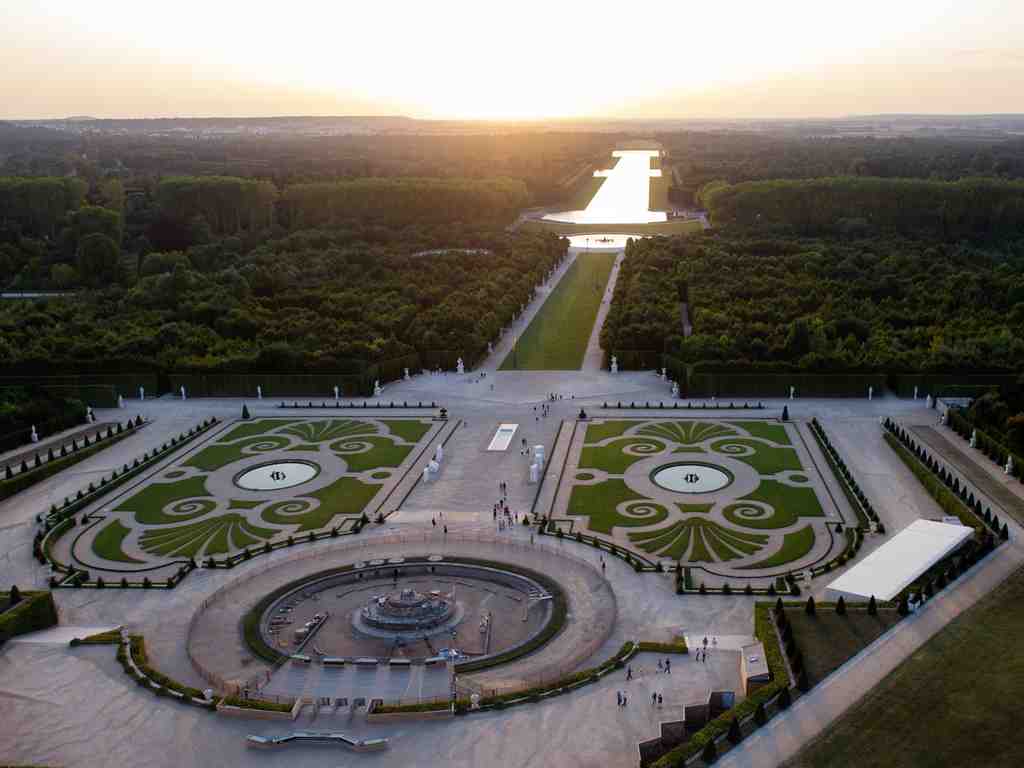
    Directly in front of you is a grand oval basin surrounded by swirling green patterns in the grass, pathways that swoop out in spirals, and a cascade of terraces topped by a majestic sculpted group-this is the Latona Parterre, centered in the vast perspective of Versailles with the fountain and statue easily visible straight down the main avenue. Welcome to the Latona Parterre! Now, take a look at that grand, multi-tiered fountain rising at the heart of this swirling green carpet, and picture this scene almost 400 years ago when Versailles was the playground for French royalty and their most creative artists. Designed by André Le Nôtre back in 1666, and later dramatically reworked by Jules Hardouin-Mansart, this parterre has always been a stage for theater, rivalry, and divine punishment-oh, and for frogs! Here’s where myth meets marvel. High atop the fountain stands the marble goddess Latona with her two famous children, Apollo and Diana. But don’t be fooled: their serene faces have witnessed some seriously wild drama. According to the Roman poet Ovid, Latona-having caught the attention of Jupiter and the eternal jealousy of his wife Juno-was banished from every land. Pregnant and exhausted, she roamed the countryside, finally giving birth on the tiny island of Delos, only to find herself once again wandering through Lycia, desperate for water for her thirsty babies. When the local peasants, following Juno’s orders, cruelly forbade Latona and her children from drinking, the goddess had the last word: she transformed those unfriendly folks into frogs. Imagine the surprise on their faces-one second telling off a goddess, the next, croaking by the pond! In the beginning, the fountain looked a bit different: animals and then humans surrounded the center, all poised in mid-metamorphosis. Imagine a circle of six unlucky peasants, their limbs shrinking, their mouths broadening, their eyes bulging-poor things!-and another ring of twenty-four croaking companions, forever frozen in frog form. Later, Hardouin-Mansart lifted Latona and her children up, placing them like royalty atop a dramatic cone of terraces, while peasants in mid-transformation populate the third terrace and alligator-turtles scuttle along the bottom, ensuring no one mistakes these gardens for just any old patch of green. But wait, there’s more! Surrounding the water and the lush grass are grand statues of mythological heroes, philosophers, and legendary beauties-all sculpted by the finest French artists. If you see someone looking thoughtful, it might just be Diogenes or Plato, pondering the meaning of all these frogs. Along the ramps are elegant marble copies of antique statues, including gods, fauns, and heroes, each one echoing ancient glories. The parterre isn’t all marble and myth, though-in 1671 these statues were actually gilded, shining like sunbeams during the lavish festivities of Louis XIV! And speaking of parties, the Latona Parterre once stole the show during royal celebrations: the fountains erupted with spray, the edges flickered with a thousand lights, and the garden seemed to shimmer under fireworks and the reflection of water-a show truly fit for the Sun King himself. For Louis XIV, this wasn’t just a tale of cranky countryfolk and magical revenge. It was a message: defy the king and, well, you might just find yourself hopping around the lily pads. The imagery here quietly echoes the real-life drama of the Fronde, when rebellious nobles threatened young Louis, and reminds everyone-friends or frogs-who’s really in charge. Centuries later, the Latona Parterre inspired gardens far beyond France, including the famous Buckingham Fountain in Chicago. After all, if frogs and gods can endure this long, why not a little slice of Versailles across the ocean? So as you stand here, see Latona guarding her children, listen for a phantom frog or two, and imagine golden statues dazzling under royal fireworks-proof that even the greatest gardens can be filled with mischief, beauty, and just a little bit of royal warning. Yearning to grasp further insights on the iconography, location and composition or the a manifesto of royal power? Dive into the chat section below and ask away.

    Apri pagina dedicata →
  10. Ah, welcome to one of the most enchanting corners of Versailles: the Grove of Rockeries, also known as the Ballroom Grove! Now, don’t reach for your dancing shoes just yet, but if…Leggi di piùMostra meno

    Ah, welcome to one of the most enchanting corners of Versailles: the Grove of Rockeries, also known as the Ballroom Grove! Now, don’t reach for your dancing shoes just yet, but if you suddenly feel a mysterious urge to waltz, you’re standing in the right place. This isn’t just another leafy patch in the garden; it’s where music, dance, and Baroque excess all come together in spectacular style. Let me transport you back in time, to when this was newly built in the 1680s by the master garden designer André Le Nôtre, for the entertainment of Louis XIV-the Sun King himself. Close your eyes for a moment and imagine it’s 1685. The Grove is bustling with guests dressed in silk and powdered wigs, the scent of orange blossoms drifting from the nearby Orangery, and suddenly you step into this magical clearing. The Ballroom is shaped like an Italian theater, with a vast, open ellipse at its center, surrounded by wild greenery, artfully clipped box hedges, and towering trees. But here’s the real showstopper: on one side, a grand cascading fountain flows over terraces built from local stones, flint, fantastic “gogottes” from Fontainebleau, and, believe it or not, real shells from Madagascar. Peer closely and you might even spot a glint of lapis-lazuli, sparkling blue under the sun. Across from the water, the banks are lined with grassy steps-these are the “buxus” benches, perfect for an 18th-century nobleman to perch upon and watch the festivities below. Originally, the very center was an artificial island, circled by two charming canals, with four ornate vases bristling with musical instruments, as if they were daring guests to start a dance themselves! Sadly, those vases left the party in 1706 and moved out to Marly. Apparently, they didn’t handle a waltz very well and disappeared entirely by the time of the French Revolution! But the magic didn’t end there. Walk around and you’ll see eight tall torchères-now there’s a fancy name for giant candleholders. Four, by Pierre Legros and Benoît Massou, stand on cheerful cow’s feet, while the other four stride on the paws of proud lions, designed by Noël Jouvenet and Pierre Mazeline. These torchères tell the story of both day and night, symbolizing this grove’s dual life: elegant by daylight, dazzling by torchlight at night, when a soft glow would bounce off the marble and the gentle river of water. Can you picture the sculptures and vases that once adorned this space? To the east, four grand vases by Louis Le Conte, two crowned with dolphins, two with lions-evoking the grandeur of the Medici. Along the stairs, other vases seem to parade around, their sculpted reliefs showing dancing children, sea gods, and musical revelers, celebrating the playfulness and abundance of Versailles. High up, where musicians used to play, the marble statues changed over the centuries, each trying to outshine the last. There was La Paix des Grecs with its heroic mother and son-transferred to the Tuileries in Paris during turbulent times-replaced by depictions of love, myth, and music. It’s almost like the grove had a revolving door for artistic celebrities! Perhaps the greatest thrill was in the approach. You didn’t simply stumble upon the Ballroom Grove; you would wind through grand, shady avenues, turn a corner, and suddenly-BAM!-the grove opened in a burst of water, art, and surprise. Le Nôtre believed nature should throw you a plot twist or two, and here’s where he excelled. The parties haven’t completely stopped either. In 1980, baroque dancers twirled here again, reviving the music and choreography of old. It’s even appeared in a film, “A Little Chaos,” celebrating its birth and beauty. And in 2024, the Olympic flame itself made a dramatic entrance during the Paris Games! So, standing here, you’re not just visiting a grove. You’re standing where centuries of music, laughter, intrigue, and celebration have filled the Stage… and perhaps, if you listen closely, you might hear a faint echo of violins and laughter, inviting you to take a few steps and let your imagination dance.

    Apri pagina dedicata →
  11. Imagine the chilly winter outside, while behind those enormous arched windows, over 1,500 potted trees-mainly orange trees, but also myrtles, laurels, and pomegranates-are basking…Leggi di piùMostra meno

    Imagine the chilly winter outside, while behind those enormous arched windows, over 1,500 potted trees-mainly orange trees, but also myrtles, laurels, and pomegranates-are basking in the warmth like VIP guests at an exclusive spa. The walls here are more than five meters thick, so thick that frost has never dared to creep in. Back in the old days, gardeners would sneak in through clever cat-sized doors in the middle of the night rather than open the massive windows. The doors were stuffed tight with straw to keep out any wintery drafts. I bet those gardeners were hoping for a little orange juice as a reward. Now, let’s rewind to when citrus was the greatest status symbol you could show off. The orange first arrived in Europe in the 15th and 16th centuries-think of it as the iPhone of the Renaissance: rare, exotic, and everyone wanted one. The bitter orange came first, followed by the sweet variety after Vasco da Gama’s ocean adventures. An enthusiasm for these juicy novelties swept France. Ornamental orangeries became all the rage with kings and queens-Charles VIII built the first at Amboise to show off his new artichokes and bitter oranges, and Henri IV followed suit with one at the Louvre. By summertime, from June to October, Versailles flexed its botanical muscles. Nearly 900 orange trees would be rolled out into the lower parterre for everyone to admire in neat military precision. Their blossoms inspired everything from tapestries to wedding bouquets; orange blossom is still considered a wedding favorite today. All this glory, and yet, in 1871, the Orangery briefly became something rather unexpected: a prison for the Communards after the Paris Commune. From pampered citrus to convicts-history works in mysterious ways. If you’re wondering about the sculptural drama in the center, that’s “The Abduction of Proserpine by Pluto” by François Girardon-a bit of mythological chaos among all this botanical order. So whether you came for the history, the horticulture, or the mischievous oranges, this Orangery has many a layered tale up its leafy sleeves.

    Apri pagina dedicata →
  12. Right in front of you stands a marble spectacle with as much drama as a palace soap opera-the Equestrian statue of Louis XIV, reimagined as the Roman hero Marcus Curtius. Imagine…Leggi di piùMostra meno

    Right in front of you stands a marble spectacle with as much drama as a palace soap opera-the Equestrian statue of Louis XIV, reimagined as the Roman hero Marcus Curtius. Imagine the scene: the late 17th century, Versailles a flurry of masons, carpenters, gardeners, and the King himself, the proud Louis XIV, always eager for a good dose of glory and a little bit of mythology sprinkled on top. Now, for a king who liked making an entrance (he even called himself the Sun King, after all), an ordinary statue wouldn’t do. Enter Gian Lorenzo Bernini, the Italian master of Baroque who could make marble look soft as velvet. In 1665, after wowing everyone with a bust of Louis XIV, Bernini suggested a monument that would rock the realm-a grand, heroic statue, rivaling the famous one of Emperor Constantine in the Vatican. It was to sit right between the Louvre and the Tuileries, a stage fit for a deity. And to make things even more epic, this wasn’t just going to be any old king on a horse. No, this would be Louis as a dazzling new Hercules, clambering up the mythical “mountain of Virtue,” a gentle nudge reminding everyone of his (supposed) links to Hercules himself. Bernini and his team of French Academy prodigies in Rome set to work. Imagine the marble flying, chisels ringing, artists arguing over just how big a king’s wig needs to be. The statue took years-marble was carved from 1671 to 1673, and it was finally completed in 1677. Next challenge: how do you move a giant hunk of royal marble across half of Europe? The answer: very, very carefully. After all, you don’t want the king’s nose chipped before anybody’s seen it! Embarking on a journey worthy of its own opera, the statue braved choppy seas from Rome to France. At one point, an engineer considered wrecking the ship just to get the statue off at Le Havre! That’s devotion-or maybe just desperation. Eventually, the monument traveled upriver to Paris and, in August 1685, took its place inside Versailles’ famed orangery. Picture the anticipation: the king returning from Fontainebleau, courtiers ready to fan themselves dramatically at the sight, all waiting for his verdict. But, here’s the twist: Louis took one look and wasn’t a fan. Maybe he thought his horse looked too wild, or his own head not quite kingly enough. (He did have a reputation to uphold!) Minister Louvois covertly wrote to the sculptor François Girardon-official fixer of royal statues-urging a makeover. Girardon worked his magic, transforming the statue from kingly to classical Roman hero, complete with a new helmet and an identity shift from monarch to Marcus Curtius, the legendary Roman soldier who leaped into a fiery chasm to save Rome. Talk about a dramatic plot twist! The horse’s wild eyes and flaring nostrils stayed, but now it reared heroically over flames rather than enemy flags. The whole experience is like a centuries-old reality show about artistic ambition, royal egos, and the ever-important question: can you ever please your boss? Bernini’s daring drapery is still there, swirling majestically, the king’s wig almost flowing in the breeze. The proportions are, let’s say, optimistic-Louis is a little larger than life, literally. There’s no saddle, no stirrups; the king is riding bareback because, hey, who needs equestrian equipment when you’ve got style? After a whirlwind tour of various parts of the palace, and an unexpected stay at the Neptune Fountain, the statue survived revolution, weather, and even a vandal attack in the 1980s. It was painstakingly restored over six years and placed safely in the orangery-Versailles’ own statue sanctuary. Today, the original sits in the orangery, while two copies live on outside-the Louvre’s Napoleonic Court and the southern edge of the pièce d’eau des Suisses. The legacy of Bernini, Girardon, and a king with high standards lives on, carved in marble and crowned in legend. Now, as you stare up at this marvel, picture those centuries of ambition, rivalry, and marble dust-a grand finale to our journey through Versailles’ artistry and intrigue. And if you’re ever feeling dramatic, just remember: nobody has ever had a bad hair day quite as gloriously as Louis XIV in marble.

    Apri pagina dedicata →

Domande frequenti

Come inizio il tour?

Dopo l'acquisto, scarica l'app AudaTours e inserisci il tuo codice di riscatto. Il tour sarà pronto per partire immediatamente – tocca play e segui il percorso guidato dal GPS.

Ho bisogno di internet durante il tour?

No! Scarica il tour prima di iniziare e goditelo completamente offline. Solo la funzione chat richiede internet. Ti consigliamo di scaricare tramite WiFi per risparmiare dati mobili.

È un tour guidato di gruppo?

No – è un tour audio autoguidato. Esplori in autonomia al tuo ritmo, con la narrazione audio riprodotta dal tuo telefono. Nessuna guida, nessun gruppo, nessun orario.

Quanto dura il tour?

La maggior parte dei tour richiede 60–90 minuti, ma sei tu a controllare il ritmo. Metti in pausa, salta le tappe o fai pause quando vuoi.

E se non riesco a finire il tour oggi?

Nessun problema! I tour hanno accesso a vita. Metti in pausa e riprendi quando vuoi – domani, la prossima settimana o il prossimo anno. I tuoi progressi vengono salvati.

Quali lingue sono disponibili?

Tutti i tour sono disponibili in oltre 50 lingue. Seleziona la lingua preferita quando riscatti il codice. Nota: la lingua non può essere cambiata dopo la generazione del tour.

Dove accedo al tour dopo l'acquisto?

Scarica l'app gratuita AudaTours dall'App Store o Google Play. Inserisci il codice di riscatto (inviato via email) e il tour apparirà nella tua libreria, pronto per essere scaricato e avviato.

verified_user
Soddisfazione garantita

Se il tour non ti piace, ti rimborseremo l'acquisto. Contattaci a [email protected]

Pagamento sicuro con

Apple PayGoogle PayVisaMastercardPayPal

AudaTours: Tour Audio

Tour a piedi autoguidati, coinvolgenti e convenienti

Prova l'app arrow_forward

Amato dai viaggiatori di tutto il mondo

format_quote Questo tour è stato un ottimo modo per vedere la città. Le storie erano interessanti senza sembrare troppo scriptate, e mi è piaciuto poter esplorare al mio ritmo.
Jess
Jess
starstarstarstarstar
Tour Tbilisi arrow_forward
format_quote Un ottimo modo per conoscere Brighton senza sentirsi un turista. La narrazione aveva profondità e contesto, senza esagerare.
Christoph
Christoph
starstarstarstarstar
Tour Brighton arrow_forward
format_quote Ho iniziato questo tour con un cornetto in mano e zero aspettative. L'app ti accompagna tranquillamente, niente pressione, solo tu, le tue cuffie e delle storie interessanti.
John
John
starstarstarstarstar
Tour Marseille arrow_forward

Tour Audio Illimitati

Sblocca l'accesso a OGNI tour nel mondo

0 tour·0 città·0 paesi
all_inclusive Esplora Illimitato

