मर्सिया ऑडियो टूर: कैथेड्रल जिले के अजूबे
आधी रात की सड़कों से गुज़रता एक कार्निवल ताबूत। गॉथिक रहस्यों से सजे ऊँचे शिखर। मर्सिया में, हर पवित्र चीज़ की एक छाया होती है और हर उत्सव एक कहानी छिपाता है। खोजकर्ताओं के लिए बनाए गए इस स्व-निर्देशित ऑडियो टूर पर इन विरोधाभासों का पता लगाएँ। पोस्टकार्ड दृश्यों से आगे बढ़ें क्योंकि आप उन कहानियों को उजागर करते हैं जिनके बारे में स्थानीय लोग भी फुसफुसाते हैं—कहानियाँ जो अलंकृत पत्थरों में उलझी हुई हैं, कैसीनो के दरवाजों के पीछे झिलमिला रही हैं और उन जंगली उत्सवों में फूट रही हैं जिनकी आपने कभी कल्पना भी नहीं की थी। किस सदियों पुराने झगड़े ने कभी कैथेड्रल के रखवालों को विभाजित किया था? हर वसंत में हज़ारों लोगों के जयकार करने के दौरान आग एक कागज़ की सार्डिन को क्यों खा जाती है? मर्सिया के कैसीनो के मखमली गलियारों में कौन सा छिपा हुआ घोटाला छिपा है? हर कदम पर श्रद्धा और उल्लास के बीच यात्रा करें। उन गलियों में उतरें जहाँ एक पल में सत्ता हथिया ली गई या खो गई। मर्सिया धीरे-धीरे खुद को प्रकट करता है, उन लोगों को अपनी पहेलियाँ पेश करता है जो उनका पीछा करने को तैयार हैं। शहर के सबसे जंगली रहस्य आपकी पहुँच में हैं। प्ले दबाएँ और उन सभी को अनलॉक करें।
टूर पूर्वावलोकन
इस टूर के बारे में
- scheduleअवधि 40–60 minsअपनी गति से चलें
- straighten2.4 किमी पैदल मार्गगाइडेड पथ का पालन करें
- location_on
- wifi_offऑफ़लाइन काम करता हैएक बार डाउनलोड करें, कहीं भी उपयोग करें
- all_inclusiveलाइफ़टाइम एक्सेसकभी भी, हमेशा के लिए फिर सुनें
- location_onPaseo del Malecón से शुरू होता है
इस टूर के स्टॉप
You are looking for a wide, elevated paved walkway bordered by vintage style black metal street lamps and a sturdy metal railing on one side, flanked by a dense line of tall trees…और पढ़ेंकम दिखाएँ
समर्पित पेज खोलें →
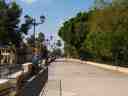
Paseo del MalecónPhoto: Morini33, Wikimedia Commons, CC BY-SA 3.0 ES. Cropped & resized. You are looking for a wide, elevated paved walkway bordered by vintage style black metal street lamps and a sturdy metal railing on one side, flanked by a dense line of tall trees on the other. What looks like a casual pedestrian boulevard is actually a massive piece of defensive engineering.
This is the Paseo del Malecón, an earth and stone barricade built three meters above the ground, stretching out for over one point five kilometers. Its original job was to stop the winding Segura River from completely drowning the west side of the city. It turns out, when you build a giant, flat wall with a great view to hold back water, people will inevitably decide it makes a fantastic place for a stroll. In fact, by the year seventeen thirty-six, the wall was so heavily damaged by rain and horse carriage traffic that an architect had to rebuild it entirely.
It was a solid investment. During the infamous Santa Teresa flood of eighteen seventy-nine, the river absolutely raged, but this retaining wall held firm. Unfortunately, the water simply bypassed it and flooded the city center from an entirely different direction, which is a classic engineering technicality. Today, this Bien de Interés Cultural, or Cultural Interest Asset in Spanish law, acts as a protected historical bridge between the urban grid and the old agricultural orchards. For your convenience, the walkway is open twenty-four hours a day, Monday through Sunday.
It stands as a charming reminder that sometimes the best civic defense doubles as a pretty nice place for a walk. Take a moment to soak this in, and when you are ready, we can head to the Almudí Palace.
On your left, you will spot the Almudí Palace, a sturdy pale stone building defined by a massive arched wooden doorway beneath elaborately carved coats of arms. Today it is a…और पढ़ेंकम दिखाएँ
समर्पित पेज खोलें →
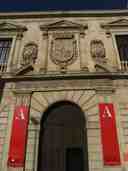
Almudí PalacePhoto: Gregorico, Wikimedia Commons, CC BY-SA 3.0. Cropped & resized. On your left, you will spot the Almudí Palace, a sturdy pale stone building defined by a massive arched wooden doorway beneath elaborately carved coats of arms. Today it is a peaceful archive and art gallery, but its history is remarkably volatile.
Back in fifteen fifty-four, the city council decided to build a municipal wheat granary here. They chose a very interesting spot... right next to the city's gunpowder store. Naturally, one night in sixteen twelve, lightning struck the gunpowder. The resulting explosion was spectacular, and the granary burned completely to the ground. They rebuilt it bigger and better by sixteen twenty-eight, funding the impressive stonework you see now with money from Murcia's booming silk trade.
If you glance at your screen, you can see a close up of the entrance. That massive carving in the center is the royal crest of the Habsburg dynasty, the family ruling Spain at the time. It is flanked by two smaller shields of Murcia, sporting just six crowns, which tells us this was carved before King Philip the Fifth added a seventh crown later on.

The main entrance features a semicircular arch and a broken pediment displaying the royal Habsburg shield, flanked by two Murcia shields with 6 crowns, predating the reign of Philip V.Photo: Gregorico, Wikimedia Commons, CC BY-SA 3.0. Cropped & resized. Now, look at your app one more time to see a fascinating survivor from the original building. This is the Matron of Murcia, a stone relief carved in fifteen seventy-five. She is depicted breastfeeding a stranger's child... a symbol of the city's legendary hospitality. And above her sits a pelican, which in classical art represents abundance and self-sacrifice.

This relief of the Matron of Murcia, dating from 1575 and sculpted by Hernando de Torquemada, symbolizes the city's hospitality with the matron breastfeeding a child, topped by a pelican for abundance.Photo: Gregorico, Wikimedia Commons, CC BY-SA 3.0. Cropped & resized. As an engineering nerd, my favorite detail is actually inside. The architects needed to support the massive weight of all that stored grain, so they filled the interior with towering Tuscan columns... thick, unornamented pillars built for pure strength. Even better, they used a surviving stretch of the city's ancient Arab defensive wall as a load-bearing foundation. That is what I call practical recycling.
If you want to see those columns, the building is open Tuesday through Saturday from ten A-M to two P-M, and again from five to eight P-M.
It is a beautiful piece of civic architecture with a truly explosive past. Enjoy the details, and when you are ready, let us press on.

The Almudí Palace, originally a municipal wheat granary built in 1554, has served various purposes including a cavalry barracks and a Palace of Justice before becoming an exhibition hall and archive in 1985.Photo: chisloup, Wikimedia Commons, CC BY 3.0. Cropped & resized. You should see the bright red fabric of the city flag proudly displayed here, featuring a rectangular shape centered with an intricate crest of tiny castles and golden crowns.…और पढ़ेंकम दिखाएँ
समर्पित पेज खोलें →
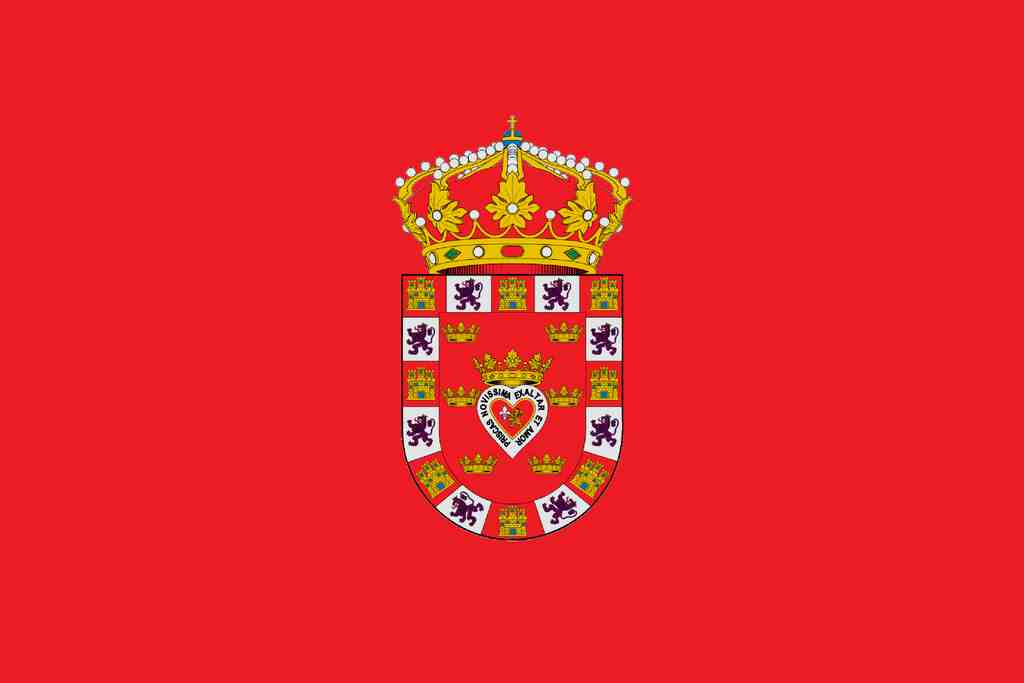
MurciaPhoto: Bertobarc90, Wikimedia Commons, CC BY-SA 4.0. Cropped & resized. You should see the bright red fabric of the city flag proudly displayed here, featuring a rectangular shape centered with an intricate crest of tiny castles and golden crowns.
Welcome to the heart of Murcia, the seventh most populated municipality in Spain, and a place built entirely on water, war, and some surprisingly literal heartache.
The name Murcia itself was historically a nightmare for linguists. They eventually figured out it comes from the Latin word Myrtea, meaning a place where myrtle shrubs grow. When the Moors arrived, they adapted it to Mursiya. In the year eight hundred twenty-five, the Emir of Al-Andalus, Abderramán the Second, officially founded the city to crush local tribal rebellions. Take a look at your screen to see a monument dedicated to him.
Let us look closer at that flag. The crest tells you exactly how much the Spanish monarchy relied on this city. It features seven crowns. King Alfonso the Tenth originally granted a seal with five crowns. In thirteen sixty-one, King Pedro the First tossed in a sixth crown to thank the city for its military support. Then, in seventeen zero nine, King Philip the Fifth added the seventh crown to reward their loyalty during the War of Succession. They collected crowns like loyalty stamps. But the most interesting detail is right in the middle. Below the central crown, there is a heart. That is not metaphorical. It commemorates the literal, physical heart of King Alfonso the Tenth, which he ordered to be buried right here in the city, and which still rests in the nearby cathedral.
Step back over a century to see how the majestic Iglesia de San Esteban has beautifully withstood the test of time since this late nineteenth-century view was published.
Now, the real reason this city thrived was not just royal favor. It was brilliant hydraulic engineering. Murcia sits in a valley along the Segura River, which is notorious for extreme droughts followed by violent, catastrophic floods. The river was both a blessing and a menace. As we learned at the Malecón, the catastrophic eighteen seventy-nine flood sent a massive surge of water through the city, claiming over a thousand lives. The city had to continuously evolve its flood defenses, eventually building massive stone channels in the mid-twentieth century to finally tame the river.
The Muslim founders originally transformed the ancient Roman agricultural zones by engineering a massive irrigation network. They built a diversion dam, channeling the unpredictable river into a complex system of canals and ditches. This created the Huerta of Murcia, an incredibly fertile orchard region that eventually became known as the Orchard of Europe. To manage all that water, they needed strict rules. So, they established the Council of Good Men, an ancient customary court. If two farmers had a dispute over irrigation rights, this council would hold a swift, verbal trial to settle it. It is such an effective and historic legal system that UNESCO, the United Nations Educational, Scientific and Cultural Organization, declared it an Intangible Cultural Heritage of Humanity.
A city built on myrtle bushes, royal hearts, and brilliantly managed mud. Enjoy the lively square before continuing to our next destination.

The Baroque facade of Murcia Cathedral, a celebrated landmark with a mainly Gothic interior.Photo: Claudia H, Wikimedia Commons, CC BY-SA 3.0. Cropped & resized. 
The primarily Gothic interior of Murcia Cathedral, a central element of the city's historical-artistic heritage.Photo: Millars, Wikimedia Commons, CC BY-SA 4.0. Cropped & resized. 
A 19th-century image of the Junterones Chapel within Murcia Cathedral, part of the city's rich historical-artistic patrimony.Photo: British Library, Wikimedia Commons, No restrictions. Cropped & resized. 
An intricate Arabic archway within Murcia's famed Casino, renowned for its sumptuous interiors and diverse architectural styles.Photo: Jorge Saturno, Wikimedia Commons, CC BY-SA 4.0. Cropped & resized. 
The Convalecencia building, part of the University of Murcia, highlighting the city's long-standing academic tradition since 1272.Photo: B.N.Sanchez., Wikimedia Commons, CC BY-SA 4.0. Cropped & resized. 
This map illustrates the Taifa Emirate of Murcia around 1160, when the city was the capital of various important Taifa kingdoms during the Middle Ages.Photo: Wario2, Wikimedia Commons, CC0. Cropped & resized.
11 और स्टॉप दिखाएँकम स्टॉप दिखाएँexpand_moreexpand_less
You will recognize the building by its twin square towers flanking a pale stucco and exposed brick facade, featuring a prominent oval medallion set right above the main wooden…और पढ़ेंकम दिखाएँ
समर्पित पेज खोलें →
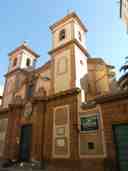
Museum of the Church of San Juan de DiosPhoto: Gregorico, Wikimedia Commons, CC BY-SA 3.0. Cropped & resized. You will recognize the building by its twin square towers flanking a pale stucco and exposed brick facade, featuring a prominent oval medallion set right above the main wooden doors.
Welcome to the Museum of the Church of San Juan de Dios. If you are looking for a building with an identity crisis, you have found it. This site has been a royal Islamic palace, a Templar hospital, a church, and now, a museum.
Let us start from the bottom up, because the basement here is hiding a massive secret. Beneath your feet lie the archaeological remains of the Alcázar Mayor, the grand Islamic fortress that once dominated the city. Down there, archaeologists uncovered a beautifully painted twelfth-century prayer niche, known as a mihrab, along with a royal pantheon. They found nine tombs intact within the royal cemetery, including adults, young children, and two newborns, likely belonging to a high-ranking family of the Muslim court.
When the Christians took control of Murcia in twelve forty-three, the future King Alfonso the Tenth claimed this fortress. Alfonso, known as Alfonso the Wise, became incredibly attached to this specific location. He built the first Christian church in Murcia right over the Muslim oratory. In his will of twelve eighty-four, he demanded to be buried here. But, being a pragmatic man, he added a backup clause. If his body could not make it to Murcia, he requested that his entrails be removed and sent here instead.
Things did not go exactly as planned. His heart was originally supposed to go to the Holy Land, but the logistics failed. So, for two hundred and forty-one years, the king's heart and entrails rested in this very spot, before Emperor Charles the Fifth ordered them moved to a nearby cathedral in fifteen twenty-five.
After Alfonso, the Knights Templar set up shop, transforming the complex into a hospital. For centuries, this site was the most important medical facility in the city. Eventually, the Brothers of the Order of San Juan de Dios took over administration in sixteen seventeen, giving the church the name it holds today.
The structure you are looking at now replaced the original in seventeen eighty-one, designed by architect Martín Solera. And from an engineering perspective, it is brilliant. Solera abandoned the standard cross-shaped layout. Instead, he gave the church a highly unusual elliptical floor plan. The door is on one long side of the oval, and the altar sits directly opposite. This clever geometry turns the entire church into a theatrical stage, drawing every eye directly to the center where they kept the Eucharist, the ceremonial bread of the Christian faith, in a jewel-encrusted display. It is a masterpiece of Rococo design, utilizing curved walls and eight massive pillars to create a sweeping sense of motion.
If you want to see the Islamic ruins, the elliptical nave, or the impressive religious sculptures inside, the museum is open from ten A-M to one thirty P-M Tuesday through Sunday, with evening hours most days, though it is completely closed on Mondays.
Take a moment to soak in the layered architecture of this remarkable building. When you are ready, we can head to the next stop.
On your left is the Episcopal Palace, a massive rectangular building instantly recognizable by its striking red facade covered in white painted medallions, centered around a grand…और पढ़ेंकम दिखाएँ
समर्पित पेज खोलें →
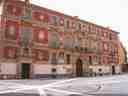
Episcopal Palace of MurciaPhoto: Katsumaru, Wikimedia Commons, CC0. Cropped & resized. On your left is the Episcopal Palace, a massive rectangular building instantly recognizable by its striking red facade covered in white painted medallions, centered around a grand arched wooden door and an ornate stone balcony.
Now, the story of how this eighteenth-century Rococo masterpiece, an architectural style famous for its highly ornate and theatrical designs, came to be is a perfect example of extreme urban planning. You see, the original bishop's palace used to sit directly opposite us, essentially exactly where this grand open plaza is today. But in the mid-eighteenth century, the city built a spectacular new facade for the Cathedral, which is right next door. The problem? The old palace completely blocked the view of the new cathedral. The solution? They simply demolished the bishop's palace. Creating this wide open space was entirely about giving the cathedral room to breathe and, frankly, show off.
So, they had to build a new palace right here. Construction kicked off in seventeen forty-eight, but they started with a section overlooking the river known as the hammer. They built the viewing deck first so the bishop could enjoy the gardens while the rest of his house was being slowly assembled. I respect those priorities.
Look closely at the exterior. Unlike most Spanish Baroque buildings that relied on carved stone, this facade features elaborate frescoes by Genoese masters. They used trompe l'oeil, a painting technique that creates an optical illusion of three-dimensional space, to add fake architectural details. And if you direct your attention to the large stone coat of arms directly above the main balcony, you will spot a delightfully dry structural joke. The shield belongs to Bishop Rojas y Contreras. Notice the castle carved into it? It is upside down. This was not a mistake by a tired stonemason. It is a visual pun on his surname, Contreras, which translates to the opposite or the reverse.
This building has seen an absurd amount of drama. During the Peninsular War, French troops used it as their headquarters. In eighteen sixty-two, Queen Isabel the Second stayed here. To impress her, local officials threw a wildly lavish, out-of-season version of their famous Burial of the Sardine parade. It is exactly what it sounds like, a massive mock-funeral procession for a giant fish figure. The event was so expensive it completely bankrupted the city, and they could not afford to hold the festival for the next two years.
Later, during the Spanish Civil War in the nineteen thirties, the building was seized and turned into the Communist Party headquarters, earning the nickname the Red Palace. In the chaotic final days of the war in March nineteen thirty-nine, rival republican factions actually fought each other right here. Machine guns were mounted on the cathedral tower, firing down on this very building. If you inspect the iron grilles on the facade, you can still find the bullet holes.
The palace is open Monday through Friday from nine AM to two PM, and again from five to eight PM, but remains closed on weekends. Appreciate the bold frescoes here, and we can proceed when you are ready.
You will know you are in the right place when you spot the towering, square stone pillar rising from a stepped base, crowned by a pale statue of a figure with a halo of stars.…और पढ़ेंकम दिखाएँ
समर्पित पेज खोलें →
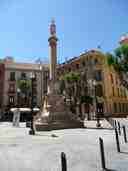
Plaza de Santa CatalinaPhoto: chisloup, Wikimedia Commons, CC BY 3.0. Cropped & resized. You will know you are in the right place when you spot the towering, square stone pillar rising from a stepped base, crowned by a pale statue of a figure with a halo of stars. This is Plaza de Santa Catalina. Today, it is a unified pedestrian zone packed with tapas venues, but do not let the relaxed atmosphere fool you. For centuries, this was the absolute political epicenter of Murcia.
During the Islamic period, this area was the highly active neighborhood of Zabazala, an Arabic term meaning head of prayer, anchored by a major mosque. When the Christian conquest swept through, the new rulers implemented their standard urban renewal strategy. They knocked down the mosque, built the Church of Santa Catalina right over the foundations, and engineered the surrounding space into the city's main square.
By the fifteen hundreds, this plaza was the undeniable center of civic life. Proclamations were read, local politicians argued, and public hangings were executed right outside the church doors. It was civic engagement, medieval style. The church itself featured a soaring late Gothic tower, which for a long time was the absolute tallest structure in Murcia. This height was extremely practical. It served as an early-warning watchtower to spot incoming Berber pirates sailing from the North African coast, giving locals just enough time to secure their valuables.
If you look around, you will see a fascinating mix of brickwork and nineteenth-century architectural problem solving. Over at the bright yellow eighteen sixty mansion known as Casa Palarea, you can spot classic curved iron window grilles, a design allowing residents to look down the street while remaining protected. That building now houses the museum of the renowned Murcian painter Ramón Gaya.
But there is a major phantom building here, too. In sixteen oh one, the city constructed a massive institution called the Contraste de la Seda. Silk was serious business in Murcia, and this building was the regulatory headquarters. Officials systematically inspected the silk and rigorously weighed gold and silver coins to prevent counterfeit currency from crashing the local economy. It was an absolute economic fortress. Naturally, the city tore it down in nineteen thirty-two. Now, the towering nineteen forties La Unión y el Fénix building stands exactly in its footprint.
As the city expanded into the eighteenth century, political power shifted toward the Cathedral area, and Santa Catalina became a little quieter. The central stone monument you saw when you arrived was designed by the architect Carbonell and added in nineteen fifty-four, honoring the Immaculate Conception.
It is quite the layered structural history for a spot where you can now just sit and order a plate of cured meats. Whenever you are ready to keep exploring, we can easily make our way to the next stop.
You have arrived at the Gran Vía Escultor Francisco Salzillo, a broad asphalt avenue defined on your right by the sharp architectural contrast between a classical sandstone…और पढ़ेंकम दिखाएँ
समर्पित पेज खोलें →
Gran Vía Sculptor Francisco SalzilloPhoto: Bertobarc90, Wikimedia Commons, CC BY-SA 4.0. Cropped & resized. You have arrived at the Gran Vía Escultor Francisco Salzillo, a broad asphalt avenue defined on your right by the sharp architectural contrast between a classical sandstone building with heavy pillars and a sleek, geometric tower paneled in reflective blue glass.
Now, look straight down this wide boulevard. It is hard to imagine, but to build the very street you are looking at, the city had to bulldoze its own history. Until the mid nineteen fifties, this area was a dense, medieval labyrinth of narrow, winding alleys. As motor vehicles arrived in the early twentieth century, the city realized that cars and medieval street grids are natural enemies. They needed a massive central artery to connect the north and south train stations, and they wanted to shake off their provincial image to become a modern, influential metropolis.
Of course a little real estate speculation never hurts, either.
To carve out this grand avenue, hundreds of old buildings were demolished starting in the late nineteen thirties, including a renaissance mansion and two full convents. But by nineteen fifty, the grand project hit a massive historical speed bump. Right in the planned path sat the Madre de Dios Arab Baths. They were legally protected, having been declared a National Monument in nineteen thirty-one.
So, how do you pave over a protected medieval treasure? You wait. The city let the ancient baths severely deteriorate. Then, after a partial roof collapse, the mayor at the time, Domingo de la Villa, simply blamed the damage on heavy rain and ordered the whole thing torn down in February nineteen fifty-three. The demolition sparked a massive public outcry, which is quite an achievement considering Spain was under a dictatorship with strict media censorship at the time.
With the pesky monument out of the way, the street was fully cleared and paved by nineteen fifty-six. Originally named after a political figure of the regime, it was wisely renamed after the beloved local sculptor Francisco Salzillo once democracy returned.
As you look down the street, you can see a timeline of architectural fads. That heavy, classical stone building on the right is the Bank of Spain, designed in a historicist style, a type of architecture that deliberately mimics grand, ancient temples to project wealth and stability. It was actually built before the street was even opened. Then came the modernists in the nineteen sixties and seventies, dropping in towering structures of concrete, metal, and glass, like the seventeen story Hispania building, completely abandoning the classical look.
The result is exactly what you see today, a thoroughly modern avenue built quite literally on the rubble of the past. Feel free to linger a bit, and we will continue our walk shortly.
Look for the light grey facade defined by its three arched doorways, a prominent circular rose window above a row of slender columns, and an asymmetrical single bell tower rising…और पढ़ेंकम दिखाएँ
समर्पित पेज खोलें →
Church of San BartoloméPhoto: Morini33, Wikimedia Commons, CC BY-SA 3.0 ES. Cropped & resized. Look for the light grey facade defined by its three arched doorways, a prominent circular rose window above a row of slender columns, and an asymmetrical single bell tower rising only on the left side. Welcome to the Church of San Bartolomé.
This spot has been sacred ground for a very long time. When Christian forces conquered the city in February twelve sixty-six, they took over the existing Muslim mosque right here in the center of the medieval medina and transformed it into a parish.
But the building you are looking at now took an almost comical amount of time to actually get built. In the eighteenth century, the city decided to demolish the old medieval structure and start fresh. They broke ground on this current iteration in August seventeen sixty-seven. And then... the motivation, or perhaps the funding, simply ran out. Construction completely stopped.
By the year eighteen twenty-one, over fifty years later, all they had finished was the apse, the semicircular dome at the back of the altar, and part of the transept, which is the crossing arm that gives the church its Latin cross shape. For decades, the congregation just used a humble side door as their main entrance because the front of the church simply did not exist.
It was not until eighteen seventy-nine that an architect named Justo Millán was brought in to finally finish the job. He completed the main central hall, known as the nave, and designed the facade in front of you. Millán used an eclectic historicist style, which is a polite way of saying he mixed and matched his favorite parts of history, blending chunky Romanesque arches with Byzantine geometric details.
Notice the single bell tower on the left. Architectural historians love to argue over whether a matching tower was planned for the right side but left unfinished. However, if you look closely at the right side of the facade, the masonry is wider and completely different from the left. It seems highly likely the mismatched, lopsided look was entirely intentional.
Inside, the church houses an incredible collection of art, though it nearly lost it all. During the Spanish Civil War, the building was heavily looted. Statues and altarpieces were violently destroyed. But thanks to the swift action of the local mayor, Fernando Piñuela, several priceless works were hidden away. Among the saved treasures is a spectacular sculpture of the Virgin Mary from seventeen forty, widely considered to be the very first masterpiece by the legendary local sculptor Francisco Salzillo.
If you want to view that masterpiece yourself, the church is open most mornings and evenings during the week, with varied afternoon access on weekends. It took centuries of false starts, clashing architectural styles, and a daring wartime rescue to give us this stubbornly asymmetrical survivor.
Take a moment to admire this quirky survivor before we head out.
On your left is the spiritual heart of one of Spain's most wonderfully absurd traditions. The Burial of the Sardine. Yes, a literal fish. Back in eighteen fifty-one, a group of…और पढ़ेंकम दिखाएँ
समर्पित पेज खोलें →On your left is the spiritual heart of one of Spain's most wonderfully absurd traditions. The Burial of the Sardine. Yes, a literal fish.
Back in eighteen fifty-one, a group of university students, including a poet named José Selgas, decided to mock the elaborate masquerades of Madrid. After a hearty carnival dinner, they grabbed a real wooden coffin, tossed a tiny sardine inside, and paraded it through the dark streets to the absolute bewilderment of the locals. Fast forward, and this bizarre little joke is now a massive, internationally recognized pagan festival. It celebrates the victory of Don Carnal, representing the indulgence of carnival, over Doña Cuaresma, representing the strict fasting of the Catholic Lent.
I have always appreciated a clever workaround, and this festival survived the strict religious censorship of the Franco dictatorship through pure bureaucratic camouflage. When the church tried to ban this highly pagan celebration on Ash Wednesday, the organizers simply dropped the original name and rebranded it under the generic title of Spring Festivities. The government looked the other way, and the flames kept burning.
Take a look at your screen to see what those flames look like today. This towering structure is the catafalque designed for the hundred and seventy-fifth anniversary in twenty twenty-six. A catafalque is essentially a decorated framework supporting the effigy. Every year, a massive structure like this is erected right here to be ceremoniously burned at the festival's climax. The locals act as amateur augurs, or ancient Roman fortune tellers, watching the fire. If the structure burns fast with a clear flame, it means a prosperous year for the local orchards. If it belches thick black smoke, well, bad news for everyone.

The monumental sardine catafalque designed for the 175th Anniversary of the Burial of the Sardine in Murcia, a towering structure burned at the culmination of the festivities.Photo: Jojo.alguazas2, Wikimedia Commons, CC0. Cropped & resized. But playing with fire has real consequences. In nineteen oh five, an acetylene lighting system exploded on one of the parade floats. A young woman named María García, who was tied to the structure for safety during the bumpy ride, was trapped. She was heroically pulled from the flames by a spectator known only as El Inglés, but she suffered terrible burns. The incident sparked a fierce moral debate in the press about the safety and decency of the festival.
Then there are the purely technical failures. In twenty twenty-five, local artist Pepe Yagües built the sardine catafalque just a little too well. He miscalculated and used materials that simply refused to burn. After watching thousands of people stare at an un-ignitable fish, frustrated firefighters actually had to bring in a heavy crane to rip the structure apart just to force combustion. An engineering marvel, perhaps, but terrible for a bonfire.
Despite the occasional mishap, the parade remains a spectacle of noise and fire, featuring mechanical fire-breathing dragons and hachoneros, who are traditional torchbearers wearing striped robes and tall cone hats.
This public area is open twenty-four hours a day, from Monday to Sunday, so you can always stand right here and imagine the roaring heat of the sardine's fiery farewell. Whenever you are ready to leave the folklore behind, let us walk on.
You are looking at a multi-story facade featuring a solid, rough-textured rusticated stone ground floor with dark iron window grates, topped by smooth upper levels, and a deep…और पढ़ेंकम दिखाएँ
समर्पित पेज खोलें →
Museum of the Cathedral of MurciaPhoto: Catedral de Murcia, Wikimedia Commons, Public domain. Cropped & resized. You are looking at a multi-story facade featuring a solid, rough-textured rusticated stone ground floor with dark iron window grates, topped by smooth upper levels, and a deep arched stone entryway on the right. This is the Museum of the Cathedral of Murcia. It occupies the spaces of the old Chapter House, which was essentially the boardroom where the cathedral clergy would meet to handle official business, as well as the mid-fourteenth-century Gothic cloister, a traditional covered walkway that once surrounded an inner courtyard.
The museum was founded in nineteen fifty-six by the decree of Bishop Miguel de los Santos, but the space itself represents a brilliant piece of architectural problem-solving. During a recent and massive rehabilitation project, engineers and archaeologists managed to recover almost the entire original structure of the Gothic arches. But as they dug deeper beneath the floors, they made a fascinating discovery. They unearthed the foundation, ancient dwellings, and structural remains of the massive Arab mosque that originally stood on this exact site before the Christian cathedral was ever built.
Now, rather than burying that history again, the designers did something very clever. They installed a structural glass walkway right over the archaeological remains. So, if you step inside, you can literally walk suspended above medieval Islamic architecture while looking at Catholic relics from the sixteenth century. Talk about a visually layered history.
The collection housed inside spans from the Roman era all the way to the present day. You will find massive Roman stone sarcophagi from the third century, including the beautifully carved Sarcophagus of the Muses, sharing space with stunning Gothic altarpieces. There is also a spectacular Renaissance painting by Hernando de Llanos, an artist who was an actual, literal student of Leonardo da Vinci.
We also have a great thematic connection here. A few minutes ago, we walked down Gran Vía Sculptor Francisco Salzillo. Well, this museum is where you can see exactly why the man got a major street named after him. They hold three of his most important wooden carvings here, including his striking sculpture of Saint Jerome and the intricately detailed Christ of the Lectern.
The museum's treasury is equally staggering. You will find towering works of silver and gold, like the Corpus Monstrance crafted by Antonio Pérez de Montalto. A monstrance is an ornate vessel used to display the consecrated communion bread, and this one is an absolute masterclass in metalwork.
Oh, and do not miss the ancient Moorish bell dating back to the fourteenth century. It was historically known as the bell of conjurations, famously rung by the clergy in an attempt to magically ward off incoming storms, agricultural plagues, and evil spirits. Because naturally, nothing terrifies a severe weather system quite like a very loud piece of bronze.
If you want to see these incredible artifacts and architectural layers for yourself, the museum is open Tuesday through Sunday from ten AM to five thirty PM.
Take your time exploring the history here. When you are ready, let us continue.
Look to your right for a striking facade of pale stone and stucco, featuring a deeply carved arched entrance flanked by wide glass windows and an intricately sculpted upper…और पढ़ेंकम दिखाएँ
समर्पित पेज खोलें →
Casino of MurciaPhoto: realcasinomurcia.com, Wikimedia Commons, CC BY-SA 4.0. Cropped & resized. Look to your right for a striking facade of pale stone and stucco, featuring a deeply carved arched entrance flanked by wide glass windows and an intricately sculpted upper balcony. Welcome to the Real Casino de Murcia. And no, despite the name, no one is losing their life savings at a roulette wheel in there. In nineteenth-century Spain, a casino was a private social club for a city's wealthy bourgeoisie. Basically, it was a place to see, be seen, and aggressively show off how much money you had.
The original club started in eighteen forty-seven, but they moved to this spot in eighteen fifty-three and just kept adding to it for the next fifty years. What you are looking at is the nineteen hundred and two facade designed by Pedro Cerdán. It is a masterpiece of eclectic architecture, combining elements from multiple historical periods into one grand, unapologetic statement.
Notice those two large glass rooms flanking the main door. The locals affectionately call them the fishbowls. They were designed specifically so the elite could sit comfortably inside and watch the commoners walk by, while the commoners watched the elite sitting comfortably inside. A perfect ecosystem of judgment.
If you step through that door, the architectural flexing only intensifies. You immediately enter the Moorish Patio. It features a spectacular glass vault, the highest in the entire building, and the walls are covered in over twenty thousand sheets of gold leaf. An Arabic inscription wrapping around the room reads, Nothing greater than Allah. A bold decorative choice for a nineteenth-century Catholic Spanish gentlemen's club, but they clearly appreciated good design.
Beyond that, the building is a labyrinth of elaborate set pieces. There is a Pompeian courtyard from eighteen ninety-three, ringed by fourteen columns topped with Ionic capitals, the classic Greek architectural style with scroll-like designs at the top. In the center stands a sculpture of Venus. There is an English library completed in nineteen thirteen where the upper wooden gallery is held up by cast-iron brackets shaped like flamingos. Why flamingos? Because when you are incredibly wealthy in the early twentieth century, you do not have to explain your interior design choices to anyone.
But the absolute peak of this place is the neo-baroque ballroom from eighteen seventy-five. It is a massive, double-height space dripping in excess. Hanging from the ceiling are five chandeliers imported from Paris in eighteen eighty-six. They are made of gold-plated bronze and adorned with precisely one thousand eight hundred pieces of crystal. The engineering required just to keep those ceilings from collapsing under the weight of all that French glass is impressive in its own right.
After falling into disrepair, the building underwent a massive restoration completed in two thousand and nine, earning the title of Royal Casino from King Juan Carlos the First. Today, it is the most visited civil building in the region, drawing over one hundred and fifty thousand people in organized groups alone every year. If you want to check out the fishbowls and chandeliers for yourself, the building is open to visitors every day from ten thirty A-M to seven P-M.
Take your time admiring the sheer architectural confidence of this historic facade. Whenever you are ready to move on, our next stop is waiting.
Look down this straight pedestrian thoroughfare framed by towering stone facades, tall wrought-iron balconies, and the large, rounded entrance archways of the historic buildings…और पढ़ेंकम दिखाएँ
समर्पित पेज खोलें →
Traperia StreetPhoto: Murcianboy, Wikimedia Commons, CC BY-SA 3.0. Cropped & resized. Look down this straight pedestrian thoroughfare framed by towering stone facades, tall wrought-iron balconies, and the large, rounded entrance archways of the historic buildings lining the path. Welcome to Trapería Street, the main north-to-south artery of the old town.
The story of this street begins in February twelve sixty-six, when King James the First of Aragon conquered the city and decided to fix the resulting demographic tension with a massive wall. He quite literally split the city down the middle, forcing Christians to the east and Muslims to the west. As you might imagine, building a giant wall to solve a complex social problem went about as you would expect. It caused immense friction and constant disputes, so much so that soon after, King Alfonso the Tenth decreed that the wall be completely demolished, ordering the Muslim population to move out to the suburbs instead.
When the rubble of the wall was finally cleared, the city was left with a surprisingly wide, perfectly straight avenue. This was a sharp contrast to the winding, maze-like street plans typical of Islamic cities at the time, and from an engineering standpoint, it was a logistical dream. Naturally, it became the commercial center. By the fourteenth century, Maltese, Genoese, and Catalan merchants had flocked here, giving the street its name, which comes from the cloth merchants who set up shop. At the four corners where this street crosses Platería Street, merchants even set up stone altars to Saint Christopher, the patron saint of travelers, to protect their long-distance trade.
If you take a look at your screen, you can see a historical photo of the Casa de los Celdranes. This was a stunning Plateresque building... Plateresque being a highly ornate Spanish architectural style meant to look like intricate silverwork... that housed the Fine Arts Circle until it was torn down in nineteen thirty-one.

This historical image depicts the former Casa de los Celdranes, a Plateresque building on Trapería Street that housed the Círculo de Bellas Artes of Murcia until its demolition in 1931.Photo: British Library, Wikimedia Commons, No restrictions. Cropped & resized. This street has always been a canvas for ambitious redesigns. In fact, since we just visited the Casino of Murcia a few minutes ago, you should know that its wealthy founders deliberately bought and demolished existing buildings in the early twentieth century just to secure a grand entrance right here on Trapería Street. If you were a member of the bourgeoisie, this was simply the only street that mattered. Today, the avenue is a fascinating mix of eclectic twentieth-century designs, where sweeping modernism sits right next to rationalist blocks from the nineteen thirties.
It remains the proud, bustling architectural spine of the city. Enjoy the energetic pulse of the avenue, and our walk will continue when you are ready.
On your left, look for the grand brick and stone facade of the Almodovar Palace, anchored by a heavy arched doorway and two imposing stone giants standing guard on either side of…और पढ़ेंकम दिखाएँ
समर्पित पेज खोलें →
Almodóvar PalacePhoto: Gregorico, Wikimedia Commons, CC BY-SA 3.0. Cropped & resized. On your left, look for the grand brick and stone facade of the Almodovar Palace, anchored by a heavy arched doorway and two imposing stone giants standing guard on either side of the central balcony.
This is what happens when noble families want to make a statement. The palace origins trace back to medieval houses built right up against the old city walls. Over time, the property passed to the counts of Almodovar. Now, these counts were members of the Rosary Brotherhood, whose chapel was just across the street. But walking across a public street to attend mass? Absolutely out of the question.
So, they hired an architect to build an elevated archway over the street, connecting their palace directly to the chapel. It was the ultimate architectural shortcut, allowing them to attend services without ever having their boots touch the public cobblestones below.
If you glance at your screen, you can get a closer look at those giants flanking the balcony. In architectural terms, these are called salvajes, or wild men. They represent a late Renaissance motif that toyed with the myth of the noble savage, acting as a heraldic symbol and paving the way for the dramatic excess of the Baroque era. To me, they look like they are holding up the weight of all that aristocratic pride.

Observe the distinctive facade of the Almodóvar Palace, featuring "salvajes" (giants) on either side of the main balcony, a heraldic motif that prefigures Baroque architecture.Photo: Luistxo, Wikimedia Commons, CC BY-SA 4.0. Cropped & resized. The building underwent a massive renovation in nineteen oh eight. They added a basement with windows, bumped up the roofline with an extra floor, and carefully moved that grand central doorway to its current position. By the twentieth century, the palace traded its noble roots for bureaucratic authority. Up until nineteen fifty, it served as the headquarters for the provincial civil government and, rather fittingly for a building with stone giants acting as bouncers, a police station.
Today, the palace stands as a brilliant piece of layered history, blending medieval ambition with Renaissance flair. Take your time admiring the intricate stonework, and whenever you are ready, we will wander toward our final stop.
Look to your left for a towering building with a striking red brick and white stone facade, anchored by a prominent cylindrical corner tower topped with a rounded dome. That…और पढ़ेंकम दिखाएँ
समर्पित पेज खोलें →
Plaza de Santo DomingoPhoto: Murcianboy, Wikimedia Commons, CC BY-SA 3.0. Cropped & resized. Look to your left for a towering building with a striking red brick and white stone facade, anchored by a prominent cylindrical corner tower topped with a rounded dome.
That eye-catching structure is Casa Cerdá, completed in nineteen thirty-six, and it serves as the perfect introduction to Plaza de Santo Domingo. For centuries, this space was simply called the Market Square, sitting just outside the old city walls.
It was the commercial heart of Murcia. Back in twelve seventy-two, King Alfonso the Tenth of Castile officially designated this exact spot for the Thursday market. Two hundred years later, in fourteen seventy-six, Queen Isabella the First of Castile granted this market the exclusive right to sell salt. Controlling the salt trade in the fifteenth century was essentially a license to print money, as it was the primary way to preserve food before refrigeration.
Because it was the busiest spot in town, it naturally became the place for public spectacle. In fourteen eleven, Saint Vicente Ferrer visited Murcia to preach to the masses. To ensure absolutely everyone could see him, a special stone balcony was built onto the side of the nearby Church of Santo Domingo. It is a completely fake balcony. It connects to nothing inside the church and is accessible only from the outside, designed solely as an architectural prop for a very loud saint.
Of course, not all public spectacles here were quite so holy. The square also served as the city's premier venue for public executions. In eighteen twenty-four, a notorious local bandit named Jaime el Barbudo, or James the Bearded, met his end right where you are standing. He was hanged for his extensive career in robbery and murder, providing a grim afternoon of entertainment for the local shoppers.
Eventually, the city decided to clean up the square's bloody image. Take a look at the enormous, sprawling tree anchoring the plaza. That is a giant ficus, planted in eighteen ninety-three. It has survived over a century of urban chaos, including the Spanish Civil War, when the ground directly beneath its massive roots was hollowed out to build an underground air raid shelter.
Speaking of trees, somewhere in the flowerbeds nearby is a bronze bust of a man named Ricardo Codorníu, placed there in nineteen twenty-six. He was an engineer, affectionately known as the Apostle of the Tree. At the end of the nineteenth century, Murcia suffered from catastrophic flash floods because the surrounding mountains had been entirely stripped of vegetation. Codorníu figured out that the best flood defense system was not a concrete dam, but a massive reforestation project. He successfully replanted the mountains, using complex root systems to stabilize the soil and absorb the torrential rains. It was an incredibly elegant piece of environmental engineering that saved the city from washing away.
In nineteen ninety-eight, the city completely remodeled this space, filling in the old military bunker and turning the whole plaza into a pedestrian haven. Today, it is a much quieter place. No bandits, no fake balconies in use, just clever engineering and some very old shade.
अक्सर पूछे जाने वाले प्रश्न
मैं टूर कैसे शुरू करूँ?
ख़रीदारी के बाद, AudaTours ऐप डाउनलोड करें और अपना रिडेम्पशन कोड दर्ज करें। टूर तुरंत शुरू करने के लिए तैयार होगा - बस प्ले टैप करें और GPS-गाइडेड रूट का पालन करें।
क्या टूर के दौरान मुझे इंटरनेट चाहिए?
नहीं! शुरू करने से पहले टूर डाउनलोड करें और पूरी तरह ऑफ़लाइन इसका आनंद लें। केवल चैट फ़ीचर को इंटरनेट की ज़रूरत है। मोबाइल डेटा बचाने के लिए WiFi पर डाउनलोड करने की सिफ़ारिश है।
क्या यह एक गाइडेड ग्रुप टूर है?
नहीं - यह एक सेल्फ-गाइडेड ऑडियो टूर है। आप अपनी गति से स्वतंत्र रूप से खोजते हैं, आपके फ़ोन से ऑडियो कथन बजता है। कोई टूर गाइड नहीं, कोई ग्रुप नहीं, कोई शेड्यूल नहीं।
टूर में कितना समय लगता है?
अधिकांश टूर पूरा करने में 60-90 मिनट लगते हैं, लेकिन गति पूरी तरह आपके नियंत्रण में है। जब चाहें रुकें, स्टॉप छोड़ें, या ब्रेक लें।
अगर मैं आज टूर पूरा नहीं कर सकता/सकती तो?
कोई समस्या नहीं! टूर की लाइफ़टाइम एक्सेस है। जब चाहें रोकें और फिर शुरू करें - कल, अगले हफ़्ते, या अगले साल। आपकी प्रगति सेव रहती है।
कौन सी भाषाएँ उपलब्ध हैं?
सभी टूर 50+ भाषाओं में उपलब्ध हैं। अपना कोड रिडीम करते समय अपनी पसंदीदा भाषा चुनें। नोट: टूर जेनरेट होने के बाद भाषा बदली नहीं जा सकती।
ख़रीदारी के बाद मैं टूर कहाँ एक्सेस करूँ?
App Store या Google Play से मुफ़्त AudaTours ऐप डाउनलोड करें। अपना रिडेम्पशन कोड (ईमेल द्वारा भेजा गया) दर्ज करें और टूर आपकी लाइब्रेरी में दिखेगा, डाउनलोड और शुरू करने के लिए तैयार।
अगर आपको टूर पसंद नहीं आया, तो हम आपकी ख़रीदारी वापस करेंगे। हमसे संपर्क करें [email protected]
सुरक्षित चेकआउट