
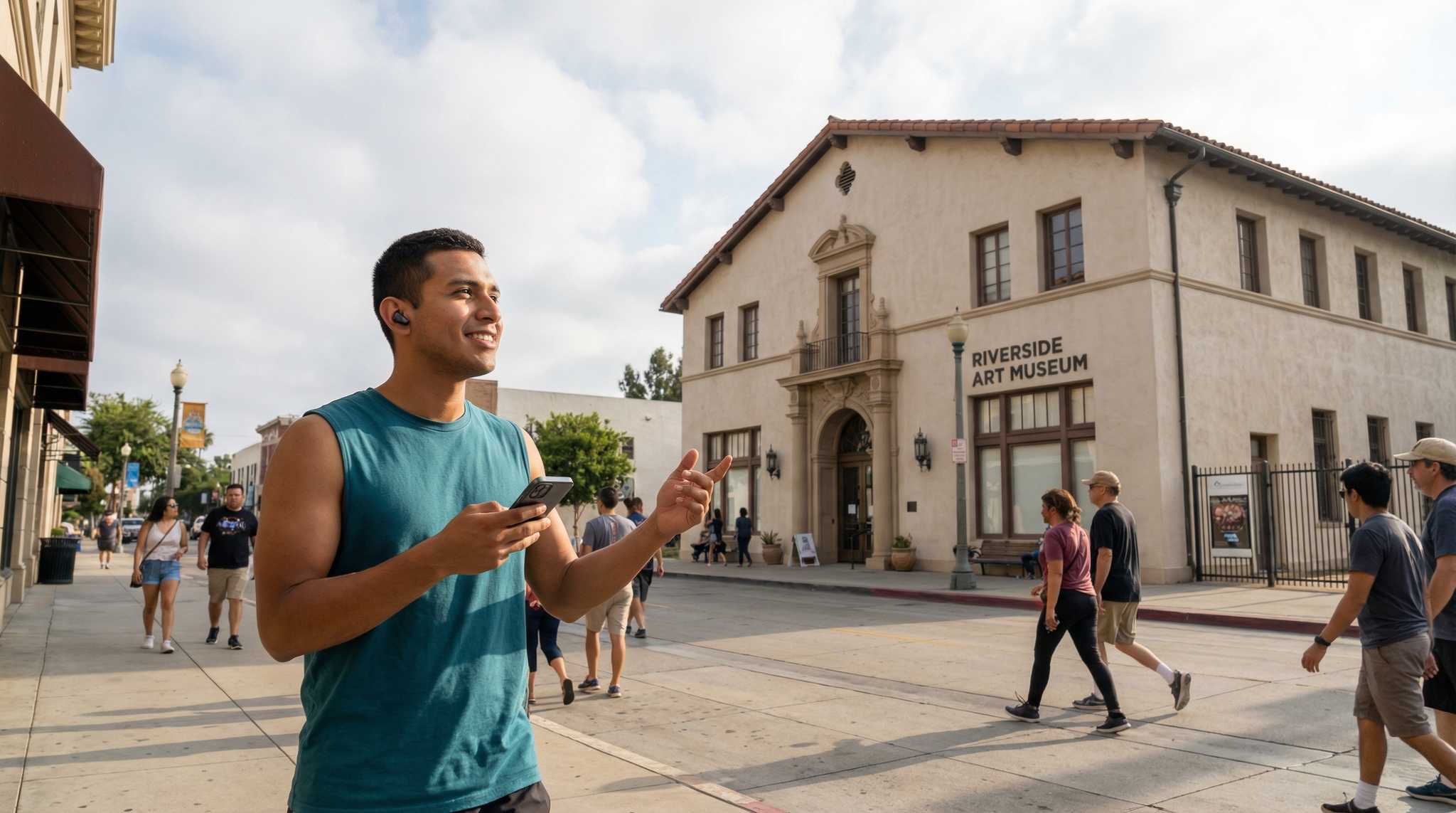
Visite audio de Riverside : Histoires et icônes du centre-ville historique
Sous les rues ensoleillées de Riverside, légendes et secrets résonnent entre les arches ornées et les façades de briques. Cette visite audio autoguidée transforme les trottoirs de la ville en un sentier de murmures, vous guidant vers des moments dramatiques et des joyaux oubliés cachés à la vue de tous. Pourquoi une simple maison a-t-elle déclenché une bataille juridique nationale ? Quels mystères dorment dans les tunnels sous les salles dorées du Mission Inn ? Qui a un jour déclenché de fausses alarmes depuis le service d'incendie de Riverside lors d'un acte nocturne qui a changé les règles pour toujours ? Parcourez des récits de chocs culturels, de merveilles architecturales et de confessions de minuit. Sentez le pouls de la ville dans les places animées et les couloirs silencieux. Chaque arrêt vous emmène au-delà de l'évidence, révélant Riverside comme une tapisserie de rébellion, de vision et d'intrigue. Découvrez ce que la plupart ne voient jamais. Le voyage vous attend là où la lumière du soleil touche l'histoire — appuyez sur lecture et commencez la chasse.
Aperçu du tour
À propos de ce tour
- scheduleDurée 40–60 minsAllez à votre propre rythme
- straightenParcours à pied de 3.0 kmSuivez le sentier guidé
- location_onEmplacementRiverside, États-Unis
- wifi_offFonctionne hors ligneTéléchargez une fois, utilisez n'importe où
- all_inclusiveAccès à vieRéécoutez n'importe quand, pour toujours
- location_onCommence à Commission des transports du comté de Riverside
Arrêts de ce tour
Cities are shaped just as much by what happens inside boardrooms and courtrooms as they are by asphalt and steel. Public projects often look like seamless lines of progress on a…Lire plusAfficher moins
Ouvrir la page dédiée →Cities are shaped just as much by what happens inside boardrooms and courtrooms as they are by asphalt and steel. Public projects often look like seamless lines of progress on a map, but underneath those lines lies a web of hidden battles. From bureaucratic showdowns to fierce neighborhood resistance, the infrastructure we walk and drive on is forged in conflict.
Look straight ahead at this imposing structure made of smooth concrete and reflective glass, shaped into clean rectangular blocks and anchored by a prominent recessed main entryway. This is the Riverside County Transportation Commission, or RCTC.
For nearly two decades, this agency was driven by Anne Mayer, a civil engineer who smashed glass ceilings in a male dominated field, eventually retiring in May 2024. She secured massive federal investments for the county, but the road to progress was paved with fierce legal showdowns.
Take the Perris Valley Line, a 232.7 million dollar commuter rail extension. In May 2013, a local group called Friends of Riverside's Hills effectively slammed the brakes on the entire project through a massive lawsuit. A judge agreed with the group, ruling the environmental report ignored critical issues like pedestrian safety near the university, the massive number of dirt excavation trucks, and the screeching noise of trains taking sharp turns.
You can imagine the absolute frustration of local officials. The mayor of Perris publicly fumed that a handful of residents were holding the entire region hostage. Facing the loss of 75 million dollars in federal funding, the RCTC ultimately agreed to a 3 million dollar settlement. They paid to install soundproofing windows in nearby homes and bought up wildlife conservation lands in the Box Springs area just to get the trains moving again.
But the fights did not stop there. They went toe to toe with the Southern California Gas Company over moving gas lines for the very same rail project. The gas company refused to pay for the relocation, forcing RCTC to front the cash. RCTC sued, and in a massive 2020 victory, a court ruled that public utilities cannot stand in the way of progress and must cover their own relocation costs.
Even their wildlife conservation efforts are tangled in court, with developers recently accusing the agency of weaponizing environmental rules to deliberately delay building entitlements, which are the legal permissions required to develop land. From pushing a massive 1.5 billion dollar passenger rail project to the Coachella Valley, to dealing with backlash over toll lane costs, this building is ground zero for the push and pull of civic growth.
It is fascinating to see how modern transit disputes shape the city, but Riverside's drive to organize and build its community goes back much further. Next we will head over to the Masonic Temple, just a two minute walk away, to see how early residents forged their own powerful alliances. If you need to stop inside the commission here for any transit maps, they are open weekdays starting at 8 AM, though they close a bit early on Fridays and are locked up on weekends.
On your left, you will spot the museum by its pale upper facade contrasting with heavy dark entrance pillars, and a very distinct, protruding black box sitting right on the upper…Lire plusAfficher moins
Ouvrir la page dédiée →On your left, you will spot the museum by its pale upper facade contrasting with heavy dark entrance pillars, and a very distinct, protruding black box sitting right on the upper balcony.
It takes a fierce, almost radical kind of imagination to look at an abandoned retail shop and decide it should be transformed into a giant, inhabitable machine. This push for unconventional, modern ideas is exactly what defines the California Museum of Photography.
You are looking at a renovated 1930s dime store... a classic early twentieth century shop where everyday goods were sold for just five or ten cents. Back in 1986, the university bought this building from the city for exactly one dollar. Architect Stanley Saitowitz gutted the inside, redesigning the entire space as a literal metaphor for a camera, working on the philosophy that the people walking through it are the film.
And that strange black box up on the balcony? That is a walk-in camera obscura. A camera obscura is an ancient optical device, essentially a completely pitch-black room with a tiny hole that naturally projects a live, upside-down image of the outside world onto an interior wall. You can actually step inside it and stand physically within the mechanics of early photography.
The museum itself actually began as a grassroots effort in 1969, when an orthopedic surgeon named Dr. Robert Bingham teamed up with an art professor in the basement of a university library. He donated two thousand vintage cameras... a collection that has now swelled to ten thousand pieces of photographic apparatus.
But the true power of this museum lies in what it protects. With the largest photographic holdings in the Western United States, this institution has been shaped by individuals who refused to let history be erased. Consider the legendary photographer Ansel Adams. In 1964, he was hired to photograph the university system for a massive project. He spent three years traveling, trying to capture the invisible product of knowledge. But in a sharp twist of political conflict, his celebratory book was published the exact same month the new state governor abruptly fired the university president. Adams watched the institution he just spent years documenting get politically dismantled, leaving his seven thousand negatives as a poignant record of a fractured era.
Then there is the Keystone-Mast Collection, an archive of over two hundred and fifty thousand stereoscopic negatives. Stereoscopy was an early craze where two slightly offset photos were viewed together to create a three-dimensional illusion. Because they were meant to look perfectly natural, photographers captured an immense amount of hidden detail. Decades later, a contemporary artist examining these glass plates discovered something bizarre... the original photographers had secretly staged dead birds and rabbits hidden deep in the foliage of the landscapes.
The museum is closed Monday through Wednesday, but opens its doors Thursday through Sunday from midday to late afternoon. Now, let us walk toward the pedestrian area just ahead, as we make our way to the Main Street Pedestrian Mall.

Afficher 11 arrêts de plusAfficher moins d'arrêtsexpand_moreexpand_less
Look straight across the street at that sprawling white stucco building, anchored by its classic red tile roof and a distinctive, multi-tiered tower rising right over the corner…Lire plusAfficher moins
Ouvrir la page dédiée →Look straight across the street at that sprawling white stucco building, anchored by its classic red tile roof and a distinctive, multi-tiered tower rising right over the corner entrance. Sometimes the most defining moments of a city's identity happen completely behind closed doors, hidden away from the world until the exact right second. This magnificent theater is a living monument to that kind of secret history. Built in 1929, the Fox Performing Arts Center was perfectly designed to match the city's Spanish Colonial Revival style, a look that mimics the rustic beauty of early Spanish missions. But the architects had a brilliant trick up their sleeve. Patrons walking through those traditional doors were suddenly hit with a lavish Art Deco interior, a wildly modern style packed with sleek, geometric shapes and exotic Hollywood glamour that was the absolute height of luxury.
Fox Theater, Riverside, California LCCN2017707868Photo: John Margolies, Wikimedia Commons, Public domain. Cropped & resized. Because Riverside perfectly represented the demographics of everyday America, big studios used this theater as their ultimate testing ground. When a special sign lit up out front, locals knew a secret preview was happening, drawing legends like Judy Garland and Bing Crosby to secretly gauge the crowd. But the most legendary secret of all happened on September 9, 1939. Producer David O. Selznick drove out here with a highly guarded rough cut of his newest film. That night, after the main feature ended, the manager told the audience they could leave, or they could stay for a surprise preview on one absolute condition... they would be locked inside, and no phone calls were allowed. When the title card for Gone With the Wind hit the screen, the audience completely lost their minds. People literally stood on their seats yelling with joy, giving Selznick what he later called the greatest moment of his life. What an incredible way to accidentally witness cinema history.
Fox Theater, Riverside, California LCCN2017707870Photo: John Margolies, Wikimedia Commons, Public domain. Cropped & resized. That incredible high met a harsh reality during World War Two. The manager let exhausted soldiers sleep right on the thick lobby carpets, and eventually, the soaring main auditorium was physically walled off and divided to create a smaller, second theater in the back. By the late 1970s, the grand main room showed Spanish language films while the partitioned back section became an adult theater, before economic pressures forced the whole place to shut down. Left empty, the historic building was tragically stripped by vandals. But Riverside locals refused to let this cultural cornerstone fade away. Driven by sheer willpower, the city launched a massive 35 million dollar renovation. They tore down the dividing walls, miraculously stitching the space back together into a single, grand auditorium with over a thousand seats that triumphantly reopened in 2010. The app has a neat side by side showing what this place looked like back in 1978 compared to today... it is quite a transformation. This theater survived because individuals had the unyielding vision to reclaim it from the brink. We are going to see that same kind of relentless ambition next, as we head toward a monumental church driven by a powerful local figure. That is the First Congregational Church of Riverside, just a six minute walk away. And just so you know, the Fox Theater is completely closed on Saturdays through Tuesdays, but the doors are usually open Wednesdays through Fridays from noon to 4 PM.
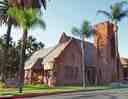
Look for the monumental beige stucco building shaped like a traditional cross, anchored by an intricately carved, 125-foot corner bell tower. Riverside wasn't just built…Lire plusAfficher moins
Ouvrir la page dédiée →
FirstCongregationalChurch20090821fPhoto: MissionInn.Jim, Wikimedia Commons, Public domain. Cropped & resized. Look for the monumental beige stucco building shaped like a traditional cross, anchored by an intricately carved, 125-foot corner bell tower. Riverside wasn't just built organically, it was willed into existence by forceful personalities. Enter Frank Miller. He was a domineering civic force and the proprietor of the famous Mission Inn just down the street. Miller didn't just run a hotel, he wanted to shape the city's entire architectural identity to match his grand, romantic vision. A member of this congregation since 1878, Miller championed the hiring of architect Myron Hunt in 1913 to build a structure that perfectly complemented his hotel's Spanish Revival aesthetic.

Architectural detail of the bell towerPhoto: 3Kathleen3, Wikimedia Commons, CC BY-SA 3.0. Cropped & resized. That soaring tower is designed in the Churrigueresque style, an intensely ornate form of Spanish architecture loaded with complex, dramatic sculptural details. Surprisingly, despite its grandeur, that towering belfry sat completely empty for over seventy years. It wasn't until 1986 that congregants finally installed 24 French bells, creating the only pealing set in Southern California.

Architectural detail of the front archesPhoto: 3Kathleen3, Wikimedia Commons, CC BY-SA 3.0. Cropped & resized. This building is so much more than a pretty facade, it is a fortress of conviction. Just after opening in 1914, Booker T. Washington spoke from its pulpit. During World War Two, when Japanese Americans were forced into internment camps, this church stepped in to safely hold and protect the assets of Riverside's Japanese American congregation.

County of Riverside Historical MarkerPhoto: 3Kathleen3, Wikimedia Commons, CC BY-SA 3.0. Cropped & resized. That fierce protective spirit has never faded. In 1995, after a local gay man named Jessy Owens was killed steps from these doors, the church hung a massive rainbow flag in defiance. They later proudly performed the county's first legal same-sex marriage, and in 2017, they gathered 42 volunteer immigration lawyers to offer this building as a sanctuary for undocumented immigrants facing deportation. It is a place where marginalized people, like a transgender woman named Eva-Genevieve Scarborough who initially hid in the balcony out of fear, eventually found a community that brought her right to the front pews. If you want to peek inside, their doors are generally open middays during the week, except on Tuesdays. Now, as we transition from these deep spiritual foundations to literal trials by fire, let's head to the Riverside Fire Department, just a five-minute walk away.
Standing here on the right side, facing the main entrance, look for the bold metal insignia marking the station, a sharp hexagonal shield edged in dark blue, featuring a bright…Lire plusAfficher moins
Ouvrir la page dédiée →
The bold metal insignia of the Riverside Fire Department, featuring its iconic shield and bell. (2019)Photo: RFD, Wikimedia Commons, Public domain. Cropped & resized. Standing here on the right side, facing the main entrance, look for the bold metal insignia marking the station, a sharp hexagonal shield edged in dark blue, featuring a bright red cross and a gleaming gold bell in its center. In the late nineteenth century, this growing town faced a brutal trial by fire. Wooden structures dominated the landscape, meaning a single rogue spark could erase entire livelihoods in minutes. The citizens had to fight the flames themselves or risk losing everything they had built. Back in 1882, an unorganized group of volunteers was all that stood between the town and total destruction. Frank Miller, the ambitious owner of the Mission Inn, persuaded local businessmen to chip in 500 dollars, which is roughly 15,000 dollars today, for a simple wagon and fire buckets. But a man named William Hayt knew that was not enough. Hayt pushed the city Board of Trustees for a complete, official fire department. He offered to raise half the money and put up the rest himself. His sheer willpower paid off, and the Riverside Fire Department was officially born on October 7, 1887. They started with a chief, two assistants, a clerk, and fifty volunteers operating out of a simple shed. Their gear, including a hose reel and a hook and ladder, a long wagon carrying extension ladders for reaching tall buildings, was entirely pulled by manpower. Picture dozens of men sprinting down dirt roads, dragging heavy wooden carts with nothing but muscle and adrenaline.

Firefighters battling a hotspot during the intense Fairview Fire. (2022)Photo: Cal Fire/Riverside County Fire Department, Wikimedia Commons, Public domain. Cropped & resized. They needed that adrenaline on April 21, 1888. A catastrophic blaze broke out at the Pavilion, a sprawling wood frame building used for theaters and dances. The flames consumed the massive structure with terrifying speed, spreading wildly until they devoured the entire city block. It was an absolute inferno. Yet, through pure grit and their brand new training, those early firefighters held the line. They stopped the blaze from jumping further, saving the rest of Riverside highly flammable downtown from being completely wiped off the map. They proved their worth, and the city ultimately invested in their future. By 1909, they even replaced their beloved fire horses with a loud, smoke belching gasoline truck that cost 4,750 dollars, or roughly 160,000 dollars today. The people who stepped up, faced absolute ruin, and pushed forward to protect their neighbors truly forged the resilient backbone of this community. This active station is open twenty four hours a day, always ready for the next call. Now, let us keep moving toward a masterpiece designed by a pioneering female architect, as we take a quick three minute walk over to our next stop, the Riverside Art Museum.
Look to your right and you will spot a pale concrete building topped with a low terra cotta tiled roof and defined by three tall, arched windows lining its left side. This is the…Lire plusAfficher moins
Ouvrir la page dédiée →
The Riverside Art Museum, a pale concrete building with a terra cotta tiled roof.Photo: MissionInn.Jim~commonswiki, Wikimedia Commons, Public domain. Cropped & resized. Look to your right and you will spot a pale concrete building topped with a low terra cotta tiled roof and defined by three tall, arched windows lining its left side. This is the Riverside Art Museum, but long before it housed fine art, it was the site of a fierce clash over the very identity of this city. In 1929, the local Young Women's Christian Association, or YWCA, wanted an urban sanctuary for women. They needed funding, and local magnate Frank Miller offered to help finance the project, provided they build it right next to his famous Mission Inn. But Miller's money came with heavy strings attached. He aggressively demanded they hire a local male architect to match the Spanish fantasy style of his hotel. He even patronizingly insisted the women serve the nearby Municipal Auditorium.

The front south-facing facade of the historic Old YWCA Building (1899).Photo: 3Kathleen3, Wikimedia Commons, CC BY-SA 3.0. Cropped & resized. The women of the YWCA flatly refused. They reportedly declared they did not want to be anyone's servants. Instead, they stuck to their guns and hired trailblazing female architect Julia Morgan over Miller's vocal objections. Julia Morgan was a visionary who prioritized structural integrity just as much as aesthetics. Knowing she was building in earthquake country, she designed this structure using reinforced, poured in place concrete, meaning the liquid concrete was poured directly into molds right here on the site to create an incredibly sturdy shell. To Miller's intense disapproval, Morgan bypassed his preferred style entirely, designing an innovative tri-block building in a blend of Mediterranean and Classical Revival styles, mixing Italian and Spanish architectural elements to give it a distinctly modern feel.

A detailed look at the Old YWCA Building's east wall, showing off its innovative architectural blends and distinctive tile framing the windows (1899).Photo: 3Kathleen3, Wikimedia Commons, CC BY-SA 3.0. Cropped & resized. There are profound battles poured into the very foundation of this building. Inside, Morgan even designed a massive first floor swimming pool. For decades, it was a lively community hub where local kids learned to swim. When the Riverside Art Center bought the building in 1967 for two hundred fifty thousand dollars, which is over two million dollars today, they did not demolish the pool. Instead, they ingeniously filled the basin and transformed it into a dramatic, sunken, multi-level exhibition space. The sheer scale of that former pool offers a striking contrast to traditional galleries, serving as a lasting testament to Morgan's highly adaptable structural design. It stands as a monument to a group of women who refused to compromise their vision against intense pressure from powerful men.

A historic view looking from east to west of the original Old YWCA site (1899).Photo: 3Kathleen3, Wikimedia Commons, CC BY-SA 3.0. Cropped & resized. If you want to view their permanent collection of around fifteen hundred pieces or step inside that ingenious sunken gallery, the museum is open Wednesday through Saturday from ten to five, and Sunday afternoons from twelve to five. Now, we are going to walk toward a church with a completely different history of dramatic relocation and remarkable resilience, so let us head toward the Universalist Unitarian Church of Riverside, just a two minute walk away.
Look to your left for a striking building constructed of rough-hewn red sandstone, featuring a steeply pitched roof and a prominent square tower topped with castle-like…Lire plusAfficher moins
Ouvrir la page dédiée →
A historic 1899 view inside the auditorium of the All Souls Universalist Church, featuring beautiful golden oak and redwood trusses painted to match.Photo: 3Kathleen3, Wikimedia Commons, CC BY-SA 3.0. Cropped & resized. Look to your left for a striking building constructed of rough-hewn red sandstone, featuring a steeply pitched roof and a prominent square tower topped with castle-like battlements. The app has a cool historic photo showing what this place looked like back in 1899.
What you are looking at is the Universalist Unitarian Church of Riverside, and its story is one of sheer determination and constant evolution. You see, before they had this elegant structure, the congregation's first home was entirely recycled. Back in 1882, they purchased Riverside's original wooden schoolhouse for a mere 300 dollars, which is roughly 9000 dollars today. They hauled that wooden building to a donated lot and remodeled it into a chapel. This ability to take something old, move it, and completely repurpose it for a growing community perfectly captures Riverside's early spirit. When resources were scarce, the people here did not just give up... they adapted and rebuilt with whatever they had at hand. That rugged resourcefulness laid the groundwork for the ambitious city we see today.
By 1891, local builders faced the new church walls with imported Supai sandstone. That is the exact same ancient red stone that forms the spectacular slopes of the Grand Canyon. It was an extraordinary logistical feat for the era to bring that massive rock all the way from Arizona.

The stunning large triple window that serves as the focal point on the church's north wall, captured in 1899.Photo: 3Kathleen3, Wikimedia Commons, CC BY-SA 3.0. Cropped & resized. As the decades passed, the congregation proved just as adaptable as their architecture. In 1938, they officially bridged the gap between two liberal faiths by joining the American Unitarian Association. Interestingly, when the church reincorporated in 1957, they made a highly unusual choice. They deliberately placed the word Universalist before Unitarian. It was a defiant nod to their origins as the first Universalist parish in the American Southwest, completely reversing the standard national naming convention.
Their protective spirit eventually extended to the building itself. When experts realized this historic unreinforced masonry building, meaning heavy stone construction lacking internal steel supports, was incredibly vulnerable to California's earthquakes, the congregation rallied. They undertook a massive seismic retrofitting project, successfully saving the structure from disaster in 1988.
If you want to peek inside, they are open Sundays from 10 AM to noon, and Tuesday through Friday from noon to 2 PM. Next, we are going to explore how Riverside protected its mind as well as its soul, as we take a quick one-minute walk to uncover the story of the city's rescued literary treasures at the Riverside Public Library.
On your right, look for the striking white stucco building featuring a red-tiled dome and a prominent, three-tiered bell tower. This is the First Church of Christ, Scientist,…Lire plusAfficher moins
Ouvrir la page dédiée →
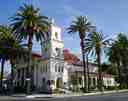
The First Church of Christ, Scientist building in Riverside is a striking example of Mission Revival architecture. (2012)Photo: Steve Rouhotas, Wikimedia Commons, CC BY-SA 3.0. Cropped & resized. On your right, look for the striking white stucco building featuring a red-tiled dome and a prominent, three-tiered bell tower. This is the First Church of Christ, Scientist, completed in 1901, and it is a masterpiece of design.
The architect behind this beauty was a man named Arthur Benton. Benton was not just a hired hand for this project, he was actually one of the founding members of the congregation and served as its secretary. His deep personal investment shines through every detail of this building, which was his very first design in Riverside and a pioneering example of Mission Revival architecture, a style that draws heavily on the smooth walls, rounded arches, and clay roof tiles of historic Spanish missions.

The exterior of the First Church of Christ, Scientist, featuring the distinctive bell towers flanking the main entrance. (2012)Photo: Steve Rouhotas, Wikimedia Commons, CC BY-SA 3.0. Cropped & resized. But the story of this building really starts with the fierce determination of one woman, Emma Stanton Davis. She moved to Riverside in 1887 and began practicing Christian Science, which had been founded by Mary Baker Eddy just a couple of decades earlier. Davis was the very first class-taught student of the religion in all of California. Her healing work quickly attracted a devoted following of prominent citizens, including wealthy citrus growers who helped legitimize and fund this exact building.
The church actually built a permanent tribute to her relentless drive. Look at the two bell towers flanking the main entrance portico. The one on the left has two segments, but the larger one on the right has three. That right tower is not just decorative. The functional second floor of that larger tower was originally built specifically to serve as the personal room of Davis herself.

A historical plaque commemorates the rich history and enduring legacy of the First Church of Christ, Scientist. (2012)Photo: Steve Rouhotas, Wikimedia Commons, CC BY-SA 3.0. Cropped & resized. Over the years, the interior of the church had its own evolution. In 1913, the congregation purchased a massive pipe organ. To fit the enormous instrument, they had to entirely repurpose the original choir loft into a chamber for the organ pipes. Later on, original stained glass windows located near the rostrum, which is the raised platform where speakers stand, were moved and eventually relocated to a neighboring Sunday school building.
But the true legacy of this church extends far beyond its walls. When it was dedicated, the local paper declared it the prettiest in the city. A man named Frank Augustus Miller, who ran a modest adobe tourist hotel nearby, walked over and was absolutely captivated by the work Benton did here. Miller saw this building and instantly realized Benton was the exact visionary needed to transform his simple adobe into a grand, palatial destination.
That spark of inspiration changed the identity of this city forever. Let us take a short walk to see what Benton and Miller built next, the internationally famous Mission Inn Hotel and Spa is just a three minute walk away.
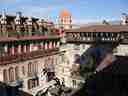
On your left is the Mission Inn, a sprawling fortress of textured stucco walls and arched colonnades, crowned by a striking orange tiled dome. This place is an absolute…Lire plusAfficher moins
Ouvrir la page dédiée →
DJI 0625-HDR - editedPhoto: Steve Carroll, Wikimedia Commons, CC BY-SA 4.0. Cropped & resized. Look for the smooth concrete sign wall with raised metal lettering standing guard in front of the tall stucco tower and its massive grid of dark vertical glass. Updating the…Lire plusAfficher moins
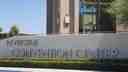
Ouvrir la page dédiée →Look for the smooth concrete sign wall with raised metal lettering standing guard in front of the tall stucco tower and its massive grid of dark vertical glass. Updating the city's architectural footprint is never just about pouring fresh concrete... it usually means confronting the toxic ghosts of the past.
As you stand looking at this massive facade, imagine what lies beneath. When the city decided to completely rebuild this site in 2014, they wanted to ditch the 1970s vibe that lacked a wow factor and replace it with something grander. They envisioned a towering sixty six foot structure featuring elegant arched windows and rich rosewood panels to reflect the classic Spanish and Mission Revival styles seen just moments ago at the nearby Mission Inn.
But when crews started gutting the original 1976 building, they stumbled into a nightmare. They uncovered hazardous materials lurking practically everywhere. Toxic substances were hiding out in the parking structure, the transit storm drain, the subterranean piping, and even in the mastic glue... a heavy resin based adhesive used back in the day to secure floor tiles. Suddenly, a routine demolition became a massive environmental hazard. The project could have completely derailed.
This is where we see true community resilience. Rather than panicking, the team completely overhauled their schedule. They safely removed every trace of the toxins and rebuilt the entire mechanical system. Incredibly, workers logged over two hundred thousand hours of labor in these dangerous conditions without a single lost time accident. The forty three point six million dollar rebuild miraculously opened on time in March 2014, earning a prestigious national safety award.
The center operates every day from 8 AM to 5 PM, hosting countless events across its modern footprint. But our journey is nearly complete. Next, we will walk about five minutes away to discover a humble home with a monumental legacy... the Harada House.
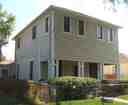
Just a short walk from the modern sprawl of the Convention Center, look to your right for an unassuming two-story frame house, recognizable by its pale horizontal wood siding and…Lire plusAfficher moins
Ouvrir la page dédiée →
Harada House 20091024cPhoto: MissionInn.Jim, Wikimedia Commons, Public domain. Cropped & resized.



Foire aux questions
Comment commencer le tour ?
Après l'achat, téléchargez l'application AudaTours et entrez votre code de réduction. Le tour sera prêt à commencer immédiatement - il suffit d'appuyer sur lecture et de suivre l'itinéraire guidé par GPS.
Ai-je besoin d'Internet pendant le tour ?
Non ! Téléchargez le tour avant de commencer et profitez-en pleinement hors ligne. Seule la fonction de chat nécessite Internet. Nous recommandons de télécharger en WiFi pour économiser vos données mobiles.
S'agit-il d'une visite de groupe guidée ?
Non - il s'agit d'un audioguide en autonomie. Vous explorez indépendamment à votre propre rythme, avec une narration audio diffusée par votre téléphone. Pas de guide, pas de groupe, pas d'horaire.
Combien de temps dure le tour ?
La plupart des tours durent entre 60 et 90 minutes, mais vous contrôlez totalement le rythme. Faites des pauses, sautez des arrêts ou arrêtez-vous quand vous le voulez.
Et si je ne peux pas finir le tour aujourd'hui ?
Pas de problème ! Les tours disposent d'un accès à vie. Faites une pause et reprenez quand vous le souhaitez - demain, la semaine prochaine ou l'année prochaine. Votre progression est sauvegardée.
Quelles sont les langues disponibles ?
Tous les tours sont disponibles dans plus de 50 langues. Sélectionnez votre langue préférée lors de l'utilisation de votre code. Note : la langue ne peut pas être changée après la génération du tour.
Où accéder au tour après l'achat ?
Téléchargez l'application gratuite AudaTours sur l'App Store ou Google Play. Entrez votre code de réduction (envoyé par e-mail) et le tour apparaîtra dans votre bibliothèque, prêt à être téléchargé et commencé.
Si vous n'appréciez pas le tour, nous vous rembourserons votre achat. Contactez-nous à [email protected]
Paiement sécurisé avec 


