
Cádiz Audio Tour : Tours, marchés et légendes maritimes
Entre le vent de l'Atlantique et le calcaire doré, Cadix apparaît comme une forteresse de lumière. Mais sous ses places et ses ruelles se cache une ville pleine de tumulte, de cupidité et de secrets. Cette visite audio autoguidée mène à la Cathédrale de Santa Cruz, à la Tour Tavira et jusqu'au Château de San Sebastián. En chemin, des histoires et des détails qui échappent à de nombreux visiteurs se révèlent. Quels combats politiques et nuits rebelles ont failli étouffer Cadix. Quels signaux énigmatiques émanaient autrefois de la Tour Tavira et qui écoutait en secret. Et pourquoi une certaine heure apparaît-elle sans cesse dans les anciens récits devant la cathédrale. Chaque arrêt entraîne plus profondément. De la nef résonnante aux étroits chemins de ronde en bord de mer. Scandales, moments oubliés et ombres fraîches deviennent soudainement visibles. Cadix se ressent différemment après cela. Commencez maintenant et comprenez la lumière de la ville de l'intérieur.
Aperçu du tour
À propos de ce tour
- scheduleDurée 30–50 minsAllez à votre propre rythme
- straightenParcours à pied de 3.1 kmSuivez le sentier guidé
- location_on
- wifi_offFonctionne hors ligneTéléchargez une fois, utilisez n'importe où
- all_inclusiveAccès à vieRéécoutez n'importe quand, pour toujours
- location_onCommence à Cathédrale de Santa Cruz
Arrêts de ce tour
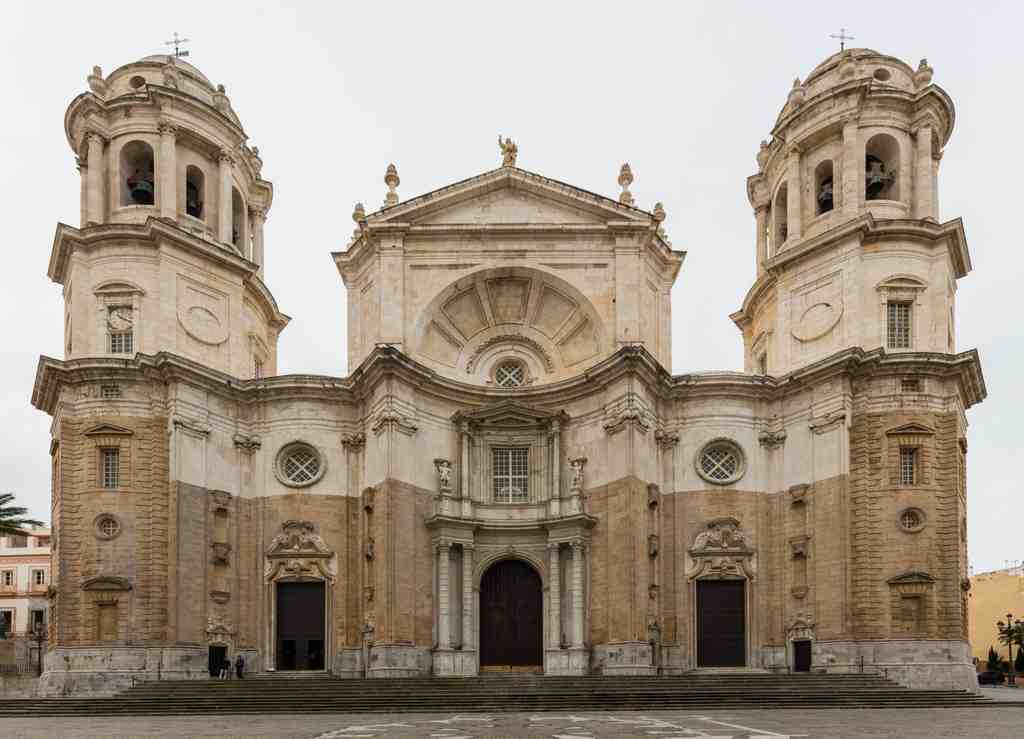
You'll recognize the Catedral by its wide, sand-colored Baroque facade with two imposing towers on the left and right - lift your gaze to the center, where the large, semicircular…Lire plusAfficher moins
You'll recognize the Catedral by its wide, sand-colored Baroque facade with two imposing towers on the left and right - lift your gaze to the center, where the large, semicircular gable sits above the main portal. Welcome to the Catedral de Cádiz, officially quite solemnly called 'Santa y Apostólica,' but often simply referred to as 'the New One' by locals - because Cádiz, of course, also has an 'Old One.' That fits this city: it collects centuries like other people collect fridge magnets. The reason for needing to build anew was practical and a little vain. The old Catedral was not in particularly good condition, and Cádiz suddenly felt very important at the beginning of the 18th century: in 1717, the central trade authority for the America routes was moved here from Sevilla. In other words: money, ships, influence - and the urgent desire for a house of worship that radiated that importance. So, construction began in 1722, and if you think that was quick: it was finished in 1838. 116 years. That's less of a 'construction project' and more of a 'family tradition.' And as with long family histories, the main characters here also changed: first Vicente Acero planned it, then he stepped down in 1739. After that, Gaspar Cayón took over, passing it on to his nephew Torcuato Cayón in 1757, later Miguel Olivares, Manuel Machuca y Vargas joined - and finally, from 1832, Juan Daura oversaw it until its completion. Each generation brought its taste, and because Cádiz wasn't always flush with cash in between, the result is visible to this day: Baroque meets Rococo meets Neoclassicism. An architectural 'we'll take what we can get,' so to speak. Look at the main facade: this undulating movement of back and forth, concave and convex, is typical Baroque - drama in stone. And then the towers: tall, very prominent, almost like observation posts. This is actually remarkable because the Bourbons generally didn't like such tall church towers in coastal cities - too good a target for enemies. Cádiz did it anyway. You could say: pious, but not shy. The materials also tell of Cádiz's connections to the outside world. Construction wasn't just local here: for altars and portals, for example, marble from Genoa was used, along with jasper, and for the exterior, limestone and the typical 'piedra ostionera,' that shell stone that looks as if the sea helped build it. Which, frankly, it continues to do: the Catedral stands almost by the water, and salty air is a patient but merciless craftsman. Over the years, the stone developed a kind of 'disease' - it crumbles. That's why nets hang inside under some vaults, to prevent anything from falling down. Not romantic, but very Cádiz: beauty, right next to reality. When you go inside, you'll find a Latin cross floor plan, three naves, mighty Corinthian columns, and a large, pentagonal ambulatory behind the altar. Above, many shallow dome vaults arch - often with relief decoration. The high altar is a freestanding Neoclassical baldachin dedicated to the Immaculate Conception: elegant, almost cool, as if one had finally taken a deep breath after all that Baroque. And beneath you, under the main altar, lies the crypt - below sea level. Famous names like Manuel de Falla rest there. The acoustics down there are famous: a short sentence can feel like it takes another stroll around the corners before disappearing.
Ouvrir la page dédiée →To your left, you'll see a large, sand-colored stone arch with a wrought-iron gate beneath it and the sign 'MERCADO PÚBLICO' at the very top - that's the entrance to the Plaza de…Lire plusAfficher moins
To your left, you'll see a large, sand-colored stone arch with a wrought-iron gate beneath it and the sign 'MERCADO PÚBLICO' at the very top - that's the entrance to the Plaza de Abastos. Standing here, the whole thing almost looks like a small city gate: strong stone, clear lines, and that sober, declarative tone in the lettering, as if Cádiz is saying: 'No flirting here, just shopping.' The market was planned in the 19th century - by architect Torcuato Benjumeda - as a Neoclassical, square building with Doric columns, like a covered plaza. And that's already a small shift in times: the square sits on the former garden of a 'Descalzos' (Barefoot Friars) monastery - religious retreat turned into public everyday life. This was made possible by the great wave of expropriation of church property in Spain in the second decade of the 19th century. The market opened in 1838, and then… surprisingly little happened for a long time. A century with practically no major improvements - Cádiz is charming, but sometimes also patient to the point of stubbornness. Only at the end of 1926 did things pick up speed: the Sevillian architect Juan Talavera y Heredia began a major redesign. Politically, this fell into the era of Mayor Ramón de Carranza - although the original plan had already been initiated by his predecessor Agustín Blázquez. Carranza then primarily hit the gas: build faster, less hassle, and please, cleaner. Talavera kept the old Doric columns - about four meters high - and worked his way from the outside in. Sounds smooth, but it wasn't: under the construction site were cisterns that were still in use. Imagine wanting to pour foundations and suddenly finding the historical water supply still saying 'hello.' A construction site with brakes. And then the hygiene plot twist: they even hired a veterinarian to inspect fruits and vegetables. Vendors had to wear white clothing with arm protectors for aesthetic and health reasons - which smelled so much like regulation that Cádiz turned it into a Carnival tango. Of course. In the 21st century, it was extensively modernized again, including a gastronomy area - today a market and, incidentally, a very convincing reason to get hungry.
Ouvrir la page dédiée →


Afficher 2 arrêts de plusAfficher moins d'arrêtsexpand_moreexpand_less
To your right, a spacious, rather 'tidy' Plaza opens up with light cobblestones, wrought-iron double lanterns, and tall residential buildings in white, ocher, and pastel, all with…Lire plusAfficher moins
To your right, a spacious, rather 'tidy' Plaza opens up with light cobblestones, wrought-iron double lanterns, and tall residential buildings in white, ocher, and pastel, all with ornate balconies. You're standing in the Plaza de San Antonio, a square that at first glance seems almost a little too modest for all that has happened here. No grand statue in the center, no fountain for the obligatory photo - just space, light, and that quiet Cádiz elegance. And that's precisely the trick: this square was never just decoration, but a stage. In the past, this wasn't a 'Plaza' feeling at all, but rather an open field on the outskirts of the city: Campo de la Jara. Imagine wind from the Atlantic, dusty ground, and nearby a small hermitage - the Ermita de San Antonio. Over time, it became a proper church, and the name stuck. Cádiz likes to do that: first the city grows, then it pretends everything has always been right here. The names of the square changed as if someone was constantly swapping the door sign: sometimes San Antonio, then 'Constitución,' later renamed again - each era wanted to put its own headline here. And in 1812, things got serious: the Spanish Constitution was proclaimed in Cádiz, and this very square was one of the places where the new political self-awareness became public. If you squint your eyes for a moment, you can almost hear the crowd: footsteps on stone, excited voices, that crackle in the air when people realize that history doesn't just happen in books. But Cádiz wouldn't be Cádiz if hope wasn't also followed by a shadow. In 1820, when liberal movements flared up again, brutal action was taken here. The same open square that can carry cheers can also carry fear - and without a monument in the center, it's sometimes the emptiness itself that makes such memories louder. Incidentally, the place was also practical: in the 16th century, there was a well here that supplied the neighborhood with water - today it lies inconspicuously on an adjacent private property. History, typically Andalusian, doesn't always stand on a pedestal; sometimes it's hidden behind a door. All around, you see how the square became a civic living room: church, provincial library, stately homes, old bank premises, even the Casino Gaditano. The building was once the family seat of a politically influential lineage before becoming a casino in 1848. At the end of the 19th century, an Arab-inspired courtyard was added there - totally in vogue at the time - with echoes of the Alhambra and especially the Patio de las Muñecas of the Reales Alcázares in Sevilla. A bit of exotic splendor for the members, without having to leave Cádiz. Nice, too.
Ouvrir la page dédiée →

Foire aux questions
Comment commencer le tour ?
Après l'achat, téléchargez l'application AudaTours et entrez votre code de réduction. Le tour sera prêt à commencer immédiatement - il suffit d'appuyer sur lecture et de suivre l'itinéraire guidé par GPS.
Ai-je besoin d'Internet pendant le tour ?
Non ! Téléchargez le tour avant de commencer et profitez-en pleinement hors ligne. Seule la fonction de chat nécessite Internet. Nous recommandons de télécharger en WiFi pour économiser vos données mobiles.
S'agit-il d'une visite de groupe guidée ?
Non - il s'agit d'un audioguide en autonomie. Vous explorez indépendamment à votre propre rythme, avec une narration audio diffusée par votre téléphone. Pas de guide, pas de groupe, pas d'horaire.
Combien de temps dure le tour ?
La plupart des tours durent entre 60 et 90 minutes, mais vous contrôlez totalement le rythme. Faites des pauses, sautez des arrêts ou arrêtez-vous quand vous le voulez.
Et si je ne peux pas finir le tour aujourd'hui ?
Pas de problème ! Les tours disposent d'un accès à vie. Faites une pause et reprenez quand vous le souhaitez - demain, la semaine prochaine ou l'année prochaine. Votre progression est sauvegardée.
Quelles sont les langues disponibles ?
Tous les tours sont disponibles dans plus de 50 langues. Sélectionnez votre langue préférée lors de l'utilisation de votre code. Note : la langue ne peut pas être changée après la génération du tour.
Où accéder au tour après l'achat ?
Téléchargez l'application gratuite AudaTours sur l'App Store ou Google Play. Entrez votre code de réduction (envoyé par e-mail) et le tour apparaîtra dans votre bibliothèque, prêt à être téléchargé et commencé.
Si vous n'appréciez pas le tour, nous vous rembourserons votre achat. Contactez-nous à [email protected]
Paiement sécurisé avec 


