
Visite audio de Narbonne : Échos de foi, de gloire et de pierres cachées
Sous les pierres baignées de soleil de Narbonne, des secrets aussi anciens que Rome murmurent depuis les cathédrales imposantes et les cryptes antiques. Ici, l'histoire se cache à la vue de tous, chaque ruelle sinueuse attendant de révéler un drame oublié. Cette visite audio autoguidée vous invite à vous perdre dans le passé complexe de Narbonne, déterrant des histoires étonnantes et des recoins tranquilles souvent manqués par les voyageurs pressés. Quelle lutte de pouvoir obscure a autrefois paralysé la Cathédrale Saint-Just-et-Saint-Pasteur ? Quelles empreintes de pas subsistent dans les chapelles silencieuses de la Basilique Saint-Paul ? Pourquoi un bol ordinaire trouvé au Clos de la Lombarde a-t-il suscité un débat furieux parmi les archéologues ? Promenez-vous à travers des siècles de rébellion, de miracle, de scandale et d'intrigue. Laissez vos pas retracer les couches cachées de la ville, des reliques romaines à l'ambition médiévale, et sentez le véritable esprit de Narbonne prendre vie à chaque découverte. Déverrouillez les mystères sous la surface. Commencez votre voyage au cœur secret de Narbonne.
Aperçu du tour
À propos de ce tour
- scheduleDurée 30–50 minsAllez à votre propre rythme
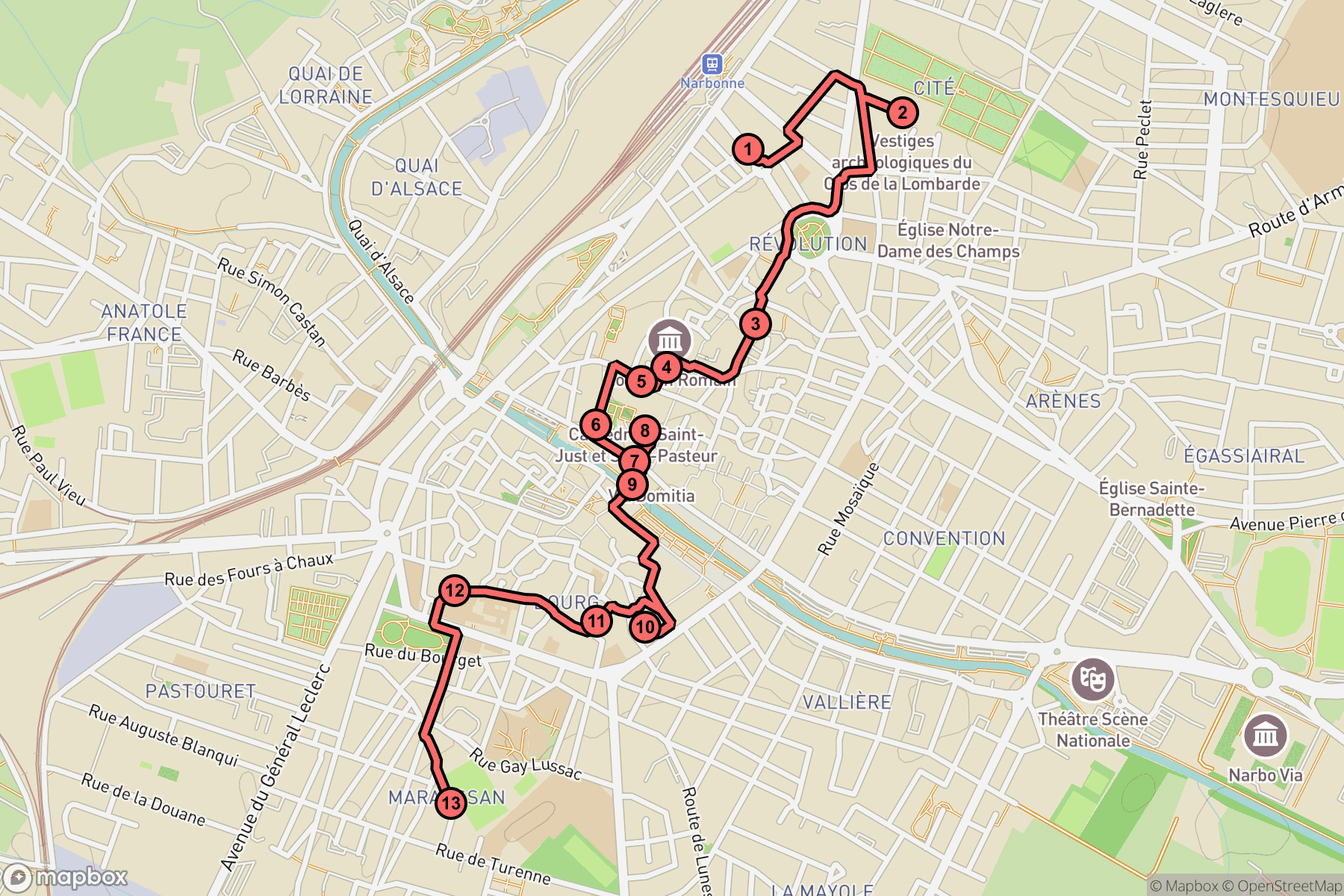
- straightenParcours à pied de 3.1 kmSuivez le sentier guidé
- location_on
- wifi_offFonctionne hors ligneTéléchargez une fois, utilisez n'importe où
- all_inclusiveAccès à vieRéécoutez n'importe quand, pour toujours
- location_onCommence à Temple protestant de Narbonne
Arrêts de ce tour
To spot the Protestant Temple of Narbonne, just look for a tall, pale stone building with three big arched windows above three arched doors, all facing the street, and standing…Lire plusAfficher moins
To spot the Protestant Temple of Narbonne, just look for a tall, pale stone building with three big arched windows above three arched doors, all facing the street, and standing proudly behind an iron gate-almost as if it’s got its fancy collar popped up for a special occasion! Let’s step back in time to 1903, when the people of Narbonne were buzzing with excitement on the corner of Boulevard Condorcet. Imagine the gentle echo of voices, the swish of long skirts and coats, and that proud, brand-new scent of cut stone and possibility. This wasn’t just any building-it was a symbol of hope for the city’s Protestants. Just a few decades before, there were only about 150 of them in town, and it wasn’t exactly easy being a Protestant here. But then, of all things, a tiny little bug called phylloxera changed everything. It ruined vineyards, but it also brought new faces and opportunities, so the Protestant community grew to around 500 strong. Suddenly, they needed a space of their own-a temple where they could sing, pray, and, let’s be honest, gossip a little before heading home. Thanks to the mayor, Dr. Ernest Ferroul, who was a bit of a local fixer-as well as a freemason and married to a Protestant-getting the land was surprisingly easy. The clever architect Henri Gay drew up the plans, and in July 1903, Pastor Guiraud opened the doors for the very first time. Can you picture the celebrations? Maybe someone even dropped their hymn book in excitement. In the decades since, this temple has seen all sorts of changes-like the dividing of the main hall in 1984 to fit more meeting rooms. In 2012, a plaque was raised for Gabriel Amalins, a Protestant who met a tragic end centuries ago. The temple has since become a place for all faiths to meet and talk about peace. So as you stand here, imagine the laughter, the prayers, and the echoes of stories that have filled these arches for over a hundred years. Now, shall we continue our adventure?
Ouvrir la page dédiée →Look just past the fence and you’ll spot a patchwork of ancient stone walls, low ruins, and a few upright columns-the Archaeological remains of the Clos de la Lombarde are laid…Lire plusAfficher moins
Look just past the fence and you’ll spot a patchwork of ancient stone walls, low ruins, and a few upright columns-the Archaeological remains of the Clos de la Lombarde are laid out right in front of you, edged by red and white tape, with a backdrop of trees and the nearby cemetery. Now, let’s set our clocks back-way, way back! Imagine standing here nearly two thousand years ago, with the sun shining down on a busy neighborhood full of elegant houses, bustling workshops, and the occasional waft of something fishy coming from the garum factory. But first, a funny thing about these ruins: their discovery began entirely by accident! In the early 1900s, a man dug a well here, just looking for water, and ended up finding two sarcophagi. Talk about digging up the past, literally. Fast-forward to the 1970s, and the real adventure begins. The government bought this land hoping to build a tax office. But what did they find? Not paperwork, but fragments of dazzling murals and mosaics from the 1st and 2nd centuries-that’s ancient Roman luxury! Soon, archaeologists realized they were standing on a forgotten Roman quarter, with hidden stories just waiting to be told…and no accountant in sight. If you could walk through ancient Clos de la Lombarde, you’d find two grand houses-the Maison à Portiques and the Maison au Grand Triclinium. The Maison à Portiques looked right out onto three city streets, inspired by the stylish homes of Pompeii. Imagine polished mosaics glinting in the light, and painted walls complete with frescoes like the “fresco of the genie”-it was truly the height of Roman fashion! Next door, the Maison au Grand Triclinium had a dining room large enough to throw the mother of all dinner parties-87 square meters of feasting space. One tiny altar even hints that Marcus Clodius Aestivo, a mystery man, might have lived here. But life wasn’t always easy in Roman Narbonne. Just as these houses thrived, trouble came-barbarian invasions in the 3rd century sent residents running for safer ground behind city walls. The houses and neighborhood baths, once fragrant with steam and laughter, were abandoned. You’d think the story ends there, but not quite! In the 4th century, as Christianity rose, a new basilica appeared, built right over the ruins of older homes. With its long, simple design inspired by Syrian churches, it shows how beliefs and lifestyles shifted with the tides of history. Back to those baths-imagine the hiss of water, the buzz of conversation, and even the secret worshippers sneaking in when Christianity was still gaining ground. In the cooling rooms, remnants of pagan altars, including one to the goddess Isis, tell of a city in religious transition. And right next door, pick up the scent of the garum workshop: this was where Romans made a fish sauce that, well, let’s just say, you’d either love or hate at dinner. Much of the ancient neighborhood remains a mystery. Archaeologists have found hints of artisan workshops, colorful mosaics, and even a fullonica-a textile workshop from the 3rd century-while parts of the site disappear under the nearby cemetery. There’s a sprinkle of frustration and heartache here, too: some mosaics have been damaged by vandals, and the whole site lies exposed to wind, rain, and the occasional mischief. But don’t worry! Locals take great pride in these ruins. Since 2010, an association called “Les Amis du Clos de la Lombarde”-Friends of the Clos-has cared for the site and welcomes visitors each summer. Most of the delicate mosaics and murals have moved to the new Narbo Via museum, so they’re safe for future generations to admire. Plus, the entire site became an official historic monument in 2007. Not bad for a place almost turned into a tax office! As you take in the stones before you, try to picture Narbonne’s Roman citizens laughing in their sunny atrium, children chasing each other through the streets, and the scent of Mediterranean gardens drifting past. Each layer of ruin whispers tales of survival, change, faith, and even the occasional party foul when the garum spilled! If these old stones could talk, they’d have endless stories to share-and I’d never get to finish this tour! If you're keen on discovering more about the historical, description of the site or the management and conservation, head down to the chat section and engage with me.
Ouvrir la page dédiée →To spot the Church of Saint-Sébastien, look for a tall, pale stone building squeezed tightly between the street and surrounding houses, with a spiky, neo-Gothic facade, a pointed…Lire plusAfficher moins
To spot the Church of Saint-Sébastien, look for a tall, pale stone building squeezed tightly between the street and surrounding houses, with a spiky, neo-Gothic facade, a pointed bell tower, and a rose window over an arched doorway. Welcome to the Church of Saint-Sébastien-Narbonne’s Gothic gem that’s been standing here since the 15th century! Imagine you’re traveling back in time, walking down this very street, when stonemasons and cartloads of ancient rocks rattled by you. In fact, rumor has it the original builders snuck in stones from the old Roman capitol-imagine, Roman blocks being recycled for holy business. I’ll bet you didn’t expect to find a bit of the Roman Empire hiding behind that bell tower, huh? This church was built between 1436 and 1456, not as a grand city cathedral, but as a chapel for the chapter of Saint-Étienne. Under Bishop Jean d’Harcourt, the place was buzzing with priests in flowing robes and whispered prayers echoing off the stones. If you stare up at the ceiling and squint, you can almost see their coats of arms marking the very keys of the vault, their legacy literally holding up the roof. By the 1600s, this spot became a refuge for Carmelite nuns-imagine gentle footsteps gliding down the halls, the faint scent of incense, and distant choral singing. The Revolution rolled in with less gentle footsteps, forced everyone out, and the old convent next door eventually turned into housing for the elderly-a little quieter these days, I hope, unless there’s a bingo night. Outside, you’ll see the church is dressed for drama: a sharp, spiky facade in neo-Gothic style from the 1800s, topped by a little bell tower and sporting a round rose window that almost winks at you. If you get closer, take a peek at the wooden relief over the door-it shows the wild story of Saint Sebastian, the church’s namesake, tied to a tree and courageously facing down a storm of arrows. Inside, old paintings still tell stories too: there’s Saint Sebastian being cared for by Saint Irene in a style so dramatic, you’d think Caravaggio himself had dropped by for a brushstroke. Mass here is still said in Latin when the doors do open. But most of the time, this place keeps its secrets
Ouvrir la page dédiée →
Afficher 8 arrêts de plusAfficher moins d'arrêtsexpand_moreexpand_less
Look for a tall, elegant stone building right in front of you with large wooden windows and a small, charming turret rising above the entrance-right on rue Rouget-de-Lisle. Now,…Lire plusAfficher moins
Look for a tall, elegant stone building right in front of you with large wooden windows and a small, charming turret rising above the entrance-right on rue Rouget-de-Lisle. Now, let’s slip back in time together! Imagine it’s the year 1635, and this very spot is bustling with whispers of secrets and the shuffle of official papers. The Archdeacon’s Hotel was built as the luxurious home of Arnaud de Cazalets, who was no ordinary man-he was the archdeacon, a figure so important he probably had a bell just to summon his shoes! As you stand here, picture he might be gliding through the front door, his robes trailing behind, ready to host grand gatherings in lavish rooms and perhaps enjoy a sneaky snack when no one was watching. Over the years, the house grew even grander, swallowing up the neighbor’s house (don’t worry, it was very polite about it) and staying in the family until the 1700s. Fast forward to the 21st century: in 2001, this beautiful mansion was declared a protected monument, with its spiral turret, winding staircase, and ornate interior guarded like precious treasure. So, while the Cazalets might have moved out, the echoes of laughter, intrigues, and the clatter of fancy shoes still linger in the air-especially if you listen closely!
Ouvrir la page dédiée →You’ll know you’ve found the Cathedral of Saint-Just-et-Saint-Pasteur when you spot the enormous, stone-gray Gothic building rising high above the red rooftops, to your left, its…Lire plusAfficher moins
You’ll know you’ve found the Cathedral of Saint-Just-et-Saint-Pasteur when you spot the enormous, stone-gray Gothic building rising high above the red rooftops, to your left, its flying buttresses and towers towering dramatically over the city like a medieval castle that’s just a little too ambitious for its own good. Welcome to the mighty-if a bit unfinished-Cathedral of Saint-Just-et-Saint-Pasteur! This glorious monument has stood at the heart of Narbonne since the Middle Ages and, trust me, it’s got enough stories to fill every stone and shadow. Imagine you’re in the 13th century: bishops, stonemasons, and townsfolk are bustling all around, the clang of hammers on stone echoing through the city. The air is thick with dust and hope, because they believe they're building something so grand that it will rival any cathedral in France. The cathedral’s roots stretch way back. Long before this Gothic giant, there was a basilica here right after Emperor Constantine crowned Christianity legal. By the 5th century, that basilica had burned down, rebuilt by Bishop Rustique, celebrated with probably more than a few medieval pastries. For centuries, church after church rose and fell on this spot, sometimes as basilicas, sometimes mosques - even the Saracens left their mark, showing just how many times this place has changed hands. But the version you see today truly began in 1272 when the Pope who used to be the Archbishop of Narbonne decided, “Enough is enough-we’ll have a cathedral to make Paris jealous!” And so the construction kicked off with a ceremony so grand that even the first stone had papal approval. The plans were… well, let’s say “ambitious.” Only the chancel, or choir-the head of the cross shape-was ever finished. Why? Picture a medieval game of tug-of-war, but it’s not villagers vs. knights-it’s the city consuls vs. the church leaders, and the rope is the ancient city walls. The cathedral needed more space, but those sturdy Roman-Visigothic walls were in the way, and nobody wanted to make a hole just so a church could stretch out its arms! To spice things up, throw in a side of disasters-plague sweeping through the city, the dreaded Black Prince rampaging at the gates, and the Hundred Years’ War making everyone rethink “ambitious building projects.” Narbonne’s fortunes spilled away like sand through your fingers, until eventually, everyone had to admit the cathedral would remain incomplete-a majestic choral hall without its nave, a head without arms. Some say it’s like a northern maiden dressed in southern style, half-Paris, half-Languedoc, and entirely unique. Inside, you’d find towering arches soaring up 41 meters-making this the fourth highest cathedral in all of France. The choir glows with old light through stained glass, and side chapels hide treasures: ancient statues, medieval reliquaries, and retables that date back centuries. And don’t get me started on the organ-it’s so huge it clings to the back wall like a ship about to launch. In its heyday, choirs of boys sang alongside rows of musicians with serpents and cellos, filling the space with music bouncing off stone. Climb into the cloisters and you’ll walk among strange gargoyles, fanciful arches, and balustrades adorned with pinacles-look out for curious faces and fantastic creatures! Down one corridor, you might pass a statue once in a church now long gone, or a marble Virgin orphaned from some long-forgotten altar. Every century, someone tried to finish what the Middle Ages began: a new archbishop here, a famous architect there, even the legendary Viollet-le-Duc swooped in, dreaming of finally giving the cathedral its missing wings. But every time, money, politics, or plain bad luck stopped the work. So Saint-Just-et-Saint-Pasteur stands as a breathtaking promise-Narbonne's "almost cathedral," rising out of the city just as proud, unfinished, and magnificent as its dreamers wished. So, as you look up at these mighty stones, imagine centuries of voices, the echo of choirs, the clang of disputes, and the relentless hope of a city determined to leave its mark. Not bad for a building with a little “unfinished business,” don’t you think? Seeking more information about the historical, description of the cathedral or the the exterior? Ask away in the chat section and I'll fill you in.
Ouvrir la page dédiée →Look straight ahead for a grand stone fortress with two powerful square towers and a row of arches, a clock, and flags flying above the entrance-this is the Narbonne Museum of Art…Lire plusAfficher moins
Look straight ahead for a grand stone fortress with two powerful square towers and a row of arches, a clock, and flags flying above the entrance-this is the Narbonne Museum of Art and History, right in the middle of the majestic Archbishop’s Palace. Welcome, adventurer! You’ve reached one of the treasures of Narbonne-a palace that has seen centuries of secrets, celebration, and more than a few coats of paint. Picture yourself standing here back in the days of the French Revolution: the palace is full of anxious whispers as people scurry about, hurriedly rescuing art and precious objects before they’re scattered forever. It was the painter Jacques Gamelin who first dreamed, in 1792, of gathering up Narbonne’s wandering masterpieces and giving them a safe home right here. But the real magic began in 1833, thanks to a very determined local named Paul Tournal. He and the town’s scholars made it their mission to scour Narbonne for anything that told the story of the city: paintings, books, mysterious ancient objects, even musty furniture. Imagine all these thoughtful gifts and secret donations piling up over the years-a priceless chest left by Barathier here, a set of rare drawings from Bonnel there, and, surprisingly, even a flamboyant Asian urn from the enigmatic Tiffy family in the 1970s! Now, step inside with your imagination… The museum sits in the old apartments of the archbishops, and each room is a chapter out of history. The famous chapel of Madeleine, the rooms of council and the ancient dining halls-some still look exactly as they did hundreds of years ago. The ceiling in the audience hall, painted in elegant French style in 1634, shelters roaring fires in a grand fireplace decorated with grinning faces. Hanging above, you’d spot Saint Joseph gently holding the infant Jesus-a masterpiece by Vicente Carducho, court painter to Spanish kings. But don’t forget to look up! The so-called “King’s Room” boasts a breathtaking Italianate ceiling with forty-nine painted panels-all dedicated to the Nine Muses (talk about being inspired). It was fit for a king, quite literally: Louis XIII prepared for war in this very room. Along the walls, polychrome woodwork and colorful paintings surround a floor mosaic-unearthed from Narbonne’s ancient fortifications-like a secret message from the city’s Roman past. The gallery will amaze you with its ceiling: glowing with neo-Gothic patterns and brilliant crests, designed by the artist Alexandre Denuelle following plans by the legendary Viollet-le-Duc. The long, hushed gallery holds cabinets stuffed with 180 historic apothecary jars that once held everything from chicory to rose petals-the kind of pharmacy that would give Hogwarts a run for its money. If you get hungry, the old archbishops’ dining room is decorated with grand hunting trophies and even a sculpted lion-a hint, perhaps, at the last archbishop’s coat of arms. Don’t miss the terrine shaped like a duck; I suppose that’s one way to make dinner a little more…quackers! But what really makes Narbonne’s museum famous isn’t just the furniture or even its ancient ceramics from all over France-it’s the dazzling painting collection. You can wander from a room of dazzling Italian Renaissance works through to Dutch, Flemish, and bursting French masterpieces. Here’s where you’ll come face-to-face with Jan de Beer, Brueghel, Ribera, Boucher, Géricault, and many more. The portraits of Narbonne’s consuls, who once ran the city, stare out at you in a group, silent and severe, almost as if they’re waiting for you to ask their opinion on your outfit. And in the 19th century, the museum assembled one of the very first collections in France devoted to orientalist art-evoking the dreamy colors and distant lands that French artists believed to be full of mystery. Take a peek into rooms that glow with the magic of Morocco, Tunis, and the Nile at twilight, thanks to works by Benjamin-Constant, Hippolyte Lazerges, Jacques Majorelle, and more. Time continues to layer on surprises. Sculptures like René Iché’s powerful “Etude de lutteurs” and the whimsical “La Petite Danseuse” whisper tales of the 20th century. Even today, the palace’s halls seem to echo with the laughter of children, the stern footfalls of archbishops, and the shaky hands of nervous artists leaving their mark on Narbonne’s grand story. So, take a deep breath-let your imagination run wild-and step inside a palace where the past isn’t forgotten, it’s on vivid display. Let’s hope you don’t bump into any stern archbishops on the way!
Ouvrir la page dédiée →To spot the Chapel of the Madeleine, look up at the first floor of the stone tower in the corner of the old Archbishop’s Palace courtyard-notice the tall arched window framed with…Lire plusAfficher moins
To spot the Chapel of the Madeleine, look up at the first floor of the stone tower in the corner of the old Archbishop’s Palace courtyard-notice the tall arched window framed with columns high above you, almost as if someone decided to put a little Romanesque balcony in midair! Now let me spin you a tale that goes back almost nine hundred years-no time machines needed! Picture yourself in the twelfth century, when Narbonne was a city bustling with archbishops, stonemasons, and the odd knight clanking through the streets. This little Romanesque chapel, nestled inside the mighty walls of the Archbishop’s Palace, was built for some of the most important figures in town. The window you see-towering and arched, with its spiraled columns and leafy capitals-watched over centuries of courtly drama, whispered prayers, and probably a few top-secret church meetings (let’s imagine the medieval gossip echoing across those stones!). And if you think the story ends there, think again. In the thirteenth century, while the thunder of hammers and chisels filled the air as workers built the grand cathedral next door, the chapel was given a makeover. Styles changed, builders tinkered, but the core of the chapel endured. Fast forward again-cue the eighteenth-century wig-wearing bishops and then the curious renovators of the nineteenth century, each leaving their mark like graffiti artists of their own time. By the way, if you’re standing in the courtyard on a sunny day, take a moment to squint up at the “floating” portal: doesn’t it look almost magical, as if it’s inviting a visitor from a forgotten world? Among all the grand medieval palaces of southern France, only the chapel at Albi is older! No wonder the French decided to protect this place as a historic monument in 1937-they must have realized what a precious survivor it is. So, as you stand in its shadow, imagine the passing centuries, the swirling cloaks, the flicker of torchlight-and if you hear echoes, don’t worry, it’s probably just a bishop late for prayers… or maybe the walls themselves telling you their secrets! Shall we continue to the next stop?
Ouvrir la page dédiée →Look ahead for a commanding stone church with sturdy buttresses and a crenellated roofline, almost like a defensive fortress rising above the street-if you see a tall, weathered…Lire plusAfficher moins
Look ahead for a commanding stone church with sturdy buttresses and a crenellated roofline, almost like a defensive fortress rising above the street-if you see a tall, weathered building with a tower and chunky walls behind some trees, you’re in the right place! Welcome to the Church of Notre-Dame de Lamourguier! Before you stands a true survivor, a building that-believe it or not-has seen it all: prayers, war, revolution, soldiers, archeologists, and even a bit of dust… and possibly the ghost of an old monk or two. Close your eyes for a moment and imagine it’s the year 782. This would’ve been one of the oldest churches around, a place so important that grand events, like nobility settling their disputes, were happening right where you’re standing. Back then, the church had a different name: Sainte-Marie. Picture clerics and townsfolk shuffling in, taking solemn oaths under the rather stern gaze of the local count and the archbishop. But not everything was so neat and tidy-by the 11th century, the church had a little drama. It was in the hands of a group of priests known as the Nicolaïtes, who, let’s say, didn’t always play by the church’s rules. If walls could talk, these ones would have some exciting confessions! By the late 1000s, the church’s story shifts again. It becomes part of a powerful abbey in Marseille, getting a brand new name-Beata Maria de la Morguia. And its luck? Well, it wavered. Imagine the 1500s: the place was so empty, sometimes only three monks and a sacristan wandered these halls, their footsteps echoing off cold, empty stone. By 1572, mass had stopped altogether. So, if you feel a bit of a draft, it might just be from all those centuries of underused prayers floating about. But don’t worry, the story picks up! In the 17th century, a new congregation steps in and breathes life into the old stone. After the French Revolution-cue drumroll-this church once again leapfrogs into another chapter: army barracks! Soldiers with muddy boots and loud laughter made this place buzz with a completely different kind of energy. And then, with a twist worthy of a museum heist movie, Notre-Dame de Lamourguier becomes a treasure chest for forgotten stones. Yes, these somber walls have protected not just people, but over 1,700 ancient relics: carved blocks, steles, Roman columns, even sarcophagi. They were discovered hidden in Narbonne’s old defenses, all tucked away inside to keep them safe. From 1868 until just a few years ago, it was the ultimate lapidary museum-stone fans, eat your heart out! Even the roof and tower have their secrets. The church was rebuilt in the 13th century in a style called southern Gothic-look for those huge buttresses and the shell of a gallery above the chapels, made for sneaky walks during midnight prayers. The semicircular arch and sturdy portal you see may go back as far as the 1100s! Its southern wall is guarded by a tower with a quirky pentagonal turret, and at one time, its back wall formed part of the town’s own defenses-talk about being part of the neighborhood watch. Oh, and about the excitement: in March 1871, with revolution in the air, the church briefly hosted the local Revolution Club-wild speeches and bold plans! So, as you gaze at this age-old survivor, remember: you aren’t just staring at weathered stones, but at the beating, storied heart of Narbonne, still standing tall after more than a thousand years. Now, who’s up for counting every single stone? Just kidding-better leave that to the archaeologists!
Ouvrir la page dédiée →To spot the Church of Notre-Dame-de-Grâces, look for a narrow classical facade right along Rue de Belfort, with a rounded fronton above the doorway and a tiny statue of the Virgin…Lire plusAfficher moins
To spot the Church of Notre-Dame-de-Grâces, look for a narrow classical facade right along Rue de Belfort, with a rounded fronton above the doorway and a tiny statue of the Virgin Mary perched high in a niche-blink and you’ll miss its quiet elegance! Now, pause right here and imagine yourself back in Narbonne’s winding streets centuries ago-life bustling around you, the air a swirl of ancient secrets. This church wasn’t always so peaceful. Picture the Augustinian monks arriving way back in 1262, robes swishing as they looked for a place to settle. Sadly, when King François I decided the neighborhood needed new fortifications, their old convent was flattened-talk about a royal eviction notice! Not ones to mope, the resourceful monks started fresh right where you’re standing now, building a new home and this very church by 1523, with the gentle clang of chisels in the air as their cloister rose by 1542. But oh, the twists of fate! Fast-forward to the chaos of the French Revolution: the monks ousted, their property up for grabs, the once elegant church stripped bare by looters. For a moment, Notre-Dame-de-Grâces became nothing more than a drying shed for a local tannery-imagine those monks watching in dismay from the great beyond as cowhides hung where hymns once echoed. But wait, here’s the comeback! Enter the Pénitents blancs in 1816, a brotherhood with a talent for making sacred spaces shine again. They snapped up the church, patched up ruined chapels, and-presto-mass was back, echoing off the freshly rebuilt vaulting. In the 20th century, this place saw even more changing roles, hosting everything from youth cinema nights (popcorn not included, sadly) to parish theater, a spiritual hall with a side hustle as Narbonne’s community room. Don’t let the modest Gothic arches fool you-step inside and look up at the high ribs and gothic windows, the abside’s dramatic five sides, and you’ll notice sunlight slanting in through oculi, painting soft halos on floors marked by centuries-old memorial stones. Peek at the four ornate sculptures: stories from the Virgin Mary’s life springing from the walls. Even on quiet days, traces of holy drama and old-world artistry patiently wait for fresh eyes-yours! And upstairs, a grandstand held by Tuscan columns, snug but minus the grand organ (they did try an enthusiastic harmonium). This isn’t just a church; it’s where laughter, prayer, revolution, and maybe the world’s oldest film club all claimed a chapter. A place where stone remembers every whisper, footstep, and secret handshake between history and hope.
Ouvrir la page dédiée →You’re almost nose-to-nose with the Basilica of Saint-Paul-the building in front of you with huge pale stone walls and a sturdy, square bell tower topped with an iron spire; just…Lire plusAfficher moins
You’re almost nose-to-nose with the Basilica of Saint-Paul-the building in front of you with huge pale stone walls and a sturdy, square bell tower topped with an iron spire; just glance up in the narrow street and you can’t miss it rising above the cars. Now, take a moment to imagine the centuries of stories packed into those very stones. Ready for a tale that’s got as many twists as the alleys in Narbonne? Well, buckle in! You’re standing before a church that’s been a silent witness to fires, battles, miracles, and maybe even a one-legged frog - but more on that in a minute. It all started way, way back. Originally, in the 5th century, there stood another church here, but a great fire reduced it to ashes. Not for long, though-soon it was rebuilt, and by the 8th century, life here got, shall we say, “interesting.” In 719, Muslim armies swept through Narbonne, and part of what had been the basilica’s atrium actually became a mosque. Just imagine: right here, the echo of different prayers and voices in contrasting tongues. The mosque was gone just decades later, after Merovingian forces reclaimed the city, but the memory of this short-lived transformation still lingers, almost like a ghostly layer beneath the stone. By the 12th century, a pre-Romanesque church had risen-about the size you see before you-with a single nave, a small transept, and a chancel. Over the next hundred years, that chancel was torn down and rebuilt; rebuilding became almost a tradition here, as if Narbonne’s masons just couldn’t resist turning a wall or two into something new every few generations. Under Abbot Robaldus, who must have been quite the go-getter (he later became bishop of Pavia), the whole place underwent another transformation in 1224-nave, transept, and aisles all got a facelift. And then, in a moment worthy of a grand procession, the tomb of Saint Paul, the very first bishop of Narbonne, was transferred to the choir in 1244. It made the basilica a buzzing stop for medieval pilgrims-think of it as an early version of a must-see on Tripadvisor. If you’re wondering about the mighty tower overhead, well, its story has a few hiccups of its own. In 1368, a fire gobbled up the roof, so the vaults and porch bell tower you can see today were added. And then, get this: in the early 16th century, they started building a grand tower over the western porch, but ran out of steam (or maybe out of money) and left it unfinished-a bit like never finishing your cake because someone took the last egg. The present basilica is a patchwork of almost every era since the 12th century, each bishop, abbey, or restorer leaving a little signature in stone, brick, or balustrade. Step inside, and things get more mysterious. Peer at the capitals on the columns and you’ll spot tortured souls being munched by monsters-talk about facing your demons at church! The choir’s pillars bloom with acanthus leaves and daisies, like a garden frozen in stone. Over the choir stalls, gigantic paintings by Jacques Gamelin bring scenes like the Assumption of the Virgin or Saint Charles Borromeo dashing through plague-ridden Milan to vivid life. On the left, old Renaissance-era doors are topped by what was once precious Aubusson tapestries, though some have vanished into history’s mists. Now, for a touch of mythical mayhem! Near the south door is a holy water font with a surprise at the bottom-a stone frog. Legend has it that a young carpenter revisiting town, egged on by his dad, cracks the frog's leg with a mallet, and instantly the water turns blood-red. From then on, the font kept its reddish hue, as if the frog wanted to remind everyone of the trickster’s mishap. Be careful where you dip your fingers! Outside, the basilica seems fortress-like, with thick masonry and narrow windows letting in shafts of light. No flying buttresses here-just massive walls doing all the heavy lifting, each chapel umbrella-ed together under a single sloping roof. Even now, there’s a hum of steam and dust every few decades as repairs are made to keep Saint Paul standing proud. Buried beneath your feet, by the church’s northern flank, is a cemetery as old as Roman times, containing sarcophagi clustered like pearls, where the first Christians of Narbonne wished to rest close to their beloved bishop. Medieval pilgrims thronged here, and over centuries, skeleton keys, mosaics, and little mysteries were unearthed by archaeologists. New discoveries still happen from time to time. So, standing here between centuries, if you feel a hint of a chill or catch a whiff of old incense, don’t be surprised. You’re shoulder-to-shoulder with history, in a basilica that’s survived fire, conquest, and the odd act of frog-based vandalism. Not many buildings can boast that! Yearning to grasp further insights on the historical, interior or the outside? Dive into the chat section below and ask away.
Ouvrir la page dédiée →If you look just ahead, you’ll spot Cassayet Stadium by its classic concrete grandstand with orange trim and the rugby posts rising proudly above a lush green field. You’ve made…Lire plusAfficher moins
If you look just ahead, you’ll spot Cassayet Stadium by its classic concrete grandstand with orange trim and the rugby posts rising proudly above a lush green field. You’ve made it to one of Narbonne’s most historic sporting hotspots-and the oldest playing field around! Picture this: It’s the early 1900s, and instead of a rugby stadium, this spot was covered in grapevines. That’s right-what you’re standing on was once a vineyard! But soon after the Racing Club Narbonnais rugby team sprang to life, those vines were yanked up and the very first version of the stadium was laid out. At first, the field saw more galloping horses and trampled turf than perfect passes, since it was used mainly for equestrian contests. Imagine those poor rugby players trying to sprint across a bumpy, battered patch of grass while dodging leftover hoof prints-now that’s what I call a home field disadvantage! Fast forward to 1922, when the rugby club’s president finally secured the stadium just for rugby. Not long after, excitement buzzed through Narbonne as the stadium was chosen for the 1925 French championship final - a once-in-a-lifetime event! To mark the big occasion, the cement grandstand you see before you was built, making space for cheering fans and the smell of fresh-cut grass mixed with suspense and the scent of local pastries wafting from the stands. By 1928, the place had a new name: Cassayet Stadium, in honor of Aimé Cassayet-Armagnac, a legendary club player with a heart as big as his tackles. Though the main team moved on in the ‘70s, Cassayet remains the proud old-timer of Narbonne’s sports world-the soul of rugby here, still housing the RCN’s headquarters and echoing with shouts and laughter during every match and practice. You might say this pitch is where Narbonne’s sporting dreams, thunderous celebrations, and even a few dramatic tumbles have played out for generations!
Ouvrir la page dédiée →
Foire aux questions
Comment commencer le tour ?
Après l'achat, téléchargez l'application AudaTours et entrez votre code de réduction. Le tour sera prêt à commencer immédiatement - il suffit d'appuyer sur lecture et de suivre l'itinéraire guidé par GPS.
Ai-je besoin d'Internet pendant le tour ?
Non ! Téléchargez le tour avant de commencer et profitez-en pleinement hors ligne. Seule la fonction de chat nécessite Internet. Nous recommandons de télécharger en WiFi pour économiser vos données mobiles.
S'agit-il d'une visite de groupe guidée ?
Non - il s'agit d'un audioguide en autonomie. Vous explorez indépendamment à votre propre rythme, avec une narration audio diffusée par votre téléphone. Pas de guide, pas de groupe, pas d'horaire.
Combien de temps dure le tour ?
La plupart des tours durent entre 60 et 90 minutes, mais vous contrôlez totalement le rythme. Faites des pauses, sautez des arrêts ou arrêtez-vous quand vous le voulez.
Et si je ne peux pas finir le tour aujourd'hui ?
Pas de problème ! Les tours disposent d'un accès à vie. Faites une pause et reprenez quand vous le souhaitez - demain, la semaine prochaine ou l'année prochaine. Votre progression est sauvegardée.
Quelles sont les langues disponibles ?
Tous les tours sont disponibles dans plus de 50 langues. Sélectionnez votre langue préférée lors de l'utilisation de votre code. Note : la langue ne peut pas être changée après la génération du tour.
Où accéder au tour après l'achat ?
Téléchargez l'application gratuite AudaTours sur l'App Store ou Google Play. Entrez votre code de réduction (envoyé par e-mail) et le tour apparaîtra dans votre bibliothèque, prêt à être téléchargé et commencé.
Si vous n'appréciez pas le tour, nous vous rembourserons votre achat. Contactez-nous à [email protected]
Paiement sécurisé avec 


