
Tour de audio de Frankfort: Poder, Prestigio y Penitencia en la Capital
Bajo las majestuosas fachadas de Frankfort, luchas de poder y escándalos secretos han moldeado el corazón palpitante de Kentucky durante generaciones. Este tour de audio autoguiado te saca del camino trillado, llevándote a las cámaras interiores del Senado de Kentucky, los históricos salones de la Cámara de Representantes y rincones del Distrito Histórico de Celebridades donde las leyendas aún susurran. ¿Por qué los legisladores rivales se enfrentaron una vez en un duelo que casi cambió Kentucky para siempre? ¿Qué viejo secreto perdura bajo los retratos en estos salones de mármol? ¿De quién son los pasos que resuenan por el Distrito Histórico de Celebridades a medianoche, y qué quieren que encuentres? Múevete de cámara en cámara y de calle en calle, desenterrando los conflictos ocultos de la ciudad, extrañas alianzas y momentos que podrían haber reescrito la historia. Cada esquina ofrece una nueva intriga y el pulso de una ciudad revelada bajo una nueva luz. ¿Listo para descubrir las historias más audaces de Frankfort? Comienza tu búsqueda ahora.
Vista previa del tour
Sobre este tour
- scheduleDuración 30–50 minsVe a tu propio ritmo
- straighten3.9 km de ruta a pieSigue el camino guiado
- location_onUbicaciónFrankfort, Estados Unidos
- wifi_offFunciona sin conexiónDescarga una vez, úsalo en cualquier lugar
- all_inclusiveAcceso de por vidaReprodúcelo en cualquier momento, para siempre
- location_onComienza en Cámara de Representantes de Kentucky
Paradas en este tour
Look to your left for a big, boldly classical mansion-think white stone, tall columns, and formal gardens lined up like someone really wanted their backyard to impress a king.…Leer másMostrar menos
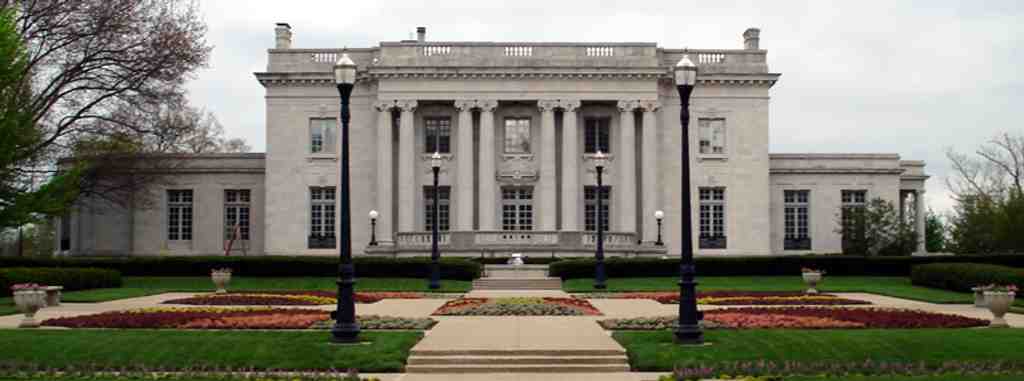
Look to your left for a big, boldly classical mansion-think white stone, tall columns, and formal gardens lined up like someone really wanted their backyard to impress a king. This is the Kentucky Governor’s Mansion, where Kentucky’s top boss comes home after a long day of politics. Picture this: It’s 1912, and Frankfort’s getting a new centerpiece-no log cabins here-just a grand home inspired by the French Petit Trianon at Versailles, of all places. If you’re getting royal vibes, that’s on purpose. The politicians in charge wanted the mansion built using only Kentucky’s own stone, which meant the state quite literally built this symbol of leadership from the ground up-local style. Now, you’ll notice some architectural flourishes that say “nobility on a budget.” The official commission went to the Weber brothers, who-surprisingly-weren’t actually architects. The real brains behind the place was a guy named John Scudder Adkins, an unsung hero in the world of Midwestern design. Classic politics: give credit to the connected, let the genius do the hard work. By the 1980s, this “palace” was a little down-in-the-mouth, and First Lady Phyllis George Brown jump-started a restoration. In today’s money, she rallied the equivalent of hundreds of thousands of dollars, giving the mansion a second life-right on time for its next century. Even now, the Governor’s Mansion is both the state’s living room and a living piece of art, open for tours if you want a glance behind the velvet ropes. When you’re ready, just walk west for about four minutes and you’ll hit the Floral Clock.
Abrir página dedicada →Look to your left and you’ll spot a massive, colorful clockface planted right into the slope, spelling out “KENTUCKY” with more flowers than most folks have in their entire…Leer másMostrar menos
Look to your left and you’ll spot a massive, colorful clockface planted right into the slope, spelling out “KENTUCKY” with more flowers than most folks have in their entire garden-if the hands are as long as a pickup truck, you’re at the right place. Now, if you thought telling time was just a matter of glancing at your phone, Frankfort would kindly like to remind you: why not use 10,000 flowers and a 15-foot-long hour hand instead? The Floral Clock behind the State Capitol isn’t just a timepiece-it’s Frankfort’s answer to “go big or go home.” Here’s how it all grew (pun intended). Back in 1961, Governor Bert Combs saw a fancy floral clock in Edinburgh, Scotland, and decided Kentucky deserved its own. Combs dipped into the state’s wallet-about $50,000, which would be nearly half a million dollars today-to build what was quickly dubbed “Combs’ Folly” by his rivals. The state teamed up with the Garden Club of Kentucky, who probably didn’t mind being given a few tons of begonias and a blank check. Opponents rolled their eyes-imagine political debates featuring not taxes, but timekeeping petunias. The most vocal critic was A.B. “Happy” Chandler, who threw out quips like, “It’s two petunias past the jimson weed,” instead of “half past two." But the joke was on them. Folks from all over came to gawk at the spectacle; soon, the clock was Frankfort’s unofficial must-see sight. Stand here and you’ll see its 34-foot diameter face tilting toward you at 26 degrees. Those gigantic hands weigh about as much as a motorbike and sweep over thousands of vibrant blooms-many of them Joseph’s coat and begonias-planted in soil nurtured in state greenhouses just down the road. The whole thing floats above a pool of water-yep, you can toss in a coin and make a wish. For decades, the “wishing well” money funded things like gym gear for kids or scholarships for budding landscape designers. Today, the pool’s treasure haul still gives local horticulture students a leg up. Ready for the next chapter? When you’re set, Jesse R. Zeigler House is a 7-minute walk northwest.
Abrir página dedicada →

Mostrar 8 paradas másMostrar menos paradasexpand_moreexpand_less
On your right, you’ll spot the Jesse R. Zeigler House-keep an eye out for a sharp-edged, white-and-black two-story home tucked partly behind a screen of mature trees, with big…Leer másMostrar menos
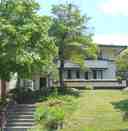
On your right, you’ll spot the Jesse R. Zeigler House-keep an eye out for a sharp-edged, white-and-black two-story home tucked partly behind a screen of mature trees, with big overhanging eaves and a low, straight-lined vibe that screams “architectural statement.” Alright, let’s step back in time for a second. Picture Reverend Jesse Zeigler, packed for a transatlantic journey in 1909, bumping into the one and only Frank Lloyd Wright on a boat to Europe- talk about an unlikely meeting spot for Kentucky and one of America’s most famous architects. They get to chatting, Zeigler’s got some ideas, and boom-a year later, this striking modern home pops up right here, far before ‘modern’ was even cool. It’s actually the only home Wright ever designed in Kentucky, and it’s a classic example of his “Fireproof House for $5,000”-which sounds thrifty until you realize that’s about $160,000 in today’s cash. The house is privately owned, so no poking around inside, but hey, just standing here you’re catching a rare bit of architectural history. When you’re ready, head north for about 15 minutes and you’ll find yourself at the Old United States Courthouse and Post Office.
Abrir página dedicada →Look to your left for a grand limestone building with a tall, fancy turreted tower-pretty hard to miss with its slate roof, sharp angles, and the kind of presence that almost…Leer másMostrar menos
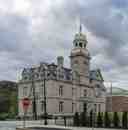
Look to your left for a grand limestone building with a tall, fancy turreted tower-pretty hard to miss with its slate roof, sharp angles, and the kind of presence that almost demands a tip of the hat. Step back and picture this spot in the 1880s, when this building was shiny and new-built with old-school, load-bearing walls and timber beams that have outlasted plenty of trends and a fair bit of Kentucky weather. Originally serving as both courthouse and post office, it saw serious business-federal law, big decisions, and surely more than a few whispered secrets in the halls-while doubling as Frankfort’s post office until 1965. Back in the day, mailing a letter here would set you back just two pennies, which is basically sixty cents in today’s money… but the stories? Those were priceless. Later, it was given new life as the town library, and these days, it's all academia as part of Kentucky State University. So standing here, you’re face-to-face with a building that's worn more hats than a Kentucky derby crowd. Alright, if you’re ready for a change of pace, just stroll northeast for one minute and you’ll hit the Corner in Celebrities Historic District.
Abrir página dedicada →Just to your left, you’ll spot a leafy stretch of sidewalk hugging a grand old brick building, with a dark green historical sign out front that reads “Corner in Celebrities”-if…Leer másMostrar menos
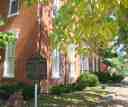
Just to your left, you’ll spot a leafy stretch of sidewalk hugging a grand old brick building, with a dark green historical sign out front that reads “Corner in Celebrities”-if you see a row of crisp white windows and Federal-style doorways tucked in the shade, you’re in the right spot. Now, the name “Corner in Celebrities” might sound like something out of a Hollywood gossip column, but Frankfort got there first. Instead of red carpets, it’s brick sidewalks and historic homes. This neighborhood is basically the Kentucky version of a celebrity home tour-minus the tinted windows and nosy tour buses. If these walls could talk, you’d hear over 200 years of political intrigue, family drama, and more senators and governors than you can shake a stick at. Picture this: back in the late 1700s, Frankfort was just carving out its place along the Kentucky River. General James Wilkinson-a man who somehow found time to run a ferry, launch a city, and allegedly dabble in espionage on the side-owned this stretch of land. When Kentucky became America’s 15th state, Frankfort bagged the title of state capital thanks, in part, to Wilkinson’s campaign skills and prime riverfront property. Right down Wapping Street, which gets its name from London’s “Old Wapping Stairs” (call it a bit of British homesickness from John Instone), you’ve got a parade of personalities. Some of their names are still spoken in Capitol halls, law schools, or, occasionally, muttered in exasperation at local trivia nights. Let’s start with Thomas Todd, who gave his name to one of the proudest brick houses here. Todd, a self-made legal expert who started as a Revolutionary War officer, went on to serve as Kentucky’s first Supreme Court clerk before climbing the ranks to Chief Justice-and then all the way to Washington, D.C., as a U.S. Supreme Court Justice, courtesy of President Thomas Jefferson. Not bad for a Kentucky boy. Todd bought his place on Wapping Street for what was probably less than the cost of a nice dinner out today-adjusted for inflation, that’s still a steal for a Supreme Court seat. His wife, by the way, was Dolley Madison’s sister. The guest list was never dull. A few doors down at 401 Wapping Street sits the Vest-Lindsey House, one of the oldest in town. Little George Graham Vest grew up here, and later coined the phrase, “Dog is man’s best friend.” Senator, legal legend, and clearly a dog lover. In 1846, Union General Daniel Lindsey took over the house-his family held onto it for over a century. And at the Bibb-Burnley House, also known as Gray Gables, you’ll find a 21-room Gothic Revival showpiece-built for John Bibb, who came to town as a state legislator. Writers and musicians flocked here; you could think of it as Frankfort’s unofficial early arts club. Don’t forget to glance at the parade of names listed on that marker: Harlan, Crittenden, Metcalfe, Vest, Morehead, Owsley, and Rodman. Their stately homes are sprinkled along Wapping and Wilkinson Streets, each with tales from the Civil War, state politics, journalism, and family roots that sink deep into Kentucky’s past. Today, this district is wrapped inside the larger Central Frankfort Historic District-sort of a nesting doll of landmark neighborhoods. But no matter how you dress it up, the Corner in Celebrities is still the beating heart of old Frankfort character. When you’re ready for a bit more 18th-century charm, Liberty Hall is just a 5-minute walk northwest along Wapping Street.
Abrir página dedicada →Alright, look to your left-that stately brick mansion with the trimmed lawns and the tall trees shading the walkway? That’s Liberty Hall. Quiet now, isn’t it? Hard to believe it…Leer másMostrar menos
Alright, look to your left-that stately brick mansion with the trimmed lawns and the tall trees shading the walkway? That’s Liberty Hall. Quiet now, isn’t it? Hard to believe it was once the social engine of early Kentucky, where lawmakers mingled, ideas bounced around, and a little political mischief was no doubt cooked up over tumblers of whiskey-purely for democracy’s sake, of course. Let’s turn back the clock. Picture it: 1796. Frankfort’s pretty much a frontier outpost, with muddy lanes and rugged folks carving out the state’s future. John Brown, not only a lawyer and a politician but also one of the guys who basically helped *create* Kentucky, snapped up this curving patch of ground for his grand dream home. In fact, he bought four whole acres-back then, you could get it for a price that, today, would barely get you a used pickup. He didn’t just want somewhere to hang his tricorn hat. He wanted *roots*. What you see today is a top-tier example of the Federal style-clean lines, symmetry, and serious dignity, brick walls right from Frankfort’s own clay, baked in kilns dug out of the cellar. You have to wonder who designed it-it’s a bit of a mystery-but John Brown surely had a hand in those solid choices. Mind you, it took years to get the whole thing finished. Brown worked in Philadelphia, then the U.S. capital. He came home just often enough to see the walls creeping up... and possibly to grumble about construction delays. Guess some things never change. There were plenty of outbuildings too: kitchen, smokehouse, laundry, stables, and, of course, quarters for enslaved people-reminders, for better or worse, of the era’s realities. The glass for the windows didn’t even arrive until 1804, so for a while, winter in this manse must’ve been brisk, to say the least. Liberty Hall stayed in the family into the 20th century, sheltering Brown’s children, grandchildren, even a future Kentucky governor and a Vice Presidential candidate. It's also the childhood home of children’s author Margaret Wise Brown, who penned “Goodnight Moon.” Can you imagine growing up here, surrounded by so much history-and probably the odd ghost story or two? In the 1930s, long after the last Brown moved out, concerned locals came together to save Liberty Hall. They scraped up the cash-about $5,000 at the time, which would be well over $110,000 today-to turn it into a museum instead of letting it slide into ruin. Now, the National Society of the Colonial Dames keeps the place open for tours, weaving in those stories and, sometimes, a little Southern gossip. You might even catch a whiff of pipe tobacco or hear a creak or whisper as you pass by-people say Liberty Hall has its resident spirits. But you’ll have to see for yourself. When you’re ready, the Frankfort Commercial Historic District is about a 7-minute walk southeast. Let’s go see where the city’s business happened.
Abrir página dedicada →On your right, you’ll spot a cluster of handsome brick and stone buildings, some with grand facades and decorative trim-you’ll recognize the district by its lively mix of historic…Leer másMostrar menos
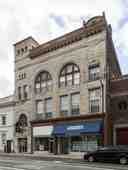
On your right, you’ll spot a cluster of handsome brick and stone buildings, some with grand facades and decorative trim-you’ll recognize the district by its lively mix of historic storefronts and old-fashioned charm, lining both sides of the street. Now, picture yourself strolling here in the late 1800s: shopkeepers urging you inside, the clop of horses over the Singing Bridge, and a skyline punctuated by domes, arches, and even a hint of Italianate flavor. This part of Frankfort isn’t just a main street-it's a snapshot of Kentucky commerce as it once was. More than eighty buildings make up this district, and each one brings a tale: from the 1845 stonework of the Hampton-Williams House to the Beaux-Arts drama of the Old State National Bank, courtesy of about $25,000 in the 1850s-that’s not pocket change; today, we’re talking over $900,000. Architect Gideon Shryock left his mark here, too-just imagine the competition and camaraderie among local architects, each vying for bragging rights. Even the Masons got in on the act, commissioning Clarke and Loomis for a Romanesque lodge that still guards its secrets. When you’re ready, Old State Capitol (Kentucky) is a 6-minute walk northeast.
Abrir página dedicada →To your left, you’ll spot a stately limestone building with a row of six massive columns and no front windows-like a Greek temple keeping its secrets behind closed doors. Now,…Leer másMostrar menos
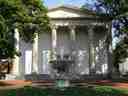
To your left, you’ll spot a stately limestone building with a row of six massive columns and no front windows-like a Greek temple keeping its secrets behind closed doors. Now, this isn’t just any temple-looking structure; it’s Kentucky’s Old State Capitol, the heart of state politics from 1830 to 1910. Picture young architect Gideon Shryock-just twenty-five!-choosing Greek Revival style to make Kentucky look as dignified as ancient Athens. The front, modeled after the Temple of Minerva, has no windows-because, you guessed it, Greek temples didn’t have any. Step inside, and you’d find a stone staircase that stands on its own, no support beams-just a puzzle of engineering bravado. The building saw its share of drama, including the assassination of William Goebel in 1900 after a bare-knuckles disputed election. There’s even a plaque out front to prove it-talk about political tension you could cut with a knife. If these marble halls seem peaceful now, remember, history was made right here-sometimes the kind that makes the hairs on your neck stand up. Alright, when you’re ready, the Old Governor’s Mansion is just a 5-minute walk southeast.
Abrir página dedicada →Alright, right here on your right is the Old Governor’s Mansion-though back when it was built in 1798, locals liked to call it the “Palace.” Not a bad bit of real estate for a…Leer másMostrar menos
Alright, right here on your right is the Old Governor’s Mansion-though back when it was built in 1798, locals liked to call it the “Palace.” Not a bad bit of real estate for a place built from funds set aside by the Kentucky General Assembly-three thousand dollars back then, which is roughly seventy thousand dollars in today’s money. Of course, it’s gotten a touch-up or two along the way: note the splash of Victorian design in the windows and trim, layered over its original style like architectural patchwork. This spot claims a dramatic history-fires, long bouts of neglect, and enough political maneuvering to fill a novel. Somehow, it’s hung on as the official residence for Kentucky’s lieutenant governor longer than any executive mansion in the lower forty-eight. Imagine the guest list: Theodore Roosevelt, Andrew Jackson, French royalty, even the Marquis de Lafayette blowing through for a nightcap. The bricklayer and stonemason who helped build it-Robert Letcher and Thomas Metcalf-both wound up as governors and lived here. Now, it’s in the care of the Kentucky Historical Society. Alright, ready to keep exploring? The Kentucky State Penitentiary in Frankfort is just a 4-minute walk northeast.
Abrir página dedicada →You’ve made it to our final stop-the Kentucky State Penitentiary in Frankfort, on your left. If these bricks look a bit stoic, well, they’ve seen every sort of drama you could…Leer másMostrar menos
You’ve made it to our final stop-the Kentucky State Penitentiary in Frankfort, on your left. If these bricks look a bit stoic, well, they’ve seen every sort of drama you could imagine. Built in 1800, this was the first prison planted west of the Alleghenies, back when Kentucky was still, let’s face it, more wilderness than commonwealth. The locals called it simply “Kentucky Penitentiary” for a good century or so. And at its founding, the legislature dug deep-well, about $500 to get started, which might buy you an appliance or two today, but back then, that was closer to $12,000 in today’s money. Imagine: brick walls, stone cells, and a stern promise that nobody, and I mean nobody, was supposed to get out. “Strong enough to keep the prisoners from getting away.” That’s always a hopeful blueprint. But this wasn’t just any old jail. For decades, it was the only such lockup west of Philadelphia. One acre donated by Henry Innis, appointed commissioners, and a contractor named Colonel Richard Taylor, who had the delightful job of making sure the convicts’d be well-contained... and definitely not bored. Speaking of the incarcerated, let’s sprinkle in a few names. The first admitted was John Turner, a horse thief, ushered in just months after the grand opening. Rachel Miller may have been the first woman, arriving in 1804. The youngest? Try Sam Dodd, just eight years old-sentenced for grand larceny in 1893, in an era when childhood came with hard time for a stolen item. Life here was rarely easy. By the 1820s, keepers ran this place on what you could call a business partnership: the State fronted money for materials, and the keepers-yes, the folks running the show-split profits from inmate labor. One infamous keeper, Zeb Ward, leased the whole operation for $6,000 a year, which today sounds modest but was the modern equivalent of almost $200,000. In four years, he’d walked away with-adjusted for inflation-over $3 million. He was described, let’s say, as “colorful.” A gambler, cronies in high places, and little sense of decency. And then there was Calvin Fairbank, the abolitionist, and Delia Webster, thrown in here for helping people escape slavery. This wasn’t just a place for the run-of-the-mill baddies; it was a flashpoint for moral battles of the day. Fires, reforms, and even a gothic entrance modeled on British castles-Frankfort’s pen could’ve inspired a prison movie or three. Punishments changed over time; gallows gave way to electric chairs after the 1910 reform bill, uniforms swapped from stripes to pale blue. No amount of reform could prepare them for what came in 1937. Picture this: the Ohio and Kentucky rivers turned into inland seas, swollen to the point where towns vanished underwater. The old prison was left reeling, the water swallowing cell blocks, workshops, and all the “no escape” promises. Guards hustled prisoners into boats, ferries, whatever would float. The sick were shipped to Lexington; the women, to a temporary schoolhouse. It was chaos-more tense than any Hollywood jailbreak-but nobody could argue with nature’s verdict. In the end, state officials finally shut it down for good. Floods did what decades of reformers, keepers, and crooks could not. What remains? A reminder that behind every stone lies a story-sometimes grim, sometimes hopeful, always human. Thanks for walking with me in Frankfort. It’s been a strange and wonderful journey, hasn’t it?
Abrir página dedicada →



Preguntas frecuentes
¿Cómo empiezo el tour?
Después de la compra, descarga la app AudaTours e ingresa tu código de canje. El tour estará listo para comenzar de inmediato - solo toca play y sigue la ruta guiada por GPS.
¿Necesito internet durante el tour?
¡No! Descarga el tour antes de empezar y disfrútalo completamente sin conexión. Solo la función de chat requiere internet. Recomendamos descargar en WiFi para ahorrar datos móviles.
¿Es un tour guiado en grupo?
No - esta es una audioguía autoguiada. Exploras de forma independiente a tu propio ritmo, con narración de audio reproduciéndose en tu teléfono. Sin guía, sin grupo, sin horario.
¿Cuánto dura el tour?
La mayoría de los tours toman 60–90 minutos para completar, pero tú controlas el ritmo completamente. Pausa, salta paradas o toma descansos cuando quieras.
¿Qué pasa si no puedo terminar el tour hoy?
¡No hay problema! Los tours tienen acceso de por vida. Pausa y continúa cuando quieras - mañana, la próxima semana o el próximo año. Tu progreso se guarda.
¿Qué idiomas están disponibles?
Todos los tours están disponibles en más de 50 idiomas. Selecciona tu idioma preferido al canjear tu código. Nota: el idioma no se puede cambiar después de generar el tour.
¿Dónde accedo al tour después de comprarlo?
Descarga la app gratuita AudaTours desde App Store o Google Play. Ingresa tu código de canje (enviado por email) y el tour aparecerá en tu biblioteca, listo para descargar y comenzar.
Si no disfrutas el tour, te reembolsamos tu compra. Contáctanos en [email protected]
Paga de forma segura con 


