Tour de audio de Örnsköldsvik: Monumentos, Leyendas y Caminos de Aprendizaje
Una sola torre brilla sobre el horizonte de Örnsköldsvik, sus ventanas de cristal reflejando tanto la promesa como los secretos de esta ciudad nórdica. Bajo la superficie pulida, historias inesperadas se entrelazan por las calles, esperando justo fuera de la vista. Sigue estas historias en un viaje de audio autoguiado. Abre puertas a dramas ocultos y rincones escondidos que el visitante ocasional pasa por alto. ¿Qué choque de ideologías dividió una vez los pasillos de la Escuela Superior Popular de Örnsköldsvik? ¿Qué escándalo se gestó tras las puertas cerradas del Hotel de la Ciudad, dejando reputaciones en ruinas? ¿Y por qué hay una habitación en Ting1 que los residentes evitan después del anochecer? Muévete por el corazón de Örnsköldsvik, cada parada latiendo con ecos de controversias no contadas y misterios espectrales. Deja que callejones y torres revelen el drama bajo la tranquilidad, cambiando cómo ves cada piedra. Busca los secretos de la ciudad: pulsa reproducir y comienza donde el horizonte proyecta sus sombras más evocadoras.
Vista previa del tour
Sobre este tour
- scheduleDuración 30–50 minsVe a tu propio ritmo
- straighten2.3 km de ruta a pieSigue el camino guiado
- location_onUbicaciónOrnskoldsvik, Suecia
- wifi_offFunciona sin conexiónDescarga una vez, úsalo en cualquier lugar
- all_inclusiveAcceso de por vidaReprodúcelo en cualquier momento, para siempre
- location_onComienza en Järnvägsgatan, Örnsköldsvik
Paradas en este tour
Look for a short, straight street edged by modern glass-and-stone blocks, with the station at one end and the city hall called Kronan as the clearest marker. Järnvägsgatan is…Leer másMostrar menos
Abrir página dedicada →
Järnvägsgatan, ÖrnsköldsvikPhoto: Leojth, Wikimedia Commons, CC BY-SA 3.0. Cropped & resized. Look for a short, straight street edged by modern glass-and-stone blocks, with the station at one end and the city hall called Kronan as the clearest marker.
Järnvägsgatan is barely a street by big-city standards... no longer than two hundred meters. Yet that is exactly its point. It begins at Örnsköldsvik Central Station, where arrivals first meet the city, then runs north past Kronan, which has served as the town hall since March twenty fifteen, and past the Arken complex. In this brief stretch, travel, government, and everyday city life stand almost shoulder to shoulder. At Strandgatan, Järnvägsgatan breaks into other roads, as if this whole street exists to gather people in and send them onward. That makes this place feel less like a grand boulevard and more like a hinge... a small turning point where movement becomes civic life.
This little street shows how compact and purposeful the center of Örnsköldsvik really is.
Take a moment here, and when you're ready, we can continue to the next stop.
Look for the modern harbor-side station with metal cladding, a low rectangular shape, and broad bay doors that show it is built for work. This is Räddningsstation Örnsköldsvik,…Leer másMostrar menos
Abrir página dedicada →
Rescue station ÖrnsköldsvikPhoto: Boberger, Wikimedia Commons, CC BY-SA 3.0. Cropped & resized. Look for the modern harbor-side station with metal cladding, a low rectangular shape, and broad bay doors that show it is built for work.
This is Räddningsstation Örnsköldsvik, one of the Swedish Sea Rescue Society stations, set here on Varvskajen near the old railway station. Since two thousand ten, about twenty-five volunteer sea rescuers have worked from this base... ordinary people who turn toward emergencies when someone else is in danger. Their boats carry that responsibility out onto the water: Rescue Ilse Sanne, an eleven point eight meter Victoria-class rescue vessel - meaning one of a standard family of rescue boats - built in two thousand seven by M-B Marin A-B in Henån; Rescue Yvonne Bratt, a Gunnel Larsson-class craft from two thousand sixteen; and the three-fifty-one Rescuerunner Höga Kusten Flyg, a smaller fast-response craft from two thousand twelve. Earlier crews launched Rescue Örnsköldsvik and Rescue Traviata Wallenius from here as well.
Fittingly, this station stands ready twenty-four hours a day, every day of the week. This is a place where service matters more than spectacle. When you're ready, we can continue to Örnsköldsvik City Hotel.
Look for the light masonry facade rising from a granite base, a broad rectangular front, and the formal entrance that anchors the building. This hotel grew out of ambition...…Leer másMostrar menos
Abrir página dedicada →Look for the light masonry facade rising from a granite base, a broad rectangular front, and the formal entrance that anchors the building.
This hotel grew out of ambition... and delay. In eighteen eighty-nine, city leaders planned one grand building for both the town hall and the city hotel. Architect Emil Befwe drew sketches in eighteen ninety-five, but three years later the town changed course and gave the hotel its own site. Workers laid the granite foundation and terrace, then money ran short and everything stalled at the turn of the century. Not until nineteen eleven did Gustaf Sällström push the project forward again.
The opening came on the thirteenth of January, nineteen thirteen, with real ceremony. The county governor attended, guests sat through a dinner that lasted three hours, Herbortska solistkapellet played, and afterward people danced. Inside, the hotel offered twenty-one guest rooms, fourteen rooms with sleeping alcoves, and three unpacking rooms... spaces where traveling salesmen could open their sample cases and stay the night.
Then the place kept reinventing itself. Stockholmsdistriktets Allmänna Restaurang Aktiebolag, known as SARA, took over operations in nineteen thirty-nine. A fire in October nineteen seventy-four destroyed the dining rooms, bar, pub, and six rooms above, yet everyone escaped without injury, even though the hotel was full. The restaurant reopened the next year. By twenty twenty-four, the hotel held one hundred fifteen rooms.
For a practical note, the hotel stays open twenty-four hours a day.
This building tells a quiet story about a town that kept choosing to renew itself.
When you're ready, we can continue toward Campus Örnsköldsvik.
Mostrar 6 paradas másMostrar menos paradasexpand_moreexpand_less
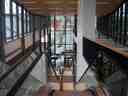
On your left, look for a modern brick-and-glass building with a long rectangular frontage and a clearly marked main entrance. Campus Örnsköldsvik shows how a smaller city…Leer másMostrar menos
Abrir página dedicada →On your left, look for a modern brick-and-glass building with a long rectangular frontage and a clearly marked main entrance.
Campus Örnsköldsvik shows how a smaller city decides to keep knowledge close to home. This campus serves mainly Umeå University, but it also gathers higher vocational programs... practical, job-focused training... and some remaining work from Mid Sweden University. That mix gives the place its character.
One turning point came in nineteen ninety-five, when the nursing college in Östersund joined what was then Mid Sweden University. Then, on the first of July, two thousand and seven, Umeå University took over nurse training here in Örnsköldsvik. With that change, this campus lost its formal status as a Mid Sweden campus. But the story did not end there. Mid Sweden University still teaches and researches digital printing here through the Digital Printing Center, a field shaped by the region’s paper industry.
There is also a branch of Umeå University Library here, open not only to students and researchers, but to the public as well.
This is a place where education keeps adapting without losing its purpose. When you’re ready, we can continue on to Ting1.
On your right stands a square tower of glazed ceramic and painted metal, with boxed glass balconies jutting out and a patchwork of red, yellow, and green that makes it easy to…Leer másMostrar menos
Abrir página dedicada →
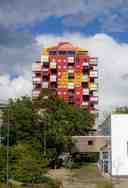
Ting1Photo: user:dcastor, Wikimedia Commons, CC BY-SA 4.0. Cropped & resized. On your right stands a square tower of glazed ceramic and painted metal, with boxed glass balconies jutting out and a patchwork of red, yellow, and green that makes it easy to spot.
Ting one refuses to behave like an ordinary apartment building. Gert Wingårdh designed it, and residents moved in in twenty thirteen, but its story begins with the older courthouse below and around it. In twenty ten, Nicklas Nyberg and Torsten Kai-Larsen bought that raw concrete building from nineteen sixty-six, a tough, heavy example of new brutalism, an architectural style that favors exposed concrete and bold mass. They wanted homes here, but the old structure could not carry the weight.
So Wingårdh solved the problem with sheer nerve. Ting one stands on a separate concrete core, only eight by eight meters wide, planted in the courthouse courtyard. Above the old roofline, the building thrusts outward to a broad twenty-two by twenty-two meters. That kind of overhang is called a cantilever, meaning the upper floors project far beyond the support below. All the strength sits in that central tower, packed with an unusually dense web of steel reinforcement.
If you glance at your screen, the façade makes the idea clear. Wingårdh drew its colors from Bengt Lindström’s painting Women’s Dance, turning it into a kind of pixelated skin in glazed ceramic. Then he added seventy-eight glass balconies for fifty-one apartments.

Ting1’s colorful façade and stacked glass balconies make the building famous as Örnsköldsvik’s so-called 'Legohuset'.Photo: Tunegravity, Wikimedia Commons, CC0. Cropped & resized. People argued fiercely over it... award-winning in twenty fourteen, and also mocked as Sweden’s ugliest new building, the so-called Lego House.
Ting one shows how one building can become both engineering feat and public provocation.
When you’re ready, we can continue toward the Oscar Gallery.
On your right, The Oscar Gallery stands out as a broad modern block with pale exterior panels, long bands of glass, and a clean commercial facade that stretches across the street…Leer másMostrar menos
Abrir página dedicada →
The Oscar GalleryPhoto: Petey21, Wikimedia Commons, Public domain. Cropped & resized. On your right, The Oscar Gallery stands out as a broad modern block with pale exterior panels, long bands of glass, and a clean commercial facade that stretches across the street line.
What you are looking at began in nineteen sixty-four, when Domus used this building as a department store... the kind of place meant to gather daily life under one roof. In the late nineteen nineties, the city reshaped it into a shopping gallery, though at first it did not even have an official name. Back then, it held only sixteen shops on two floors. Then came the decisive change: during the rebuilding of two thousand and four and two thousand and five, owners turned it into the modern three-floor center you see now, covering about eight thousand six hundred square meters and housing around thirty-five shops. It opened as Oskargallerian on the twenty-second of September, two thousand and five, and claimed a quiet distinction as the third largest shopping center in Västernorrland, after Birsta and In: in Sundsvall.
It still keeps regular shopping hours, usually ten to seven on weekdays, with shorter hours on weekends. This is a story of reinvention, written in glass and floor space. When you are ready, we can continue to the next stop.
Look for the pale brick building with a long rectangular frontage and steady rows of windows, a schoolhouse shape made unmistakable by its simple symmetry. Standing outside a…Leer másMostrar menos
Abrir página dedicada →
Örnsköldsvik Folk High SchoolPhoto: Deryni, Wikimedia Commons, CC BY-SA 3.0. Cropped & resized. Look for the pale brick building with a long rectangular frontage and steady rows of windows, a schoolhouse shape made unmistakable by its simple symmetry.
Standing outside a school, you can feel how education leaves layers behind. In South Korea's Imsil County, Cheongung School began on the sixteenth of March, nineteen twenty-two, as Cheongung Private Common School. Five years later, officials approved it as Cheongung Public Common School. Then the country changed, and the school changed with it: in nineteen thirty-eight it became a simsang school, a standard elementary school, and in nineteen forty-one a national school. A one-class kindergarten opened in nineteen eighty-one. Okseok Branch closed into the main school in nineteen eighty-nine, Seongeo Branch in nineteen ninety-three. In nineteen ninety-six it took its current name. The thirty-first principal, Choi Byeong-cheol, arrived in twenty nineteen. At the eighty-ninth graduation, on the thirteenth of February, twenty twenty, only four students graduated, bringing the total to seven thousand one hundred sixteen. Weekdays are generally open around the clock, with weekends closed. This stop reminds us that a school's true architecture is memory. When you're ready, we can continue toward the church.
On your right, look for the light masonry church with its tall square tower, steep rooflines, and the carved stone relief set above the main entrance. Örnsköldsvik gave itself…Leer másMostrar menos
Abrir página dedicada →
Örnsköldsvik ChurchPhoto: user:dcastor, Wikimedia Commons, CC0. Cropped & resized. On your right, look for the light masonry church with its tall square tower, steep rooflines, and the carved stone relief set above the main entrance.
Örnsköldsvik gave itself this church in nineteen ten, and architect Gustaf Améen designed it to feel steady rather than showy... a landmark that could gather a growing town around one shared center. The church opened on the eleventh of December, nineteen ten, the third Sunday in Advent, and that timing matters. It entered local life not as a monument standing apart, but as part of the yearly rhythm of worship, work, and memory.
Above the main doors, the relief tells you a great deal about the building’s purpose. At its center is Christ, described here as the sun of grace, gentle and radiant. Around him are the four ancient symbols of the Evangelists, the writers of the Gospels: the lion for Mark, the angel for Matthew, the eagle for John, and the ox for Luke. Even before anyone steps inside, the message is clear. This is a church that teaches in images.
And inside, it keeps doing that. Much of the interior you would see today comes from a major restoration between nineteen fifty-three and nineteen fifty-five, when architect Martin Westerberg reshaped parts of the church, changed the colors, and introduced new furnishings. If you glance at the image on your screen, you can see the bright chancel painting, the space around the altar, called The Great Banquet. Sigurd Möller painted it in a dry fresco technique, showing Jesus’ parable of an open feast where the invited guests do not all come, and others are welcomed in instead.

The chancel interior with Sigurd Möller’s fresco-secco, “The Great Banquet,” one of the church’s most distinctive post-restoration artworks.Photo: This image was produced by me, David Castor (user:dcastor). The pictures I submit to the Wikipedia Project are released to the public domain. This gives you the right to use them in any way you like, without any kind of notification. This said, I would still appreciate to be mentioned as the originator whenever you think it complies well with your use of the picture. A message to me about how it has been used would also be welcome. You are obviously not required to respond to these wishes of mine, just in a friendly manner encouraged to. (All my photos are placed in Category:Images by David Castor or a subcategory thereof.), Wikimedia Commons, CC0. Cropped & resized. That spirit of welcome echoes through the details. Clarence Blum designed the sculpted panels of the altar rail, where a young woman carries grain and a young man gathers grapes, ordinary harvest turned into symbols of communion. The baptismal font, carved in granite by A-F Berg, stands beneath a votive ship, a model vessel hung in the church. In coastal Sweden, that ship remembers both the sea that sustained the region and an older Christian image: the believer carried across the rough waters of time toward safety.
One of the loveliest changes came later. In nineteen seventy-two, the north transept arm became a smaller chapel, often called the Sköld Chapel, after professor Otte Sköld’s sixteen medallion windows showing the miracles of Jesus. If you're curious, the before-and-after image in the app is worth a quick look; the church itself stays reassuringly familiar while the world around it shifts almost without announcing it.
Up in the tower, three bells still define the building’s public voice. They weigh one thousand six hundred and fifty, one thousand four hundred, and eight hundred and fifty kilograms, and their notes ring out as C sharp, E flat, and F... not just to call people to worship, but to mark the border between ordinary time and something set apart.
If you want to step inside later, the church is usually open weekdays from eight to four, and on Sundays from ten to noon.
This church holds the town’s faith, craft, and memory in one calm body. Take a moment with it... and when you’re ready, we can continue to the next stop.

A sweeping aerial view of Örnsköldsviks Church and its setting in the town, useful for showing the landmark’s overall footprint and location.Photo: This image was produced by me, David Castor (user:dcastor). The pictures I submit to the Wikipedia Project are released to the public domain. This gives you the right to use them in any way you like, without any kind of notification. This said, I would still appreciate to be mentioned as the originator whenever you think it complies well with your use of the picture. A message to me about how it has been used would also be welcome. You are obviously not required to respond to these wishes of mine, just in a friendly manner encouraged to. (All my photos are placed in Category:Images by David Castor or a subcategory thereof.), Wikimedia Commons, CC0. Cropped & resized. 
The church seen from the northeast in late autumn — a clear exterior view of the 1910 church designed by Gustaf Améen.Photo: Hans Lindqvist, Wikimedia Commons, CC BY-SA 3.0. Cropped & resized. 
Aerial perspective highlighting the church’s roof and plan, giving context to the 20th-century building in Örnsköldsvik.Photo: This image was produced by me, David Castor (user:dcastor). The pictures I submit to the Wikipedia Project are released to the public domain. This gives you the right to use them in any way you like, without any kind of notification. This said, I would still appreciate to be mentioned as the originator whenever you think it complies well with your use of the picture. A message to me about how it has been used would also be welcome. You are obviously not required to respond to these wishes of mine, just in a friendly manner encouraged to. (All my photos are placed in Category:Images by David Castor or a subcategory thereof.), Wikimedia Commons, CC0. Cropped & resized. In front of you stands a broad brick school building, rectangular and orderly, with long bands of windows and a clearly marked central entrance that gives it a calm, modern…Leer másMostrar menos
Abrir página dedicada →
Örnsköldsvik's higher general grammar schoolPhoto: Henrik Sendelbach, Wikimedia Commons, CC BY-SA 3.0. Cropped & resized. In front of you stands a broad brick school building, rectangular and orderly, with long bands of windows and a clearly marked central entrance that gives it a calm, modern weight.
This place carries more than one school life. The story began in eighteen sixty-one, when Örnsköldsvik founded a smaller grammar school. Over the decades, it kept changing with the town itself: in nineteen oh five it became a coeducational school, teaching girls and boys together, and from nineteen forty-four it grew into a higher general grammar school with a four-year gymnasium, the university-prep level. Architect Paul Hedqvist gave it this brick form, and the first lessons started here on the twenty-sixth of August, nineteen forty-nine, with seven hundred and eighty-nine students.
When Princess Sibylla came for the opening in April nineteen fifty, this building already held an ambitious world inside: a library, rooms for the humanities, geography, biology, physics, chemistry, technical training, crafts, household studies, and even an organ in the assembly hall. In nineteen sixty-six, the municipality took over and renamed it Nolaskolan. If you plan to return, it usually opens on weekdays and stays closed on weekends.
Preguntas frecuentes
¿Cómo empiezo el tour?
Después de la compra, descarga la app AudaTours e ingresa tu código de canje. El tour estará listo para comenzar de inmediato - solo toca play y sigue la ruta guiada por GPS.
¿Necesito internet durante el tour?
¡No! Descarga el tour antes de empezar y disfrútalo completamente sin conexión. Solo la función de chat requiere internet. Recomendamos descargar en WiFi para ahorrar datos móviles.
¿Es un tour guiado en grupo?
No - esta es una audioguía autoguiada. Exploras de forma independiente a tu propio ritmo, con narración de audio reproduciéndose en tu teléfono. Sin guía, sin grupo, sin horario.
¿Cuánto dura el tour?
La mayoría de los tours toman 60–90 minutos para completar, pero tú controlas el ritmo completamente. Pausa, salta paradas o toma descansos cuando quieras.
¿Qué pasa si no puedo terminar el tour hoy?
¡No hay problema! Los tours tienen acceso de por vida. Pausa y continúa cuando quieras - mañana, la próxima semana o el próximo año. Tu progreso se guarda.
¿Qué idiomas están disponibles?
Todos los tours están disponibles en más de 50 idiomas. Selecciona tu idioma preferido al canjear tu código. Nota: el idioma no se puede cambiar después de generar el tour.
¿Dónde accedo al tour después de comprarlo?
Descarga la app gratuita AudaTours desde App Store o Google Play. Ingresa tu código de canje (enviado por email) y el tour aparecerá en tu biblioteca, listo para descargar y comenzar.
Si no disfrutas el tour, te reembolsamos tu compra. Contáctanos en [email protected]
Paga de forma segura con