AudaTours logoAudaTours

Audioguía de Santiago: Revelando el Alma Cívica de Santiago

Guía de audio15 paradas

Un disparo rompió la tranquilidad del Cerro Santa Lucía y los ecos de la rebelión aún resuenan entre las columnas ornamentadas del Teatro Municipal de Santiago. Hay más en esta ciudad que tráfico y cafés; sus secretos están enterrados bajo cada paso. Este audioguía autoguiado te invita más allá de los folletos turísticos a un Santiago trazado por la intriga y la ambición. Descubre historias escondidas en patios y susurros llevados por el viento a través de los salones cívicos. ¿Qué escándalo obligó a bajar el telón en la noche de estreno del escenario más grandioso de Chile? ¿Quiénes escalaron los empinados senderos de Santa Lucía como revolucionarios y por qué un reloj infundió terror en los académicos universitarios? ¿Por qué las cámaras del Consejo resuenan con leyendas de traición? Múevete a través de piedra, sombra y luz solar mientras las capas se desprenden para revelar convulsiones políticas, estallidos creativos y actos silenciosos de desafío. El verdadero Santiago se eleva bajo tus pies. Comienza tu viaje ahora, y deja que la ciudad revele lo que guarda escondido.

Vista previa del tour

map

Sobre este tour

  • schedule
    Duración 40–60 minsVe a tu propio ritmo
  • straighten
    3.1 km de ruta a pieSigue el camino guiado
  • location_on
    UbicaciónSantiago, Chile
  • wifi_off
    Funciona sin conexiónDescarga una vez, úsalo en cualquier lugar
  • all_inclusive
    Acceso de por vidaReprodúcelo en cualquier momento, para siempre
  • location_on
    Comienza en Consejo de Rectores de las Universidades Chilenas

Paradas en este tour

  1. You’re now standing in front of the Council of Rectors of Chilean Universities, a place that might look calm on the outside, but inside, it’s where the titans of Chilean education…Leer másMostrar menos

    You’re now standing in front of the Council of Rectors of Chilean Universities, a place that might look calm on the outside, but inside, it’s where the titans of Chilean education come together to shape the future. Let’s wind the clock back to 1954. Imagine the city buzzing with the energy of post-war growth. Cars roll down the avenue-now and again, a bus rattles past--and indoors here, a far quieter but no less important revolution is underway. Picture a group of university rectors, the sharpest minds from all over Chile, gathering for the first time by law number 11.575. Their goal? To bring order to the sometimes wild world of Chilean university education. Before this, each university was like a lone rock star, playing its solo; but the government decided it was time to form a band. Of all the instruments, the founder members were the rectors from the University of Chile, University of Concepción, both Catholic Universities of Santiago and Valparaíso, and a few other classics. The main tune? Creating annual plans to coordinate science and technological research, using whatever budget the universities could cobble together. You know academics-never shy of asking for a larger slice of cake! In 1964, the Council got a promotion: its own legal personality! It was finally a recognized “personality,” unlike that one uncle at family gatherings. The minister of Education took center stage as the President, and with a rotating Vice President spot, everyone got a turn at holding the microphone. The first council regulations debuted then, laying out everything from how to organize research to the all-important business of keeping detailed, and sometimes comically complex, statistics about every student, faculty member, and degree in the country. For years, the Council handled public research funds, beating out other government agencies until 1967, when the responsibilities shifted to CONICYT. Talk about passing the hot potato! Through the 1970s and 80s, the list of universities expanded, shrunk, then expanded again, like a sponge at a science fair. The rules changed too-at one point, the Minister of Education himself led the group, sometimes bringing a little too much government “flavor” into university decisions. Yet, the core mission endured: help universities work together, but never at the cost of their own independence or unique quirks. The Council coordinates things that every nervous 18-year-old in Chile knows well: university admissions. Since 2013, the Council led the Single Admission System, making entry into thirty traditional universities-and now 16 more private ones-just a tiny bit more organized. And to get in, students now face the PAES test, a rite of passage that’s legendary for keeping folks up at night. The University of Chile helps run this operation, surely fueling even more campus coffee breaks. But it’s not just about admissions. The Council also prints annual posts about university stats-how many students, how many classes, costs, even lists of faculty degrees. Talk about transparency! Future trivia nerds, rejoice. What’s fascinating is the tapestry of universities represented here. State universities, old and new, and a powerful lineup of private ones, some Catholic, some secular. Every year, the roster grows. Newcomers like the University of O’Higgins, University of Aysén, and even private institutions like Diego Portales, Alberto Hurtado, and Los Andes have recently taken their seats at the table. Getting a seat on this Council is no easy feat-there are rules, and more exceptions than a pirate’s code. Inside those walls, sessions happen at least once a month, sometimes more, when urgent issues arise. Three-fifths of the members need to show up to set things in motion, but big decisions demand even higher consensus. Seems even rectors have trouble agreeing what’s for lunch! The Council is a mastermind, but it never oversteps. It makes recommendations, offers insights, coordinates studies, and issues declarations when times get tough. Yet every university keeps its own voice, its own way of doing things-like students at a group project who actually, miraculously, get along. And yes, all these brains need backing, so every member university chips in to keep the lights on. The sound of calculators clicking is part of the monthly rhythm--reminding everyone that even the loftiest ideas need a well-planned budget. So here you are, outside a quiet facade, but behind it, Chile’s academic brain trust has been plotting and planning for decades. A place where debates probably get heated, but everyone knows what they’re arguing about: the country’s future. Exploring the realm of the structure, powers or the composition? Feel free to consult the chat section for additional information.

    Abrir página dedicada →
  2. Straight ahead, towering over the neighboring buildings, you’ll spot the Torre Entel-a tall, concrete shaft ending in a wide, round top filled with antennas and crowned by a…Leer másMostrar menos

    Straight ahead, towering over the neighboring buildings, you’ll spot the Torre Entel-a tall, concrete shaft ending in a wide, round top filled with antennas and crowned by a massive LED screen about a block away from Alameda Avenue. Now that you’re here, let me set the scene. Imagine standing in downtown Santiago in the early 1970s. The city hums with the energy of change-cars honk, people bustle by, and construction workers clang away as something new rises above the skyline. Suddenly, in a space that used to be just an ordinary corner on Amunategui Street, a massive telecommunications tower begins to take shape. This is the birth of the Torre Entel-a project started in 1970 during President Eduardo Frei Montalva’s government. Its mission? To become the nerve center for all of Chile’s communications… no pressure! When it was finished in 1974, this tower was the tallest structure in all of Chile, stretching a neck-bending 128 meters into the sky with 18 whole floors. People must have wondered if it was also built as a giant perch for visiting UFOs. In fact, the Torre Entel was built to look a bit like an old telegraph torch system, mixing ancient communication ideas with high-tech ambition. Pioneering Chilean architects and engineers, like Carlos Alberto Cruz Claro and Rodrigo Flores Álvarez, worked for years, pouring tons of iron and concrete-so much, it went 18 meters underground just for stability. The result? A tower so tough, it was designed to outlast even the strongest earthquakes-good news in Santiago, where the ground occasionally throws a real party. But what’s a futuristic tower without a few gadgets? In 1975, the magic began as two huge satellite dishes were attached-these were the first antennas anyone could see from the outside. By 1976, all sorts of telephone channels started running through the tower, connecting not just Santiago, but all of Chile, from north to south, and even as far as Mendoza in Argentina. Just picture it: conversations, news broadcasts, and microwaves all zipping through the air, making Torre Entel the country’s vital hotline. Over the years, this tower has seen it all-massive firework displays every New Year’s Eve as thousands gather below, and even gigantic butterflies and a massive woodpecker, thanks to artists from the Hecho en Casa festival. Yes, once, a giant bird was perched right up there, thinking it had finally found Chile’s tallest tree! And speaking of big things, in 2009, they installed the biggest LED screen in South America at the top-320 square meters of glowing lights, blaring the weather and breaking news for everyone within a few kilometers to see. But for all its technology, this place has felt the tremble of history, too. In 2019, amid a wave of protests, the base was damaged and graffiti covered the lower walls. Through it all, though, the tower stands solid-a true Santiago survivor and symbol. So, next time you spot this tower from far away, remember: it’s not just a hunk of concrete and steel, it’s Santiago’s giant ear and megaphone, humming day and night, connecting voices and stories all across Chile. And if you’re here on New Year’s Eve, you might just catch the tower lighting up the city and ringing in the future-now that’s what I call a signal worth catching.

    Abrir página dedicada →
  3. You’re now face-to-face with MetroArte, which, believe it or not, is much more than just walls and platforms-this place is a whole underground art adventure. Founded back in 1992…Leer másMostrar menos

    You’re now face-to-face with MetroArte, which, believe it or not, is much more than just walls and platforms-this place is a whole underground art adventure. Founded back in 1992 by Metro S.A., MetroArte is like the city’s own secret superhero, transforming plain subway stations into vibrant galleries and cultural hotspots. Picture the buzz of commuters moving all around you, but now imagine those same crowds pausing to marvel at murals, sculptures, and even dioramas that bring slices of Chilean history to life. One of the earliest masterpieces-“Interior Urbano”-first splashed across the Universidad de Chile station in 1993, kicking off a movement that now fills the Metro with 25 spectacular art installations. MetroArte didn’t stop there; it organizes events like “Santiago en 100 Palabras,” a city-wide story contest where thousands of people try to squeeze their whole world into just 100 words. Not easy! If you ever need writing inspiration, just hop on the subway. And let’s talk about those dioramas! Since 1986, the artist Zerreitug has crafted mini worlds hidden in stations. Some show historic Chilean moments, others reveal playful scenes linked to the names of the stations-so even catching your train feels like you’re popping into a history museum. There’s even an international twist: at Ñuñoa station, you’ll find “Suizspacio,” a permanent gallery focused on Swiss-Chilean exchange. It exists thanks to the Swiss Embassy and local Swiss community, who brought a taste of the Alps here to the metro in 2021. Picture a bit of Swiss cheese melting... perhaps not in your bag, but in the form of art on the walls! So, next time you swipe your Metro card, remember: you’re entering a subway where art and culture ride beside you. Welcome to MetroArte-no ticket to Europe required!

    Abrir página dedicada →
Mostrar 12 paradas másMostrar menos paradasexpand_moreexpand_less
  1. Look straight ahead for a grand, rectangular building with light greenish walls, tall arched windows, ornate balconies, and a huge black-and-white banner draped over the top -…Leer másMostrar menos

    Look straight ahead for a grand, rectangular building with light greenish walls, tall arched windows, ornate balconies, and a huge black-and-white banner draped over the top - that’s Casa Espínola Pereira right there, proudly facing the Alameda. Let me take you back in time: Imagine it’s the early 1900s and this corner of Santiago is alive with the sound of horse carriages and the smell of fresh pastries from street stalls. Ricardo Solano Astaburuaga decides to build a showstopper home here - only to barely live in it! He sold it off to Belisario Espínola, and, faster than you can say “neoclassical French,” the house found its way to Julio Pereira Íñiguez in the roaring 1920s. Pereira brought in the star architect Alberto Cruz Montt, who filled the place with grand wooden halls, parlor rooms with fantastic textiles, parquet floors with quirky patterns, and ceilings dressed up with genuine old-school plasterwork. But life in this house was never boring. After Pereira’s family, the government bought the property, planning to turn it into a museum, but fate had other ideas! Instead, Soviet-donated toys and teaching gadgets brightened up its huge rooms as a kindergarten from 1972. Children’s laughter echoed off the high walls and out into the gardens around the back, at least until the 1985 earthquake shook things up and left the building silent for five long years. But you can’t keep a legend down! Since the '90s this unique mansion has belonged to the Central Unitaria de Trabajadores, Chile’s big union. In 2024, it was finally crowned a National Monument. So while you gaze up at those elegant arches, know you’re looking at a survivor - a place that’s held fancy dinners, sheltered children, rebuilt after disaster, and now champions the voice of Chile’s workers. Not bad for a building that almost ended up being just an empty museum!

    Abrir página dedicada →
  2. To spot the General Treasury of the Republic, look for a grand, beige stone building with a tall arched doorway and the words "TESORERIA GENERAL DE LA REPUBLICA" carved above the…Leer másMostrar menos

    To spot the General Treasury of the Republic, look for a grand, beige stone building with a tall arched doorway and the words "TESORERIA GENERAL DE LA REPUBLICA" carved above the entrance-right here in front of you! Now, get ready for a little time-travel-with a twist of drama and a sprinkle of suspense! Imagine yourself in the early days of Santiago, in a bustling city square, where coins clink, serious faces shuffle stacks of papers, and, honestly, someone in a wig is probably grumbling about taxes. The story of Chile’s Treasury goes all the way back to 1541, when legendary explorer Pedro de Valdivia founded Santiago and gave a new arrival-Gerónimo de Alderete-the job of keeping track of royal money. That was a risky gig! Gerónimo wasn't your average accountant; he once sailed to Spain to convince the king that Valdivia was still the boss in Chile and hand over a load of gold coins as proof. Talk about an “expensive” trip! Alas, the drama of colonial politics caught up: Valdivia met his end in battle against the Mapuche, and poor Alderete caught malaria and died in Panama before ever returning to take his post. Under Spanish rule, the finances of this huge, distant territory fell to nineteen trusted treasury officials, each charged with keeping the books balanced and the royal gold safe. But the world was changing fast and, after the chaos of wars and independence, the new Republic of Chile formed its own Ministry of Finance in 1817 and appointed Hipólito Villegas as both Minister and Treasurer-clearly, he didn’t believe in delegating! Money kept marching on: through the 19th century, new presidents and ministers came and went. There was Manuel Rengifo, famed for straightening out Chile’s finances in the 1830s-as thrilling as fiscal order can get! The Treasury became the unsung lifeline during the War of the Pacific, conjuring up paper money and debt to keep the war effort funded. A major shakeup in 1875 renamed it the Dirección del Tesoro y Amonedación; picture coordinated teams collecting taxes and even turning gold and silver into new coins, all under one roof! That’s multitasking before email was invented. By 1927, President Carlos Ibáñez del Campo thought it was time to supercharge the system. With a sweep of his pen (and maybe a dramatic flourish), he signed Decree 1.708, creating the Tesorería General de la República as we know it today. The very first General Treasurer was Augusto Merino Segura, a bank manager trusted to bring order, security, and a bit of bank-approved flair to public finances. Around the same time-cue a drumroll-the government invited a team of financial pros led by American Edwin Kemmerer to overhaul Chile’s whole system, leading to the creation of institutions like the Central Bank. No pressure! Through fires, reforms, and mountains of paperwork, the General Treasury centralized accounts, streamlined the flow of tax money, paid public workers, wrangled debts, and kept a close watch over every peso and coin coming in or out of the nation’s pocketbook. In the 1960s, sweeping changes further organized the institution, launching the mighty Fiscal Single Account in Banco Estado-a super-bank account for managing Chile’s money. Fast forward to today, the Treasury isn’t stuck in the past. Imagine a digital future-no more waiting in long lines or paper headaches. By 2023, over 80% of citizen requests arrived virtually, thanks to new technologies, online platforms, and remote help desks. The Treasury’s reach stretches from Arica to Porvenir with 53 offices-so whether you’re paying taxes, bonds, or just a curious time traveler, they’ve got you covered. So here you stand, outside the living legacy of centuries of Chile’s fiscal adventures-where every coin, voucher, and bill has a story. Don’t worry, I promise I won’t make you fill out any forms on this tour-though, between us, the Treasury would probably love your signature!

    Abrir página dedicada →
  3. Right in front of you stands a grand, bright-white neoclassical palace with a stately arched entrance in the center, ringed by tall flagpoles flying red, white, and blue Chilean…Leer másMostrar menos

    Right in front of you stands a grand, bright-white neoclassical palace with a stately arched entrance in the center, ringed by tall flagpoles flying red, white, and blue Chilean flags-just look down the wide path flanked by blooming flowers, and you can’t miss it! Now, while you gaze at the impressive Palacio de la Moneda, let’s take a journey through its fascinating-and often dramatic-history. Imagine the year is 1786. The air in Santiago is thick with the sounds of building; workers unload heavy stones and wood, while the Italian architect Joaquín Toesca supervises every single detail. If you listen closely, you might almost hear the clatter of chisels and hammers as this masterpiece is born atop land once owned by the Jesuits. But hang on-La Moneda wasn’t always the center of power you see now. It actually started as a mint, stamping out shiny coins for the Spanish crown! Picture local businessman Francisco García de Huidobro in his finery, nervously waiting for approval from the King of Spain himself, as he risked his fortune to launch the Royal Mint right here in Santiago. The Spanish were picky about where their coins were made; first plans were rejected, and even after work began, a surprise-underground water flooded the site! I bet someone wished for a blueprint that was also a life raft. After several ups and downs, it took decades, tons of imported materials, and lots of patience before the first chunk of silvery coin rolled out and Toesca’s palace was officially inaugurated in 1805. Sadly, Toesca himself never got to see his creation finished-a bitter-sweet twist for any architect. Now, let’s jump ahead-imagine dusty streets, elegant horses, and serious-faced presidents. By the mid-1800s, the Chilean government was ready for a serious upgrade. The old Governor’s Palace was too cramped and worn out, so President Bulnes moved headquarters here to La Moneda. Ministers bustled in and out, secretaries scurried down corridors, and the building even continued minting coins for several years. The new palace-sprawling with over 40 rooms, sumptuously furnished-quickly became a symbol of Chilean pride and political power. Yet, La Moneda has faced danger more times than a cat has lives. Fires, earthquakes, and yes, political drama! In 1973, smoky chaos overtook the palace during Chile’s infamous military coup. Imagine the booming echoes of cannons and the shriek of jet engines as the building was bombarded, its noble walls blackened and precious artifacts tragically lost to the flames. For almost a decade, La Moneda was under wraps, getting some much-needed restoration. Workers reinforced those thick, solid walls so they could keep standing proud through any Santiago shake-up. The outside was painted into a gleaming white, so crisp that-on a bright day like this-it almost dazzles the eyes. By the way, the color choice was debated for years. Apparently, everyone’s an art critic when it comes to presidential palaces! Today, the palace is still the heartbeat of Chilean politics, where presidents meet their cabinets in elegant rooms decorated with treasures from centuries past. Peer through the windows and imagine leaders planning the country’s future, or picture the bustling ceremonies in the Patio de los Naranjos-now planted with orange trees, their fruit gleaming under the sun. And here’s a fun fact: presidents and famous figures have leaned from the palace balconies to greet the crowds-sometimes waving, sometimes giving history-shaping speeches. Over the years, La Moneda has gone from mint to the most fortified address in Santiago, but it always kept its stately soul-and maybe a secret or two behind those thick old walls. If only palaces could talk, right? Fascinated by the architecture, dependencies or the environment? Let's chat about it

    Abrir página dedicada →
  4. Imagine the buzz in the air back on January 26, 2006 - crowds gathering, cameras flashing, and the proud voice of President Ricardo Lagos ringing out as he officially opened this…Leer másMostrar menos

    Imagine the buzz in the air back on January 26, 2006 - crowds gathering, cameras flashing, and the proud voice of President Ricardo Lagos ringing out as he officially opened this ambitious project, part of preparations for Chile’s Bicentennial. You’d hear the echo of footsteps from hundreds of people moving through these halls on opening day, each eager to experience Chile’s new hub for reflection, imagination, and art. From the beginning, CCLM wasn’t just a gallery; it was a promise to put Chile on the international cultural map and to offer every citizen, old or young, local or foreign, a chance to interact with extraordinary pieces from all over the globe. And, like any great performer, it’s always evolving-there’s always a new show to steal your heart or a new lesson to learn. If you trip over a wandering school group, fear not; education has always been a core mission here! Now, let’s take a quick stroll, in our minds, to the main exhibition halls tucked three floors down: Andes to the east, Pacífico to the west, each with enough space to hang your dreams-or at least, some very grand paintings. Over the years, these spaces have welcomed everything from the haunting terracotta warriors of Ancient China to the playful pop genius of Andy Warhol. One month, it’s Egyptian mummies; the next, it’s the dazzling, neon-bright pop of Picasso or the surreal splendor of contemporary Latin American artists. There’s always a surprise, and teenagers in search of selfies. And that’s just the main event. There’s a dedicated design gallery-the first in Chile!-that’s seen everything from sleek modern furniture to wild fashion. For the history buffs, the Galería del Patrimonio has celebrated everything from the culture of indigenous Chile to the legendary Violeta Parra’s 47 collected artworks. You might even stumble across the photography tunnel, now called the Galería de Fotografía-don’t worry, it’s not a wormhole, just a space where shutterbugs and storytellers meet. If you brought your little ones along, Galería Cero is dedicated especially to kids up to 8 years old-here, art meets imagination, and anything is possible, so keep your eyes wide open or you might awaken a parade of giggling toddlers. And for book lovers: the Espacio Lector opened in 2021, turning quiet corners into bustling salons for reading, chatting, and, occasionally, intense games of “who can find the weirdest fact in this book?” Now, if you’re more into movies than paintings, don’t miss the Cineteca Nacional de Chile-a film archive so thorough you could lose whole afternoons (and all your popcorn) catching classic Chilean films and international gems alike. CCLM’s exhibitions are legendary for their scope and flavor. In a single year, you might see treasures from Roman times courtesy of the Vatican, fragile watercolors from Turner’s England, relics of Samurai Japan, or explore the wild world of Bauhaus and its mark on Chilean design. Did the group over there just gasp in front of a Picasso or Warhol? Happens daily! Sometimes, the biggest problem is choosing what not to gawk at. Of course, all of this innovation needed some strong captains at the helm. Directors have come and gone, each adding a splash of personality to the programming, from Morgana Rodríguez Larraín to today’s Regina Rodríguez Covarrubias. Keeping up with Chilean society’s changes, every leader has introduced new ideas, from boosting diversity and critical reflection to celebrating Chile’s artistic legacy and its connections with the rest of the world. Even the archivists have special status here-they guard artistic treasures like heroic librarians in a fantasy novel. Funny to think: just a few decades ago, this spot was nothing but pavement and traffic. Now, it’s a playground of ideas, a meeting place of worlds, and, yes, the only place in Santiago where you descend beneath a plaza and surface wide-eyed in Ancient Egypt, modern Venice, or a Chilean classroom all in a single afternoon. So take a look at the entrance-what stories, wonders, and perhaps a few unexpected laughs will you find downstairs? Only one way to find out-let’s continue the adventure! Intrigued by the introduction, main exhibits or the other background? Explore further by joining me in the chat section below.

    Abrir página dedicada →
  5. In front of you, you'll see a striking yellow neoclassical palace stretching along the avenue, with high white columns, arched windows, and a grand entrance right in the center…Leer másMostrar menos

    In front of you, you'll see a striking yellow neoclassical palace stretching along the avenue, with high white columns, arched windows, and a grand entrance right in the center topped by an elaborate crest-just look for the large statue on a pedestal out front. Welcome to the Central House of the University of Chile! If this building looks like it’s seen a lot, that’s because it has-since 1872 it’s been the beating heart of public education in Chile. Let’s slip into the story, where old Santiago smelled of horse hooves, and students strolled down the Alameda dressed in stiff collars and bowler hats. Imagine the construction unfolding in the 1860s, work overseen by Fermín Vivaceta, one of Chile’s first homegrown architects. He directed teams hammering and chiseling away under the direction of French architect Lucien Hénault, bringing a bit of Parisian neoclassicism to the middle of Santiago. Back then, this was the first tall building along this avenue, and only the third major project that Chile had ever paid for with public funds-now that’s an academic achievement. Right behind the main door, there’s a grand vestibule with twin staircases climbing to the next floor, and just ahead, the famous Hall of Honor comes into view, decorated in stately Doric columns over three impressive levels, perfect for ceremonies where everyone tries not to trip on the way up. Leading universities clearly demand some extra drama! Outside, in the courtyard now known as Patio Andrés Bello, stands a Carrara marble statue of Andrés Bello, the legendary founder, sculpted by Nicanor Plaza. That statue has traveled almost as much as a college student on spring break-starting at the old National Congress, moving to the Justice Tribunal, then the Alameda, before finally coming home to this building in 1974. And just to maximize confusion, the one you’ll spot right out front on the avenue is actually a replica made by Samuel Román. But oh, what drama these old walls have seen. In 1938, a group of young National Socialist rebels stormed the building, capturing the university’s rector and barricading themselves inside. The government ordered up artillery-yes, really-and blasted the main doors. It was a violent day, remembered as part of the tragic “Matanza del Seguro Obrero.” Amid all this chaos, the building’s famous Hall of Honor, which once displayed a massive painting called "The Allegory of Sciences, Arts and Letters," lost its masterpiece during wild student protests in the late 1920s. Art and revolution often make a messy pair, don’t they? In the 20th century, this palace grew along with the university-at one point plans for a third floor were thrown out the window (metaphorically, don’t worry), and entire departments shuffled in and out like an old university sitcom. Even the library got a new lease on life thanks to donations from literary giants like Pablo Neruda and Amanda Labarca. Not bad for an archive! Fast-forward to 1974, and the Central House finally becomes an official national monument-Chile making very sure that what happens here, stays here. The metro station Universidad de Chile opened just underneath in 1977, so every time you catch the train, you’re joining thousands of students and curious travelers under these historical floors. The building survived two major earthquakes, once in 1985 and again in 2010, suffering cracks and ceiling damage. For a while, only the rector braved the inside, while everyone else bundled off to nearby offices. But by 2015, after plenty of repairs (and probably a lot of paint), the palace was ready to welcome everyone again, complete with a special Senate Hall and new exhibition spaces. Today, it isn’t just about bureaucratic offices. Inside, you’ll find university councils, libraries, university bookstores, photography archives-plus a bit of poetic flair, like Pablo Neruda’s shell collection and a museum room named for Gabriela Mistral. So, if you ever hear students swapping stories here, just know: this is a building that’s been repainted by history, shaken by revolution, sung to by poets, and still manages to stay ready for another academic year-no homework required! Curious about the design, statue of andrés bello or the dependencies? Don't hesitate to reach out in the chat section for additional details.

    Abrir página dedicada →
  6. You’re standing in front of something truly extraordinary-a mural so vast it practically gives the Metro a whole new wardrobe! Welcome to “Memoria visual de una nación,” the…Leer másMostrar menos

    You’re standing in front of something truly extraordinary-a mural so vast it practically gives the Metro a whole new wardrobe! Welcome to “Memoria visual de una nación,” the dazzling masterpiece of Chilean artist Mario Toral. This isn’t just a mural; it’s a whirlwind journey through the heart and soul of Chile-1200 square meters of color, drama, and history, split between the Past and the Present. Imagine the bustle of Santiago’s University of Chile metro station, where thousands shuffle by each day… but for the curious among us, the busy subway tunnels open into an enormous, glowing gallery. Toral’s murals sprawl over every wall, tumbling with the images and stories that built this nation. It’s history you can read at 40 kilometers an hour-much more fun than a history textbook, if you ask me! Let’s start with the Past, over to the east side of the station. Picture it: long before Spanish boots left tracks on Chilean soil, indigenous peoples lived off the land’s rivers and forests. Here, Toral paints a tribute called “Antiguos pobladores.” In the center, a mythic woman gives birth-an ancient symbol, repeated across Mesoamerica and the Incan empire, for the birth of America and the ongoing miracle of life. Scattered around her are scenes from daily life: bodies bathing in the river, a young Mapuche woman braiding her hair, a bird-shaped pottery vessel from the Diaguita. Above, flying in, is a stone bird-choroy, whose arrival marks the changing seasons. You might spot two snakes entwined-the Mai-Mai and Ten-Ten-fabled by Mapuche myth to have created, and could destroy, the world. Oh, and that’s not just a totem pole; it’s a rehue, a sacred staircase to the heavens. But it’s not all peace. Towards the side, you’ll notice a body pierced by arrows-reminders of the tension and wars over land and food. And as you move along, you see a warrior chief, an Araucanian with a clava in his hand-that’s a badge of power, not a trendy new dance move! Scenes of Onas and Alacalufes huddling by fi res, and haunting Mapuche poems about stones, wind, and old wars, are written right into the art, making each panel a living, visual book. Now, overhead, “El encuentro” signals a darker time ahead: a young Mapuche, beside his sacred drum and cultural emblems, stares toward an oncoming storm of Spanish helmets, swords, and horses-war is in the air, and not the kind you can just sweep aside with a feather duster. Jump forward to “La conquista,” where Galvarino, the legendary Mapuche fighter, appears on horseback, arms severed after Spanish capture but still flowing with life and hope, his blood sprouting new beginnings from the earth. Below him sprawls a “who’s who” of Chilean history-Inés de Suárez, Pedro de Valdivia, Lautaro-while battles rage beside parchment-blazoned canons and a golden sun-black at the middle, brooding over it all. It’s got everything: heroic last stands, Spanish conquistador drama… and, of course, a poetic cameo from Ercilla, who wrote the epic “La Araucana” that inspired these scenes. No pressure, Mario Toral! Just down at the stairs, “Crucifixión” floats a symbolic Christ over the Andes, while a rainbow promises a just future, born of two cultures merging, however painfully. Step into the Present, and things don’t get much calmer-Toral isn’t afraid to call out Chile’s tough moments. “Los conflictos” lays out scars of blood and protest: coal miners’ struggles, the murder of Diego Portales, the burning of the presidential La Moneda palace in 1973, the tragedy of Rodrigo Rojas and Carmen Gloria Quintana (censored for years), all etched in paint. Even Bertolt Brecht gets a line here, musing: why bother with spaceships if people aren’t happy? Good question, Bertolt. Not all is conflict, though-look up to “Arturo Prat” and remember the naval hero who became a national symbol of sacrifice at the Battle of Iquique. Over there, you’ll see a poetic hall of fame: Pablo Neruda, Gabriela Mistral, Vicente Huidobro, Pablo de Rokha… legends whose words shaped Chile’s spirit. And don’t miss Violeta Parra, queen of folk music, surrounded by flowers and rural ceramics in honor of Chile’s enduring traditions. And, for a salty twist, “Tributo a nuestro océano” crashes with blue waves, a ship’s carved prow, and a tower built of shells-because Chile isn’t just mountains and poets; it’s a nation shaped by the wild Pacific. “Isla de Pascua” waits too, suggesting Chile’s always been open to new worlds and new dreams. It’s no wonder Lonely Planet ranks this as one of the world’s most artistic metro stops-more heroism than a blockbuster movie, more drama than an opera, and enough color to outshine a rainbow. So next time someone says the only interesting thing in a metro station is the sound of the train, just wink knowingly; you’ve seen the story of a nation written in paint, right before your eyes. Interested in a deeper dive into the metroarte project, work or the description? Join me in the chat section for an insightful conversation.

    Abrir página dedicada →
  7. Spanish architect José Forteza was the creative mind behind this otherworldly building. Commissioned as a residence for the influential lawyer and politician Luis Undurraga García…Leer másMostrar menos

    Spanish architect José Forteza was the creative mind behind this otherworldly building. Commissioned as a residence for the influential lawyer and politician Luis Undurraga García Huidobro, the palace was a true mix of styles-otherwise known as eclecticism’s last hurrah in Santiago. Each of the four floors showed off its character: imagine gothic columns on the ground floor holding up solemn arches, a second floor with seventeen windows, each with a different, flamboyant gothic touch-sort of like stained glass at a disco. The third floor ramped up the decoration with even more ornate balconies, and at the top, a sprawling attic dotted with lanterns and little towers just to really drive home that “haunted castle” look. But inside, things got even livelier: the ground floor was home to shops like the famous Signese hat store (because every castle needs a good hat), salons, a billiard room, a cozy chapel, and an elegant dining room on the upper levels, bustling family quarters above that, and service spaces way up under the eaves. After Amelia Fernández de Undurraga passed away in 1932, the magic faded. The palace hosted everything from Spanish social clubs to pension offices, until 1976, when the spell was broken-the building was demolished. Today, all that remains are a portrait of the Virgin Mary and two lanterns, keeping the palace’s memory alive over at Viña Undurraga. So, for now, if you really want to see the palace, you’ll have to visit a vineyard. At least the wine will help your imagination!

    Abrir página dedicada →
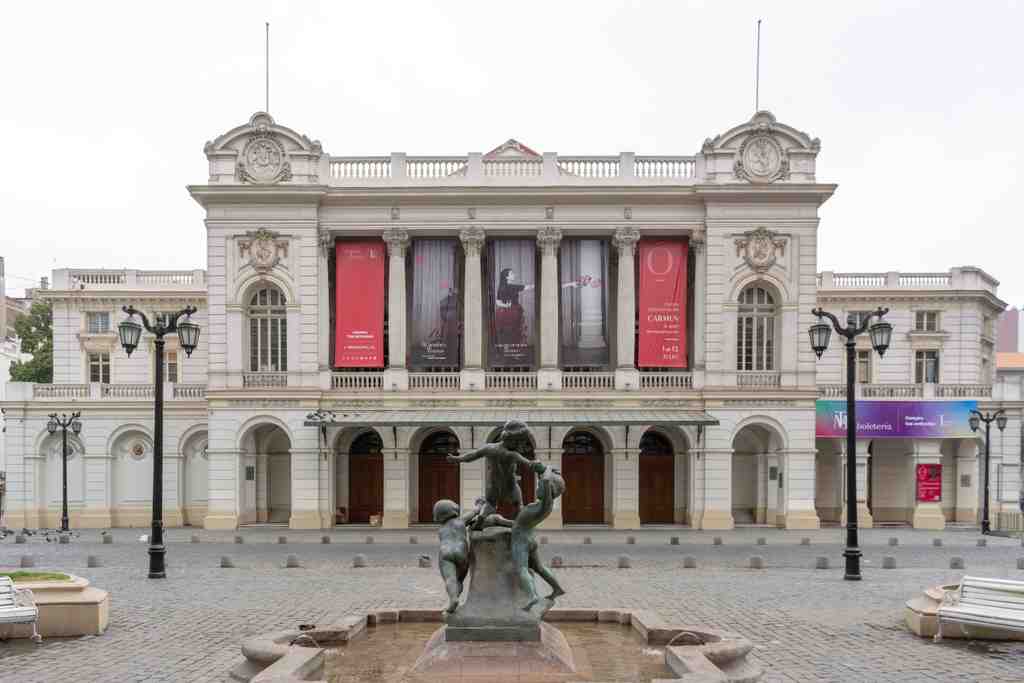
  8. To spot the Santiago Municipal Theatre, look for a grand cream-colored building right in front of you, with four massive columns, statues staring down from high balconies, and a…Leer másMostrar menos

    To spot the Santiago Municipal Theatre, look for a grand cream-colored building right in front of you, with four massive columns, statues staring down from high balconies, and a playful bronze fountain of children in the plaza at its feet. Now, take a moment to drink in the old-world elegance right before your eyes-welcome to the beating heart of Chile’s performing arts! Imagine bustling crowds in the 1850s, horse-drawn carriages, and the waft of cigar smoke as Santiago’s high society strolled the plaza to catch the opening night. President Manuel Montt ordered its construction way back in 1853, dreaming of a palace for culture that would outshine anything the city had seen. It’s got French flair for days-designed by a team of architects who brought a slice of Paris to Santiago, all towering columns, ornate carvings, and enough marble to make a sculptor faint. The theatre opened in style on September 17, 1857, with Verdi’s opera Ernani performed by an Italian troupe specially flown in. Picture the excitement and the fancy hats! Santiago’s aristocrats fell instantly in love-they gathered for operas, symphonic concerts, wild dance balls, and secret gossip sessions in velvet-draped corners. But the theatre’s story isn’t all glitz and glamour. On a good night, you’d spot legends like Nureyev leaping across its stage, or hear Pavarotti belting out so passionately you’d worry the windows might shatter. Yet behind those elegant doors, drama played out offstage too. In 1870, after a night of soaring arias, the gigantic red velvet curtain-over a ton of it-snapped a gas pipe as it fell. Searching for a leak, someone’s lamp ignited accumulated gas and, well, things went from “Bravo!” to “Fire!” Germán Tenderini, a brave firefighter, dashed in and became a hero, giving his life in the flames. To this day, the street beside the theatre bears his name-a tribute to true dedication. Rebuilt in just three years, with even more splendor, the theatre survived earthquakes and more flames. In 1906, a quake shook the very bones of the building, but French architect Emilio Doyère stepped in to restore it, swapping out adobe for sturdy brick and marble stairs grand enough for kings and prima donnas. Well, fire wasn’t quite done with the place. In 1924, another blaze singed the stage-this time “only” the foyer and backstage, sparking a round of repairs and design upgrades. The place has been shuffled and modernized ever since, declared a national monument, and lovingly polished up for its centennial. Now, here’s a slice of drama: in 2013, the theatre had just finished a performance of the ballet Mayerling-one known to bring bad luck-when yet another fire sparked in the costume room, sending 16 fire brigades into action. Luckily, Santiago’s spirit-and generous donors-came together, raising nearly a billion pesos to rebuild. They say Mayerling cursed the night; I think the theatre just likes to keep things interesting! Despite fires, quakes, and the odd pandemic that turned performances into digital broadcasts, the show always goes on. The theatre now houses its own orchestra, ballet, and chorus, along with a ballet school and a heap of hardworking staff. Its glittering main hall still seats 1,500, under a chandelier with over 14,000 sparkly crystals. Four mighty red velvet curtains have come and gone-the current one weighs as much as a small family car. So, from world-famous musicians to local talents, age-old dramas to Netflix-era broadcasts, the Santiago Municipal Theatre has weathered it all-and still dazzles, every night, in the city’s cultural spotlight. Now, step a little closer and imagine the hush before the curtain rises-will tonight be a drama, a miracle, or maybe a little of both?

    Abrir página dedicada →
  9. Directly in front of you stands the National Library of Chile-a grand stone palace with tall columns, glowing lamps, and a majestic domed roof, right beside the bustling Avenida…Leer másMostrar menos

    Directly in front of you stands the National Library of Chile-a grand stone palace with tall columns, glowing lamps, and a majestic domed roof, right beside the bustling Avenida Alameda. Let your imagination loose for a moment: the year is 1813, and Santiago is still a small, lively city at the very edge of independence. The country’s leaders, led by José Miguel Carrera-who, by the way, had a real knack for starting things-dreamed up a national library, a place for the minds and hopes of a whole nation. At first, the collection was almost a neighborhood project. The government published a call for everyone to donate books, and soon, precious volumes began piling up in the University of San Felipe’s rooms. I’m sure there were a few “very rare” cookbooks in there along with some ancient philosophy! The next few years? Absolute chaos! The library was only open a short time before a disastrous defeat at Rancagua in 1814 saw Chileans exiled, books quietly locked away, and the country thrown back under royalist rule. Picture the old city, its hopes seeming as silent as the books sitting in dusty rooms. But the flame of independence wouldn’t die. With the victory at Chacabuco, Chile’s patriots returned, and the library flickered back to life. The mighty San Martín even sent back a refunded 10,000 pesos-asking it be used “to make a real National Library, please!” As the decades passed, this library did what libraries do best-it grew, wandered around the city, and faced more drama than a telenovela. It was set up in an old customs house, then a new adobe building, then a former colonial tribunal. Each move saw new books, new directors, and new rules. One director, Francisco García-Huidobro, ran the place for 27 years! Under him, the book count nearly doubled. You wouldn’t believe it now, but for a while, the library building was so damp that water crept up a “vara” high (about 80 centimeters!) on the walls before hasty repairs. But the real magic is in the grand building you see before you, finished in 1925 for the library’s hundredth birthday-right on the ground of an old monastery. Architects went wild, creating a cross of monumental pavilions with imposing columns, elegant gardens, and intricate French-inspired details. The collection didn’t stop growing either-by 1864, there were nearly 38,000 volumes, and today, those numbers have exploded to nearly 850,000 in just the Chilean section alone! Through the 20th century, the National Library became Chile’s bookish nerve center, guardians of fragile documents, newspapers, and even handwritten treasures from famous thinkers like Andrés Bello. Fires, floods, and politics threatened along the way, but somehow, the volumes survived each chapter. During the dictatorship of the 1970s, the Library was at last named a National Monument-and the internet age brought yet another transformation, with millions of digital visits and online archives making many of its riches accessible to curious minds around the globe. And the funny thing? For all this bookish seriousness, they’ve even created websites just for kids, with quirky cartoon friends helping young Chileans meet their history. Each May, crowds pour in for Heritage Day-imagine the stately reading rooms filled with excited footsteps and whispered “wows.” So, while this building may seem like it’s made of nothing but stone and silence, really, it’s powered by two centuries of ambition, disaster, recovery, and brilliant Chilean creativity-and the next chapter is always just waiting to be written.

    Abrir página dedicada →
  10. Then, in 1607, people built a tiny chapel here in honor of San Saturnino, who was considered Santiago’s superhero against earthquakes. Even he, however, couldn’t save the chapel…Leer másMostrar menos

    Then, in 1607, people built a tiny chapel here in honor of San Saturnino, who was considered Santiago’s superhero against earthquakes. Even he, however, couldn’t save the chapel when the Mapocho River raged and swept it away just two years later. Flood insurance must have been impossible to get back then! By 1723, things took a wild turn. The site became a house of correction for women whose behavior the church found... let’s just say, “less than saintly.” The idea was strict discipline; the reality was less effective than a screen door on a submarine, and the project faded away. This place later morphed into a blood bank, then an artillery barracks. In 1851, it became the scene of the Urriola riot-a burst of political fireworks that included an ill-fated attempt to storm the barracks. Colonel Pedro Urriola himself lost his life here. Fast forward to 1901, and everything was cleared away for the plaza you see now. In 1908, standing proudly center-stage, a bronze statue of Benjamín Vicuña Mackenna appeared, crafted by Jules-Félix Coutan. Vicuña Mackenna holds a pencil and papers, ready to write down Santiago’s next chapter. He’s surrounded by symbols of his life and accomplishments, and all of it sits within a lovely fountain. The square was spruced up in 2012, so it’s looking its sharpest for you. So, as you look around, picture wagons, floods, rebellious colonels, and finally, a historian immortalized for all time-talk about a plot twist!

    Abrir página dedicada →
  11. Directly in front of you, you'll spot a tall, pale yellow building with striking pointed gables on its roof and a faded sign above the main entrance reading “Comisión Chilena de…Leer másMostrar menos

    Directly in front of you, you'll spot a tall, pale yellow building with striking pointed gables on its roof and a faded sign above the main entrance reading “Comisión Chilena de Derechos Humanos”-that’s the old Clínica Santa Lucía. Now-imagine Santiago in the 1970s: the city center is busy just as it is today, but here at number 162 Santa Lucía Street, a very different story was unfolding behind those gothic-inspired windows and under that decorative Tudor arch at the entryway. This building, at first glance just part of a row of townhouses, hides a far darker chapter of Chile’s recent history. Built in 1934 by the famous architect Alberto Cruz Montt, its style stands out-look for the ornate window ledges, the curious cross-shaped designs, and that attic up top that once held more secrets than Christmas decorations. And let’s not overlook the little details above-blind round windows in a four-leaf clover shape, and fanciful stone supports holding the balconies, like the world’s most serious shelf brackets. But here’s where things get serious. Back in 1972, this house was alive with politics, bustling as a base for the Movement of Popular Unitary Action-a group full of energy and debate. Then came the 1973 military coup, and like some tale from a spy novel, this friendly townhouse became seized property, its halls and rooms quickly transformed. What the neighbors saw as just another downtown building was in fact one of the dictatorship’s darkest sites, silently working as a secret clinic under the command of DINA-the Chilean secret police. Picture the tension: people brought here often had no idea where they were. Sometimes, just a glimpse from one of those balconies, or the midday sound of the cannon firing from Santa Lucía Hill, gave prisoners a clue to their whereabouts. Imagine that confusion and hope mixing together. Inside, rooms that once discussed politics became places of pain. According to those who passed through here, even treatment was a kind of trap-prisoners were brought in following brutal torture to be patched up just enough for another round of interrogations, all under the careful watch of doctors whose job was to keep people alive, but not to heal the suffering. Scarily, the clinic operated on two fronts: medical care for both DINA personnel and their families, and, most infamously, as a center for interrogations and torture. There are stories from survivors of being blindfolded, tied to beds, hearing the radio buzz with voices: nearby, other relatives were being tormented, their pain and screams echoing between sites as if cruelty needed a megaphone. The attic-once a light-filled play area, perhaps-held secret cells. The lower levels witnessed confessions forced out under shocking pressure. Even doctors and nurses joined the interrogations, an upside-down world where those who should heal became agents of fear. It sounds almost surreal, but it’s what happened, and the names and faces of many staff involved still remain hidden and untouched by the law. Today, thankfully, the building’s darkness isn’t kept secret anymore. It stands as a monument to memory and to justice, home to the Human Rights Commission. Now, exhibitions and documentaries shine a light on what was once hidden, welcoming the public to learn, reflect, and maybe even crack a nervous laugh at the cheerful yellow paint outside-perhaps Santiago’s way of insisting that even places with terrible histories can change, offering hope and a little color on the road to healing. So, while it’s easy to walk by and just admire the curious rooflines and bold facade, standing here connects you to a river of stories that run right through Chilean history-some terrible, some courageous, and all vital to remember. And if you hear the cannon on the hill at noon today, know that, for some, even that banging sound once meant a sliver of hope amidst the unknown. If you're keen on discovering more about the architecture and uses of the building, how the clinic works or the recognition of the centre, head down to the chat section and engage with me.

    Abrir página dedicada →
  12. Long, long ago, when giant sheets of ice covered this valley, people were already passing through. Santiago itself stands on what researchers believe was the southernmost…Leer másMostrar menos

    Long, long ago, when giant sheets of ice covered this valley, people were already passing through. Santiago itself stands on what researchers believe was the southernmost administrative center of the mighty Inca Empire. Imagine what it must’ve been like: holy ground for ceremonies, rulers issuing commands, trades buzzing with mining and agriculture, and the rivers Mapocho and Maipo glimmering nearby. Some say the settlement here was once compared to Cuzco itself-a kind of sister city full of bustling energy and purpose. If history had taken another turn, you might be ordering an empanada in Quechua right now. When the Spanish conquistadors arrived, this rocky hill went from sacred ground to the ultimate lookout and defensive point. Pedro de Valdivia, eager to make a lasting impression, announced the founding of Santiago on February 12, 1541-though why he named it after Santa Lucía is anyone’s guess, since her saint day is actually December 13th! Maybe he preferred to do things out of order. Or maybe he was rushing because he knew the best picnic spots get taken early. Fast forward: the first flour mills in Chile spun their wheels at the western slope, while the earliest vineyards started right around here. Rodrigo de Araya and Bartolomé Blumenthal (whose descendants knew a thing or two about causing trouble) planted vines that would help turn Chile into a world-famous wine country. Over time, the surrounding land split up, new streets emerged, but without care it all started looking more “dump yard” than urban jewel. Things began to change in the 19th century. With revolution and independence stirring the air, Santa Lucía Hill gained military importance. Spanish royalists built two sturdy forts here for defending the city. The Castillo Hidalgo you see atop the crest stands as a reminder-though it looks peaceful now, at one point, it was meant to hold out against all comers. Picture muskets, uniforms, and the sharp bark of orders as soldiers scrambled to defend Santiago. Although, funnily enough, these constructions never saw actual battle; they were mostly scenic, if intimidating, additions! By 1847, science took a turn atop the hill. A US Navy lieutenant set up one of the Americas’ earliest observatories here, right where the city lights now gleam. Stargazers published dozens of studies, turning Cerro Santa Lucía into Santiago’s own stargate long before science fiction was cool. But the biggest change came in 1872. Benjamín Vicuña Mackenna, the city’s energetic mayor, was determined to transform this old pile of rocks into something beautiful. He dug in terraces, ponds, and gardens-transporting the styles from Paris straight to Santiago. If you’ve ever wanted a Chilean selfie that screams European elegance, thank Mackenna. Over the years, locals kept improving the site, finally adding the magnificent south entrance in 1903. For a while, even an electric train zipped up the western side, whisking passengers past the gardens. Today, find shade under Chilean palms brought from far-off farms, relax by the fountains, or search out the Japanese garden on the eastern slope, a gift from a faraway friend in 1959. The castle, once left neglected, now hosts glitzy events. Santa Lucía is a city monument, officially protected since 1983. Walk a little, and you’ll find a tall stone inscribed with words from Pedro de Valdivia-imagine him kneeling on this slope, penning letters to the Spanish king about this “land of wonders.” Don’t be surprised if, precisely at noon, a sudden boom rocks the air! Since 1825, a cannon has fired almost daily to mark the hour. At least, when neighbors weren’t hiding their alarm clocks in protest-hey, sometimes the cannon had a louder voice than the local church bell! Santa Lucía Hill has seen centuries of joy, war, neglect, and rebirth. Its old stones have outlasted conquistadors, stargazers, partygoers, protestors, and poets. With every step you take up its winding paths, you’re joining a story still being written, one beat, one echo, one cannon boom at a time. For further insights on the toponymy, monolith with writing by pedro de valdivia or the traditions, feel free to navigate to the chat section below and inquire.

    Abrir página dedicada →

Preguntas frecuentes

¿Cómo empiezo el tour?

Después de la compra, descarga la app AudaTours e ingresa tu código de canje. El tour estará listo para comenzar de inmediato - solo toca play y sigue la ruta guiada por GPS.

¿Necesito internet durante el tour?

¡No! Descarga el tour antes de empezar y disfrútalo completamente sin conexión. Solo la función de chat requiere internet. Recomendamos descargar en WiFi para ahorrar datos móviles.

¿Es un tour guiado en grupo?

No - esta es una audioguía autoguiada. Exploras de forma independiente a tu propio ritmo, con narración de audio reproduciéndose en tu teléfono. Sin guía, sin grupo, sin horario.

¿Cuánto dura el tour?

La mayoría de los tours toman 60–90 minutos para completar, pero tú controlas el ritmo completamente. Pausa, salta paradas o toma descansos cuando quieras.

¿Qué pasa si no puedo terminar el tour hoy?

¡No hay problema! Los tours tienen acceso de por vida. Pausa y continúa cuando quieras - mañana, la próxima semana o el próximo año. Tu progreso se guarda.

¿Qué idiomas están disponibles?

Todos los tours están disponibles en más de 50 idiomas. Selecciona tu idioma preferido al canjear tu código. Nota: el idioma no se puede cambiar después de generar el tour.

¿Dónde accedo al tour después de comprarlo?

Descarga la app gratuita AudaTours desde App Store o Google Play. Ingresa tu código de canje (enviado por email) y el tour aparecerá en tu biblioteca, listo para descargar y comenzar.

verified_user
Satisfacción garantizada

Si no disfrutas el tour, te reembolsamos tu compra. Contáctanos en [email protected]

Paga de forma segura con

Apple PayGoogle PayVisaMastercardPayPal

AudaTours: Audioguías

Tours a pie autoguiados entretenidos y económicos

Probar la app arrow_forward

Amado por viajeros de todo el mundo

format_quote Este tour fue una excelente manera de ver la ciudad. Las historias fueron interesantes sin parecer demasiado guionadas, y me encantó poder explorar a mi propio ritmo.
Jess
Jess
starstarstarstarstar
Tour de Tbilisi arrow_forward
format_quote Esta fue una forma sólida de conocer Brighton sin sentirme como un turista. La narración tenía profundidad y contexto, pero no se excedía.
Christoph
Christoph
starstarstarstarstar
Tour de Brighton arrow_forward
format_quote Empecé este tour con un croissant en una mano y cero expectativas. La app simplemente vibra contigo, sin presión, solo tú, tus auriculares y algunas historias geniales.
John
John
starstarstarstarstar
Tour de Marsella arrow_forward

Audioguías Ilimitados

Desbloquea el acceso a TODOS los tours del mundo

0 tours·0 ciudades·0 países
all_inclusive Explorar Ilimitado

