
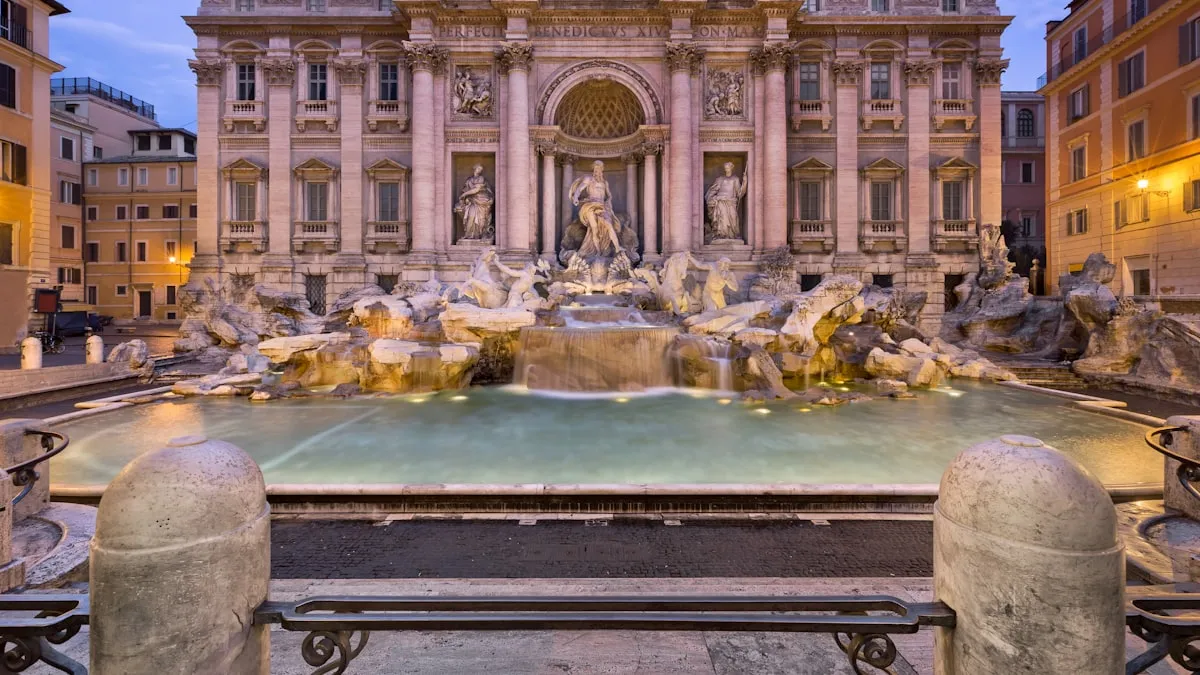
Rome is a walking city. The ancient center is compact enough that most major landmarks sit within 20 minutes of each other on foot. The Colosseum, Pantheon, Trevi Fountain, and Spanish Steps are all connected by streets where the real sightseeing happens between the big stops.
Here's how to cover the best of Rome without getting on a bus.
Colosseum to the Roman Forum
Start at the Colosseum, then walk 500 metres to the Roman Forum. This short stretch along Via dei Fori Imperiali takes about 10 minutes, and it's the most historically dense walk in the city. The Forum sprawls below street level, with temple ruins, triumphal arches, and the spot where Julius Caesar's body was cremated.
Keep walking past the Forum to Palatine Hill for views over the ancient city. The full Colosseum-Forum-Palatine loop takes about 90 minutes if you stop to read the plaques and take it in.
Piazza Navona to the Pantheon and Trevi Fountain
From the Colosseum, head northwest about 1.5 km (20 minutes) to reach the Pantheon. The walk takes you through quieter residential streets where laundry hangs above the sidewalk and scooters outnumber cars.
The Pantheon to Piazza Navona is only 400 metres, about 5 minutes on foot. Bernini's Fountain of the Four Rivers anchors the piazza, and the surrounding streets are full of cafes with outdoor seating.
From Piazza Navona, it's a 15-minute walk northeast to the Trevi Fountain (roughly 1 km through narrow streets). The Trevi sits in a small square that's almost always crowded, but arriving early morning or late evening changes the whole feel.
Spanish Steps to Piazza del Popolo
If you're coming from the north end of the city, start at Piazza del Popolo and walk 800 metres south to the Spanish Steps. From there, it's about 1 km (10 to 15 minutes) to the Trevi Fountain. This loop through Rome's shopping district along Via dei Condotti is one of the most popular evening walks in the city.
Vatican City and St. Peter's
The Vatican sits about 4 km from the Colosseum, roughly 45 minutes on foot. Most people walk there from the Pantheon area, which cuts the distance to about 2 km (25 minutes). Cross the Tiber at Ponte Sant'Angelo and walk along Via della Conciliazione toward St. Peter's Basilica. The approach gives you the full reveal: the dome growing larger with every step until the piazza opens up in front of you.
Trastevere, Testaccio, and the Aventine Keyhole
Cross the Tiber south of the Vatican and you're in Trastevere. Cobblestone alleys, ivy-covered buildings, and some of the best dinner spots in the city. Basilica di Santa Maria in Trastevere is worth a stop for the mosaics alone.
South of Trastevere, the Testaccio neighbourhood is where Romans go when they want to eat well without a tourist markup. The Mercato di Testaccio is an indoor food market where you can try supplì (fried rice balls) and cacio e pepe in its birthplace.
From Testaccio, climb Aventine Hill to the Priory of the Knights of Malta. Look through the keyhole in the wooden door on Piazza dei Cavalieri di Malta. You'll see a perfectly framed view of St. Peter's dome at the end of a hedged garden tunnel. It's free, takes 5 minutes, and it's one of the most surprising views in Rome.
Practical tips for walking Rome
- Drink from the nasoni. Rome has over 2,500 free cast-iron drinking fountains scattered across the city. The name means "big noses" after the curved spout shape. The water is cold, clean, and comes from the same ancient aqueduct system that has supplied the city for centuries. Bring a refillable bottle.
- Wear sturdy shoes. Rome's sampietrini cobblestones are charming but unforgiving. Flat, closed-toe shoes with good grip will save your feet and your ankles.
- Walk early or late. Summer temperatures push past 35°C by midday. The best walking hours are before 10am and after 5pm. You'll also dodge the tour-bus crowds at the Colosseum and Vatican.
- Expect 10 to 15 km per day. A full day of sightseeing on foot covers serious ground. Factor in hills (Aventine, Palatine, Janiculum) and heat, not just distance.
An AudaTours self-guided audio tour of Rome puts all of this on a GPS-tracked route with narration that plays automatically at each stop. Download it over Wi-Fi, walk at your own pace, and skip anything that doesn't interest you. Tours are available in 50+ languages, work completely offline, and cost a few dollars each. Or unlock every tour in every city with an Unlimited subscription.
Browse all walking tours and start planning your route.




