

Lewiston Audio-Tour: Echos und Eleganz des geschichtsträchtigen Herzens der Innenstadt
Zwillingskirchtürme werfen lange Schatten über Lewiston, während geheime Geschichten durch gepflasterte Gassen und hallende Mühlenhallen widerhallen. Diese selbstgeführte Audio-Tour führt tief in das Herz der Stadt und enthüllt die unerzählten Kämpfe und Geschichten, die sich hinter prächtigen Fassaden und ruhigen Ecken verbergen. Entdecken Sie Orte und Momente, die selbst Einheimische übersehen. Warum prallten machthungrige Feinde unter den Buntglasfenstern der Basilika der Heiligen Peter und Paul aufeinander? Welche verlorene Erfindung verweilt in den Mauern der Maine MILL und schürt Gerüchte über Sabotage? Wer verschwand während einer skandalösen Nacht im Agora Grand und hinterließ Gerüchte, die nie verstummten? Bewegen Sie sich durch das lebendige Geflecht der Stadt auf einer Reise, die mit Ehrgeiz, Glauben und Rebellion verknüpft ist. Jeder Schritt weckt Drama, Ehrfurcht und eine aufregende neue Sicht auf Lewiston. Erwarten Sie Offenbarungen, die in jede Straße und jeden Stein eingewoben sind. Wagen Sie es, unter den Türmen zu gehen. Lewistons Schatten sind bereit, ihre Geheimnisse preiszugeben.
Tourvorschau
Über diese Tour
- scheduleDauer 60–80 minsEigenes Tempo
- straighten6.1 km FußwegDem geführten Pfad folgen
- location_onStandortLewiston, Vereinigte Staaten
- wifi_offFunktioniert offlineEinmal herunterladen, überall nutzen
- all_inclusiveLebenslanger ZugriffJederzeit wiederholen, für immer
- location_onStartet bei Agora Grand Veranstaltungszentrum
Stopps auf dieser Tour
Look for a massive, striking brick building with two tall, pointy spires topped by crosses-it stands commandingly beside the road and is hard to miss! Welcome to the Agora Grand…Mehr lesenWeniger anzeigen
Look for a massive, striking brick building with two tall, pointy spires topped by crosses-it stands commandingly beside the road and is hard to miss! Welcome to the Agora Grand Event Center! As you stand here, imagine you’re about to enter one of Maine’s most breathtaking buildings. These two spires, stretching up to 220 feet, aren’t just showing off-this former church is the second-tallest building in the whole state! It all began way back in 1887, when Bishop Healy himself placed the first stone. Picture the sounds of hammers and chisels, the hopes and dreams of a growing town. For over a century, this was St. Patrick’s Church, a marvel of Gothic beauty built with brick and rockfaced granite, proudly sitting above the city, gazing over the park. Its beautiful windows, granite trim, and arched doorways made it not just an architectural wonder but a spiritual home for generations. Back in 1896, people called it “unsurpassed,” with enough space for 1,000 souls to gather, and two spires soaring above everyone’s heads. But every great place has its mysteries. Deep in the basement, behind cold stone walls, there was a crypt, where the church’s original priest, Monsignor Thomas Wallace, was entombed for over a century! When the last Mass was held in 2009, the church closed-only to rise again in 2016, thanks to Andrew Knight, who turned it into this stunning event center. He even got married here, making his own wedding its very first! Perhaps the spookiest detail: the crypt became a hotel room-the only one in a former church crypt in the world! How’s that for a place to rest your head? Now, whenever you walk by the Agora Grand, you’re walking past more than a building; you’re passing by decades of faith, laughter, mystery, and maybe even a friendly ghost or two.
Eigene Seite öffnen →Look to your right for a grand two-and-a-half-story red brick house with a pointy turret on the corner and a two-story wooden porch right in the center-if you see a building that…Mehr lesenWeniger anzeigen
Look to your right for a grand two-and-a-half-story red brick house with a pointy turret on the corner and a two-story wooden porch right in the center-if you see a building that looks like it’s auditioning to be a castle, you’ve found the Dr. Louis J. Martel House! Imagine it’s 1883 and this neighborhood is buzzing with the clatter of factory workers and the chitchat of Franco-American families. Rising above the rowhouses and tenements, this brick beauty practically shouts, “Look at me!”-and with its dramatic hip roof, gabled projections, and that octagonal turret capped by a fancy finial, who could resist? Dr. Louis J. Martel was the star of Maine’s French-speaking community, running a lively French newspaper, fighting for workers as a politician, and once coming nail-bitingly close to being mayor. But he wasn’t just about the votes-he helped build Saint Mary’s hospital and organized a church that remains a city landmark. Locals must’ve wondered if the brick house on Bartlett Street had secret passageways or maybe a teleportation device, given Dr. Martel’s relentless pace. Today, as you gaze up at the ornate porch and turret, picture the doctor standing proudly above the street, dreaming big-because this was more than a home; it was the heart of progress for generations. And hey, with that turret, maybe he got a great view of the competition during election season!
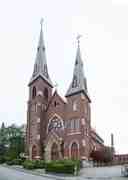
Eigene Seite öffnen →Rising dramatically in front of you, the Basilica of Saints Peter and Paul stands with its twin gray stone towers and pointed spires reaching high into the sky-just look for the…Mehr lesenWeniger anzeigen
Rising dramatically in front of you, the Basilica of Saints Peter and Paul stands with its twin gray stone towers and pointed spires reaching high into the sky-just look for the massive arched doors and the intricate circular stained glass window above. Now, let’s set the stage for this grand basilica. Imagine Lewiston in the late 1800s: the air filled with the distant clatter of textile mills, and the streets bustling with French-Canadian families who had just arrived, drawn by the promise of steady work. These new residents came in droves, so many that the only way they could fit for Mass was to squeeze into the basement of another church-talk about a packed house! Soon, even Saint John’s nave couldn't hold them all. It was clear: Lewiston needed a place of worship as grand as the community itself. So, in 1872, the parishioners laid the cornerstone for Saint Peter’s, like laying the first brick of a dream. By 1873, their dedication paid off with the first Mass, but the story was just beginning. The Dominicans took over in the 1880s, adding a certain French flair from Lille, France, and Quebec. Over the decades, the parish kept outgrowing itself, splitting again and again to form new churches. Every time they saved up money to finish the top of the church, they’d have to split those funds to help start another parish. You could almost feel the suspense: would they ever finish this mammoth church? Finally, in the 1930s-after more twists than a mystery novel-the Diocese gave the thumbs up to finish the upper part. With hammers swinging and hope soaring, they completed the basilica in 1936. It opened to a crowd in 1938, dedicated to Saints Peter and Paul, towering as the second-largest church in all of New England. And by the way, the basilica is home to not one but two mighty pipe organs-one up front and one in the gallery. The gallery organ holds a jaw-dropping 4,622 pipes, making it the largest church organ in Maine! Just imagine the thunderous chords filling this soaring space. The basilica also keeps its French roots strong-one of the last places in Maine to offer Mass in French. Today, thanks to new waves of French-speaking immigrants from central Africa, that tradition goes on, making this church a living, breathing piece of Lewiston’s story, bridging cultures and generations. And yes, after all those years of building, splitting, and joining, those doors are still wide open.
Eigene Seite öffnen →
17 weitere Stationen anzeigenWeniger Stationen anzeigenexpand_moreexpand_less
Look for a large, three-and-a-half story red brick building with a striking mansard roof, white-trimmed windows, and a central wooden portico-right ahead on Ash Street, stretching…Mehr lesenWeniger anzeigen
Look for a large, three-and-a-half story red brick building with a striking mansard roof, white-trimmed windows, and a central wooden portico-right ahead on Ash Street, stretching across nearly half a city block. Take a look at this grand, H-shaped building-picture it back in 1893, when dozens of boys’ footsteps echoed on these stone steps, and the air was filled with the scents of brick dust and homemade bread. The Healy Asylum was brought to life thanks to Msgr. James Augustine Healy, whose name it proudly carries. It was the era of bustling textile mills in Lewiston, and the town was overflowing with French Canadian families who had crossed the border for work, dreams, and sometimes, a bit of trouble. When the Grey Nuns from Saint-Hyacinthe, Quebec arrived, their original job was to teach the children of those mill workers. But as the story goes, in 1892, the nuns swapped their chalk for a new mission-caring for orphaned and troubled boys, after some “gentle” persuasion. Imagine the nuns, gliding down these halls, their feet barely making a sound, except for the occasional clatter of a broom falling over. The boys here came from all across Maine, sent by a diocese that sometimes forgot to send the check. Funding was always a headache-one might say you could hear the arguments echo down Ash Street on budget day! Designed by local architects Jefferson L. Coburn & Sons, the Healy Asylum’s red brick walls soon saw decades of laughter, tears, and a bit of mischief, until 1973, when the last boy left and time slowly transformed the orphanage into a peaceful home for seniors. Now, as Healy Terrace, it’s a place for stories rather than shenanigans, and one can almost hear the soft voices of history if you listen carefully.
Eigene Seite öffnen →To spot Lewiston City Hall, just look for the grand red brick building with a tall clock tower topped by a dramatic, rounded spire right at the corner of Pine and Park…Mehr lesenWeniger anzeigen
To spot Lewiston City Hall, just look for the grand red brick building with a tall clock tower topped by a dramatic, rounded spire right at the corner of Pine and Park Streets-it's hard to miss! Now, take a moment to imagine yourself here in Lewiston all the way back in the late 1800s. Picture the hustle and bustle of the city as it grows, and right in front of you, the original city hall, all 80 rooms of it, standing proudly…until one chilly January day in 1890, when disaster struck. Flames licked up behind an elevator wall, crackling through wood and brick, as the townspeople rushed to see their beloved city building. In just a few hours, it was lost-a total loss, and without insurance, ouch! Even the police station, the library, and the post office tucked inside couldn’t escape the flames. But then something remarkable happened: Lewiston rolled up its sleeves and got to work. By October of that very year, builders were back on the exact same corner, laying fresh granite for a new vision. And this time, Boston architect John Calvin Spofford brought some real drama-just look at these bold Baroque Revival curves, the granite-trimmed archway for the entrance, and a tower that stretches 185 feet above your head! Imagine the echoes of hammers and saws while this new city hall came to life. By May of 1892, the people of Lewiston were ready to celebrate-they had a new home for their government, and honestly, who could ask for a fancier spire? Today, still standing strong and listed on the National Register of Historic Places, it’s more than a building-it’s a story of rising from the ashes, with a tower that keeps its eye on the city, decade after decade. Now, that’s what I call a comeback!
Eigene Seite öffnen →To spot the Second Callahan Block, look for the striking four-story building with a yellow brick facade and a bold, gabled cornice, just east along Lisbon Street between Chestnut…Mehr lesenWeniger anzeigen
To spot the Second Callahan Block, look for the striking four-story building with a yellow brick facade and a bold, gabled cornice, just east along Lisbon Street between Chestnut and Spruce-it's the one that stands out with its arched windows up top and neat rows of rectangular ones below. Ah, welcome to one of Lewiston’s classiest addresses-at least, it sure was in 1909! Picture this street bustling over a hundred years ago: horses clopping by, shopkeepers sweeping their stoops, and smartly dressed men window-shopping for new hats or ties. Right in front of you stands the Second Callahan Block, built by the ambitious Callahan brothers, Timothy and Eugene, who thought, “Why own one grand building when you can have two?” They’d already made a splash with their first creation just next door, and in true sibling fashion, decided to up the ante with an even bigger one-this very spot, brimming with bright yellow brick and showy keystoned windows. Designed by the famous local firm Coombs & Gibbs, the building once bustled with shops and shoppers on the ground floor, while the upper stories kept a watchful eye through their arch-topped windows. Back in the day, businessmen might have argued over prices while mothers eyed fancy wares through the glass. Time has turned these old storefronts into homes-but standing here, you can almost hear the echoes of deals, dreams, and the occasional brotherly squabble. Isn’t that a block worth stopping to imagine?
Eigene Seite öffnen →Inside, the museum is packed with rescued tools, old manufacturing machines, and artifacts that might just make your jaw drop-just watch out, or you’ll trip over a loom leg! Maine…Mehr lesenWeniger anzeigen
Inside, the museum is packed with rescued tools, old manufacturing machines, and artifacts that might just make your jaw drop-just watch out, or you’ll trip over a loom leg! Maine MILL dives deep into the stories of everyday folks: you’ll find photos of determined faces, hear personal tales from workers, and even see some of their worn work boots and lunch pails. Each piece tells how tough work, creative minds, and a bunch of elbow grease made Lewiston tick. This whole district is on the National Register of Historic Places. So, when you explore the exhibits about labor and invention, you’re witnessing how sweat and brilliant ideas shaped not only the city’s skyline, but its entire community. And just so you don’t miss the present, you might hear laughter and lively discussions drift from a museum event. It’s a living tribute to the power of hard work-with a side of Maine ingenuity!
Eigene Seite öffnen →To spot the Atkinson Building, look for a tall, six-story brick and stone building with arched windows right on the pointed corner of Lisbon and Pine Streets-just look for the…Mehr lesenWeniger anzeigen
To spot the Atkinson Building, look for a tall, six-story brick and stone building with arched windows right on the pointed corner of Lisbon and Pine Streets-just look for the most impressive red-brick giant across from City Hall. Standing here today, you’re right in front of one of Lewiston’s proudest show-offs! Back in 1892, the townsfolk must’ve craned their necks in awe as this six-story Romanesque masterpiece soared above every other rooftop in town. Just imagine the fresh clang of hammers and chisel on pink-red granite brought all the way from North Conway, New Hampshire, the same quarry that worked overtime for City Hall next door. The Atkinson Building went up on land where the first City Hall unfortunately met its fiery fate in 1890-talk about putting a phoenix on the corner! Elmer I. Thomas, the building’s architect, wasn’t just out to impress. He wanted this new commercial jewel to look like City Hall’s tall, stylish cousin. Take in the pairs of sash windows and their fancy Romanesque arches on the upper floors, each outlined in lighter terra cotta. The grand, angled corner-once the bustling entrance to Atkinson Home Furnishings-invited folks in for everything from fine furniture to the latest gadgets. Down at street level, the shimmering plate glass windows hint at a time when window shopping was practically a sport. As the city bustled around it, the Atkinson Building kept watch, like a stoic guardian of Victorian style amid changing times. In 1983, it earned a badge of honor by joining the National Register of Historic Places-not bad for a building that once had to outshine the new city hall next door with a little architectural flair and a whole lot of red brick attitude!
Eigene Seite öffnen →To spot the Pilsbury Block, look for a bold, three-story red brick building with rounded corners and rows of tall arched windows right at the corner of Lisbon and Pine…Mehr lesenWeniger anzeigen
To spot the Pilsbury Block, look for a bold, three-story red brick building with rounded corners and rows of tall arched windows right at the corner of Lisbon and Pine Streets. Alright, you’re gazing at the legendary Pilsbury Block-the sturdy brick wonder that’s been holding its ground since 1870! Imagine the street bustling with horse-drawn wagons, the air filled with chatter and maybe the clink of coins as Lewiston’s merchants did business here. George H. Pilsbury dreamed up this structure when this corner of Lisbon Street was the pulsing heart of the city’s commerce, and with the help of Jesse T. Stevens (an engineer who never missed a detail), the grand rounded corner took shape. Now, if you let your eyes wander upward, you’ll spot those majestic arched windows and the fancy corbelled brickwork lining the top-a nod to the Italianate and Romanesque styles that were stylish back then. Just three years after it opened, this building got a big extension as Lewiston boomed, handled by the architecture super-team Fassett & Stevens. Over the years, the tenants may have changed, but the Pilsbury Block stubbornly stayed put, surviving fires, fashions, and flying rumors of secret tunnels (no word on hidden treasure-yet)! Today, it’s home to part of the Lewiston Public Library, and if you listen closely, maybe you’ll hear an echo or two of the past.
Eigene Seite öffnen →Looking ahead, you'll spot a tall, yellow-bricked building with big arched windows and a flat roof on the corner, standing proudly above the street. Now, imagine it’s…Mehr lesenWeniger anzeigen
Looking ahead, you'll spot a tall, yellow-bricked building with big arched windows and a flat roof on the corner, standing proudly above the street. Now, imagine it’s 1914-Lewiston was buzzing, the mills were roaring, and then all of a sudden, up went this mighty seven-story tower that was so tall, locals probably wondered if it might reach the clouds (well, at least until 1950). You’re standing before the Manufacturer’s National Bank, once Lewiston’s tallest commercial building, showing off its neat Classical Revival style like it’s dressed up for a big city party. If you look at the ground floor on Lisbon Street, those limestone pilasters and big windows make it seem almost like a fortress of finance-perfect for storing stacks of cash, and maybe a few secrets! Imagine folks nearly 110 years ago hustling inside, the smell of fresh brick and new paint in the air, excited to do business in a place that felt straight out of Boston or New York. While much has changed, this place has held strong, outlasting wars and weaving itself into downtown Lewiston’s life-quietly watching as tenants come and go, stories multiply, and time just keeps rolling by.
Eigene Seite öffnen →To spot the Lewiston Main Post Office, look just across Ash Street for a grand, two-story brick building with elegant stone trim, rounded arch windows, and a stately row of carved…Mehr lesenWeniger anzeigen
To spot the Lewiston Main Post Office, look just across Ash Street for a grand, two-story brick building with elegant stone trim, rounded arch windows, and a stately row of carved balusters lining the rooftop. Alright, you’ve found the Lewiston Main Post Office! Imagine yourself in 1933, jazz music twinkling down Ash Street, and workers hustling to finish this shining new post office-made strong from steel and concrete and dressed in fancy Colonial Revival brickwork. Step closer and picture the aroma of wet mortar, the clatter of hammers, and the shouts of builders, all under the steady eye of the mighty Office of the Supervising Architect led by James A. Wetmore. The intricate stonework, those grand arched entryways, and the dentillated cornice on top were possible thanks to extra hands-literally-because the Great Depression meant more folks from the Federal Employment Stabilization Act pitching in. Now, here’s the fun part: behind those classic stone pillars and grand doorways, the original lobby was a sparkling hub of letters and parcels, with a postmaster’s office fit for a king (or at least a stamp-loving mayor). Even as time marched on-complete with a 1975 modern wing addition-the building has stood proud and busy, serving generations of Lewistonians. Go ahead, imagine all the secret love letters, oddball packages, and newsy postcards that began their journeys here!
Eigene Seite öffnen →To spot the Dingley Building, look for a large, two-story red brick building with a tall turret topped by a dome right at the corner, just behind that cluster of trees. You’re…Mehr lesenWeniger anzeigen
To spot the Dingley Building, look for a large, two-story red brick building with a tall turret topped by a dome right at the corner, just behind that cluster of trees. You’re now standing before the Dingley Building-a place where history, drama, and a dash of architectural flair all come together! Take in those solid red bricks and the grand arched entrance that almost looks like it should lead into a castle. Built in 1890 when horse-drawn carriages clattered down Oak Street, this building was dreamed up by the talented George M. Coombs, Lewiston’s very own star architect. Imagine the excitement when students first marched through these doors, it was once called the Oak Street School, echoing with the laughter and shouts of children in old-fashioned clothes. It wasn’t until 1899 that it got its current name, honoring Nelson Dingley Jr.-a former governor and Congress member who must have had quite the collection of top hats! Let your eyes wander to that whimsical turret, which looks like a wizard’s hat, and picture schoolkids wondering what secrets it held. Over time, the building changed from a lively school to the headquarters of Lewiston’s Board of Education. In fact, if you step closer, you might even hear the faint rustle of paperwork and decisions being made inside-education never sleeps! And not even Mother Nature could resist this place. In 2008, a lightning bolt decided to pay a visit, zapping the wooden tower and giving the building a literal shock! Thankfully, everyone was safe, and the sturdy old structure withstood the drama like the hero it is. Now, the Dingley Building serves as the heart of Lewiston’s school system and a meeting place for the city’s history buffs, standing proud-both a memory and very much alive. So, what do you think-is that turret hiding lost homework, or just more history?
Eigene Seite öffnen →To spot St. Joseph’s Catholic Church, look for the tall, pointed steeple and red-brick walls with Gothic-style windows on the corner of Main and Blake Streets, right across from…Mehr lesenWeniger anzeigen
To spot St. Joseph’s Catholic Church, look for the tall, pointed steeple and red-brick walls with Gothic-style windows on the corner of Main and Blake Streets, right across from the street-you can’t miss that dramatic spire reaching for the sky! Now, as you stand in front of this grand building, let's step back in time to 1864. Imagine the clang and clatter of bricks being stacked,, as the city’s first Roman Catholic church rises from the Maine soil. Patrick C. Keely, a famed architect who probably drew churches faster than most people can draw stick figures, gave this place the Gothic Revival style you see today-tall arched windows, a sturdy red brick tower, and a spire that almost pokes the clouds. Originally, local Catholics didn’t have their own church-they gathered in a borrowed Baptist church or waited for traveling priests to come to town. But faith is persistent, and soon after St. Joseph’s congregation was formed in 1857, this new church began to take shape. Not only was it the first of its kind in Lewiston, but today it’s one of only two buildings in all of Maine designed by Keely that still stand. Picture thousands of families flocking here for generations-the warm glow of stained glass casting colors on the pews, the low murmur of voices during Mass, the glorious ring of the church bells. But every story has a twist: by 2009, the church closed its doors, and in 2013, there was talk of demolition. Thankfully, folks weren’t quite ready to say goodbye-so the church stands, still searching for its next chapter. Maybe it's waiting for the perfect idea, or the bravest dreamer, to bring it back to life!
Eigene Seite öffnen →Right in front of you is a striking three-story brick building with elaborate white-trimmed windows and two large green onion domes on the roof-just look for the building that…Mehr lesenWeniger anzeigen
Right in front of you is a striking three-story brick building with elaborate white-trimmed windows and two large green onion domes on the roof-just look for the building that looks like it teleported straight out of an Arabian Nights story! Picture this: It’s 1908, and you’re strolling down Sabattus Street, when suddenly you glimpse a building unlike any other in Lewiston-its flat roof is crowned by twin onion domes, and its front is bursting with Moorish flair, from pointed arches to delicate terra cotta filigree. This is the Kora Temple, the pride and joy of the Shriners, a group known not just for their fezzes and parades, but for their immense charity-imagine hospitals for children rising from their efforts, where little ones are treated for free. The Shriners started meeting here in 1908, after years in a humble wooden lodge, finally investing a whopping $100,000-more money than you’d want to fit in your pocket, I promise! Designed by George M. Coombs, this ornate masterpiece soon became the most mysterious looking spot in town. But if you think the outside is magical, wait till you peek inside in your imagination. Murals stretch from floor to ceiling, painted by a Shriner named Harry Cochrane, who spent years covering the walls with scenes of dazzling deserts, mystic rivers, and legends from Arabic history-talk about commitment! Golden filigree sparkles in the light, and Tiffany chandeliers hang overhead, swaying whenever a draft sneaks in. Restored in the 1970s, this building has watched generations come and go, standing guard as a monument to the Shriners’ mission and a swirl of architectural intrigue. So, next time you see a building with onion domes, remember: in Lewiston, it’s not a mirage-it’s the marvelous Kora Temple!
Eigene Seite öffnen →You’re now standing in front of the impressive Jordan School, a grand, three-story brick building with enough character to make even the nearby Bates College campus do a double…Mehr lesenWeniger anzeigen
You’re now standing in front of the impressive Jordan School, a grand, three-story brick building with enough character to make even the nearby Bates College campus do a double take. Check out those big arched windows, Romanesque entryways, and granite trim-they’re all straight out of the Italian Renaissance playbook, thanks to architect William R. Miller. It’s almost like the building is showing off, isn’t it? No wonder it earned its place on the National Register of Historic Places back in 1984. Imagine the year is 1902. Lewiston’s teenagers are trading their previous classrooms, first above today’s Dingley Building and then on Main Street, for this shiny, purpose-built high school. Picture the clamor of students arriving, shoes tapping on the granite steps, excited about their new school. The Jordan School wasn’t just another schoolhouse-it was Lewiston’s first real high school building, designed for just that purpose. The building owes its name to Lyman G. Jordan, who was a legend around here: 15 years as the first high school principal and a Bates College professor who could probably outthink the average chemistry set. He even served on the Lewiston school board, so you could say he wore a few hats-hopefully not all at once. After serving Lewiston’s older students for almost thirty years, the building shifted gears in 1931, becoming a junior high where younger voices filled the halls with laughter, the scratch of chalk, and the dreaded pop quizzes. The party lasted until 1983, when the building retired from school duty and swapped backpack-toting kids for apartment dwellers. It’s still a home today-though probably to fewer algebra tests and cafeteria mysteries! As you stand here, think of all the generations who learned, played, and maybe even plotted their next big prank inside these walls. The Jordan School’s story is truly a brick-and-mortar reminder of learning, community, and just a little bit of local flair.
Eigene Seite öffnen →To spot the Captain Holland House, look for a striking three-story red brick mansion with a distinctive sloped mansard roof, white decorative trim, and a grand portico right at…Mehr lesenWeniger anzeigen
To spot the Captain Holland House, look for a striking three-story red brick mansion with a distinctive sloped mansard roof, white decorative trim, and a grand portico right at the corner of College and Holland Streets. Now, let’s set the scene: It’s 1872, and the air is filled with the clatter of carriages and the bustling energy of Lewiston’s rise as an industrial powerhouse. Right in front of you stands the Captain Holland House, a true showstopper in Second Empire style, crowned with a dormered mansard roof that almost looks like a fancy hat perched for a night on the town. Imagine Daniel Holland himself, a powerhouse in lumber and real estate, striding up those steps with his mustache all a-twirl, knowing he’s just built the most impressive house in the neighborhood. You might catch a glimpse of politicians popping by-Holland was rubbing elbows with Maine’s Governor’s Council and even did two stints in the state senate. See those round-arched windows and the portico decked out with brackets and dentils? Those details practically shout “I’ve made it!” This house wasn’t just a home-it was a statement, a blend of power, ambition, and, let’s face it, a bit of architectural showing-off. Today, it’s a preserved piece of Lewiston’s grand ambitions-no secret passageways, but a lot of stories packed into those elegant brick corners!
Eigene Seite öffnen →To spot the Main Street-Frye Street Historic District, look at the row of grand brick and cream Victorian houses just ahead, framed by leafy trees that cast dappled shadows across…Mehr lesenWeniger anzeigen
To spot the Main Street-Frye Street Historic District, look at the row of grand brick and cream Victorian houses just ahead, framed by leafy trees that cast dappled shadows across their ornate porches and tall windows. Now, imagine the year is 1870. Horses clatter along Main Street, carriages rumble by, and you’re surrounded by the fanciest homes in Lewiston. This district was once the place to be seen, where the city’s business barons, political bigwigs, and college founders tried to outdo each other with homes that showed off every fashionable style from Greek Revival to Queen Anne-basically the architectural version of a friendly neighborhood bake-off, except the recipes are mansions. These homes stretch along Main, Frye, and College Streets, marking a boundary between the bustle of downtown and the leafy beginnings of the Bates College campus. The land here used to be just empty fields-until the mills drew people like magnets. The mighty Franklin Company, those clever mill operators, laid out the streets, and the Frye family started selling off farm plots for houses in the 1850s. Oren B. Cheney, who founded Bates College, built one of the first houses on Frye Street right after the Civil War-imagine the excitement, neighbors eyeing each other’s gingerbread trim and turrets. The magic of this area isn’t just in its looks-it’s in how many incredible stories and styles live side by side. There are over thirty houses, twelve of them dazzling Queen Anne Victorians with towers and turrets, eleven Colonial Revivals with neat lines and columns, and even some that look straight out of Gothic fairy tales. Twelve of these beauties were designed by Lewiston’s own George M. Coombs, an architect with a real flair for both fancy and practical. Many of these homes belong to Bates College now, but once they hosted wild dinner parties, heated debates, and the sound of piano music drifting through open windows. So while you’re standing here, remember you’re surrounded by the echoes of ambition, invention, and maybe just a bit of neighborly rivalry over who had the grandest front porch.
Eigene Seite öffnen →To spot the Holland-Drew House, look for a stately two-story brick building on the corner, with a low, flat-looking roof, a grand entryway with white columns, and two single-story…Mehr lesenWeniger anzeigen
To spot the Holland-Drew House, look for a stately two-story brick building on the corner, with a low, flat-looking roof, a grand entryway with white columns, and two single-story bay windows flanking the front door. Here it stands: the Holland-Drew House, a brick beauty built in 1854 back when top hats were in fashion and lumber was king in Lewiston. Picture the busy streets of yesteryear, with horse-drawn carriages clip-clopping by as Daniel Holland, a leading lumberman and real estate mastermind, gazes out these very windows after another big deal. He helped steer the city’s growth and even served on the Maine Governor’s Council-quite the resume for a man who liked a low-pitched roof. After Daniel, Franklin Drew took up residence, bringing law, order, and even a bit of Civil War command bravado to the house. Rumor has it Drew was a magistrate with a knack for storytelling and loved dazzling guests with the stained glass portraits inside-Longfellow’s thoughtful gaze and Mozart’s hair looking perfect, as always. This isn’t just a handsome Italianate home; it’s a gateway to Lewiston’s living history, watched over by brick, granite, and a touch of artistic flair, connecting statesmen and storytellers from an age of candlelight to today’s busy city streets.
Eigene Seite öffnen →Right in front of you, the Lewiston Trust and Safe Deposit Company has a dignified granite face, three stories tall, with striking round-arched windows on the second floor above a…Mehr lesenWeniger anzeigen
Right in front of you, the Lewiston Trust and Safe Deposit Company has a dignified granite face, three stories tall, with striking round-arched windows on the second floor above a black-paneled retail space and a sharp, triangular marquee-just look for the elegant stonework sandwiched between its neighbors on Lisbon Street. Picture it: it's 1898 on Lisbon Street, the heart of Lewiston's commercial world, clanging with streetcars and full of suited bankers dodging hat-wearing shoppers. This building-thanks to the brains of the local dream team, Coombs, Gibbs & Wilkinson-was the vault of Lewiston’s fortunes. Its ashlar granite façade, quoined corners, and stately metal cornice showed off the city’s ambition. Marble stairs led anxious customers to do business or, perhaps, nervously check if their coins and papers were still safe. It stayed busy through the Roaring Twenties, until the Lewiston Trust Company needed bigger digs and skipped right across the street, leaving this stone beauty behind. Enter W. Grant and his clothing shop in 1926. Suddenly, the polished banker’s retreat had to embrace mannequins in snappy suits and ties-a fashion swap, you might say, rather than a bank heist. The ground floor transformed into a showcase for sharp shirts under that modern, black-accented entrance. But even with a parade of new retail faces, the marble floors, elegant staircases, and even the old bank president’s splendid wood-paneled office upstairs stubbornly stayed put, as if expecting a banker to walk back in at any minute. Through the decades, and even now, the building keeps welcoming shoppers and tenants, wearing its original architecture almost completely intact. So next time you’re shopping here, just imagine those marble floors echoing with the clip-clop of bankers… or maybe a misplaced sock from Grant's Clothing rolling through history.
Eigene Seite öffnen →Welcome to your final stop: the site of the once-mighty Cowan Mill. Imagine yourself by the Androscoggin River in the 1850s-the hum of spinning machines fills the air, while…Mehr lesenWeniger anzeigen
Welcome to your final stop: the site of the once-mighty Cowan Mill. Imagine yourself by the Androscoggin River in the 1850s-the hum of spinning machines fills the air, while workers bustle in and out of this grand, 4-story Greek Revival building. It was built in 1850, rising right from the ashes of Lewiston’s first textile mill, which burned down in a fiery blaze just months before. David Cowan, the man behind the mill, was so involved in city life he served as Lewiston’s mayor not once, but twice-talk about multitasking! For over 150 years, the mill stood as a symbol of industry and resilience, eventually earning a spot on the National Register of Historic Places in 1985. But in a twist that could rival the best detective novels, the Cowan Mill met a mysterious end-swept away by a suspicious fire one July night in 2009. Within six days, it was declared unsafe and torn down, leaving behind only memories and perhaps a few ghostly echoes of spinning looms. Though it’s gone, its legacy is woven tightly into Lewiston’s history. Just don’t try spinning any yarns in there now-unless you want to chat with the ghosts of millworkers past!
Eigene Seite öffnen →
Häufig gestellte Fragen
Wie starte ich die Tour?
Laden Sie nach dem Kauf die AudaTours-App herunter und geben Sie Ihren Einlösecode ein. Die Tour ist sofort startbereit – tippen Sie einfach auf „Play“ und folgen Sie der GPS-geführten Route.
Benötige ich während der Tour Internet?
Nein! Laden Sie die Tour vor dem Start herunter und genießen Sie sie vollständig offline. Nur die Chat-Funktion benötigt Internet. Wir empfehlen den Download über WLAN, um mobiles Datenvolumen zu sparen.
Handelt es sich um eine geführte Gruppentour?
Nein – dies ist ein selbstgeführter Audioguide. Sie erkunden unabhängig in Ihrem eigenen Tempo, wobei die Audioerzählung über Ihr Telefon abgespielt wird. Kein Reiseleiter, keine Gruppe, kein Zeitplan.
Wie lange dauert die Tour?
Die meisten Touren dauern 60–90 Minuten, aber Sie kontrollieren das Tempo vollständig. Pausieren Sie, überspringen Sie Stopps oder machen Sie Pausen, wann immer Sie wollen.
Was, wenn ich die Tour heute nicht beenden kann?
Kein Problem! Touren haben lebenslangen Zugriff. Pausieren Sie und setzen Sie sie fort, wann immer Sie möchten – morgen, nächste Woche oder nächstes Jahr. Ihr Fortschritt wird gespeichert.
Welche Sprachen sind verfügbar?
Alle Touren sind in über 50 Sprachen verfügbar. Wählen Sie Ihre bevorzugte Sprache beim Einlösen Ihres Codes. Hinweis: Die Sprache kann nach der Tour-Generierung nicht mehr geändert werden.
Wo greife ich nach dem Kauf auf die Tour zu?
Laden Sie die kostenlose AudaTours-App aus dem App Store oder von Google Play herunter. Geben Sie Ihren Einlösecode (per E-Mail gesendet) ein, und die Tour erscheint in Ihrer Bibliothek, bereit zum Download und Start.
Wenn Ihnen die Tour nicht gefällt, erstatten wir Ihnen den Kaufpreis. Kontaktieren Sie uns unter [email protected]
Sicher bezahlen mit 


