Zamora Audio-Tour: Zamoras Historischer Herzschlag
Eine stille Armee romanischer Löwen bewachte einst das alte Herz von Zamora, ihre Geheimnisse in Stein und Schatten gemeißelt. Dies ist Ihre Einladung, Zamora auf einer selbstgeführten Audiotour zu erkunden und dramatische Geschichten und verborgene Orte zu entdecken, an denen die meisten Besucher vorbeieilen. Was geschah, als die Revolution an den unscheinbaren Mauern des Museo de Zamora vorbeizog? Welches verbotene Relikt spukt in den stillen Ecken von San Pedro y San Ildefonso? Und wer verschwand in einer stürmischen Nacht hinter den Kreuzgängen der Kathedrale von Zamora? Verfolgen Sie Jahrhunderte der Rebellion, Hingabe und Intrigen, während sich in verwinkelten Gassen Echos von Kreuzfahrern und vergessenen Künstlern offenbaren. Spüren Sie, wie die Kathedralenglocken über sonnenbeschienenen Plätzen läuten, wo Verschwörungen geflüstert und Schicksale neu geschrieben wurden. Jeder Schritt führt tiefer in Schichten von Ruhm und Aufruhr. Entdecken Sie Zamoras legendäre Vergangenheit mit einem einzigen Tipp und lassen Sie sich von den steinernen Wächtern der Stadt ins Staunen führen.
Tourvorschau
Über diese Tour
- scheduleDauer 80–100 minsEigenes Tempo
- straighten3.1 km FußwegDem geführten Pfad folgen
- location_on
- wifi_offFunktioniert offlineEinmal herunterladen, überall nutzen
- all_inclusiveLebenslanger ZugriffJederzeit wiederholen, für immer
- location_onStartet bei Kirche San Antolin
Stopps auf dieser Tour
lock_open 3 kostenlose Vorschauen · 10 mit Kauf freischalten
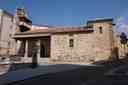
Look for the rough stone church with its compact cross-shaped body, a tall classical bell gable, and a porch that protects a single Gothic doorway. This is San Antolín, and it…Mehr lesenWeniger anzeigen
Eigene Seite öffnen →
Church of San AntolinPhoto: Tamorlan, Wikimedia Commons, CC BY-SA 4.0. Cropped & resized. Look for the rough stone church with its compact cross-shaped body, a tall classical bell gable, and a porch that protects a single Gothic doorway.
This is San Antolín, and it makes a good place to begin because Zamora does not start only with rulers and battles. It starts with neighbors. At first glance, you’re looking at an old Romanesque church, though the building has changed so much over time that its plan now forms a Latin cross, with uneven arms at the crossing. But San Antolín is more than old masonry. It is a container for memory: for arrivals, loyalties, promises, and the stubborn habit of a city repeating what matters.
The story begins with people from Palencia who settled here in the wool-working district, the Barrio de la Lana. They brought trades, families, and one very practical instinct: if you want to belong somewhere, build a place that remembers where you came from. So they raised a church to their own patron, Saint Antolín, and they installed an image of the Virgin they had carried with them. At first she was known as the Virgin of San Antolín. Then Zamora embraced her so fully that, around the year eleven hundred, local tradition says the city swore her as its patron.
Later, because her annual pilgrimage gave her a more road-tested identity, people added a shell to her image and began calling her the Virgin of the Concha. Every Pentecost Monday, the mass of the pilgrims begins here, and then the image sets out for nearby La Hiniesta, accompanied by residents and civic authorities. So this church does something stone alone cannot do... it sends memory walking through the streets. Even when the modern city gets in the way, devotion adjusts instead of retiring politely. In two thousand fourteen, work linked to the high-speed rail line forced the return route to change. Tradition, it turns out, knows how to take a detour.
You can read that long life on the outside. Along the south wall, a few Romanesque corbels still survive, those little projecting stones that once carried weight and now carry age. In fifteen ninety-six, the stonemasons Juan de Rubayo and Juan Fernández raised the bell gable above you. Much later, in nineteen ninety-eight, Lucas del Teso designed the porch to shield the church’s only Gothic entrance. Sensible, really. Even buildings need a bit of help aging gracefully.
So here’s the question to carry with you: when do newcomers stop being outsiders and start shaping the identity of a whole city?
From this neighborhood church, Zamora’s memory now widens outward. In about three minutes, at the Gate of Doña Urraca, that memory starts arguing with power, legend, and politics.
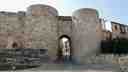
Ahead of you stands a stout stone gate with a broad rounded arch, flanking wall towers, and the worn remains of medieval masonry that once marked Zamora’s northern entrance.…Mehr lesenWeniger anzeigen
Eigene Seite öffnen →
Gate of Doña UrracaPhoto: Borjaanimal, Wikimedia Commons, CC BY-SA 4.0. Cropped & resized. Ahead of you stands a stout stone gate with a broad rounded arch, flanking wall towers, and the worn remains of medieval masonry that once marked Zamora’s northern entrance.
This is the Gate of Doña Urraca... though that name arrived later than the legend. Doña Urraca of Zamora was the sister of King Alfonso the Sixth, and tradition says he handed her the city. In the Siege of Zamora of ten seventy-two, she became the woman tied forever to its defense while her brother Sancho the Second tried to take it, with El Cid fighting on Sancho’s side. Family arguments, in other words, had become fully militarized.
The old ballads, the Romancero del Cerco de Zamora, place the scene right here: Urraca calling out from this gateway, urging El Cid to abandon the siege. So what are you looking at... a military entrance, a literary stage set, or a political memory dressed up as stone? Zamora’s answer is: yes.
Names matter here. This gate also answered to San Bartolomé, Zambrano, and even Gate of the Queen before “Doña Urraca” stuck in the seventeenth century. Renaming is how cities edit themselves in public.
Most people miss the giveaway that this medieval picture is incomplete: look for the surviving trace of a second arch, and imagine the towers with their lost tops. If you check the image in the app, you can study that scarred outline more closely. Protected as a national monument since eighteen seventy-four, it survives... but not whole. And that uncertainty follows us to City Hall, about a three-minute walk away. Conveniently, the gate keeps twenty-four-hour hours.
On your left, look for a pale, orderly facade with a broad central arch and a symmetrical neoclassical front lined with evenly spaced windows. This is Zamora’s Town Hall... and,…Mehr lesenWeniger anzeigen
Eigene Seite öffnen →
Zamora City HallPhoto: User:Luispaeez, Wikimedia Commons, Public domain. Cropped & resized. On your left, look for a pale, orderly facade with a broad central arch and a symmetrical neoclassical front lined with evenly spaced windows.
This is Zamora’s Town Hall... and, like many city governments, its story turns out to be part politics, part architecture, and part paperwork. The Town Hall is the public face of municipal power: the mayor and councilors are elected every four years, and the full council of twenty-five councillors debates the big things here, from budgets to urban planning to how the city manages its services. Heroic? Not always. Important? Constantly.
What makes this square interesting is that civic authority did not stay still. The old Town Hall stood opposite, and for centuries that older building carried the weight of meetings, records, weapons, and even punishment. In fifteen twenty-three, fire tore through it and destroyed part of the municipal archive. That sounds dry until you picture what vanished: property records, decisions, disputes, the paper memory of a city. A fire does not only burn wood and shelves; it can punch holes in how a place remembers itself.
The old building kept changing because the city kept outgrowing it. In sixteen oh three, the council decided it needed more room for meetings and for storing the city’s weapons. Then, between sixteen twenty-two and sixteen thirty-seven, they reshaped it completely. Builders gave it two levels of Renaissance galleries - open, elegant arcaded walkways - and replaced solid stone parapets with wrought-iron railings. One part of the upper floor even served as a jail. So the Town Hall was not just a respectable civic palace. It also locked people up. Administration, as ever, came with a sharper edge than the paperwork suggests.
Then came another blow. In eighteen seventy-nine, a major fire hit the Plaza Mayor and changed its appearance again. That disaster pushed the city toward a new municipal headquarters here, in the former Casa de las Panaderas. When officials rehabilitated this building in the early twentieth century, they kept its neoclassical facade and the arch that once allowed Calle del Medio to pass between the Plaza Mayor and the Costanilla. Finally, on the eighteenth of July, nineteen fifty, the old Town Hall stopped serving as the seat of government, and civic power crossed the square into this building.
Even now, city memory keeps being renegotiated here. The city still relies on the secretariat and registry - the modern custodians of records. In other words, someone still has to guard the papers that fire once stole. And in a lighter mood, the city even tuned the Plaza Mayor bells to play “The Final Countdown” for the Z Live Rock festival, proving that municipal authority can, on occasion, develop a sense of humor.
There is one more unfinished thread. The old Town Hall has reappeared in debate as a possible museum for Baltasar Lobo, Zamora’s exiled sculptor. That idea matters because official memory is fragile: archives burn, buildings change jobs, and names outlast functions. In about six minutes, at the Museo de Zamora, we’ll see how a city tries to gather its scattered memory back together.
10 weitere Stationen anzeigenWeniger Stationen anzeigenexpand_moreexpand_less
On your left, look for a pale stone palace facade with a long rectangular front and its distinctive horizontal cordon molding, backed by a clean cubic museum volume. From the…Mehr lesenWeniger anzeigen
Eigene Seite öffnen →
Museo de ZamoraPhoto: Outisnn, Wikimedia Commons, CC BY-SA 3.0. Cropped & resized. On your left, look for a pale stone palace facade with a long rectangular front and its distinctive horizontal cordon molding, backed by a clean cubic museum volume.
From the street, the Museo de Zamora looks fairly composed... which is impressive, because its life has been one long argument with disappearance.
This is where Zamora keeps a lot of its displaced heritage. By that I mean objects pushed out of their original homes by the nineteenth-century state confiscation and sale of church property, then shuffled again by demolition, delays, and lack of space. The collection does not just tell history; it has survived some of the same instability.
Locals sometimes smile at the museum’s birth certificate. King Alfonso the Twelfth inaugurated it in eighteen seventy-seven... symbolically. In real life, the museum did not properly open to the public until nineteen eleven, and even then it occupied the old convent of Las Marinas on Santa Clara in a pretty fragile setup. Then that building came down in nineteen seventy-five. The collections went into storage in the former Hospital of the Encarnación, and newspapers later recalled that some pieces even endured precarious storage in two churches before they finally found a lasting home here. Cultural memory, in other words, spent decades couch-surfing.
The solution took time. In the early nineteen eighties, people chose this site: part of the old Palacio del Cordón, the neighboring church of Santa Lucía, and a new extension designed by Luis Moreno Mansilla and Emilio Tuñón. Even that rescue stalled. The work stopped, restarted, changed shape, and only on the twenty-eighth of July, nineteen ninety-eight did the museum finally reopen in the form you see now. About sixteen years passed between the grand idea and the actual visitable building. Very Spanish, some might say... though hardly unique.
What matters is how carefully the place wears its scars. Behind the old palace facade, Mansilla and Tuñón raised a new cube and folded into it surviving arches from the original courtyard and part of the staircase. Inside, the route uses ramps across two floors, so the building feels less like a box of treasures and more like a stitched-together memory. Even the materials tell that story: Villamayor stone outside, zinc on the roof, teak underfoot.
The strongest section is archaeology. If you glance at your screen, those Roman mosaics from Requejo show the museum at full strength. There is also the Bell Beaker grave set from Villabuena del Puente, and the pre-Roman treasures of Arrabalde, linked to the lawyer and antiquarian Victorino Llordén, who tracked the find near the Castro de las Labradas. Scholars later rethought what that treasure meant, and in nineteen eighty-four a private donor added six more denarii tied to the same discovery. So even now, the story keeps getting revised.

The Roman mosaics from Requejo show why archaeology is the museum’s strongest section, with geometric floors from a luxurious villa in Santa Cristina de la Polvorosa.Photo: Jl FilpoC, Wikimedia Commons, CC BY-SA 4.0. Cropped & resized. Inside you also get Visigothic gold crosses from Villafáfila, still shadowed by mystery, paintings and sculpture gathered after suppressed monasteries vanished, and a room on the city itself with iron weather vanes so beloved they count as local celebrities.
And then there is the lovely twist: not all memory stays indoors. One of Zamora’s best-known public monuments, the bronze Viriato you are heading to next, also connects back to museum culture and even to the Prado’s long reach in this city. In about six minutes, we’ll meet him in the square, where history stops being stored and starts posing.
If you want to come back inside later, the museum is closed on Monday and otherwise opens from ten to two, with afternoon hours Tuesday through Saturday from four to nine.

Eduardo Barrón’s plaster model for Nero and Seneca links the museum’s sculpture collection to one of its best-known 20th-century artists.Photo: Jl FilpoC, Wikimedia Commons, CC BY-SA 4.0. Cropped & resized. 
This polychrome 16th-century statue reflects the museum’s bellas artes holdings, built partly from religious art saved after the suppression of local monasteries and convents.Photo: Jl FilpoC, Wikimedia Commons, CC BY-SA 4.0. Cropped & resized. 
Raimundo de Madrazo’s portrait of the Marchioness of Perinat is one of the museum’s standout paintings from the 19th century.Photo: Jl FilpoC, Wikimedia Commons, CC BY-SA 4.0. Cropped & resized. 
Carlos Verger Fioretti’s 1920 painting adds a later chapter to the museum’s fine arts collection, which spans from the 15th century to the mid-20th century.Photo: Jl FilpoC, Wikimedia Commons, CC BY-SA 4.0. Cropped & resized. 
This Roman funerary stele from Villardiegua de la Ribera fits the museum’s archaeology gallery, where inscriptions and stone pieces help tell the province’s ancient history.Photo: Jl FilpoC, Wikimedia Commons, CC BY-SA 4.0. Cropped & resized. 
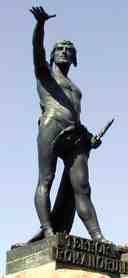
Eduardo Barrón’s bronze Viriato is a key sculpture associated with Zamora, echoing the city’s pride in its legendary warrior hero.Photo: Eduardo Barrón González, Wikimedia Commons, Public domain. Cropped & resized. On your right, look for a bronze standing warrior on a rough granite pedestal, with one arm stretched outward and a bronze battering ram thrust from the stone front. This is…Mehr lesenWeniger anzeigen
Eigene Seite öffnen →
Monument to ViriathusPhoto: Zarateman, Wikimedia Commons, CC0. Cropped & resized. On your right, look for a bronze standing warrior on a rough granite pedestal, with one arm stretched outward and a bronze battering ram thrust from the stone front.
This is Viriathus... or rather, Zamora’s idea of Viriathus, carefully staged in metal and stone. The sculptor, Eduardo Barrón, had a deep link to the city long before this monument arrived here. In eighteen seventy-five, the banker Anastasio de la Cuesta Santiago gave the teenage Barrón a small daily stipend so he could train with the local sculptor Ramón Álvarez and study drawing at the provincial institute. That kind of quiet local backing changed a life, and years later it came back as public art and civic gratitude.
Barrón finished this figure in Rome in eighteen eighty-three, while he was on a state artist’s pension. Critics there liked the clay model, Nelli’s foundry cast it in bronze, and the piece won a first medal at the National Exhibition in eighteen eighty-four. So when Zamora embraced it, the city was not just honoring an ancient rebel chieftain... it was also claiming a successful son of its own making.
The hero himself is presented with all the usual ingredients: nearly naked, standing tall, right arm extended as if rallying troops, left hand gripping a sheathed sword with a handle so long that, from certain angles, the sculptor gives posterity a slightly awkward problem. On the bronze base, Viriathus is called the “terror of the Romans.” Beneath him sits granite from Torrefrades, a village that claimed to be his birthplace, and from the front projects that bronze battering ram added in nineteen oh-three.
And yet the unveiling in nineteen oh-four was wonderfully ungrand. No big official ceremony... ordinary passersby more or less became the first audience. Later, under Franco, the Falange seized on the raised arm and turned the statue into a political emblem. Then, in nineteen seventy-one, the city moved it from the center of the square to this corner, changing the whole performance of the monument.
That is the trick with public heroes: they look fixed, but every age edits the script. We’ll see that problem of ownership sharpen again at the Church of María Magdalena, about a three-minute walk away. And conveniently, this stop is always accessible, day or night.
On your right, this compact warm-stone church is easy to spot by its rounded Romanesque massing, its deep shadowed south portal, and the small rose window framed with tiny…Mehr lesenWeniger anzeigen
Eigene Seite öffnen →On your right, this compact warm-stone church is easy to spot by its rounded Romanesque massing, its deep shadowed south portal, and the small rose window framed with tiny columns.
Santa María Magdalena looks settled... but its story refuses to sit still. Documents mention it by eleven fifty-seven, and a completion date of twelve fifteen survives in the testament of the master builder Giral Fruchel. That sounds tidy, until it doesn’t. Later writers credit Fruchel, tradition links the church to the Knights Templar, and other scholars argue it belonged instead to the Order of the Hospital, the group later known here through the Order of Malta. So this place gives us our first clear case of contested authorship and ownership: one building, several claimants, no perfectly clean origin story.
Now study that south portal for a moment. The doorway sinks inward through layered arches and slender shafts, almost like a stone funnel. Some sources say the city council gathered here, turning a church entrance into a kind of outdoor council room. In a legal text from twelve eighty-nine, Santa María Magdalena even appears as a reference point in an assault case, which is wonderfully practical. Holiness, yes... but also directions for civic business. If you want the close-up, pull up the portal image in the app.

The south portal is the landmark’s most famous doorway, where some sources say the city council once gathered.Photo: Tamorlan, Wikimedia Commons, CC BY-SA 3.0. Cropped & resized. Architectural historian Gómez Moreno thought this portal might be the oldest part of the church. It also picked up a local superstition: if you cannot make out the carved bishop here, you will never marry. Romanesque sculpture, apparently, had a side career in personal forecasting.
Inside, there is an even better mystery: a thirteenth-century tomb often attributed to Doña Urraca of Portugal, though careful scholars call her simply an unidentified lady. You can see that monument on your screen. For much of the twentieth century, the Servants of Mary cared for this church until two thousand and five; after that, it became more visibly a heritage monument, protected since nineteen ten, but also a fragile one.

A Romanesque tomb inside the church, echoing the anonymous lady often linked with Doña Urraca de Portugal.Photo: Jean-Auguste Brutails, Wikimedia Commons, Public domain. Cropped & resized. At the next stop, only about one minute away at Corpus Christi Convent, the human imprint grows much more personal. If you plan to return, the church generally opens from ten to two and from five to seven, with shorter hours on Sunday.

The church’s east end and apses show the Romanesque massing of a 12th-century building that took decades to complete.Photo: Jose Luis Filpo Cabana, Wikimedia Commons, CC BY 3.0. Cropped & resized. 
The rose window recalls the church’s refined Romanesque stonework, often compared with the Temple Church in London.Photo: Tamorlan, Wikimedia Commons, CC BY 3.0. Cropped & resized. 
A richly carved south portal with the ornate Romanesque decoration that made the doorway a local point of wonder.Photo: Jose Luis Filpo Cabana, Wikimedia Commons, CC BY 3.0. Cropped & resized. 
This 12th–13th century south portal is one of the church’s signature Romanesque features and likely its oldest major part.Photo: José Luis Filpo Cabana, Wikimedia Commons, CC BY 3.0. Cropped & resized. 
Close-up of the portal’s arch mouldings, a good view of the sculpted detail that inspired local superstition.Photo: José Luis Filpo Cabana, Wikimedia Commons, CC BY 3.0. Cropped & resized. 
The choir interior reflects the building’s medieval liturgical life and the long history of use and care inside the church.Photo: Jean-Auguste Brutails, Wikimedia Commons, Public domain. Cropped & resized. 
A carved impost from the doorway, one of the small Romanesque details that survived centuries of worship and weather.Photo: Tamorlan, Wikimedia Commons, CC BY 3.0. Cropped & resized. 
Night view of the church, showing how this protected monument still anchors Zamora’s historic center.Photo: Yildori, Wikimedia Commons, CC BY-SA 3.0 es. Cropped & resized. 
An 1844 engraved view of the Magdalena, showing how the church was documented long before modern restoration campaigns.Photo: Genaro Pérez Villaamil / Louis-Julien Jacottet, Wikimedia Commons, Public domain. Cropped & resized. 
A modern exterior view that helps connect the church’s medieval fabric with today’s conservation concerns.Photo: Miguel Hermoso Cuesta, Wikimedia Commons, CC BY-SA 4.0. Cropped & resized. On your left, the convent shows itself as a restrained stone-and-brick frontage, long and rectangular, with a simple arched portal and the enclosed church face of El Tránsito set…Mehr lesenWeniger anzeigen
Eigene Seite öffnen →
Corpus Christi ConventPhoto: Zarateman, Wikimedia Commons, CC0. Cropped & resized. On your left, the convent shows itself as a restrained stone-and-brick frontage, long and rectangular, with a simple arched portal and the enclosed church face of El Tránsito set quietly into the wall.
This place changes the story of Zamora a little. So much of the city introduces itself with gates, towers, and men holding swords... and then you arrive here, where one woman’s will redirected a noble household into a life of enclosure.
At the start, this was the residence of doña Ana de Osorio and don Juan de Carbajal. Ana de Osorio decided its second life. In her testament, she ordered that her houses and estate should found a monastery of Santa Clara in the strict observant branch, the Descalzas, literally the “barefoot” Poor Clares. Not immediately, of course. Buildings rarely obey pious intentions without a lot of rearranging. The first nuns arrived in January of fifteen ninety-seven, and they moved into an old family house that had to be taught how to behave like a convent.
That first transformation carries the mark of Sor Ana de la Cruz. She is the person to remember here. Sources tie her to high nobility and even to Saint Francis Borgia, and tradition says she brought with her a Marian devotion she had known in Gandía. She did more than supervise rooms and rules. She shaped the spirit of the place. Through Diego Enríquez de Toledo, Count of Alba de Liste, and with papal approval from Clement the Eighth in fifteen ninety-seven, the foundation took legal form... but Sor Ana gave it personality.
Most people outside never realize the convent’s finest architecture is hidden within. The key piece is the cloister, the interior courtyard around which convent life turns. It is rectangular and rises in two levels: Doric columns below, carrying carpanel arches, which are flatter and wider than a normal round arch, then Ionic columns above supporting elegant wooden brackets and a carved roof edge. Parts of the old Osorio house survived inside that religious shell. One eastern wing served later as the infirmary, and some rooms kept painted wooden ceilings with Moorish-style decoration and family heraldry. Palace and monastery never fully separated; they simply learned to share a body.
The convent even had its own music. In eighteen thirty-five, the organ builder Cándido Cabezas made an organ for this house, later lost or moved. And on the fourteenth of August, nineteen hundred, the convent church premiered a hymn to the Virgen del Tránsito for organ and five voices, with music by Pedro de Bernardi and words by Francisco Maral. Cloistered silence, yes... but not absolute silence. The nuns were not living inside a mute box.
In nineteen ninety-six, the cloister received Spain’s highest heritage protection, which is the bureaucratic way of admitting that this inward-looking place matters to the whole city.
But the heart of the story is not the paperwork. It is an image. In sixteen eighteen, Sor Ana de la Cruz commissioned the sleeping Virgin of the Tránsito, modeled on one she had known before coming here. And locals still pass along the detail that makes the legend feel uncannily exact: two pilgrims from the Camino arrived here on the second of May, sixteen nineteen, at eight in the morning. Not “one day,” not “around springtime”... eight in the morning. Half archive, half apparition.
When you are ready, walk about two minutes to the Iglesia de San Pedro y San Ildefonso... and take that strange precision with you, as if those two pilgrims had only just reached the door.
On your left stands a broad sandstone church with a square bell tower, a heavy block-like body, and a neoclassical doorway that puts a calm eighteenth-century face on a much older…Mehr lesenWeniger anzeigen
Eigene Seite öffnen →On your left stands a broad sandstone church with a square bell tower, a heavy block-like body, and a neoclassical doorway that puts a calm eighteenth-century face on a much older building.
This is San Pedro y San Ildefonso, the largest and most important church in Zamora after the cathedral... which is saying something in a city that collected churches the way other places collected arguments. It began under King Fernando the First of León and Castile, on the site of an earlier church, Santa Leocadia, and some historians push the sacred history here back as far as the seventh century. So this is not just one building. It is a stack of intentions.
At first it was Romanesque, the sturdy medieval style built for thick walls and rounded forms. Later generations kept altering it. They turned what had been three aisles into one great central hall, the nave, with ribbed vaults overhead. Remove two rows of interior supports, and stone gets temperamental, so builders added exterior buttresses and flying supports along the side street to hold the roof in place. Medieval problem-solving: first make the space grander, then invent a way to stop it falling down.
And then comes the real turn in the story. Zamora did not only defend sanctity with walls and gates; it also claimed to uncover holiness in public, dramatic ways. Sacred discoveries mattered here. Bodies, dreams, inscriptions, witnesses... that was how a city proved heaven had chosen a place.
The great episode came in the year twelve sixty. Tradition says a shepherd from Jambrina dreamed that the Virgin told him to come here, warn the priest, and point out the exact spot where Bishop Suero should dig. Suero came in person, celebrated Mass, ordered a stone slab lifted, and workers found a stone chest. Inside sat a cypress box with a Latin inscription naming Saint Ildefonso. Normally you would file that under "excellent medieval storytelling." But a Franciscan chronicler, Juan Gil de Zamora, said he actually witnessed the discovery and wrote it into his book about illustrious people. That makes the tale unusually hard to dismiss.
The find changed the church itself. What had simply been San Pedro expanded its identity to honor Saint Ildefonso as well. His relics, probably brought here by Mozarabic Christians from Toledo during the repopulation under Alfonso the Third, turned this place into a prize. Toledo wanted them back, repeatedly. There were even attempts to steal them. So Zamora answered with guardians: the Caballeros Cubicularios, a very old confraternity charged with protecting the relics of Saint Ildefonso, and later Saint Atilano too, Zamora’s first bishop and patron saint. If you check the image on your screen, you can see the saints' tombs inside the church.

The tombs of Saints Ildephonsus of Toledo and Atilano of Zamora, whose relics made this church a major pilgrimage and custodial site.Photo: Jl FilpoC, Wikimedia Commons, CC BY-SA 4.0. Cropped & resized. The building kept changing because the story kept growing. Between seventeen nineteen and seventeen twenty-three, Joaquín Benito Churriguera repaired the interior, reworked the tower, and added the west front, while the city itself paid for part of the work and placed its coats of arms there. The tower image in the app shows that later bell stage rising above the medieval core. Even in nineteen eighty-nine, restoration uncovered a carved stone altar frontal from the late thirteenth century, as if the church still had one more secret tucked into the masonry.

The church tower rising above Zamora — a key part of the medieval building that was later enlarged with a new bell section in the 18th century.Photo: Outisnn, Wikimedia Commons, CC BY-SA 4.0. Cropped & resized. In fifteen hundred it became an archpriestal church, meaning a senior parish church with special rank. Belief here never stayed private. It gave Zamora prestige, authority, and something fiercely worth defending. From here, continue in about five minutes to San Isidoro, another church where memory and relics helped shape the city’s standing.

The main altar inside San Pedro y San Ildefonso, the church that guards the relics of Saints Ildephonsus and Atilano.Photo: José Luis Filpo Cabana, Wikimedia Commons, CC BY 4.0. Cropped & resized. Look for the small golden-stone church with its sturdy rectangular body, projecting buttresses, and a simple rose window set high in the gable. San Isidoro feels modest at first…Mehr lesenWeniger anzeigen
Eigene Seite öffnen →
Church of San IsidoroPhoto: Edward the Confessor, Wikimedia Commons, Public domain. Cropped & resized. Look for the small golden-stone church with its sturdy rectangular body, projecting buttresses, and a simple rose window set high in the gable.
San Isidoro feels modest at first glance... and that is part of its trick. In a city where walls, gates, and siege stories tend to grab the microphone, this church reminds you that movement could shape a place just as strongly as defense. Not armies this time, but relics.
The story begins in the year ten sixty-six, when the relics of Saint Isidore passed through Zamora on their way from Seville to León. That journey lodged itself in local memory. People remembered the saint crossing this hilltop inside the first walled enclosure, close to one of the city’s narrow openings in the defenses. But the church you see did not rise immediately. The stone came later, probably around eleven seventy-eight, roughly a century after the relics passed by. So this building is not a hurried reaction. It is memory, made durable.
And here is the turn in the story: tradition links the foundation to Infanta Sancha Raimúndez, sister of Alfonso the Seventh. She promoted the transfer of Saint Isidore’s body to León, and her shadow falls over this site. Which is a useful correction to the usual medieval script. Not every lasting mark on Zamora came from a warrior with a banner. Sometimes a royal woman fixed devotion into the map and let the stone do the boasting later.
Architecturally, San Isidoro is early and stubbornly plain in the best Romanesque way. Romanesque means thick walls, clear shapes, and decoration used with restraint rather than sprayed around like confetti. This church has a single nave, the main central hall, divided into three sections, and a square main chapel at the east end. Much of the interior stayed remarkably close to its original form. Outside, the two doorways use concentric arches, but the jambs, the upright sides of the portal, are unusually smooth and undecorated. Above one doorway, there is a small carved bust often read as an angel... a quiet little face keeping watch. All around, rectangular buttresses brace the walls like patient shoulders.
The builders also left behind one of my favorite details: more than a hundred masons’ marks, one hundred and seventeen of them, in eighty-two different types. Most are simple cuts, just a few straight strokes. Nothing grand. Just working signatures, scratched into stone by people who probably never imagined tourists would one day squint at them with scholarly enthusiasm.
Over time, the church took on another life. In sixteen eighty-eight, the Brotherhood of the Virgin of Carmen made this its home, and people began calling it the Carmen de San Isidoro. After eighteen ninety-eight it stopped serving as a parish church and became linked to San Ildefonso, but the brotherhood kept sustaining it, even paying for painting the church and restoring altarpieces. So the building survived not by miracle alone, but by devotion... and by someone reaching for a purse.
Before you leave, glance toward the line of the wall. First, though, we head to Zamora Cathedral. If you plan to return, the church is usually open only on Friday, Saturday, and Sunday at limited hours.
On your right, Zamora Cathedral rises in pale stone as a broad Romanesque mass crowned by a ribbed dome-tower, its ring of narrow windows and little corner turrets giving it a…Mehr lesenWeniger anzeigen
Eigene Seite öffnen →
Zamora CathedralPhoto: Fernando, Wikimedia Commons, CC BY-SA 4.0. Cropped & resized. On your right, Zamora Cathedral rises in pale stone as a broad Romanesque mass crowned by a ribbed dome-tower, its ring of narrow windows and little corner turrets giving it a silhouette you really do not mistake for anything else.
This is Zamora thinking big. Not just big in size... big in ambition. Up here above the right bank of the Duero, still wrapped by walls and old gates, the cathedral gathers together so much of what this city has been arguing with for centuries: faith, power, memory, prestige, survival. A church, yes. Also a statement.
King Alfonso the Seventh backed the project, and so did his sister Sancha Raimúndez, which is a useful reminder that royal patronage here did not arrive as a boys-only enterprise. Bishop Esteban pushed the work forward and consecrated the cathedral in eleven seventy-four, though newer research suggests builders had already started as early as eleven thirty-nine under Bishop Bernardo. In other words, even the foundation story has layers. Stone likes certainty; history usually prefers footnotes.
Architecturally, this is one of Spain’s great Romanesque churches. Romanesque means thick masonry, rounded arches, and a sense of weight and order rather than airy lightness. The church follows a Latin cross plan, meaning its layout forms a cross, with a long main body and a shorter arm crossing it. Later centuries altered parts of it, especially the eastern end, where Gothic apses - the curved spaces behind the altar - replaced the earlier Romanesque ones. So even this monument to permanence kept changing its mind.
Now, take a moment and look at how it sits with the defenses nearby... does it feel more like a church guarded by a fortress, or a fortress made holy by a church?
The answer is probably both. And the dome says it best. Over the crossing, where the arms of the church meet, rises that extraordinary tower-dome with sixteen tall, narrow windows and four turret-like corners. It became one of Zamora’s emblems, echoed by other domes in the Duero valley. If you want a closer look at that crown, check the dome image on your screen.
There is even a local legend tucked into the masonry: a thief tried to steal money meant for the cathedral works, scrambled through a small opening, and got trapped as the gap narrowed around him. Medieval accounting could be surprisingly direct. People say his little carved head still warns off the next genius.
But the cathedral is not only twelfth-century triumph. Fire tore through the medieval cloister in fifteen ninety-one and destroyed two wings and artworks in its chapels. Later generations rebuilt, restored, recovered. You can see some of that shift in the before-and-after image in the app, where the setting around the north side looks far more deliberately presented to visitors now.
Inside, the story keeps accumulating: choir stalls carved by Juan de Bruselas in the early sixteen hundreds... pardon me, the early fifteen hundreds, filled not just with saints but earthy scenes of ordinary life; the Cristo de las Injurias, tied to Holy Week’s solemn vow of silence; chapels with tombs, Flemish paintings, Mudéjar pulpits, and a museum shaped as much by recovery as display.
So this cathedral endures, yes... but not by standing still. Kings sponsored it, bishops consecrated it, fire damaged it, restorers rescued it, worshippers kept giving it meaning. That is how a city makes a monument into a living center.
And now, after all this grandeur, let your gaze drop toward something much smaller nearby: a gate whose very name turns military history into a moral claim. We’ll head there next, to the Loyalty Gate, just a short walk away.

A classic view of Zamora Cathedral rising above the old city walls, reflecting how the church still stands within the medieval defenses mentioned in its history.Photo: Malopez 21, Wikimedia Commons, CC BY-SA 4.0. Cropped & resized. 
The cathedral’s full Romanesque mass seen from outside — a strong overall view of one of Spain’s finest Romanesque churches.Photo: Fernando Losada Rodríguez, Wikimedia Commons, CC BY-SA 4.0. Cropped & resized. 
Detail of the Bishop’s Doorway with Saints Paul and John, showing the high-quality Romanesque sculpture on the south side.Photo: Jl FilpoC, Wikimedia Commons, CC BY-SA 4.0. Cropped & resized. 
The main chapel with its early 16th-century grille, an important setting for the cathedral’s liturgy and later worship traditions.Photo: Jl FilpoC, Wikimedia Commons, CC BY-SA 4.0. Cropped & resized. 
The Cristo de las Injurias, central to Zamora’s Holy Week and the Juramento del Silencio rite held here each Miércoles Santo.Photo: José Luis Filpo Cabana, Wikimedia Commons, CC BY-SA 4.0. Cropped & resized. 
The Chapel of Saint John Evangelist with its Renaissance altarpiece, part of the cathedral’s rich interior chapels and funerary spaces.Photo: José Luis Filpo Cabana, Wikimedia Commons, CC BY 3.0. Cropped & resized. 
The tomb of Doctor Juan de Grado in the Chapel of Saint John, one of the cathedral’s notable burials.Photo: Jl FilpoC, Wikimedia Commons, CC BY-SA 4.0. Cropped & resized. 
Fernando Gallego’s altarpiece of Saint Ildefonso, a major Gothic-Flemish work tied to the cathedral’s east-end chapels.Photo: Jl FilpoC, Wikimedia Commons, CC BY-SA 4.0. Cropped & resized. 
One of the cathedral’s Flemish tapestries, recalling the museum’s celebrated textile collection from the 15th to 17th centuries.Photo: Jl FilpoC, Wikimedia Commons, CC BY-SA 4.0. Cropped & resized. 
A contemporary view inside the cathedral, showing that this is still a living ceremonial space, not just a historic monument.Photo: El Pantera, Wikimedia Commons, CC BY-SA 4.0. Cropped & resized. 
The cloister, shaped by later rebuilding after the 1591 fire that destroyed parts of the medieval cloister and its artworks.Photo: José Luis Filpo Cabana, Wikimedia Commons, CC BY 3.0. Cropped & resized. In front of you is a tall, narrow opening cut through rough stone walling, its slim vertical shape squeezed into one of the most irregular bends of Zamora’s ramparts. This is…Mehr lesenWeniger anzeigen
Eigene Seite öffnen →
Loyalty GatePhoto: GFreihalter, Wikimedia Commons, CC BY-SA 3.0. Cropped & resized. In front of you is a tall, narrow opening cut through rough stone walling, its slim vertical shape squeezed into one of the most irregular bends of Zamora’s ramparts.
This is the Loyalty Gate... though for generations people knew it by a much sharper name: the Gate of Betrayal. Not because the architecture demanded it. Frankly, the structure itself is almost stubbornly plain. No grand arch, no sculpted flourish, no heroic display. Just a high, tight passage in the first ring of Zamora’s walls. Most tourists walk past without realizing that its fame comes less from stone than from accusation... and from a city council decision in two thousand and ten.
The charge at the heart of it all lands on one man: Vellido Dolfos, a Leonese noble tied forever to the Siege of Zamora in ten seventy-two. According to later chronicles and the great ballad tradition, Vellido rode out from the besieged city, killed King Sancho the Second of Castile, then raced back here with El Cid in pursuit and slipped through this very postigo - a small wall opening, basically a side gate. That story gave the place its old moral verdict. Betrayal, neatly labeled in stone.
And the legend spread hard. In a sixteenth-century printed romance, the warning begins, “King Don Sancho, King Don Sancho, do not say I failed to warn you...” There, the old counselor Arias Gonzalo names Vellido outright and counts his treacheries like unpaid debts. It is wonderfully dramatic... which is exactly the problem.
Historians have poked at the story for years. The Historia Roderici, one of the sources closest to the Cid, does not mention Vellido at all and says nothing about a treacherous killing at a gate like this. Later retellings, especially the Estoria de España and the romances that followed, built the scene into a national epic. So the question becomes awkward in the most interesting way: are we looking at history, literature, or a long marriage of the two?
Then Zamora decided to intervene. On the twenty-second of December, two thousand and ten, Mayor Rosa Valdeón presided over the official renaming of this place from Betrayal to Loyalty. A plaque went up saying that, according to tradition, Bellido Dolfos entered here after killing Sancho and freeing Zamora from the siege, with the “eternal gratitude” of the people of Zamora. Historian and councilman Miguel Ángel Mateos pushed that reinterpretation hard. For him, Vellido had not betrayed anyone; he had acted loyally for Infanta Urraca and the city’s defenders.
Medieval murder, rebranded as civic virtue. Cities, like families, are very skilled at changing the label on an old argument.
There is another twist. Some recent scholars, including Charles García, argue that the very name Gate of Betrayal may not be an ancient medieval survival at all, but a nineteenth-century Romantic invention - a patriotic flourish from a later age pretending to be timeless truth. So even the “traditional” name may have been younger, and more political, than it sounded.
So here is the question this narrow opening leaves hanging: when a city changes a place-name to lift an old stain, is it repairing the record... or choosing its side in a legend? The stone stays modest. The verdict does not.
Carry that with you to the castle, where the siege becomes harder to keep at arm’s length. It is only about a one-minute walk from here, and like the wall itself, this gate remains open all day, every day.
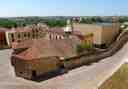
On your right, the Castle of Zamora rises in pale stone as a compact fortress with thick rectangular walls, a squat keep, and a jagged crown of battlements. This is where…Mehr lesenWeniger anzeigen
Eigene Seite öffnen →
Castle of ZamoraPhoto: Tamorlan, Wikimedia Commons, CC BY 3.0. Cropped & resized. On your right, the Castle of Zamora rises in pale stone as a compact fortress with thick rectangular walls, a squat keep, and a jagged crown of battlements.
This is where Zamora’s political drama hardens into masonry. Underneath lie foundations older than the castle itself, and the structure you see took shape between the tenth and twelfth centuries, with a broadly Romanesque design - that is, the solid, rounded, heavy style that likes to look as if it plans to outlast arguments. Ferdinand the First of León likely ordered it built or strengthened in the mid-eleventh century as frontier defense, and his daughter Doña Urraca became the ruler this place was meant to protect.
Then came the great test. In the year ten seventy-two, King Sancho the Second besieged Zamora to take it from Urraca. He failed. On the seventh of October, ten seventy-two, someone killed him outside these walls, and the city turned the episode into a lasting badge of resistance. Later chroniclers, being human, tried to tidy up the scandal. Some blamed a Zamoran noble sheltered inside the city; others strongly suspected Alfonso the Sixth and Urraca, but never named them outright.
If you check your screen, image two shows the restored roofline reopened in two thousand and nine, where the battlements became a lookout over the river and cathedral. That feels right... walls can shield a city, but not its reputation, its grief, or its legends.
When you’re ready, continue about ten minutes to the Church of Santiago el Viejo, beyond these defenses, where the city’s story slips free of the walls again. If you want to return, the castle usually opens Tuesday through Sunday from ten thirty to two and from five to eight, and closes on Mondays.

The Castle of Zamora seen from outside in full daylight, a strong view of the medieval fortress that once defended the city against Sancho II’s siege in 1072.Photo: Fernando Losada Rodríguez, Wikimedia Commons, CC BY-SA 4.0. Cropped & resized. On your right, look for a small sandstone church with a long, low rectangular body, a rounded apse at the far end, and a plain arched doorway cut into the side wall. This is the…Mehr lesenWeniger anzeigen
Eigene Seite öffnen →
Church of Santiago el ViejoPhoto: Borjaanimal, Wikimedia Commons, CC BY-SA 4.0. Cropped & resized. On your right, look for a small sandstone church with a long, low rectangular body, a rounded apse at the far end, and a plain arched doorway cut into the side wall.
This is the Church of Santiago el Viejo, also called Santiago de los Caballeros and Santiago de las Eras... a lot of names for a very small building. It stands outside Zamora’s walls, on the right bank of the Duero, facing the castle from a quieter patch of ground near Olivares and the old Valorio stream. It may be the smallest Romanesque church in the city, but it carries the kind of age that makes paperwork look a little late to the party.
The first written reference appears in eleven sixty-eight. But many historians place the church in the eleventh century, and some even suspect an earlier phase, from the late tenth or early eleventh, perhaps tied to an older parish of Santa María la Blanca. So the date stays hazy... and somehow that suits the place. Not every beginning arrives with a stamped document.
Architecturally, it is pure Romanesque discipline: one nave, meaning one simple main hall, divided into two sections; a semicircular apse, the rounded eastern end for the altar; and a straight presbytery, the space before it, strengthened outside by buttresses. Local sandstone, irregular blocks, sturdy lines, no theatrics. The entrance sits in the south wall, modest as ever.
Its life was unusual too. Cathedral chaplains kept this church, and for a long time they opened it only for the feast of Saint James the Greater on the twenty-fifth of July, when a small pilgrimage came out beyond the walls. So even when the city gathered around stronger, grander buildings, this one held on to a more occasional, almost private devotion.
Then there is the legend. Tradition says Rodrigo Díaz de Vivar, the Cid, kept vigil over his weapons here and King Fernando the First knighted him in the presence of Doña Urraca. Another version claims the Cid later forced Alfonso the Sixth to swear he had no part in Sancho the Second’s death. Modern historians have raised an eyebrow at all that, and Gómez Moreno dismissed the stories pretty bluntly. Fair enough. Memory loves a famous tenant.
Even the carvings inside refuse to be dull: foliage, lions, human figures, Adam and Eve after the Fall, and a few very pointed warnings about lust. Medieval moral teaching did not really do subtlety.
Look back toward the castle and the walls for a moment. From out here, Zamora feels larger than its defenses and older than its legends. This little church, preserved as a protected monument since the third of June, nineteen thirty-one, reminds us that a city’s truest shape also depends on the places that endure quietly at its edge.
If you plan to come back when it is open, it usually closes on Mondays and Tuesdays, and opens from Wednesday through Sunday with split hours on most afternoons.
Häufig gestellte Fragen
Wie starte ich die Tour?
Laden Sie nach dem Kauf die AudaTours-App herunter und geben Sie Ihren Einlösecode ein. Die Tour ist sofort startbereit – tippen Sie einfach auf „Play“ und folgen Sie der GPS-geführten Route.
Benötige ich während der Tour Internet?
Nein! Laden Sie die Tour vor dem Start herunter und genießen Sie sie vollständig offline. Nur die Chat-Funktion benötigt Internet. Wir empfehlen den Download über WLAN, um mobiles Datenvolumen zu sparen.
Handelt es sich um eine geführte Gruppentour?
Nein – dies ist ein selbstgeführter Audioguide. Sie erkunden unabhängig in Ihrem eigenen Tempo, wobei die Audioerzählung über Ihr Telefon abgespielt wird. Kein Reiseleiter, keine Gruppe, kein Zeitplan.
Wie lange dauert die Tour?
Die meisten Touren dauern 60–90 Minuten, aber Sie kontrollieren das Tempo vollständig. Pausieren Sie, überspringen Sie Stopps oder machen Sie Pausen, wann immer Sie wollen.
Was, wenn ich die Tour heute nicht beenden kann?
Kein Problem! Touren haben lebenslangen Zugriff. Pausieren Sie und setzen Sie sie fort, wann immer Sie möchten – morgen, nächste Woche oder nächstes Jahr. Ihr Fortschritt wird gespeichert.
Welche Sprachen sind verfügbar?
Alle Touren sind in über 50 Sprachen verfügbar. Wählen Sie Ihre bevorzugte Sprache beim Einlösen Ihres Codes. Hinweis: Die Sprache kann nach der Tour-Generierung nicht mehr geändert werden.
Wo greife ich nach dem Kauf auf die Tour zu?
Laden Sie die kostenlose AudaTours-App aus dem App Store oder von Google Play herunter. Geben Sie Ihren Einlösecode (per E-Mail gesendet) ein, und die Tour erscheint in Ihrer Bibliothek, bereit zum Download und Start.
Wenn Ihnen die Tour nicht gefällt, erstatten wir Ihnen den Kaufpreis. Kontaktieren Sie uns unter [email protected]
Sicher bezahlen mit