
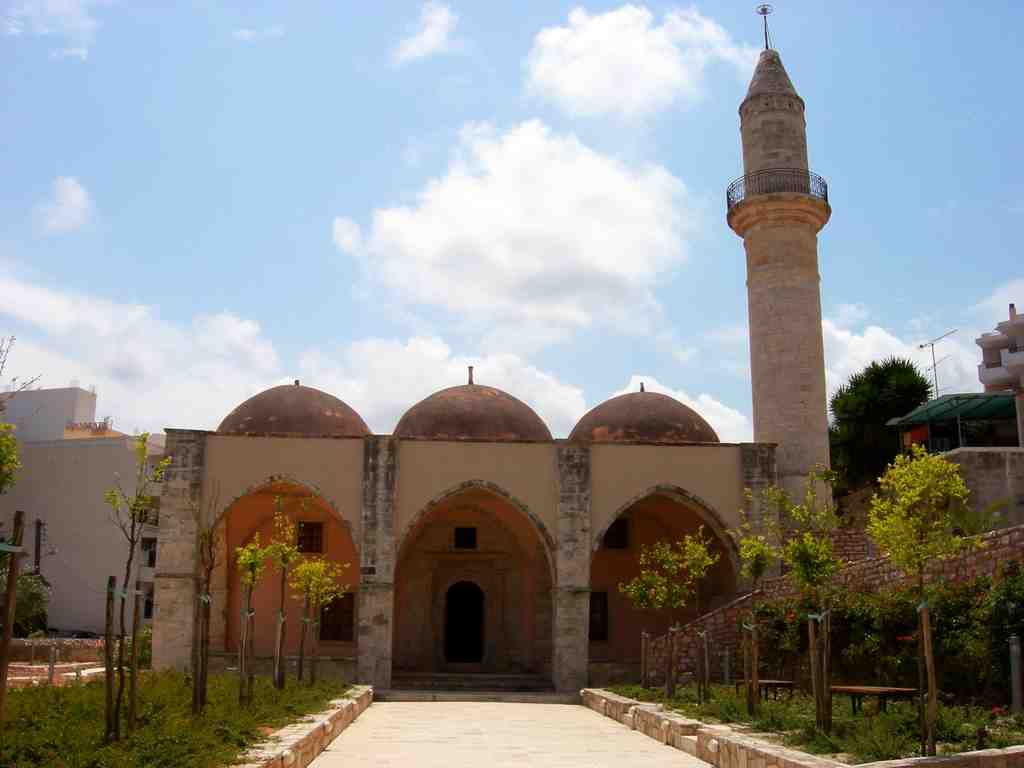
On your right, you will see a pale stone building featuring three prominent rounded domes over a series of open archways, anchored by a tall, slender cylindrical minaret tower on the right side. This is the Veli Pasha Mosque. The Ottomans built this shortly after conquering Rethymno in 1646. They built it right on the site of their former military camp, which itself sat on top of an older Christian church dedicated to Saint Onuphrius. Nothing says we are here to stay quite like building your house of worship exactly where you pitched your tents.
Take a look at the roof. You can clearly see the three larger domes over the portico, which is the covered entrance porch, but there are actually six smaller domes behind them, making nine in total. The complex originally included a tekke, a gathering place for dervishes. These were Sufi Muslim mystics who followed the Ottoman armies and played a major role in helping new communities socialize and settle.
That tall tower is Rethymno's oldest surviving minaret, dating back to 1789. The minaret was used to broadcast the adhan, the Islamic call to prayer.
In 1670, an Ottoman traveler described this courtyard as a mythical earthly paradise, lush with plants and shrubs. The mosque suffered heavy bombing damage during World War Two, but was beautifully restored in the 2010s to house, of all things, the Paleontological Museum. This structure is truly a layered fossil of the city's history. Take a moment to appreciate these layers, and whenever you are ready, we can head to the next stop.




