
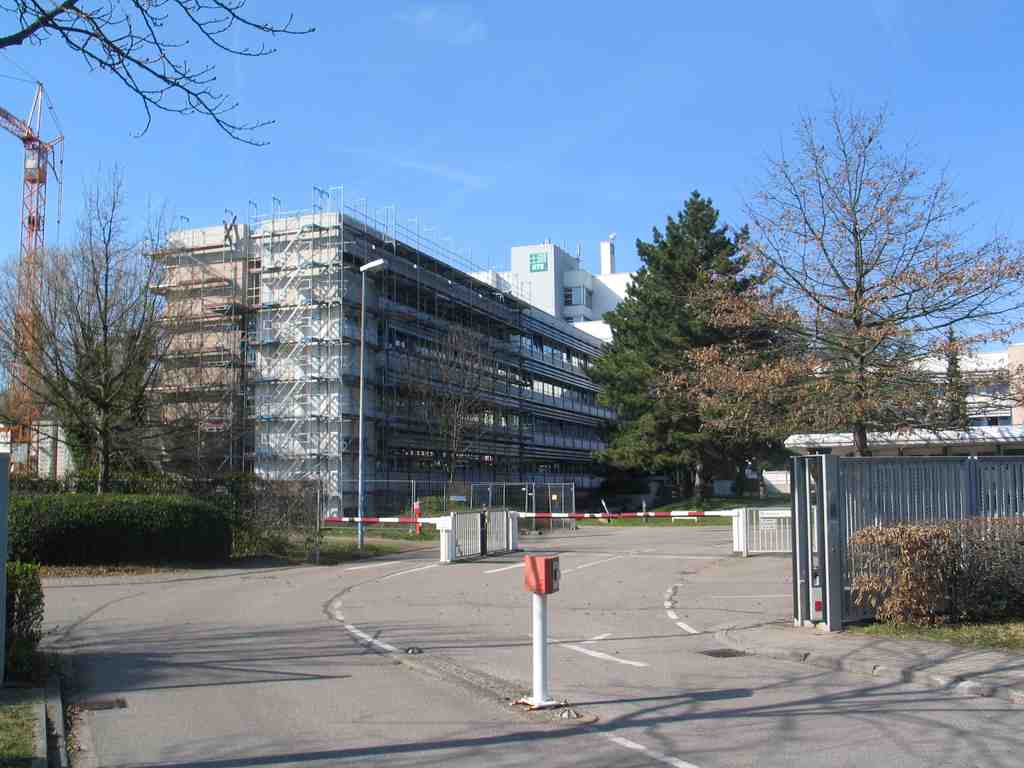
Look straight ahead to spot the long, rectangular building defined by its prominent horizontal bands of windows, punctuated by a taller, blocky tower section bearing a small green logo near the roofline.
This is the Fraunhofer Institute of Optronics, System Technologies and Image Exploitation, though thankfully everyone just calls it the IOSB. Today, it stands as a fortress of high-tech innovation, but this institute did not arrive in Karlsruhe quietly. It moved here in 1968, right into the teeth of a massive political firestorm.
During the late nineteen sixties, fierce student protests swept across the country, with young people passionately pushing back against the establishment and aggressively targeting any academic institutions involved in defense and military research. The Fraunhofer Society, deeply intertwined with government defense contracts, found itself directly in the crosshairs.
When the institute relocated to Karlsruhe with forty-five employees, the climate was incredibly tense. Across the nation, anti-war students were attempting to physically occupy Fraunhofer facilities, and in many places, only heavy police intervention kept the laboratory doors open. To make matters worse, 1968 was also the year of the infamous Petras Case. An employee from a different Fraunhofer institute abruptly defected to East Germany, where he commanded the media's attention to accuse his former employer of secretly preparing for atomic, biological, and chemical warfare. Not exactly the welcome wagon you hope for when setting up a new research center.
Despite that incredibly chaotic beginning, the scientists dug in. They transitioned from their early, somewhat quirky origins of studying mechanical vibrations and how animals process biological signals, into the sharp edge of the digital age. They began pioneering what are known as dual-use technologies. This is a polite engineering term for systems developed for civilian industries that also happen to be highly effective for military operations.
Today, the institute is deeply involved in machine vision, autonomous systems, and advanced military reconnaissance. They are developing radical concepts like non-line-of-sight imaging, which uses scattered light to literally see around corners. They also experiment with public surveillance. Recently, they tested an artificial intelligence camera system in a nearby city, designed to automatically detect criminal behavior by analyzing people as simplified digital skeletons. The rollout had a few hiccups. The complex algorithm reportedly had a very hard time distinguishing between a violent attack and two friends giving each other a warm hug.
From dodging student barricades in the sixties to training algorithms to understand human behavior today, this place perfectly maps the local shift toward complex digital networks. If you happen to be a brilliant engineer looking for work, the building is generally open Monday through Friday from seven in the morning until eight at night.
Now, let us continue tracking this digital evolution with a short four minute walk over to the Telecooperation Office.




