
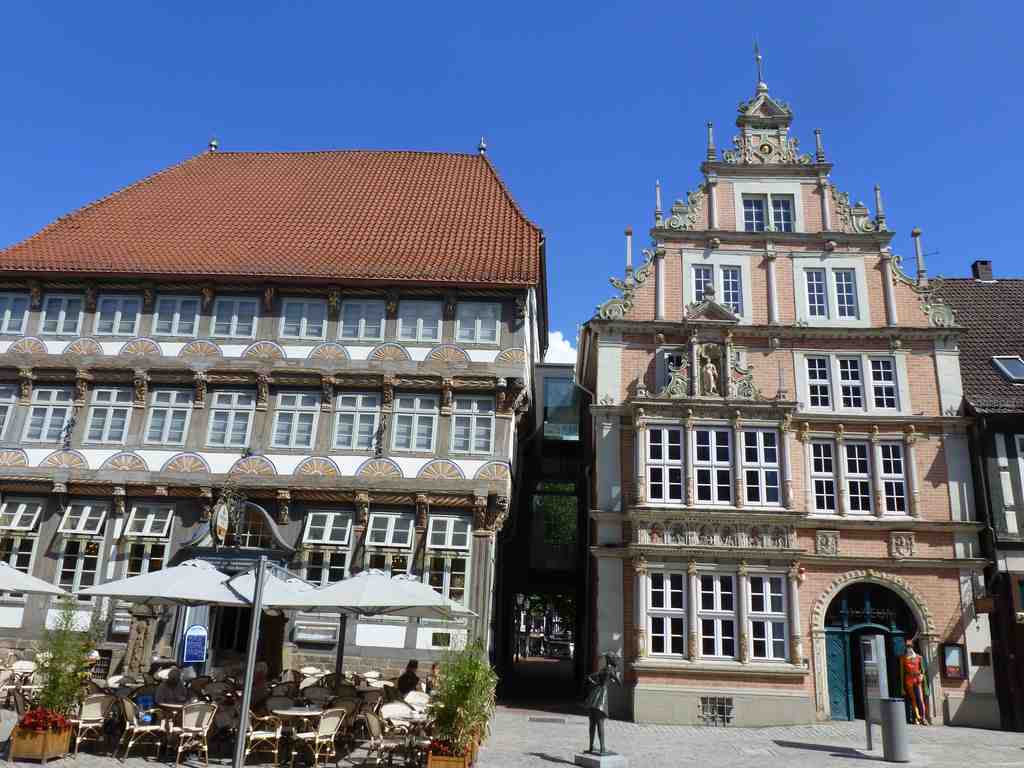
Look for a pair of pale stone-and-plaster Renaissance houses with tall gables, rows of rectangular windows, and an especially ornate right-hand façade carved like a piece of civic jewelry.
This is Museum Hameln, split between the Leisthaus on the right and the Stiftsherrenhaus on the left, two of the city’s finest buildings from the Weser Renaissance, the local sixteenth- and early seventeenth-century style that loved decorated façades and a little showmanship. Fair warning: this stop is about storytelling itself. A city does not collect itself by magic. People gather the attic finds, the documents, the costumes, the scratched clues, then arrange them so private memory turns into a shared public story. That is what this museum does, very deliberately and very well.
The roots go back to Friedrich Haspelmath, a Hameln-born traveler from seventeen ninety. He picked up objects on his journeys with the appetite of a man who never met a curiosity he did not want to bring home, then displayed them in a tower of the old city defenses. In eighteen ninety-nine, his grandson gave that tower and its contents to the museum association. So the museum began not as a cold official archive, but as one person’s very human habit of saying, “Hold on... this matters.”
The house itself adds another layer. The Wallbaum family lived in the Leisthaus from eighteen twenty-five to nineteen ten. Adolph Wallbaum, one of the last family members here, filled a diary with gloomy remarks about railways and modern youth. In other words, every generation thinks the next one is ruining civilization. Hameln found the family eccentric, but their final decision shaped the city: Adolph and Friederike Wallbaum left this house to the museum association in nineteen ten, and by nineteen twelve the museum had a permanent home.
Inside, the museum now stretches across about one thousand two hundred square meters and tells the story of Hameln and the Weserbergland by era: medieval town life, the Reformation, the boom years of the Weser Renaissance, the fortress period, industry, tourism, and the twentieth century. The Pied Piper has a major section of his own, including what the museum says is one of the world’s largest collections on the legend. There is even a mechanical Pied Piper theater by Otto Steiner, a twelve-minute installation using moving figures, light, and sound to stage the tale like a miniature dream.
And here is the important part: legend stands beside lived history, not instead of it. The hidden Hebrew letters we noticed earlier are exactly the kind of fragile trace museums and archives rescue from silence. Without patient collecting and interpretation, they remain marks in stone; here, clues like that become part of the city’s self-understanding.
The museum had to survive its own disasters too. Staff moved major collections out for safety in nineteen forty-one. American artillery damaged the Leisthaus in April of nineteen forty-five. The city took over the building in nineteen forty-six, with a promise to keep it for museum use, and the collections returned fully in nineteen forty-nine. Then, during the restoration from two thousand eight to two thousand eleven, workers opened up the old structure itself and found archaeological objects in the central hall, turning the building into an exhibit as well as a container for exhibits.
So before you head on, notice the neat trick Hameln pulls here: the museum preserves memory indoors, while the city leaves other pieces of memory standing outside in plain sight. In about a four-minute walk, you’ll meet one of those survivors at Haspelmath Tower, where collecting first took root in stone. If you want to come back inside later, the museum opens Tuesday through Sunday from eleven A-M to six P-M and stays closed on Mondays.




