AudaTours logoAudaTours

Campinas Audio-Tour: Von Rosenblüten zu Wissenschaftsechos

Audioguide10 Stopps

In Campinas verbirgt jede elegante Fassade Echos von Revolte und Neuerfindung. Jenseits der belebten Alleen verweilen Geheimnisse in Ecken, die nur wenige jemals finden. Diese selbstgeführte Audio-Tour lädt Sie ein, das rätselhafte Herz der Stadt zu entschlüsseln – indem Sie einen Kurs vorbei an Meisterwerken wie dem Kulturzentrum für Koexistenz, dem Jequitibás-Palast und dem Palast der Kacheln einschlagen, während Sie Geschichten entdecken, die die meisten Reisenden übersehen. Welches versteckte Zimmer im Jequitibás-Palast löste einst einen ungelösten Skandal aus? Welche mysteriöse Allianz wurde im Schatten des Palastes der Kacheln geschmiedet? Warum entschied sich ein Künstler, sein letztes Geständnis an eine Decke zu malen, zu der fast niemand aufblickt? Lassen Sie sich von der Neugier durch prächtige Säle und ruhige Innenhöfe ziehen, während Sie Flüstern von politischer Intrige und künstlerischer Rebellion leiten. Jede Biegung bietet eine neue Perspektive, jede Pause deutet auf eine weitere Geschichte hin, die darauf wartet, entdeckt zu werden. Wagen Sie es, auf 'Play' zu drücken und lassen Sie Campinas seine Schichten enthüllen – ein Geheimnis nach dem anderen.

Tourvorschau

map

Über diese Tour

  • schedule
    Dauer 30–50 minsEigenes Tempo
  • straighten
    2.7 km FußwegDem geführten Pfad folgen
  • location_on
  • wifi_off
    Funktioniert offlineEinmal herunterladen, überall nutzen
  • all_inclusive
    Lebenslanger ZugriffJederzeit wiederholen, für immer
  • location_on
    Startet bei Mogiana-Palast

Stopps auf dieser Tour
  1. To spot the Mogiana Palace, look for a large, elegant yellow building with tall columns, old-fashioned iron fences, and several flags flying proudly from its facade-right at the…Mehr lesenWeniger anzeigen

    To spot the Mogiana Palace, look for a large, elegant yellow building with tall columns, old-fashioned iron fences, and several flags flying proudly from its facade-right at the edge of a bustling city block. Take a moment and imagine this spot in the late 1800s-there’s the distant chug-chug of steam trains, city streets filled with the bustle of commerce, and in the middle of it all stands the Mogiana Palace, the pride of Campinas. This building was raised in the eclectic style that made people-well, at least architects-nod in approval between 1891 and 1910. Back then, it was home base for the Companhia Mogiana de Estradas de Ferro, or, in plain English, the Mogiana Railway Company. For decades, the city’s future passed through these doors on clattering trains, and if you’d been here until 1926, you would’ve seen workers busily planning new railway routes, maybe even arguing about who drank the last cup of coffee. But even palaces get a hard deal-one of its grand wings had to be demolished in 1953 just so Avenida Campos Sales could get a bit roomier. Fast forward, and it faced years of neglect so bad that even ghosts might’ve thought twice before moving in. But wait! In 2009, things took a dramatic twist-a restoration was launched, like a makeover show for historic buildings, thanks to teamwork between the city and private partners. Pretty soon, planners had visions of a cultural center, maybe swirling tango music in these halls, but government funding pulled a classic disappearing act at the last minute. Today, after its rollercoaster journey, the Mogiana Palace serves everyday heroes: job seekers and shopkeepers. It’s got some battle scars-sneaky leaks and rooftop troubles-but the community keeps a watchful eye. So as you stand by this sturdy, sunny facade, remember: this isn’t just a building. It’s a survivor, a hub, and one truly persistent piece of Campinas’s story. And hey, after dodging demolition and decades of dust, I’d say it deserves a round of applause-if you clap, just try not to scare the pigeons.

    Eigene Seite öffnen →
  2. To spot the Palace of Tiles, just look to the corner where two streets meet-right ahead, you’ll see a grand, two-story historic building with pale, patterned tiles on its upper…Mehr lesenWeniger anzeigen

    To spot the Palace of Tiles, just look to the corner where two streets meet-right ahead, you’ll see a grand, two-story historic building with pale, patterned tiles on its upper facade and a winding iron balcony stretching along both sides. Welcome to one of Campinas' most dazzling corners, where stories and ceramic tiles come together-literally! This impressive Palace of Tiles, also known as the former mansion of the Baron of Itatiba, was once the place to see and be seen. Picture this: it’s 1878, horse hooves clacking on the cobblestones, and Joaquim Ferreira Penteado, the Baron himself, is settling into his grand new home with his family. The design was clever for its time, blending solid, old-school Taipa construction with modern brick, a bit like building your house out of both chocolate cake and gingerbread. The ground floor kept with the traditions of São Paulo’s coffee barons: thick rammed-earth walls for respectability-and possibly for surviving wild dinner parties-while the upstairs got brick for those fashionable, wide windows and even bigger rooms. Take a closer look at those tiles on the upper floor. They’re Portuguese, giving the whole place its name and a certain royal shimmer. Rumor has it, these blue-and-white tiles once sparkled so brightly in the sun, people across town would squint when walking by! Instead of being set back from the street with lush gardens, this mansion fit right up to the edge of the bustling roads-there were no sidewalks in those days, so the building met the world head-on, just like its first owners. Behind these elegant doors, life was never dull. Downstairs, rooms opened onto Ferreira Penteado Street, probably used as the family’s office-imagine the whir of typewriters or the rustle of paper contracts for the latest haul of coffee beans. Way in the back, where the family kitchens were, cooks would be wrestling with clouds of smoke, the clatter of pans, mouthwatering aromas, and the not-so-melodic buzz of flies. And in a quirky architectural twist, the dining room and main entertaining spaces were upstairs, so conversation and laughter floated over Campinas with every party or family meal. As time rolled on, the Palace saw its fair share of dramas, tragedies, and transformations. In 1908, the city bought the building, knocking a wall down to join it with its twin next door. Suddenly, this grand mansion became the city’s courthouse and town hall, a one-stop shop for all legal problems, council meetings, and perhaps some legendary political squabbles. The mayor worked here until 1968, before moving on to-wait for it-the Forest Palace, proving even politicians like a dramatic exit. With such character, the Palace of Tiles was officially declared a national treasure in 1967, protected at every level of government. If anyone tried to sneak off with a tile, well, let's just say, the paper trail would be longer than a São Paulo coffee queue. Today, the building is home to the Museum of Image and Sound and holds pieces of Campinas’ history within its walls. There are still hints of the original construction everywhere: sturdy stone bases, dramatic wooden stairs brightened by a sky-lit dome, and upstairs, a glamorous parlor for guests to see just how fashionable the Penteado family was. In 2004, a fresh breath of life swept through when Petrobras backed the palace’s restoration, and more recently, it inspired a whole book filled with tales of transformation and popular use. So, as you stand here, surrounded by honking cars and the energy of central Campinas, try to imagine the cities and centuries that have passed these tiled walls-barons and bakers, mayors and musicians, city staff and museum-goers. That’s quite a guest list!

    Eigene Seite öffnen →
  3. Right in front of you stands a grand ochre-yellow cathedral with a tall clock tower, statues of angels and saints lining its rooftop, and big wooden doors framed by elegant…Mehr lesenWeniger anzeigen

    Right in front of you stands a grand ochre-yellow cathedral with a tall clock tower, statues of angels and saints lining its rooftop, and big wooden doors framed by elegant columns-just look for the bright golden façade with “N. SENHORA DA CONCEIÇÃO” above the main entrance. Welcome to the Metropolitan Cathedral of Campinas-where patience was truly a virtue! Imagine you’re here in the early 1800s: dusty streets, a sun blazing almost as brightly as today, and a small but determined town dreaming of its very own church. The story begins way back in 1774, when local families were so eager for a proper place of worship, they actually built their first chapel from mud and roof tiles, just steps from where you stand. But progress was slow... and then slower. The city kept growing, voices rose in protest, petitions were sent, and yet, every time they seemed close to finishing, something got in the way-sometimes wars, sometimes stubborn weather, and, at least once, a very impatient emperor’s travel plans. When construction on this cathedral started in 1807, some folks joked that you could finish knitting a scarf longer than the nave before the place would be done. The builders used an ancient technique with rammed earth-imagine workers pounding layers of earth, gravel, and clay for years on end. Many of the workers were enslaved people, their labor and hopes packed into these thick, cool walls. As the years dragged on, accidents happened-tragedy struck during one attempt at a grand stone tower, trapping several inside. Actually, the project changed style more times than a chameleon on a disco dance floor: from baroque to neoclassical, even flirting briefly with gothic, before landing on this stately yellow neoclassical face that smiles out at the square today. And if it looks extra fancy around the rooftop, thank a generous local named “Baía,” who not only helped fund the decoration, but also donated the oldest, proudest bell-called “Baía” too, weighing three tons! For years, the bell wasn’t even allowed to ring except for the most solemn of processions. I mean, imagine having a bell that big and being told to keep it quiet! Today, you might only hear it chime during the day, after neighbors politely asked for some nighttime peace. Step inside and you’re treated to an explosion of woodwork-cedar carvings swirling across the altar and walls, crafted by artisans from Bahia and local apprentices, including one especially skilled woodcarver who was deaf but whose hands spoke in masterpieces. The interior, rich and intricate but with none of that golden glitter you might expect from baroque-just honest, burnished wood, glowing in the sunlight filtered through high panes. This cathedral is the largest building in the world constructed with rammed earth-four thousand square meters-and it stretched the patience of an entire city, open at last in 1883 after seventy-six years. Over time, its face even changed color: after decades hidden by plain white paint, the original ochre-yellow revealed itself again in a recent restoration, shining brighter than ever toward the palm trees of José Bonifácio Square. Oh, and if you listen carefully, sometimes you’ll catch the notes of a rare French pipe organ, installed in 1883-one of the largest of its kind, its pipes once trembling with the sound of grand ceremonies, weddings, and even the occasional musical prank from nimble-fingered organists. So gaze up at the statues, peer at the clock, and imagine the generations gathered here for baptisms, imperial visits, whispered prayers, and weekday gossip. This is a cathedral built from sweat, hope, community, and just a dash of Brazilian stubbornness-it stands not just as a church, but as the beating heart and memory of Campinas.

    Eigene Seite öffnen →
7 weitere Stationen anzeigenWeniger Stationen anzeigenexpand_moreexpand_less
  1. Right ahead of you is Rosary Square, a wide, inviting open space framed by tall city buildings, tiled stone paths, and dotted with benches and classic lamp posts-just look for a…Mehr lesenWeniger anzeigen

    Right ahead of you is Rosary Square, a wide, inviting open space framed by tall city buildings, tiled stone paths, and dotted with benches and classic lamp posts-just look for a patchwork of trees and people relaxing near the heart of downtown. Let your imagination wander back to 1817, when this spot wasn’t lined with skyscrapers, but instead was anchored by the original Church of the Rosary. Picture a gathering place so essential, it drew in as many as ten thousand people in 1846 when Emperor Dom Pedro II himself paid Campinas a visit. This square-known to officials as Praça Visconde de Indaiatuba-quickly became the beating heart for political rallies, street parades, and important city events. Through the years, it’s worn many faces: back in 1874, a shiny bronze fountain caught the sunlight right here. By 1895, sharp new gas lanterns lit up the evening, while park benches tempted weary citizens to rest their feet. For a moment in 1911, every step you’d take would be over old Portuguese stone tiles, and the streets surrounding the square kept growing and stretching to fit the city’s rhythm. But Rosary Square hasn’t had it easy. In the 1950s, both the beloved church and a grand monument to Campos Sales were torn down-making way for bustling avenues and modern plans. Each decade brought a facelift: sometimes stylish canopies and fresh pathways appeared, only to be swept away by the next update. Some of those changes were even halted by heritage protectors hoping to keep the memory of old Campinas alive. By 1998, the square got its final makeover-drawing almost as much inspiration from the 1930s as from future dreams. So whether you’re sitting on a bench, hearing laughter and bus engines, or spotting someone reading beneath those trees, remember-you’re standing on a forever-changing stage where crowds have gathered, history’s unfolded, and the city’s heart is still beating.

    Eigene Seite öffnen →
  2. To spot the Basilica of Our Lady of Carmel, look for a majestic building with two tall neo-Gothic towers rising above the trees right ahead of you, its entrance framed by pointed…Mehr lesenWeniger anzeigen

    To spot the Basilica of Our Lady of Carmel, look for a majestic building with two tall neo-Gothic towers rising above the trees right ahead of you, its entrance framed by pointed arches and colorful mosaics above the doors. Imagine the year is 1774-dust swirls around, farmers lead oxen through open fields, and right here, people gather beneath a simple, straw-covered shelter for the very first Mass. The story of Campinas begins in this spot; forget Instagram, this city’s “launch party” was a church service and everyone in town was invited! As the years went by, the straw gave way to stone, and by 1781, a proper church stood proud, becoming the heart of celebrations, gossip, and city planning. Through the decades, empires have risen and fallen, but the church has watched over every twist in Campinas’ tale. But in the 1920s-oh, the drama-almost everything was torn down except the altar and towers, as the city dreamed up this neo-Gothic marvel you see now. Even with all the changes, it’s still a place where the city’s spirit gathers, where weddings and street vendors mix with the sound of shoes on ancient steps. It’s the very soul of Campinas-rebuilt, reimagined, but never gone.

    Eigene Seite öffnen →
  3. Now, as you look around, you’re surrounded by echoes of many eras. Imagine the provisional chapel and the first main church, later called the “Old Matrix” once the “New Matrix”…Mehr lesenWeniger anzeigen

    Now, as you look around, you’re surrounded by echoes of many eras. Imagine the provisional chapel and the first main church, later called the “Old Matrix” once the “New Matrix” was built. With time, divisions between parishes meant the square had to make room-a bit like a house that keeps adding more rooms for unexpected guests. By 1870, city leaders decided the square needed a fashionable update and launched a beautification project. The square transformed, even housing the old Town Hall, the local jail, and the courthouse. Later, in 1889, it got a name change to Praça Bento Quirino, honoring a prominent local figure. Around you are storied buildings like the Colégio Bento Quirino and the Jockey Club Campineiro, giving Carmo Square its lively, dignified “neighborhood watch.” But wait, there’s a dramatic twist-over on one side, you’ll see the tomb-monument to Maestro Carlos Gomes, the city’s legendary composer. In 1903, none other than the aviation pioneer Santos Dumont himself placed the cornerstone. When this majestic tribute was unveiled in 1905, it drew crowds from all over, marking Carmo Square as more than just the city’s origin point-but also its stage for celebration. Quite the showstopper!

    Eigene Seite öffnen →
  4. Look straight ahead for a tall, modern rectangular building with a white marble base, lots of horizontal windows, and palm trees standing guard out front-if you see a structure…Mehr lesenWeniger anzeigen

    Look straight ahead for a tall, modern rectangular building with a white marble base, lots of horizontal windows, and palm trees standing guard out front-if you see a structure that looks like it could host an important meeting or maybe a James Bond chase, you’ve found the Jequitibás Palace! Welcome to the Jequitibás Palace, where the pulse of Campinas beats through polished marble floors and 19 stories of history! It’s hard to believe, but where you’re standing now-above a friendly hum of city life -used to be the grounds of an old hospital. Back in the 1960s, the city decided it was time for a change. With a need to modernize, the mayor unleashed a citywide “makeover,” and the result was this striking example of modern architecture-a victorian mansion was clearly not going to fit the bill anymore. In 1957, two architects, Rubens Carneiro Viana and Ricardo Sievers, won a contest to design this beauty. They dreamed up a building with three distinct blocks and sleek brises to shade each floor. By 1968, after just two years of building (talk about efficiency!), the palace opened its doors, replacing the older venue for city business-the Palace of Tiles. Its name? That’s actually a tribute to the towering jequitibá trees that once stood tall and proud behind the old hospital here. Imagine their gentle leaves swaying. Now, only a couple remain, like the legendary “Seu Rosa,” who stood for about 150 years before finally toppling in 1999, leaving behind just stories (and probably a ton of squirrels’ dreams). Inside, you’ll find everything from the mayor’s office to the glamorous “Red Room” and, until 2006, even the local city council chambers down on the left-imagine the debates echoing through these marble-clad halls! Today, it’s not just a place of politics, but also a monument to Campinas’s dreams of the future, sprouting from the deep roots of its grand old trees. Quite a spot for city secrets, skyscraper ambitions, and just maybe, the world’s most bureaucratic game of hide-and-seek.

    Eigene Seite öffnen →
  5. Alright! Right in front of you stands the grand Carlos Gomes State School, but if you listen closely, you might just hear echoes of chalk on blackboards and the giggles of…Mehr lesenWeniger anzeigen

    Alright! Right in front of you stands the grand Carlos Gomes State School, but if you listen closely, you might just hear echoes of chalk on blackboards and the giggles of students from days gone by. Imagine it’s 1903: horse-drawn carriages clatter along Francisco Glicério and 13 de Maio. Here, a brand-new school opens, born from Law 861-it was called the Escola Complementar de Campinas. Picture it: two separate buildings, fresh paint, eager young minds, and the scent of ink and paper drifting through the air. As the decades rolled by, the school’s name changed more than a teenager changes hairstyles. It became Escola Normal Primária in 1911, Escola Normal de Campinas in 1920, and in 1936, a special honor: the school was renamed after Carlos Gomes, the beloved local opera composer, exactly one hundred years after his birth! Since then, it kept reinventing itself, even trying on long names like Instituto de Educação Carlos Gomes before finally settling on the one you see today in 1998. Phew! That’s what we call a true identity crisis. But now, take a look at the building itself. Designed in a stunning eclectic style by architect César Marchisio, a student of the legendary Ramos de Azevedo, this place is a mosaic of history. Admire the imported tiles, vivid stained glass, and artwork by Carlo De Servi, an Italian-Brazilian who must’ve loved art class just a little more than the rest of us. Since its inauguration in 1924, this building’s grandeur has stood the test of time-even getting official protection in 1982. And here's a fun moment: in 2013, when the building needed some love, the students themselves gave it a big hug-in protest! Now that’s what I call embracing your education.

    Eigene Seite öffnen →
  6. To spot Carlos Gomes Square, look ahead for a wide, open plaza filled with towering palm trees, green gardens, winding paths, and surrounded by tall city buildings. Now, let’s…Mehr lesenWeniger anzeigen

    To spot Carlos Gomes Square, look ahead for a wide, open plaza filled with towering palm trees, green gardens, winding paths, and surrounded by tall city buildings. Now, let’s step into the story! Imagine you’re surrounded by one hundred imperial palm trees swaying gently above you; they were planted way back in 1883, and most are still standing tall like dignitaries at an endless royal gathering. The square was named after the mighty composer Carlos Gomes in 1880, and its centerpiece, that charming bandstand you see, has watched over this place since 1914. Picture it: bands playing polkas and waltzes, families dressed in their Sunday best, and children’s laughter filling the air. In one corner stands a statue honoring Ruy Barbosa, and in another, Dr. Tomás Alves, a true local hero for fighting yellow fever in 1889. If you peek through the palms, you might notice the Edifício Itatiaia, the only building in Campinas designed by the legendary Oscar Niemeyer. The square is still buzzing with fairs, events, and even TV crews-yes, it starred in a soap opera, all because of its lush green heart and that photogenic bandstand. Whether you’re here for the history or just a sunny stroll, this square has a story for everyone!

    Eigene Seite öffnen →
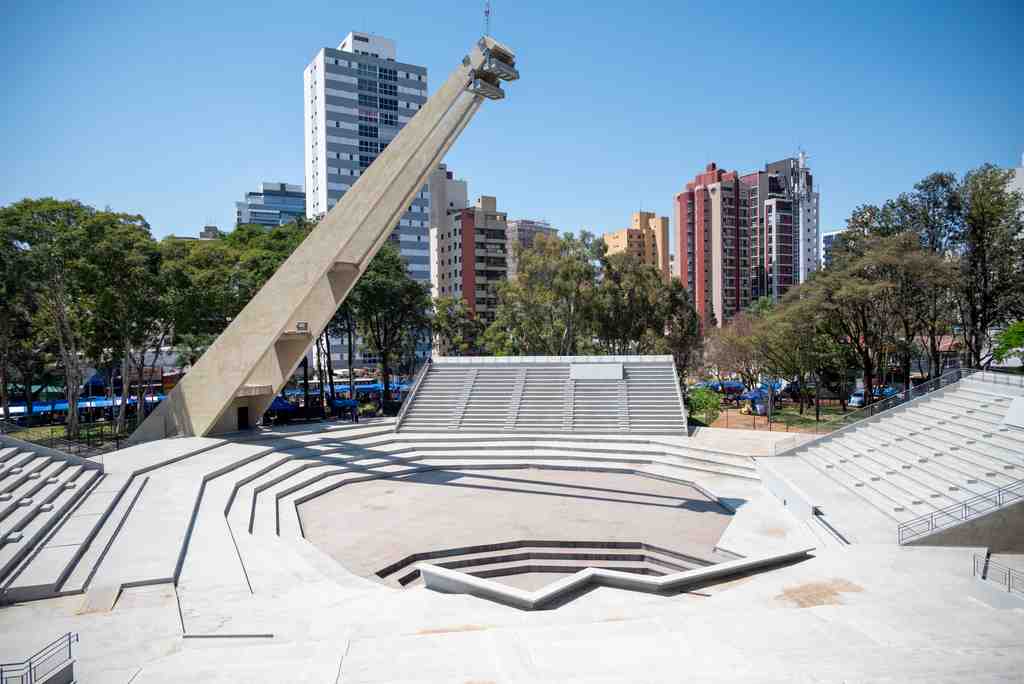
  7. To spot the Campinas Cultural Coexistence Center, look straight ahead for a bold, modern amphitheater of concrete tiers in a cross shape with a striking diagonal tower rising…Mehr lesenWeniger anzeigen

    To spot the Campinas Cultural Coexistence Center, look straight ahead for a bold, modern amphitheater of concrete tiers in a cross shape with a striking diagonal tower rising dramatically above the seats. Welcome to your final stop: the Campinas Cultural Coexistence Center - or as locals affectionately call it, simply the Centro de Convivência! Pause for a moment and take in the bold lines and crisp geometry. Can you feel the weight of almost fifty years of music, drama, and - occasionally - a bit of political hot potato right here in the heart of Cambuí? Now, close your eyes for a second and imagine the scene back in the 1800s, long before this modern marvel appeared. Instead of echoing with the laughter of theater crowds and the clatter of crafts booths, this space was the Passeio Público, inspired by Rio’s famous promenade, where people strolled under the shade of the trees, gossiping and, probably, dodging the occasional stray goose. Fast-forward to the roaring 1970s: architect Fábio Penteado came on the scene with a vision that was part opera house, part monumental plaza, and all avant-garde. Construction started in ‘67, stopped, started again, and after nearly a decade - voilà! - the Centro de Convivência was inaugurated in 1976, decked out with its four buildings in a giant cross and a slanted lighting tower that looks like an Olympic torch frozen mid-sprint. The star of the show is the Arena Theater, named for Teresa Aguiar, a jaw-dropping open-air stage with room for around five thousand people, plus the cozier Luís Otávio Burnier Show Hall, perfect for more intimate performances. Gallery spaces pop up around the arena - each named after a local legend - and there’s even a special area carved out for a café. On weekends, the air still fills with wandering musicians, artists, and the aroma of snacks from the famous Feira Hippie craft fair. But life here has had its drama! In the early 2000s, renovations shook things up: parking lots turned into gardens, the walls got a fresh coat of paint, and new blocks paved the square. Then trouble struck - unsafe conditions closed the theater in 2011, leaving the place eerily quiet. The leaks, the exposed wires, the flicker of uncertainty: it was like the city collectively held its breath. But good stories always have a comeback, and in 2018, a tidal wave of investment swept in - millions poured into high-tech sound, lighting, new seats, spruced-up dressing rooms, and even a fancy elevator. The hum of jackhammers was like an overture, growing louder until the big moment: in 2025, renovations wrapped up just in time for Campinas’s 251st birthday! The arena’s first sound after reopening? The triumphant notes of the Campinas Symphony Orchestra playing to a crowd, free and under the open sky - now that’s what I call a standing ovation. The center is breathing new life, welcoming events from theater to craft fairs, and giving locals and visitors a place to meet, mingle, and share a story or three. As you stand here, picture all that’s happened - all the dreams, the setbacks, and the comebacks - and know that YOU are part of this living landmark’s next chapter. Ready for an encore?

    Eigene Seite öffnen →

Häufig gestellte Fragen

Wie starte ich die Tour?

Laden Sie nach dem Kauf die AudaTours-App herunter und geben Sie Ihren Einlösecode ein. Die Tour ist sofort startbereit – tippen Sie einfach auf „Play“ und folgen Sie der GPS-geführten Route.

Benötige ich während der Tour Internet?

Nein! Laden Sie die Tour vor dem Start herunter und genießen Sie sie vollständig offline. Nur die Chat-Funktion benötigt Internet. Wir empfehlen den Download über WLAN, um mobiles Datenvolumen zu sparen.

Handelt es sich um eine geführte Gruppentour?

Nein – dies ist ein selbstgeführter Audioguide. Sie erkunden unabhängig in Ihrem eigenen Tempo, wobei die Audioerzählung über Ihr Telefon abgespielt wird. Kein Reiseleiter, keine Gruppe, kein Zeitplan.

Wie lange dauert die Tour?

Die meisten Touren dauern 60–90 Minuten, aber Sie kontrollieren das Tempo vollständig. Pausieren Sie, überspringen Sie Stopps oder machen Sie Pausen, wann immer Sie wollen.

Was, wenn ich die Tour heute nicht beenden kann?

Kein Problem! Touren haben lebenslangen Zugriff. Pausieren Sie und setzen Sie sie fort, wann immer Sie möchten – morgen, nächste Woche oder nächstes Jahr. Ihr Fortschritt wird gespeichert.

Welche Sprachen sind verfügbar?

Alle Touren sind in über 50 Sprachen verfügbar. Wählen Sie Ihre bevorzugte Sprache beim Einlösen Ihres Codes. Hinweis: Die Sprache kann nach der Tour-Generierung nicht mehr geändert werden.

Wo greife ich nach dem Kauf auf die Tour zu?

Laden Sie die kostenlose AudaTours-App aus dem App Store oder von Google Play herunter. Geben Sie Ihren Einlösecode (per E-Mail gesendet) ein, und die Tour erscheint in Ihrer Bibliothek, bereit zum Download und Start.

verified_user
Zufriedenheit garantiert

Wenn Ihnen die Tour nicht gefällt, erstatten wir Ihnen den Kaufpreis. Kontaktieren Sie uns unter [email protected]

Sicher bezahlen mit

Apple PayGoogle PayVisaMastercardPayPal

AudaTours: Audioguides

Unterhaltsame, budgetfreundliche, selbstgeführte Stadtrundgänge

App ausprobieren arrow_forward

Beliebt bei Reisenden weltweit

format_quote Diese Tour war eine großartige Möglichkeit, die Stadt zu sehen. Die Geschichten waren interessant, ohne zu konstruiert zu wirken, und ich liebte es, in meinem eigenen Tempo erkunden zu können.
Jess
Jess
starstarstarstarstar
Tbilisi-Tour arrow_forward
format_quote Das war eine solide Art, Brighton kennenzulernen, ohne sich wie ein Tourist zu fühlen. Die Erzählung hatte Tiefe und Kontext, übertrieb es aber nicht.
Christoph
Christoph
starstarstarstarstar
Brighton-Tour arrow_forward
format_quote Habe diese Tour mit einem Croissant in der einen Hand und null Erwartungen gestartet. Die App schwingt einfach mit einem mit, kein Druck, nur man selbst, Kopfhörer und ein paar coole Geschichten.
John
John
starstarstarstarstar
Marseille-Tour arrow_forward

Unbegrenzte Audioguides

Schalten Sie Zugriff auf JEDE Tour weltweit frei

0 Touren·0 Städte·0 Länder
all_inclusive Unlimited erkunden

